Polls opened across Israel on Tuesday morning as eligible voters head to the polls to elect the country’s next Knesset in a pivotal race pitting Prime Minister Benjamin Netanyahu and his sitting coalition against the opposition bloc seeking to replace him.
Within the opposition bloc, Gadi Eisenkot’s Yashar party has taken the lead ahead of Netanyahu’s Likud in the majority of recent polling, though neither bloc still appears able to secure a 61-seat Knesset majority.
Polling stations opened at 7:00 a.m., and exit polls are expected at 10:00 p.m., offering preliminary projections of the election results. The official results will be finalized in the coming days, following the completion of the vote count.
Voting at Israeli diplomatic missions abroad concluded on October 16, while voting at some military bases began last week.
The fateful elections will be the first to take place since the October 7, 2023, Hamas attack, with the political landscape and the issues at the forefront of voters’ minds having shifted significantly since the previous vote in 2022.
IDF manpower crisis, haredi draft, Oct. 7 commission central issues for Israeli voters
Some of the central issues include the IDF’s severe manpower crisis after three years of war, contentious haredi (ultra-Orthodox) conscription legislation, and calls for a state commission of inquiry into the government’s failures surrounding the attack.
Meanwhile, traditional election issues, such as the establishment of a Palestinian state, have moved further to the background as Israel’s security outlook has changed, and most parties stand in agreement against Palestinian statehood.
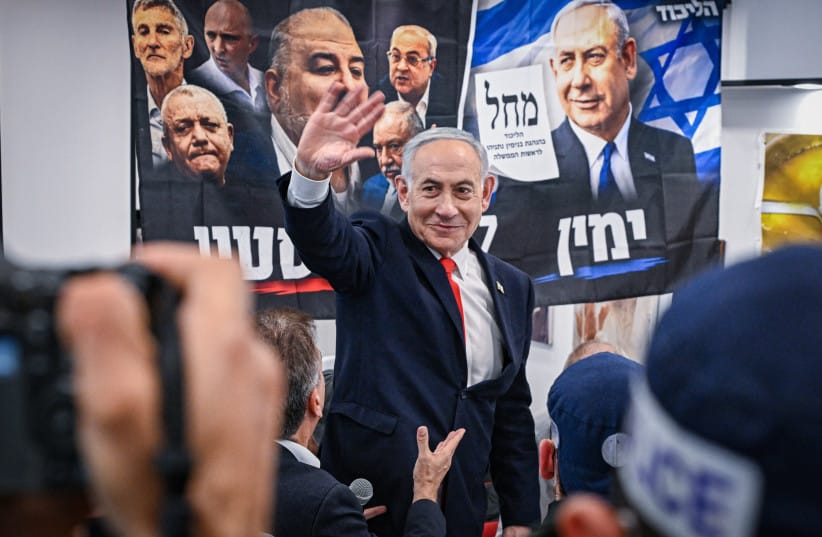
Another major issue is the fate of long-serving Netanyahu, who has led Israel for 19 non-consecutive years.
Following the October 7 massacre and the ensuing war, the opposition bloc has called for Netanyahu to be held accountable for the attacks, arguing that he should no longer serve as prime minister.
There appears to be no clear outcome for the elections, as neither Netanyahu’s bloc nor the opposition bloc has been projected as being able to secure a 61-seat majority without the support of the Arab parties.
According to the final Channel 12 poll released on Friday before the election, Netanyahu’s bloc stood at 50 seats, while the opposition bloc was projected to win 56 seats.
The Arab parties, meanwhile, were projected to win a combined 16 seats. Most opposition party leaders have pledged not to form a government with the Arab parties, arguing that such a coalition would not be viable following the October 7 attacks.
Netanyahu’s Likud party was projected to win 19 seats in the poll, down from the 32 seats it currently holds in the outgoing Knesset.
Eisenkot’s Yashar party projected to win greatest number of Knesset seats
Meanwhile, Eisenkot’s Yashar party was projected to win 22 seats, ahead of both Likud and B’Yachad, led by former prime minister Naftali Bennett, which was projected to receive 14 seats.
Voter turnout throughout the day will have a significant impact on the results of the elections. With the electoral threshold set at 3.25% of valid votes, the number of votes a party needs depends on how many people turn out on election day.
The Taub Center’s updated calculations, prepared by Prof. Alex Weinreb, head of its Demography Area and research director, estimate that at a 70% turnout rate, similar to the 2022 election, a party would need 165,635 votes to cross the threshold.
The required vote count rises as turnout increases, meaning smaller parties could face a tougher challenge if more Israelis head to the polls.
Several parties are fighting to secure enough votes to enter the Knesset and clear the threshold, including Ofer Winter’s People of Israel party and Yoaz Hendel’s the Reservists-Economics party.
Whether these parties cross the threshold is expected to significantly affect both blocs’ ability to form a coalition.
For these small parties, even a slight shift in voter support could determine whether they enter the next Knesset or leave their supporters without representation.
Meanwhile, police have prepared for the possibility of clashes and public order disruptions on Election Day, particularly in the hours following the release of exit polls.
Police announced on Monday that as part of special preparations, approximately 20,000 police officers, Border Police officers, and volunteers would carry out a range of actions throughout the country on Election Day.
Forces are expected to be deployed at thousands of polling stations nationwide and in surrounding areas to maintain public order and protect public safety and security, the police stated.
This will be done to “safeguard the integrity of the elections, and ensure that the democratic process is conducted properly and in accordance with the law,” the police added.
Alex Winston contributed to this report.