Noor Dubow says he regularly votes for Republican candidates he believes align with his economic views — even though he’s never been a fan of Donald Trump, finding himself repelled by some of the president’s dehumanizing rhetoric toward immigrants.
But this year, when Dubow cast his early ballot in the midterm election, he found himself tipping more toward Democrats because of his frustration with Trump’s decision to go to war with Iran.
“Where are the Republicans in Congress?” asked Dubow, 44, a dispatcher at a trucking logistics firm in Columbus, Ohio, where he has a bird’s-eye view of the disruption that surging fuel prices are having on the economy. “Why aren’t the Republicans holding Trump accountable?”
The Iran war, which Trump often describes as a “little detour,” has emerged as an unforced liability for the president, who once promised to keep the U.S. out of foreign wars. Republican strategists privately acknowledge the war is severely damaging the party’s push to retain control of Congress for the final two years of Trump’s presidency as rising gasoline prices drive up costs across nearly every sector and new hostilities emerge.
Voters are tired of elevated gas prices
High energy costs and voter fatigue over the nearly 8-month-old war — one Trump predicted at the onset would last a matter of weeks — are weighing heavily on Republican candidates.
Regardless of the outcome of the Nov. 3 elections, an AP-NORC poll published last week found that voters from both major political parties want the next Congress to focus on making life more affordable and ending the Iran war, which has had enormous ramifications for the global economy.
The situation has only become more complicated for Republicans making their case to voters. The conflict has spread, with Iran-backed Houthi rebels carrying out attacks on Saudi Arabia’s oil infrastructure and airports. A Saudi-led coalition has responded with its own deadly attacks on Houthi-held territory in Yemen.
Over the weekend, the State Department said it was reducing staffing at four U.S. embassies in the Middle East after receiving intelligence that Iran has stepped up efforts to target American personnel in the region and elsewhere.
Trump insists costs of war have been no big deal
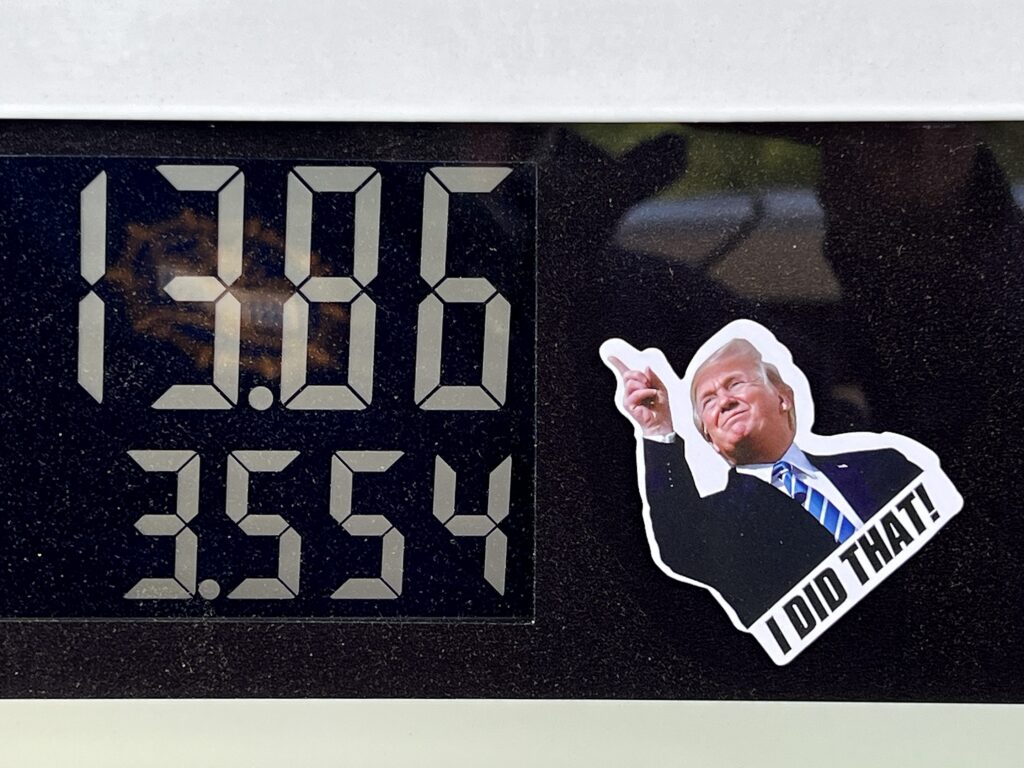
Diesel prices continue to hover near all-time highs in the U.S., creating trouble for Republicans in typically conservative states such as Iowa, Kansas, Ohio and Texas who find themselves knotted in competitive races with Democrats.
Yet, Trump has consistently downplayed the conflict’s economic impact as he rallies his supporters to try to keep the GOP’s grip on both chambers of Congress.
Trump repeatedly insists the war’s end is near, only to threaten that a new round of bombing could very well be in the offing once the election passes — often within the same campaign speech or a single exchange with reporters.
He also argues that elevated gas prices are a temporary inconvenience worth paying to defang Iran.
Trump at a weekend rally in Michigan said he has no regrets about launching the war and even argued that its economic impact has been less severe than he had expected.
“Somebody said, ‘If you had it to do again … ,’” Trump told the friendly audience. “I said, ‘Are you kidding?’ I thought gas would be double or triple. And it’s a small price to pay for taking a nuclear weapon away from maniacs.”
The president’s mixed message on Iran has left Republican candidates in a difficult, if not untenable, position, said Christopher Borick, director of the Lehigh University Opinion Observatory.
“Trump’s messaging on the war is resonating with a shrinking portion of the electorate,” Borick said. “For voters disappointed with the direction of the conflict, there’s little by way of the president’s claims that would change their negative outlook.”
GOP strategists have seen warning signs for months
Only a few elected Republicans have parted ways with Trump over the Iran conflict. Trump, for his part, has insisted the midterm elections would have no bearing on how he approached the conflict.
But some party strategists have been sounding the alarm for months.
Early in the summer, five Republican strategists involved in key races or advising campaign leadership told The Associated Press they’d begun seeing warning signs that the war could hurt their candidates if it didn’t wind down soon.
In June, after Trump forged an interim ceasefire agreement with Tehran, he and White House officials appeared more confident. But the deal unraveled within weeks.
At that point, campaign officials in some battleground races became more forceful during internal conversations about how House districts Trump won easily in 2024 looked as though they were becoming competitive, said the Republican strategists, who were not authorized to comment publicly on the internal party data and spoke on the condition of anonymity.
Oil prices peaked in May, fell in June and surged again in September as Trump threatened to escalate the conflict before backing off and suggesting a deal could be around the corner. The national average has hovered above $4 per gallon since the middle of June.
As the Labor Day holiday passed, strategists said internal polls showed voters were more frequently tying the war to higher grocery prices and travel costs.
Trump has dismissed critics who argue that the war is driving an affordability crisis for Americans as pushing a “hoax” or “scam” invented by Democrats. But internal campaign polling suggests Trump’s argument has not resonated with American voters, the strategists said.
Some Republican voters are frustrated
In interviews, even some Republican voters who say they support Trump’s decision to launch the war admit gas prices are testing their patience.
Clay Coey, 59, said he sometimes cringes when he fills the tank of his 2010 Chrysler Sebring, even as he says he’s willing to temporarily pay higher gas prices to eliminate what he sees as a major security threat to the U.S.
“Do I like it? No, I drive this old beast,” said Coey, an auctioneer from DeWitt, Michigan. “However, there does come a point in time where you have to sit here and say, ‘What is worth the cost?’”
Some voters say Trump fumbled by predicting the war would be over in a matter of weeks.
Elizabeth Marlett, 61, of Moville, Iowa, said she wished Trump had avoided setting a timeline for the conflict and wished he would order the U.S. military to act more forcefully to force Tehran to capitulate. Still, she’s sticking with Trump.
“We need to support our commander in chief, even if things take longer than expected,” said Marlett, a small-herd beef rancher from Iowa’s GOP-heavy northwest. “That’s life, and we can’t run from something we’ve started.”
Meanwhile, Trump’s decision to start the war has been seen by some supporters as a betrayal of a central tenet of the Republican leader’s “America First” campaign pledge: the promise to keep the U.S. out of the sort of “forever wars” that bogged down some of his recent White House predecessors.
Sean O’Brien, 21, a student at Auburn University in Alabama, said Trump’s Iran decision left him “very disillusioned.”
O’Brien earlier this year attended the Conservative Political Action Conference, a major gathering for those on the political right. Now, he’s rethinking his allegiances.
“At the moment, I expect to vote Democratic,” said O’Brien, who considers himself an independent.
___
Beaumont reported from Sioux City, Iowa. AP journalists Patrick Aftoora-Orsagos in Columbus, Ohio, and Jacqueline GaNun in DeWitt, Mich., contributed to this report.
This story was originally featured on Fortune.com