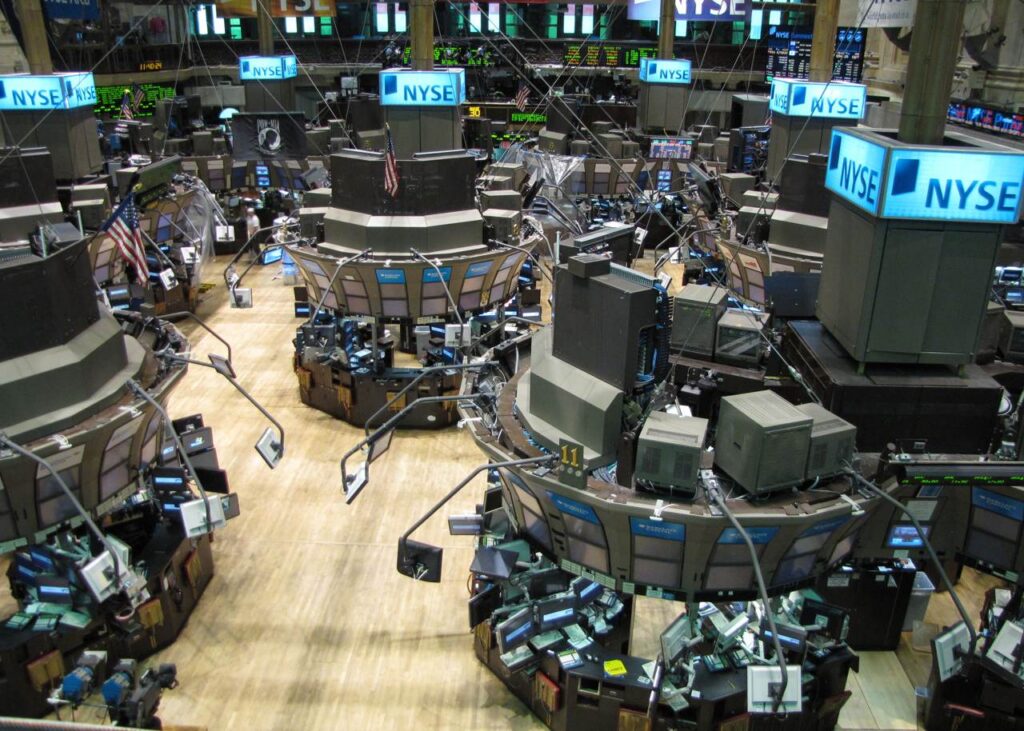
Archive photo: New York Stock Exchange trading floor, 2009. Kevin Hutchinson / Wikimedia Commons, CC BY 2.0. Cropped.
Intel crashed 29% in early trading on Friday, as the Nasdaq fell 2.23% while energy stocks climbed.
The numbers told the story of a split market. The Nasdaq composite was down 2.23% at 25,600.69 as of 9:57 AM Eastern time, on Nasdaq’s delayed index quote. The S&P 500 was at 7,635.75, -1.10%, as of 10:00 AM EDT, while the Dow Jones Industrial Average was at 52,171.42, -0.33%, as of 9:59 AM EDT, according to CNBC’s exchange-quote pages.
Intel traded at $65.48, down 28.88%, as of 10:00 AM Eastern time, after forecasting fourth-quarter revenue of $15 billion to $16 billion and GAAP earnings of just 10 cents a share on a weakening personal-computer market – a forecast that wiped out more than a quarter of the company’s market value.
Amazon fell 2.07% to $238.75 as of 10:00 AM Eastern time, as investors weighed its disclosure of a $42.4 billion free-cash-flow outflow over the past twelve months against 39% growth at its AWS cloud unit. Nvidia dropped 2.75% as of 10:00 AM Eastern time.
Energy is the morning’s other side
While tech bled, the oil majors rallied on results. Exxon Mobil rose 2.70% as of 10:00 AM Eastern time, and Chevron gained 1.86% as of 10:00 AM Eastern time. ExxonMobil reported third-quarter earnings of $15.4 billion. Chevron reported earnings of $9.9 billion and record crude throughput at its U.S. refineries.
ICE’s January 2027 Brent crude contract traded at $113.30 a barrel, up 2.26%, as of 9:50 a.m. Eastern time. ICE labels its public market data as delayed by at least 15 minutes. The January contract is distinct from the higher-priced December contract.
Labor costs rise moderately
The morning’s economic report landed at 8:30 a.m.: the Labor Department’s Employment Cost Index rose 0.8% in the third quarter, with wages and salaries up 0.7% and benefit costs up 0.9%. Over the past year, compensation costs have risen 3.4% – wages 3.1%, benefits 3.9%.
What it means for you
For retirement savers, this was another morning where the account balance depended on what you own: tech-heavy funds faced losses in Intel, Amazon and Nvidia, while the two oil majors gained. For workers, the Labor Department reported that inflation-adjusted private-industry wages and salaries decreased 0.6% over the year. That is a measure of pay after inflation, not a calculation of any one household’s purchasing power.
What to watch
Through the session: whether Intel’s collapse drags the broader chip sector lower or stays its own story, and whether energy stocks’ early resilience holds into the afternoon. These prices are a morning snapshot, not closing levels.
JBizNews Desk | Wall Street
© JBizNews.com. All rights reserved. Unauthorized reproduction or redistribution is strictly prohibited.