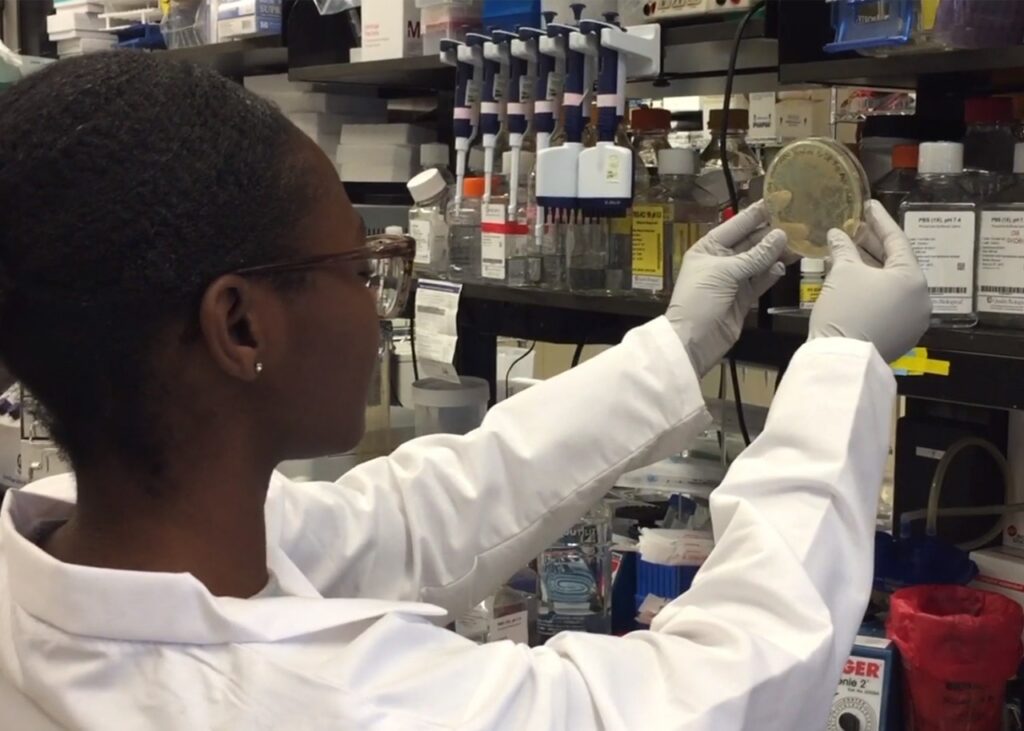
Laboratory research archive: a NIAID scientist examining an agar plate in January 2020. Not an AbbVie facility or employee. NIAID / NIH via Wikimedia Commons, CC BY 2.0. Cropped.
Medicines for painful joints, inflamed skin and serious bowel disease are driving growth at AbbVie, a U.S. company that develops and sells prescription drugs. Its newer treatments Skyrizi and Rinvoq brought in $8.48 billion in the third quarter, helping the drugmaker raise its full-year earnings forecast Friday even as sales of the older medicine Humira fell.
Skyrizi treats conditions including plaque psoriasis, which causes inflamed patches of skin, psoriatic arthritis, Crohn’s disease and ulcerative colitis. Rinvoq is a pill used for conditions including rheumatoid arthritis, psoriatic arthritis, eczema and inflammatory bowel disease, with eligibility depending on the condition and prior treatment. Humira is an injected medicine used for several inflammatory conditions, including arthritis, psoriasis and Crohn’s disease. These drugs help control illness; the earnings report is not announcing a cure.
The business reason for the sales jump is straightforward: growth in Skyrizi and Rinvoq, plus medicines for conditions such as migraine and mental illness, more than offset shrinking Humira sales and weaker cosmetic-treatment sales. The company’s revenue rose 10.3%. The release does not break that growth into how many more patients were treated versus changes in prices or product mix, so the sales increase should not be read as a patient count.
Skyrizi generated $5.776 billion in third-quarter revenue, up 22.7% from a year earlier, while Rinvoq brought in $2.706 billion, up 23.9%, according to AbbVie’s October 30 results. Humira sales fell 31.2% to $683 million. Together, Skyrizi and Rinvoq accounted for nearly half of the company’s $17.404 billion in quarterly revenue.
The replacement business is now the main business
The contrast matters more than the headline earnings number. AbbVie’s immunology portfolio grew 16.3% to $9.165 billion even as Humira continued to shrink. The two growing products are no longer simply cushioning that decline: their combined revenue was about $7.8 billion larger than Humira’s during the quarter.
Overall revenue rose 10.3% on a reported basis, or 10.5% excluding currency effects. These are company sales figures, not counts of patients or prescriptions. They do not show how much of the growth came from price, treatment volume or individual insurance arrangements.
A second engine is gaining speed
Neuroscience revenue rose 19.4% to $3.389 billion, a faster reported growth rate than the immunology portfolio. Vraylar generated $1.068 billion and therapeutic Botox $1.080 billion. The migraine medicines Ubrelvy and Qulipta produced a combined $847 million, with Qulipta’s sales up 38.2%.
The picture was not uniformly strong. Oncology revenue rose just 0.8% to $1.696 billion. Aesthetics revenue fell 1.4% to $1.176 billion, including an 11.9% decline for the Juvederm collection. Therapeutic Botox and cosmetic Botox are reported in different portfolios; their results should not be treated as the same business.
Higher guidance, with an accounting distinction
AbbVie raised and narrowed its 2026 adjusted earnings forecast to $13.95 to $13.99 a share, from $13.76 to $13.96. That forecast includes a 69-cent-per-share unfavorable effect from acquired research and development and milestone expenses incurred through the third quarter. It excludes such expenses that may occur later because the company says it cannot reliably forecast them.
For the quarter, earnings were $2.37 a share under generally accepted accounting principles, compared with adjusted earnings of $3.82. The adjusted figure excludes specified items and is not a substitute for reported profit.
The board also increased the quarterly dividend to $1.82 a share from $1.73, a rise of about 5.2%. The new payment is due February 16, 2027, to shareholders of record January 15.
What the trend does and does not tell patients
The results show where AbbVie’s commercial growth is concentrated: immunology and neuroscience, rather than a recovery in Humira or broad strength across every portfolio. For investors, the next test is whether those growing products can keep supporting the higher outlook. For patients, revenue growth alone says nothing about an individual treatment’s suitability, coverage or out-of-pocket cost. Those questions remain separate from a drugmaker’s earnings report.
JBizNews Desk | NORTH CHICAGO
© JBizNews.com. All rights reserved. Unauthorized reproduction or redistribution is strictly prohibited.