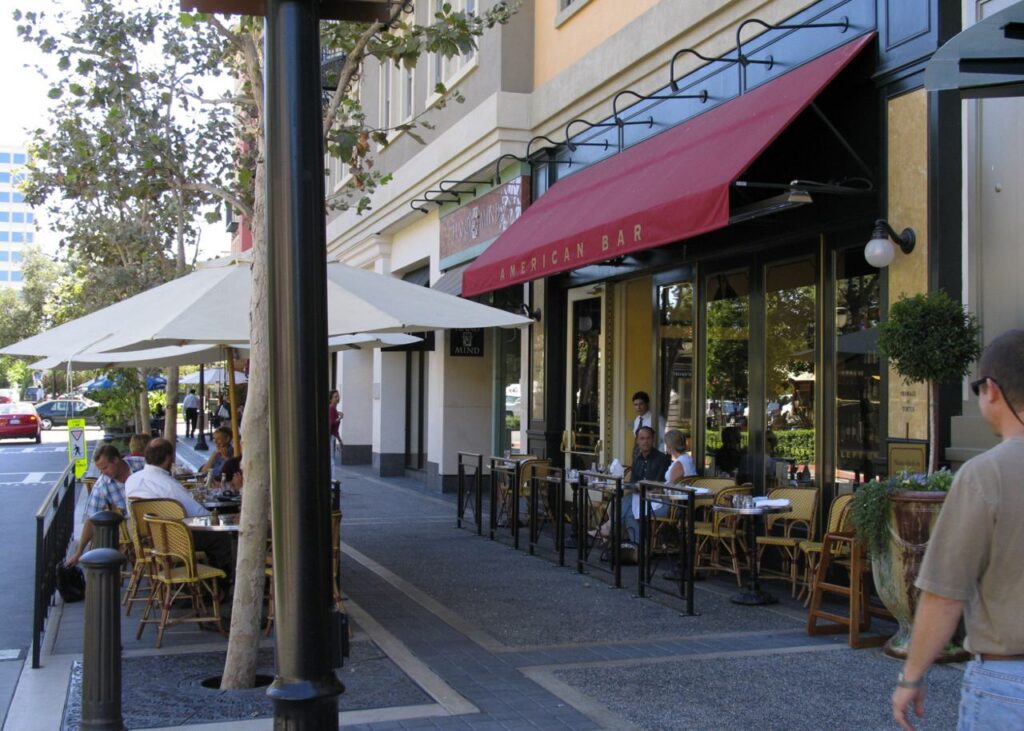
Santana Row storefronts, September 2004. Archive photo: Architecture, Food & One Little Beautiful Girl, CC BY-SA 2.0. Cropped.
Retailers signing space in Federal Realty and Kite Realty shopping centers are agreeing to pay about 14% higher cash rents on comparable leases, the landlords reported Friday. The two companies own shopping centers, rent stores to businesses and earn money from those rents. Their results show how store demand can turn into higher income for property owners, even before every new tenant opens its doors.
Federal Realty said cash rents on comparable retail leases signed in the third quarter rose 14%. Kite Realty reported blended cash leasing spreads of 14.6%. Both raised their full-year funds-from-operations guidance, though their underlying results also show why signed leases, occupied stores and reported profit need to be read separately.
The rent gap is in newly signed space
Federal Realty signed 117 comparable retail leases covering 532,220 square feet. Its 14% cash-rent increase was below the 25% increase measured on a straight-line accounting basis. The cash figure is the cleaner comparison with Kite’s stated cash leasing spreads; the two accounting measures should not be mixed.
Kite signed 160 new and renewal leases covering about 1.2 million square feet. Its 14.6% blended cash spread applied to 129 comparable leases, not every lease it signed. Comparable new leases carried a 33.7% increase, compared with 18.3% for non-option renewals and 7.6% for option renewals.
Those differences matter to tenants. A portfolio’s average increase is not the rent increase every business faces, and new leases can tell a different story from renewals where an existing option sets the terms.
Signed is not the same as collecting rent
Federal Realty ended September with 96.5% of its portfolio leased but 93.8% occupied. The occupancy rate was unchanged from a year earlier, while the leased rate had risen 110 basis points, or 1.1 percentage points.
Kite reported a 95.3% retail leased rate and a record 360-basis-point gap between leased and occupied space. It valued its signed-but-not-open net operating income pipeline at about $38.8 million. That is future contracted business awaiting openings, not money already collected in the quarter.
The near-term test for both landlords is converting that signed space into operating stores. Leasing strength can support future income, but a wider gap also means more of the growth depends on tenants actually opening.
Operating growth is positive, not identical
Federal Realty’s comparable-property operating income rose 2.5%, or 4.0% on an adjusted basis excluding straight-line rents and amortization of in-place leases. Kite reported 3.6% same-property net operating income growth. These are each company’s portfolio measures, with different definitions, rather than one uniform national shopping-center index.
Federal Realty also acquired The Summit in Birmingham, Alabama, after the quarter ended for $508 million. The 870,000-square-foot retail center has about 120 tenants. The purchase adds another source of growth beyond raising rents at existing properties.
Why the REIT earnings number needs care
Federal Realty reported net income of $64.2 million, or 74 cents a diluted share, alongside Nareit and Core funds from operations of $1.87 a share each. Kite reported a $13.3 million net loss attributable to common shareholders, while its operating partnership generated Nareit FFO of 53 cents and Core FFO of 52 cents per diluted share.
FFO is a supplemental, non-GAAP measure that adjusts reported earnings for items including real-estate depreciation and certain property gains or losses. Core FFO makes further company-specific adjustments. Neither replaces net income or cash flow, and the companies warn that similarly named measures may not be directly comparable.
Federal Realty raised and narrowed its 2026 Nareit and Core FFO outlook to $7.54 to $7.58 a share. Kite raised the lower end of its range to $2.08 from $2.06, leaving the upper end at $2.12. Forecasts remain subject to operating and financing risks.
The common signal is stronger rents on signed comparable space, with more income still waiting on store openings. It is evidence of demand in these two landlords’ portfolios, not proof that every retail corridor or tenant is enjoying the same conditions.
JBizNews Desk | REAL ESTATE
© JBizNews.com. All rights reserved. Unauthorized reproduction or redistribution is strictly prohibited.