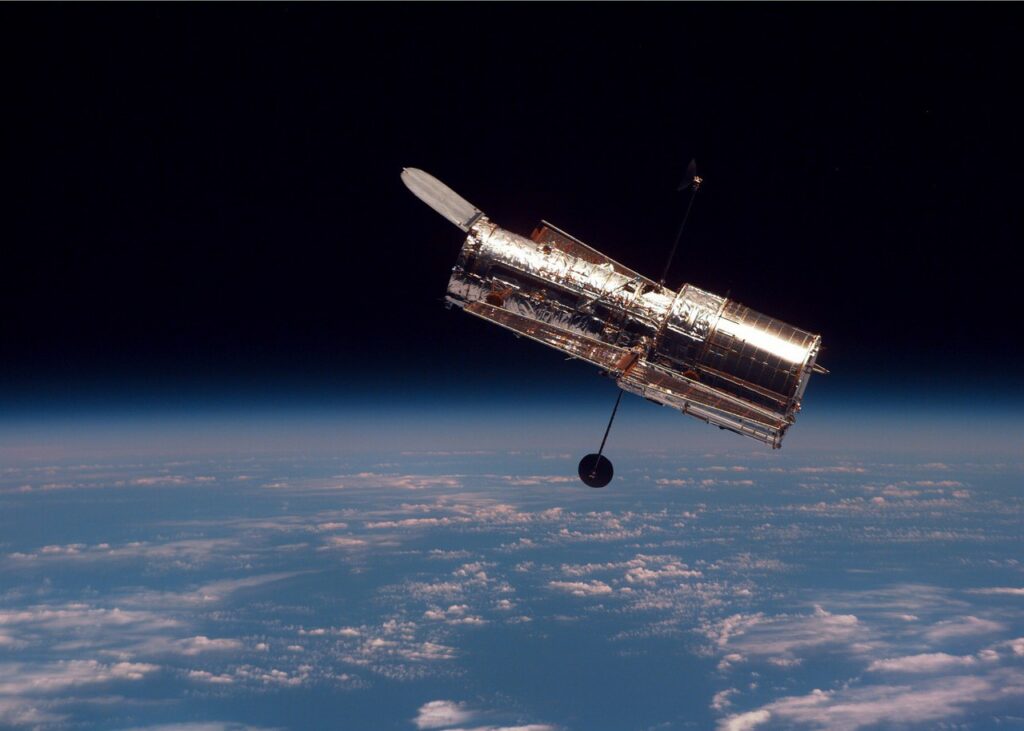
The Hubble Space Telescope returns to orbit after its second servicing mission in February 1997. Archive photo: NASA. Cropped.
NASA is asking commercial companies how they could raise the Hubble Space Telescope’s orbit, service the aging observatory or safely dispose of it at the end of its mission, opening a new search for ways to keep the telescope working longer.
The agency announced the effort Friday after issuing a Request for Information on October 29. Responses are due by 3 p.m. Eastern Standard Time on Monday, November 30.
This is an information-gathering step, not a contract award or an approved rescue mission. The official contracting notice says it is not a request for proposals and does not commit the government to a purchase. NASA will not pay companies for submitting information.
Three possible missions
NASA is seeking information about spacecraft that could capture Hubble in low Earth orbit and boost it to an altitude of at least 600 kilometers, service the telescope to improve its performance and ability to withstand aging, or carry out a controlled re-entry.
A boost or servicing mission must not harm the telescope and is expected to take place by 2032, the notice says. Companies are being asked to describe their technical approach, experience, risks, timetable, estimated cost and the resources they would need from NASA.
The agency would supply technical information, access to Hubble experts and coordinated telescope operations. A contractor would be expected to provide the other resources, including a launch vehicle, spacecraft and mission operations.
Atmospheric drag is lowering Hubble’s orbit
Hubble has no propulsion system to maintain its own orbit. Atmospheric drag is gradually lowering its altitude, and NASA said analysis predicts re-entry in the 2033-to-2034 period without intervention. That is a planning estimate, not an announcement that the telescope is about to fall.
The contracting notice provides more detail: a July 2026 lifetime analysis put the probability of re-entry by September 2032 at 10%, rising to 50% by December 2033. An orbit-raising mission could give the observatory more time for science, but the agency has not selected a company or announced an approved mission budget.
“Hubble still has important science ahead of it, and we should be looking at every reasonable opportunity to keep it delivering for as long as possible,” NASA Administrator Jared Isaacman said in the announcement.
A commercial opportunity, not yet a contract
For space companies, the notice is an invitation to show whether their satellite-capture and servicing technology could handle one of the world’s best-known observatories. NASA is asking about current and near-term capabilities rather than announcing that a particular commercial system is ready.
The agency says Hubble remains heavily sought after by researchers, with demand for observing time exceeding available capacity by more than seven to one and more than 1,000 scientific papers a year. Its ultraviolet and optical capabilities complement other space observatories.
Hubble is a partnership between NASA and the European Space Agency. NASA’s Goddard Space Flight Center in Maryland manages the telescope and mission operations, with science operations conducted by the Space Telescope Science Institute in Baltimore.
JBizNews Desk | WASHINGTON
© JBizNews.com. All rights reserved. Unauthorized reproduction or redistribution is strictly prohibited.