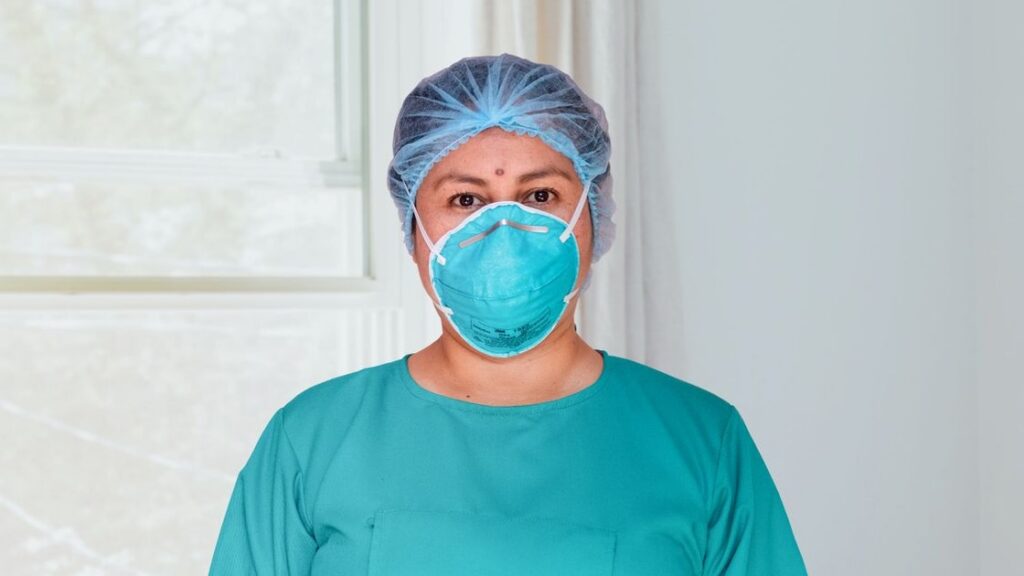
A masked healthcare professional in an illustrative clinical-setting archive photo. Photo: Gilmer Diaz Estela/Pexels, Pexels License. Cropped. The person and facility pictured are not identified as subjects of CDC guidance or a return-to-work decision.
A nursing-home employee with a common respiratory virus may be able to return to work on day four under current CDC guidance, but reaching that day is only one part of the test. Symptoms must be improving, fever must have been absent for at least 24 hours without fever-reducing medicine, and the employee must feel well enough to work.
The distinction matters as facilities prepare for winter respiratory infections. This guide explains the CDC’s September 11 healthcare-personnel recommendations, not a new rule announced Friday. Staff work restrictions and precautions for an infected resident are different decisions.
Day four is the earliest return, not an automatic clearance
For a suspected or confirmed infection covered by the guidance, CDC says staff should remain away from work until all four conditions are met:
- At least three days have passed since symptoms began, or since the first positive respiratory-virus test if the employee remains asymptomatic throughout the infection.
- The employee has been fever-free for at least 24 hours without fever-reducing medicines.
- Symptoms are improving.
- The employee feels well enough to return.
The day symptoms start is day zero. That makes day four the first possible return day, not day three. For someone who tests positive but never develops symptoms, the first positive test is day zero. If the other conditions are not met, the calendar alone does not clear the employee to work.
The routine return-to-work criteria do not require a negative test. That does not mean testing has no purpose: CDC notes that pathogen-specific tests can help guide clinical and infection-control decisions, particularly in more complicated cases.
Masking continues after the employee returns
Returning staff should wear source control through at least the end of day seven, counting the start of symptoms or the first positive test for an infection that remains asymptomatic as day zero. Day eight is the first possible day to work without source control under this part of the guidance.
Source control means a respirator or well-fitting face mask used to limit the spread of respiratory secretions. CDC says it should be worn consistently around residents, coworkers and visitors. Breaks without it, including meals and drinks, should take place privately away from other people.
This does not replace the protective equipment required for particular resident-care tasks or transmission-based precautions. An employee’s return date is not permission to drop an N95, eye protection, gown or gloves when those are otherwise indicated.
Exposure without symptoms follows a different clock
CDC does not generally recommend work restrictions for an employee who has a known or suspected exposure to a covered respiratory virus but remains asymptomatic. The employee should use source control from the day of first exposure through at least the fifth day after the last exposure, and monitor for symptoms for at least five days after that last exposure.
The last exposure is day zero, so day six is the first possible day without source control under that exposure recommendation. If symptoms develop, the employee should stop working and follow the infection-related work restrictions instead.
Severe illness and weakened immunity need individual review
CDC warns that people who were severely or critically ill, or who are immunocompromised, may remain contagious longer. Their return-to-work decisions are typically made case by case by occupational health services, potentially with an infectious-disease or immunosuppression expert and pathogen-specific testing.
The general recommendation covers viruses such as SARS-CoV-2, influenza, RSV, parainfluenza, rhinovirus and human metapneumovirus. It does not replace separate guidance for infections such as measles, mumps, rubella, chickenpox or Middle East respiratory syndrome. Facilities should first confirm which guidance applies.
Do not apply the staff clock to residents
The healthcare-personnel recommendations do not shorten a resident’s isolation or other transmission-based precautions. In a September 29 provider letter, Washington’s Department of Social and Health Services stressed that distinction and directed nursing homes to continue using precautions based on the suspected or confirmed pathogen.
The state letter also distinguishes nursing homes from assisted living and other community residential settings. Those setting-specific instructions should not be treated as a single nationwide rule for every form of senior housing.
For nursing homes, the practical task is to keep separate records for the employee’s symptom or test date, the return-to-work criteria, the source-control end date and any resident-specific precautions. Occupational health and infection-prevention teams should apply current federal guidance together with applicable state and local requirements, rather than treating a four-day headline as a universal clearance.
Healthcare Desk | WASHINGTON
© JBizNews.com. All rights reserved. Unauthorized reproduction or redistribution is strictly prohibited.