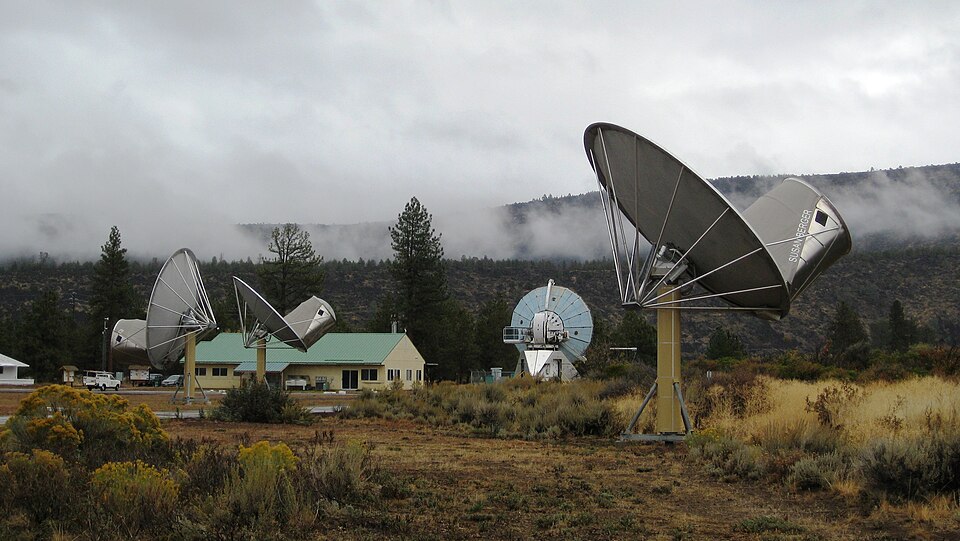
The Allen Telescope Array in October 2010. Archive photograph, not the current AI computing equipment. Photo: brewbooks / Wikimedia Commons. Resized under CC BY-SA 2.0.
Scientists at California’s Allen Telescope Array are using artificial intelligence to control observations and process radio data in real time, Nvidia said Friday, describing a new role for AI in the search for signals from beyond Earth.
The work brings Breakthrough Listen and the SETI Institute together with Nvidia technology. According to the company’s account, an AI agent can steer the telescope’s antennas, calibrate the instrument, correct data errors and plot results in response to a natural-language request.
The system is designed to help researchers sift through the vast streams of information produced by radio telescopes. It is a tool for conducting the search, not an announcement that scientists have discovered extraterrestrial life.
Nvidia said the pipeline has already detected the Crab Nebula’s pulsar in real time using AI. A pulsar is a rapidly spinning stellar remnant that emits repeating signals, a natural astronomical source rather than evidence of an alien civilization.
The company’s Holoscan platform handles incoming telescope data, while software developed at the SETI Institute processes signals using Nvidia computing libraries. Another system, called Nexus, coordinates the instrument’s state, computing resources and processing tasks.
Nvidia said the setup can handle 2.4 terabits of data per second using RTX PRO 6000 Blackwell graphics processors, with AI processing taking place on site next to the telescope rather than depending on a remote service.
The team is also evaluating open AI models, including Nvidia’s Nemotron, for settings where keeping data local and obtaining fast results matter. Nvidia described possible future uses at observatories that could operate without a continuous connection, including on the far side of the moon.
Those future applications remain prospects. Friday’s account describes the technology and its use at the Allen Telescope Array, not a completed lunar observatory or a confirmed signal from an extraterrestrial civilization.
JBizNews Desk | California
© JBizNews.com. All rights reserved. Unauthorized reproduction or redistribution is strictly prohibited.