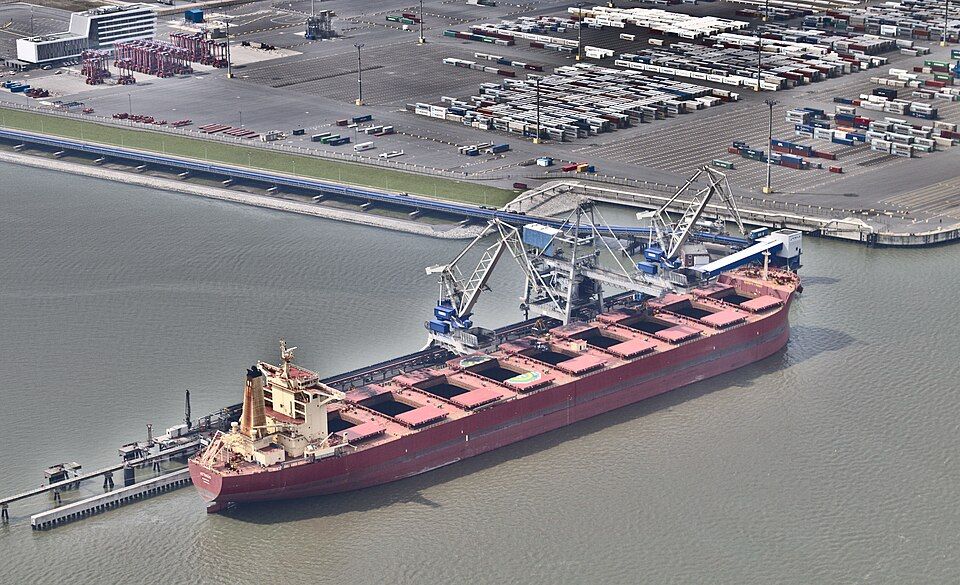
The bulk carrier Attikos unloads coal at Wilhelmshaven, Germany, in May 2017. Archive image illustrating bulk shipping; not one of the ammonia-fueled vessels. Photo: Jacek Rużyczka / Wikimedia Commons. Resized under CC BY-SA 4.0.
Japan’s Mitsui O.S.K. Lines said Friday it has named three ammonia-fueled bulk carriers being developed with Belgium’s CMB.TECH, as the shipping companies prepare to bring an alternative to conventional marine fuel into large ocean-going cargo vessels.
The ships, named Ruri Mirai, Ruri Sekai and Ruri Hikari, are scheduled for delivery in phases starting in early 2027. MOL and CMB.TECH will jointly own the vessels, with MOL planning to operate them under long-term charter contracts.
The naming ceremony took place Thursday at CSSC Qingdao Beihai Shipbuilding in China. Friday’s announcement concerns that construction milestone, not the start of commercial service.
Each vessel has approximately 209,800 tons of deadweight capacity, measures just under 300 meters long and has two ammonia fuel tanks of 3,000 cubic meters each, according to MOL.
MOL says the ships are part of the first series of ammonia-fueled Capesize bulk carriers. Its Japanese-language release distributed through PR Times qualifies that claim as based on the company’s October web research and applies it to a 10-ship series ordered and built by CMB.TECH at the Qingdao yard, including these three vessels.
Ammonia does not produce carbon dioxide when burned, MOL said, making it a candidate fuel in the company’s effort to reduce shipping emissions. That combustion property is not a claim that producing and supplying the fuel has no environmental impact.
The company said it is still developing safe operating procedures and other safety measures with partners ahead of the vessels’ entry into service. It described the ships as part of its plan to operate net-zero-emission ocean-going vessels in the 2020s and reach net-zero emissions by 2050.
JBizNews Desk | Global Shipping
© JBizNews.com. All rights reserved. Unauthorized reproduction or redistribution is strictly prohibited.