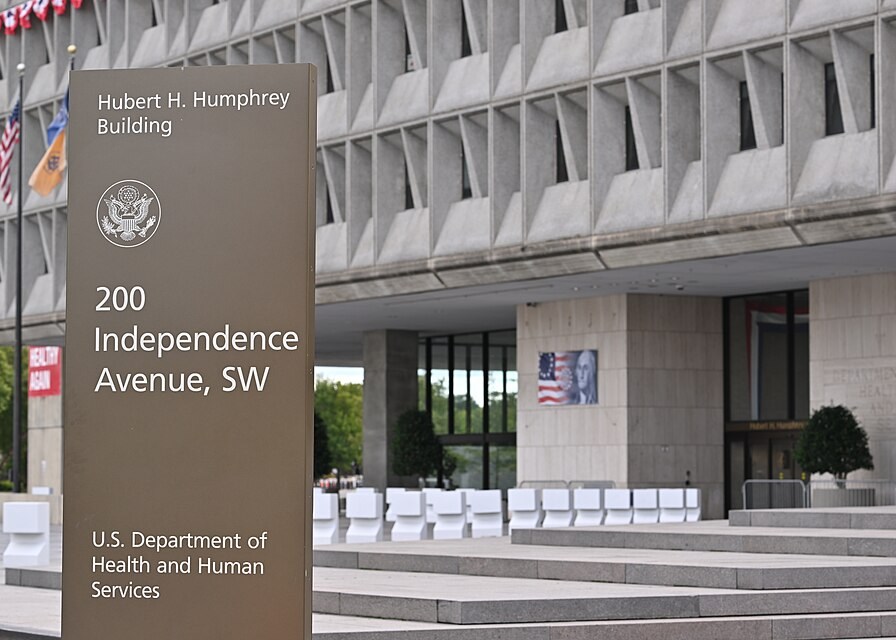
A sign outside the U.S. Department of Health and Human Services headquarters in Washington on October 12, 2026. Archive photo.
Photo: G. Edward Johnson / Wikimedia Commons / CC BY 4.0. Cropped.
Organ-donation groups will face clearer patient-safety rules and new requirements when a service area changes hands under a final rule the Centers for Medicare & Medicaid Services announced Friday. The agency also will stop counting pancreata recovered solely for research as transplants when it measures the groups’ performance.
The changes apply to organ procurement organizations, or OPOs, which secure authorization for organ donations, recover organs and coordinate delivery to transplant programs. Their work connects donor hospitals with patients waiting for a transplant. CMS said more than 100,000 Americans are waiting for transplants, despite more than 49,000 procedures performed in 2025.
The rule is final, but the changes are not described as taking effect immediately. The public-inspection version is scheduled for Federal Register publication on November 3 and says the regulations take effect 60 days after publication.
What changes for patient safety
CMS defines “unsound medical practices” to include failures that create an imminent threat to patient health and safety or pose a risk to patients or the public. Its fact sheet lists governance, donor evaluation and management, and organ procurement, allocation and transport among the areas covered. The definition clarifies when the agency can use its existing authority to decertify an organization immediately.
Organizations must have policies for identifying, reporting, analyzing and preventing adverse events during the donation process. They also must keep records showing what happens to organs recovered for research. A medical director must be licensed in at least one state or territory within an organization’s service areas, or as required by applicable law.
A research organ is not automatically a transplant
A donor whose pancreas is recovered only for islet-cell research will still count toward an organization’s donation rate. But research activity alone will no longer count toward its transplantation rate in the absence of a transplant. CMS said the distinction is intended to make the performance score reflect organs actually transplanted into patients.
Transitions without interrupting donation services
The rule allows high-performing organizations to compete for multiple donation service areas and clarifies recertification, competition and appeals. When an area changes operators, the outgoing organization must cooperate with its successor. The incoming organization must submit a transition plan and periodic progress reports to CMS to support uninterrupted service for patients and donor families.
The agency is retaining the existing three-tier performance framework, rather than replacing it. Tier 2 service areas must face competition, but tier 2 status alone is not a reason to decertify an organization. Organizations with only tier 3 service areas, the lowest-performing group, will be decertified and cannot compete for another open area, CMS said.
The final rule sets operating and oversight requirements; it does not announce a specific organization’s closure or promise that an individual patient will receive an organ sooner.
JBizNews Desk | Health Policy
© JBizNews.com. All rights reserved. Unauthorized reproduction or redistribution is strictly prohibited.