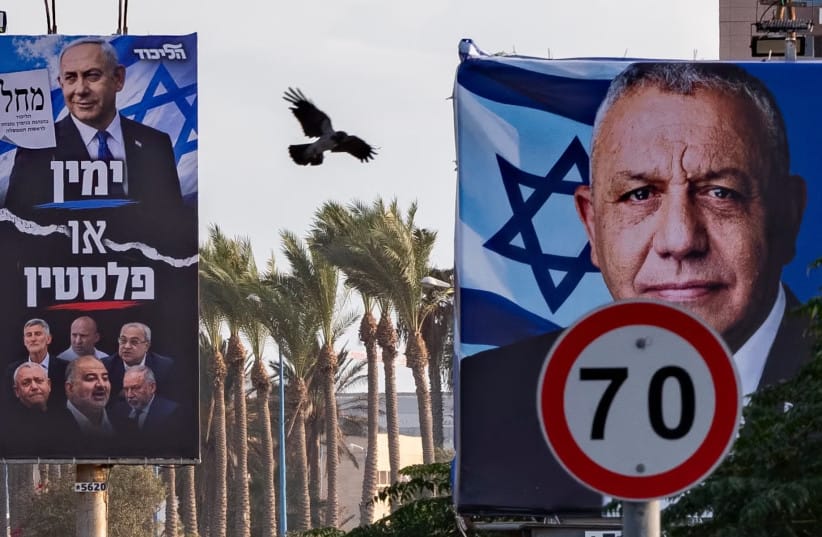
Senior figures in the opposition bloc are considering a return to direct elections for prime minister without dissolving the Knesset, following the inconclusive results of Israel’s 26th Knesset election, according to reports by Maariv commentator Ben Caspit and journalist Michael Hauser Tov.
The election results have left Israel’s political system deadlocked, with neither bloc securing the majority needed to form a government. Prime Minister Benjamin Netanyahu’s bloc holds 53 seats, the opposition bloc has 48, and the Arab parties hold 19.
Although 67 Knesset members are mathematically outside Netanyahu’s bloc, disagreements among the opposition party leaders and their commitments not to rely on the Arab parties have complicated efforts to establish an alternative government.
Alongside the possibility of another Knesset election, an alternative proposal has emerged within the bloc: restoring direct elections for prime minister without dissolving parliament.
Maariv commentator Ben Caspit addressed the possibility, noting that if Netanyahu seeks to trigger another election, the electoral system could be changed to allow a direct contest for prime minister, as Israel previously practiced.
Caspit said legislation could also be advanced to limit the prime minister’s tenure to two terms or eight years.
He raised the possibility that term-limit legislation could prevent Netanyahu from running again. However, such a scenario would depend on the law’s wording, whether it applied to previous terms in office, and the legal and political obstacles involved.
In this context, Caspit recalled comments Netanyahu made during a 1997 interview with Dan Shilon, when he supported limiting a prime minister’s tenure to two terms.
“What you can’t do in the first term, you’ll do in the second. And what you don’t do in the second term, you won’t do anymore,” Netanyahu said at the time.
The model Netanyahu himself proposed in 2021
Journalist Michael Hauser Tov also reported on Ulpan Shishi that senior figures in the opposition bloc had confirmed direct prime ministerial elections were among the options being examined following the election results.
According to Hauser Tov, the bloc has dubbed the proposal the “Netanyahu 2021 direct election model,” referring to an initiative Netanyahu attempted to advance following the election for the 24th Knesset.
The March 2021 election ended without a decisive outcome, with Netanyahu struggling to form a government even as Likud remained the largest party.
During coalition negotiations, the possibility of cooperation with the Ra’am party, led by Mansour Abbas, was raised. At the same time, a proposal to hold direct elections for prime minister was advanced.
In April 2021, amid the political deadlock, Netanyahu presented a plan intended to determine who would serve as prime minister without holding another Knesset election.
“Direct elections for prime minister will be held. The public will directly elect the prime minister in a snap election, without dissolving the Knesset,” he declared at the time.
Now, approximately five years later, the same idea is being examined by the opposition bloc, which is seeking to bring his tenure to an end.
67 seats outside Netanyahu’s bloc, but no agreement
According to Hauser Tov, one reason the proposal is being considered is the difficulty opposition party leaders face in reaching an agreement on forming a government with the support of the Arab parties.
While Democrats chairman Yair Golan has called for including the Arab parties in efforts to replace Netanyahu, Naftali Bennett and Avigdor Liberman established red lines during the election campaign regarding cooperation with them.
Legally, swearing in a government does not necessarily require the support of 61 Knesset members, but rather a majority of those participating in the confidence vote.
For example, 56 Knesset members voting in favor, 53 voting against, and the remaining 11 abstaining could be sufficient.
However, this possibility depends on political agreements that have yet to be reached, particularly the willingness of Bennett and Liberman to support such a move.
According to Hauser Tov’s analysis, direct elections could offer an alternative way to determine who serves as prime minister without requiring the opposition bloc to reach a coalition agreement with the Arab parties in advance.
Nevertheless, even a directly elected prime minister would not necessarily have the parliamentary majority needed to establish and maintain a stable government.
Historical precedent and legal obstacles
Israel has held direct elections for the prime minister position in the past. The system was first implemented in 1996, when Netanyahu defeated Shimon Peres. In 1999, Ehud Barak defeated Netanyahu, and in 2001, a special election for prime minister alone was held, in which Ariel Sharon defeated Barak.
In the first two elections, voters cast two ballots, one for prime minister and another for the Knesset.
By contrast, the 2001 election was held solely to elect a prime minister, without a new Knesset election.
The system was abolished later that year, and Israel returned to a parliamentary model in which the government serves on the basis of the Knesset’s confidence.
Restoring direct elections would therefore require significant legislative changes and could not be implemented under existing law.
The question of whether a directly elected prime minister could form a government without sufficient parliamentary support would also depend on the provisions established in the new legislation.
Furthermore, limiting a prime minister’s tenure to two terms or eight years would require a separate legislative initiative.
Applying such a restriction retroactively to previous terms in office, in a manner that would prevent Netanyahu from running, would likely raise legal and constitutional questions concerning, among other issues, the right to stand for election and changes to electoral eligibility rules.
At this stage, these remain proposals being discussed within the political system rather than a fully developed legislative initiative agreed upon by party leaders.
As Netanyahu continues serving as caretaker prime minister and the opposition bloc struggles to present an agreed-upon coalition, the possibility of changing Israel’s electoral system has returned to the political agenda.
The question is whether the parties can agree to change the rules of the electoral system, or whether this initiative will run into the same disagreements that have prevented them from forming a government.