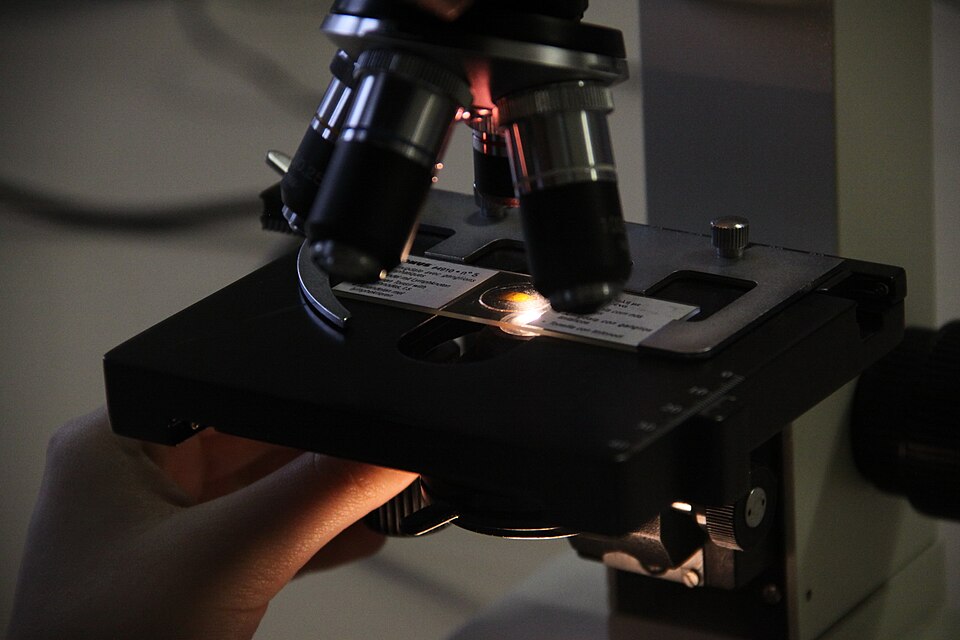
A microscope in the science laboratory at Collegio Rotondi in Italy, photographed December 13, 2023. Archive image illustrating laboratory research; not an OpenAI laboratory or a test of GPT-Rosalind-6. Giorgio Banfi / Wikimedia Commons / CC BY 4.0. Resized; no other change.
OpenAI is offering its latest life-sciences research model to a limited group of approved organizations, with access controls aimed at balancing drug-discovery and biology work against the risks of misuse.
The company published an October 30 safety report for GPT-Rosalind-6, a model intended for biology, drug discovery and translational medicine. Its updated access guidance says GPT-6 Rosalind Research is available to approved Research organizations through Work and Codex, with API access requiring separate approval.
The release is not an unrestricted addition to the ordinary ChatGPT chat window. OpenAI says applicants must pass a trusted-access review covering their proposed research, security controls and governance. Buying a subscription alone does not provide access.
A research tool, not a proven treatment
The Rosalind family is designed to help researchers work through scientific literature, biological data, medicinal chemistry and experiment planning. In its new report, OpenAI describes improvements over GPT-Rosalind-5.5 on three research benchmarks.
At the highest reasoning budget tested, the newer model scored 49.6% on a medicinal-chemistry evaluation, compared with 28.9% for its predecessor. On an applied life-sciences benchmark using tasks contributed by working scientists, its average score was 61.3%, versus 44.0%.
Those are results reported by OpenAI on specific tests. They do not establish that the model can safely diagnose patients, choose treatments or deliver a successful new medicine. The company also notes that one biological-data benchmark used a configuration different from the production system.
Access remains tightly controlled
OpenAI says the model uses the same underlying weights as GPT-6 Astra, without additional training for this release. The difference includes how biological research requests are handled and the safeguards surrounding access.
The company says Rosalind has fewer refusals on some legitimate biological questions that could also have harmful uses, while retaining refusals for biological weaponization. It classifies the launch as having high biological and chemical capability under its own risk framework, below its critical threshold.
Its Research and Discovery access tiers remain separate. Approval for Discovery does not grant access to the new Research model. In Enterprise workspaces, the new model begins with a two-week administrator preview and is off by default during that period.
For laboratories and drug developers, the announcement expands the tools available for research assistance. It does not remove the need for scientific review, controlled access or experimental validation.
Primary sources: OpenAI’s October 30 safety report and research-access guidance.
JBizNews Technology and Health Desk | San Francisco
© JBizNews.com. All rights reserved. Unauthorized reproduction or redistribution is strictly prohibited.