Bulgaria offers travelers far more than snow-capped Balkan peaks, Black Sea beaches, and ancient Thracian monuments. A journey through Sofia and Plovdiv reveals a remarkably resilient Jewish narrative, one shaped by centuries of Sephardi tradition, wartime persecution, dramatic rescue, mass emigration, and, today, a new generation determined to keep Jewish life vibrant.
In Bulgaria, Jewish history is not confined to cold museum display cases or solemn memorials. In Sofia, it manifests in a magnificent Moorish Revival synagogue that has stood at the center of the capital for over a century. In Plovdiv, it is embodied by a smaller, close-knit community and a young synagogue president whose connection to his house of worship began when he was just three years old.
Together, the two cities provide a rich introduction to the nation: Sofia, the country’s energetic capital, and Plovdiv, one of Europe’s oldest continuously inhabited urban centers. Both offer extensive Roman remains, striking architecture, vibrant culinary scenes, and welcoming atmospheres.
But for Jewish travelers, they provide something more profound: an opportunity to touch a legacy that is very much alive.
Sofia: Where history lives beneath your feet
Sofia is a capital where eras seamlessly overlap. Red-brick Roman ruins rest beside Socialist Classicist structures, while gold-domed Orthodox cathedrals, Ottoman-era mosques, and grand Jewish landmarks reflect a centuries-old multicultural crossroads.
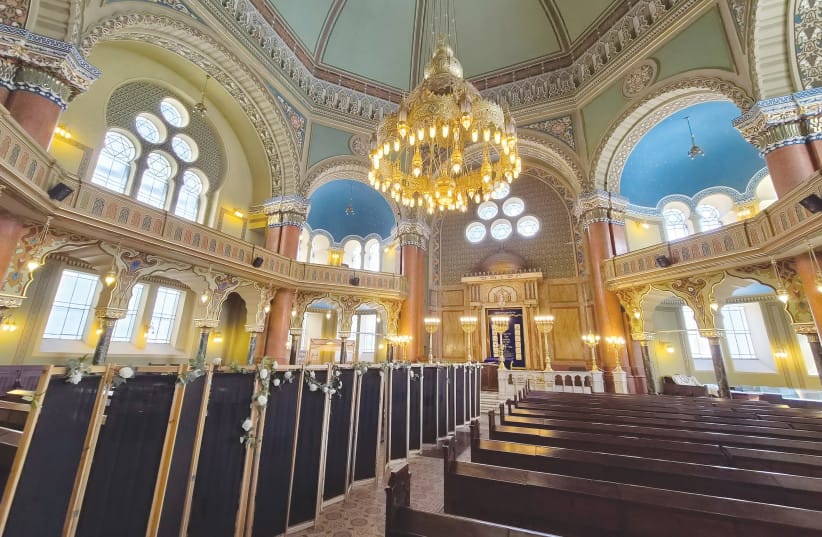
At the heart of this cityscape stands the Sofia Synagogue, the largest Sephardi synagogue in Southeastern Europe. Designed by Austrian architect Friedrich Grünanger, planning for the monumental building began in 1903, construction commenced in 1905, and the synagogue officially opened its doors in 1909 in the presence of Tsar Ferdinand I.
Its grand design, featuring intricate Venetian mosaics, hand-carved Viennese woodwork, and a soaring dome housing a two-ton brass chandelier, reflected the deep confidence and integration of Sofia’s Jewish community at the dawn of the 20th century.
Yet the building also bears physical scars of mid-century turmoil. During World War II, Sofia suffered heavy Allied bombing raids. On April 13, 1944, a bomb struck the synagogue complex. Miraculously, the shell failed to detonate, saving the core structure from destruction, though the concussive blast shattered its original stained-glass windows and damaged the surrounding library. The crater is still on show under a Perspex floor.
Now, the synagogue is far more than an architectural relic. Synagogue Director Julia Gavazova shows that it is an active center of community life. An exhibition inside, called The Niche, documents Jewish heritage, memory, and continuity across Bulgaria.
Meanwhile, the prominent presence of a chuppah (wedding canopy) in the main sanctuary serves as an active reminder that this remains a home for life-cycle celebrations rather than a museum of a bygone era.
Quantifying Sofia’s contemporary Jewish population presents a nuanced picture, according to Yulia Georgieva, chairperson of the Central Israelite Religious Council: official census records count about 900 self-identified Jews in the capital, while the local communal organization, Shalom, counts about 3,000 registered members.
A complex legacy of resistance and rescue
Understanding Bulgaria’s Jewish present requires navigating one of the most complex chapters of 20th-century history. Guide Stella Behar explained that during World War II, Bulgaria was aligned with the Axis powers, and the government enacted harsh antisemitic laws under the Law for the Protection of the Nation, restricting civil rights, imposing forced labor, and mandating the wearing of yellow stars.
Yet, when Nazi demands for the deportation of Bulgaria’s Jewish citizens reached a crisis point in early 1943, an extraordinary coalition of public figures resisted. Members of Parliament led by Deputy Speaker Dimitar Peshev, prominent leaders of the Bulgarian Orthodox Church such as Metropolitan Stefan of Sofia and Metropolitan Kiril of Plovdiv, civil society groups, and ordinary citizens voiced fierce opposition.
As a result of this internal pressure, the planned deportations of all 48,000 Jews residing within Bulgaria’s pre-war borders were repeatedly postponed and ultimately halted.
This historic rescue stands as a testament to civic courage. However, the historical record remains tragic and complex: Bulgarian authorities deported over 11,000 Jews from Bulgarian-administered territories in occupied Thrace, Vardar Macedonia, and Pirot directly to Treblinka, where virtually all perished.
The contrasting destinies of Bulgaria’s Jews are highlighted by two separate memorials in central Sofia: the memorial at St. Sophia Church, which honors those involved in saving the Jewish population, and the Monument of Salvation, which commemorates both the rescue of Bulgaria’s Jews and the tragic fate of those sent to the camps.
The post-war era brought another historic transformation. Under Communist rule, Jewish communal and religious life was increasingly restricted, while private businesses and communal institutions were brought under state control. Synagogues remained open, but religious practice declined as the authorities promoted a secular, socialist society.
Following the founding of the State of Israel in 1948, the vast majority of Bulgarian Jews made aliyah. Within a few short years, a vibrant community of over 45,000 individuals transitioned almost entirely to Israel, fundamentally reshaping the demographic landscape of Jewish Bulgaria overnight.
Navigating modern Sofia: Kosher amenities and cultural sights
For modern travelers, this heritage blends seamlessly into the rhythms of modern Sofia. Practical amenities make visiting straightforward. Kosher Point Alegria, next to the synagogue, provides a central, casual dining option with a broad menu featuring pizzas, pasta, omelets, fresh pita sandwiches, salads, and seasonal soups.
Beyond Jewish landmarks, central Sofia is eminently walkable. The iconic St. Alexander Nevsky Cathedral, with its gleaming gold domes and Neo-Byzantine architecture, commands the city’s central plaza.
Beneath the central streets and surrounding the Serdika metro station, expansive Roman archaeological digs sit integrated into daily life. Commuters walk past ancient Roman walkways, heating systems, and fortress walls on their daily journeys. History in Sofia is not isolated behind velvet ropes; it is woven directly into the contemporary landscape.
Even local sports can carry unexpected historical threads. A trip to a Levski Sofia soccer match takes you to a club that is remembered for its fan base’s opposition to wartime fascist measures, when supporters resisted “No Jews Allowed” signs posted in public venues.
Sofia’s hospitality sector is evolving rapidly to match its growing profile. At the Hilton Sofia, adjacent to South Park, General Manager Stefan Reiter showed us around the recently redesigned property, from its modern rooms and nature-inspired OXBO restaurant to the Regale bar and the hotel’s health club, with its gym, sauna, and steam room.
The hotel also makes the most of its setting, with outdoor spaces that open onto the greenery of South Park, providing guests with a welcome escape from the bustle of the city.
Plovdiv: Ancient heritage and living community
Located two to three hours southeast of Sofia by train or bus, Plovdiv offers a distinctly different pace. The regional train journey is affordable, scenic, and easy to navigate.
As one of Europe’s oldest continuously inhabited cities, predating Rome and Athens, Plovdiv’s layers of civilization are visible at every turn.
The ancient Roman Stadium of Philippopolis sits partially beneath the main pedestrian shopping street, while the remarkably preserved second-century Roman Theatre occupies a dramatic perch overlooking the city and affording views of the Rhodope Mountains. Far from a static ruin, the theatre still hosts open-air opera, concerts, and theatrical performances.
Higher up, Nebet Tepe hill offers panoramic vistas and archaeological traces stretching back to Thracian settlements from 4,000 BCE. This hillside leads down to the Old Town, renowned for its cobblestone alleys and ornate 19th-century Bulgarian National Revival mansions, reflecting distinct Ottoman and European stylistic influences.
Down in the valley sits Kapana (“The Trap”), historically the city’s artisan quarters where craftsmen worked in specialized lanes for centuries. After declining in the late 20th century, the neighborhood underwent a dramatic renaissance before Plovdiv’s 2019 tenure as European Capital of Culture. Its pedestrian grid is packed with craft breweries, independent art studios, cozy cafes, and galleries, representing the creative heartbeat of modern Bulgaria.
Zion Synagogue: A testament to continuity
Just a short walk from this contemporary creative quarter lies a very different expression of Plovdiv’s history: the Zion Synagogue, the only active original synagogue in Bulgaria outside of Sofia.
Constructed in 1886-87 and expanded in 1922, the synagogue features Moorish and Sephardi architectural elements. The traditional interior arrangement remains preserved, featuring an open central sanctuary with traditional seating for men and a women’s gallery upstairs. Its centerpiece is a remarkable Austrian floral chandelier.
Jewish presence in Plovdiv traces back nearly two millennia. Archival records indicate the city once housed four distinct synagogues; archaeological evidence suggests an ancient Jewish presence dating as far back as the third to seventh centuries CE. Before the 1948 aliyah, Plovdiv’s Jewish population exceeded 6,000 residents. Today, roughly 350 Jews remain.
During the Communist era, communal religious practice was suppressed, and the Zion Synagogue fell into disuse. Through dedicated local effort and support from international donors, major structural restorations were completed between 1998 and 2003.
Today, the complex encompasses the restored main sanctuary, a small green courtyard, and a cozy winter beit midrash (study hall) used during colder months. Weekly Kabbalat Shabbat services, holiday gatherings, and youth educational programs regularly take place within its walls.
The soul of Zion Synagogue, however, lies in its people. Community president Krystian Angelov, 27, embodies this living continuity. Angelov’s earliest memory of the synagogue dates back to attending a Purim celebration at age three. By 15, he was serving as a madrich (youth leader). He now leads the board, manages communal operations, and lives directly across the street from the building.
“To grow up inside this building and now lead its future is a responsibility, but also a privilege,” Angelov noted. His presence illustrates that Jewish life in Plovdiv is not merely a memory of the past, but an active, intergenerational community educating its youth and looking forward.
A meaningful Balkan journey
A combined trip to Sofia and Plovdiv provides a multi-faceted travel experience. Sofia provides the scale of a capital where ancient Roman subways meet grand synagogue domes. Plovdiv offers the atmospheric charm of winding Old Town streets, vibrant arts districts, and an intimate Jewish community.
To fully grasp the broader tapestry of Sephardi history in the region, travel outfits like Sephardi Balkans, founded by Sofia native Dr. Joseph Benatov, lead immersive Jewish heritage journeys across Bulgaria, North Macedonia, and northern Greece.
Growing out of Dr. Benatov’s work as a tour guide in the 1990s, where his Hebrew fluency led him to guide Israeli groups, his itineraries weave together local community encounters, personal family narratives, and historical landmarks.
Beyond the major urban centers, key stops include the Rila Monastery (offering insight into WWII history near the burial site of King Boris III), Kyustendil (home to the Dimitar Peshev Museum), and Vidin along the Danube, which features a newly restored 1890s synagogue.
For the Jewish traveler, exploring Bulgaria offers an encounter with history that goes beyond silent monuments. It is an opportunity to connect with real communities that continue to gather, celebrate, honor their ancestors, and write the next chapter of their enduring story.
The authors were guests of Sephardi Balkans (sephardicbalkans.com) and the Hilton Hotel Sofia (hilton.com/en/hotels/sofhihi-hilton-sofia). Mark and David host The Jerusalem Post Podcast Travel Edition.