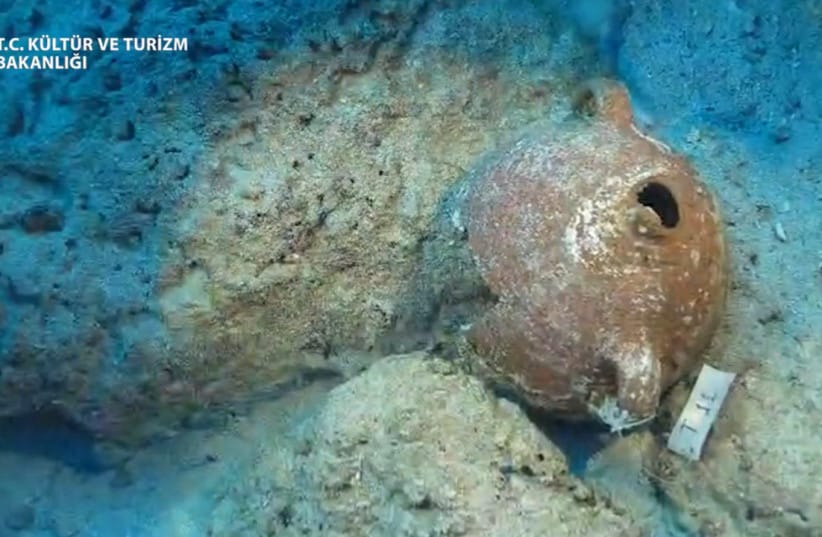
Evidence of what may be the world’s oldest shipwreck was discovered off the coast of Kekova, Turkish Tourism and Culture Minister Mehmet Ersoy announced on X/Twitter.
Kekova is a small, uninhabited island located in the Mediterranean Sea, in western Turkey.
Three stone anchors and some 30 amphorae were uncovered, according to the BBC.
“The shipwreck is a time capsule at the bottom of the sea,” Prof Hakan Öniz, from Akdeniz University in Turkey, who led the Mediterranean Archaeology Association expedition, told the BBC. “Comparing the decoration techniques… we can definitely say our wreck is Early Bronze Age. This is 100%.”
Amphorae found during the excavations date back to the Bronze Age, approximately 4,400 to 4,700 years ago, shedding light on ancient maritime trade along the coasts of Anatolia.
“We are the first humans who [have] touched these objects after 5,000 years,” Öniz told BBC. “We are always thinking of the sailors… the producers of the amphora and the person who carried the amphora on their shoulders to the ship, and the women who were waiting for their husbands, and they unfortunately couldn’t go back.”
Analysis of the vessels shape indicate that they had likely been produced in workshops in the Jordan Valley, similar to others found in Egypt, Troy, and Crete.
One of the amphora is unique, noted Ersoy, and features nine distinct markings as well as two holes in its body.
Residue indicates possibility sailors made their own food
The vessel is thought to have been used as a cheese or butter churn, indicating that Bronze Age sailors might have made their own food during long voyages.
Some of the amphorae contained a glossy residue, the BBC reported, citing Macquarie University archaeologist Dr. Karin Sowada.
Mavi Vatan’da, dünyanın en eski batığının izlerini gün yüzüne çıkarıyoruz. Kekova’da yürüttüğümüz su altı kazılarında çıkarılan, 4.700 yıl öncesine uzanan amforalar, Anadolu kıyılarının deniz ticaretindeki köklü geçmişine ışık tutuyor. Zeytinyağı ya da şarap taşımak için kullanıldığı düşünülen bu kaplar, Doğu Akdeniz’deki ticaretin ve kültürler arası etkileşimin önemli izlerini taşıyor. Kil analizleri, amforaların muhtemelen Ürdün Vadisi’ndeki atölyelerde üretildiğine işaret ediyor. Benzer örneklerin Mısır, Troya ve Girit’te de bulunması, farklı coğrafyaları deniz yoluyla birbirine bağlayan ticaret ağlarını anlamamız açısından büyük önem taşıyor. Buluntular arasında, üzerinde dokuz farklı işaret ve gövdesinde iki delik bulunan bir amfora da dikkat çekiyor. Peynir ya da tereyağı yapımında yayık olarak kullanılmış olabileceği düşünülen bu kap, denizcilerin uzun yolculuklarda kendi yiyeceklerini üretmiş olabileceklerine dair ipuçları sunuyor. Anadolu’nun denizcilik tarihini yeni bulgularla aydınlatmaya, su altındaki kültürel mirasımızı koruyarak gelecek nesillere aktarmaya devam ediyoruz. Kazıların bilimsel sorumluluğunu üstlenen Doç. Dr. Hakan Öniz’i ve emeği geçen tüm çalışma arkadaşlarımızı kutluyorum.
— Mehmet Nuri Ersoy (@MehmetNuriErsoy) October 14, 2026
“I looked inside and nearly fainted. I could not believe how much [residue] was visible. It wasn’t just like spots…. a lot of this material was still remaining,” she told BBC. “It could be olive oil, it could be wine, it could be tree resins.”
“It’s possible that [the residue] could actually be the result of reuse of the jars. I mean, these jars are huge, they’re not things that you just ship away and then never see again. People would have emptied these jars on arrival and potentially used them for many, many, many years.”
“We continue to illuminate Anatolia’s maritime history with new discoveries, preserving our underwater cultural heritage to pass it on to future generation,” Ersoy wrote on X. “I congratulate Assoc. Prof. Dr. Hakan Öniz, who holds the scientific responsibility of the excavations, and all our colleagues who contributed their efforts.”