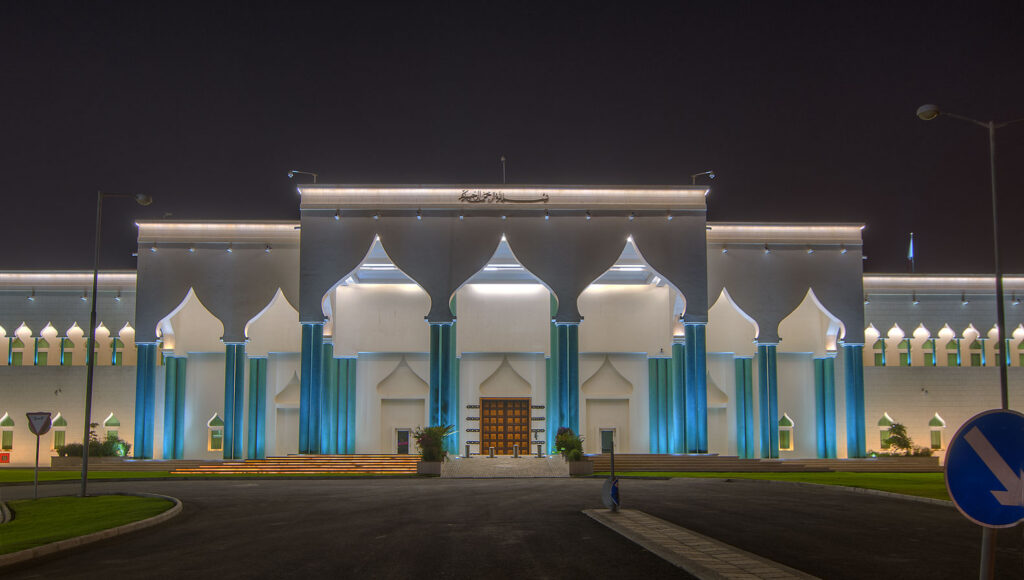
Archive photo: The entrance of the Amiri Diwan in Doha, March 2013. Photo: Alex Sergeev / Wikimedia Commons, CC BY-SA 3.0.
Qatari mediators resumed talks with Iranian officials in Doha on Saturday, pressing for an agreement that would restart direct negotiations between the United States and Iran before Tuesday’s midterm elections. No agreement had been reached by Saturday afternoon, an unnamed diplomatic source cited in Axios reporting said.
The Iranian negotiators flew back to Doha with the Qatari team after the two sides held more than 12 hours of talks in Tehran on Friday. Saturday’s session brought the Qatari delegation, led by Ali Al-Thawadi, together with Iran’s deputy foreign minister. The Qatari team stayed in regular contact with the White House throughout the talks, the diplomatic source said.
The mediators are trying to get Washington and Tehran to agree on a set of reciprocal steps, carried out over a few days, that would bring both sides back to direct talks on Iran’s nuclear program and other issues.
Two competing demands have so far blocked progress, an anonymous U.S. official told Axios. The Trump administration insists that Iran make nuclear concessions as part of resuming talks, while Iran says the United States must first lift its naval blockade, release frozen Iranian funds and allow it to sell oil. To break the deadlock, the Qataris are asking Iran to admit U.N. inspectors to its bombed nuclear sites as a confidence-building measure, which the U.S. would answer with some sanctions relief.
“There was positive progress. Talks are still ongoing in an effort to unlock a deal between the U.S. and Iran,” the diplomatic source said.
The push comes days before what U.S. officials describe as a possible major military operation against Iran after the midterms. Egypt, Turkey, Iraq, Pakistan and Saudi Arabia have been urging Iran to return to negotiations before the elections, an unnamed regional source told Axios, and the leaders of Saudi Arabia and Türkiye asked President Trump in recent days to allow more time for diplomacy.
Speaking to reporters Saturday in Atlanta, where he hosted G20 foreign ministers, Secretary of State Marco Rubio said Trump “hasn’t made a decision” on further military action. “I’m not going to characterize neither the progress on those talks nor any time frame on it, other than to tell you that if there is a diplomatic solution, we would be open to it,” Rubio said, according to a State Department transcript.
Trump told reporters Friday: “There are talks. They want to talk. They keep talking. … We have time, frankly. It’s a war, but it is not a typical war.”
Inside the administration, views differ on next steps, an anonymous U.S. official told Axios. Defense Secretary Pete Hegseth and Rubio are skeptical that any nuclear agreement can be reached with the current Iranian regime and favor weakening it further, including with additional strikes, while Vice President JD Vance and envoys Steve Witkoff and Jared Kushner want to resume negotiations. Treasury Secretary Scott Bessent is urging Trump to let his economic pressure campaign play out rather than return to combat. The same report said Israeli Prime Minister Benjamin Netanyahu is lobbying Trump to launch a joint operation against Iran immediately after the election.
A renewed war could bring heavy destruction not only in Iran but across the Gulf and deepen the global energy crisis. Iran has vowed to answer any U.S. strikes on its energy infrastructure with attacks on oil and gas facilities in Saudi Arabia, the UAE, Qatar, Kuwait and Bahrain.
JBizNews Desk | Doha
© JBizNews.com. All rights reserved. Unauthorized reproduction or redistribution is strictly prohibited.