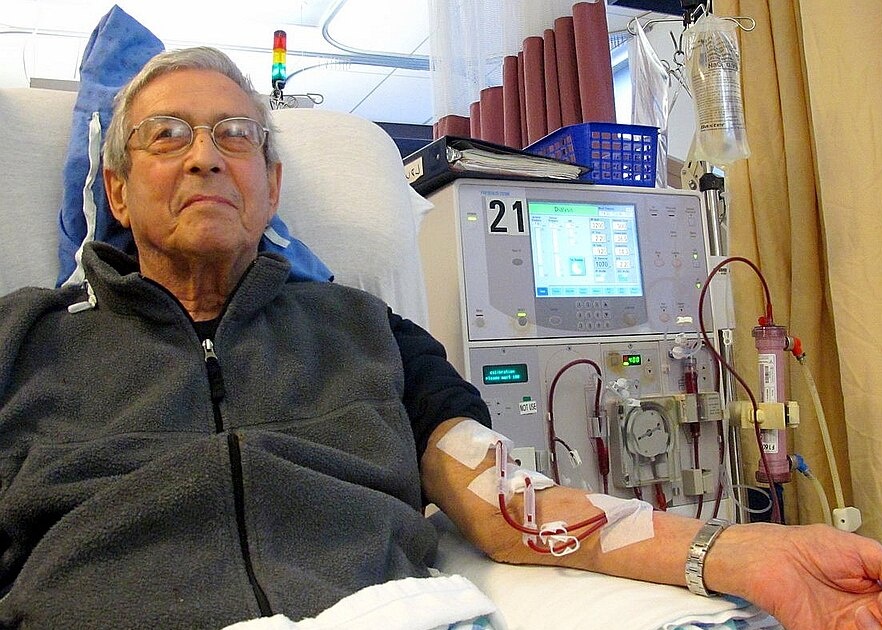
A patient receives dialysis in May 2012. Archival photo: Anna Frodesiak / Wikimedia Commons, CC0; cropped.
Medicare’s 2027 dialysis payment rule will raise the base rate paid to facilities to $297.52 per treatment and increase support for home-dialysis training. But the larger base rate is not a simple across-the-board raise for clinics, and it is not a quote for what a patient will owe.
The Centers for Medicare & Medicaid Services issued the final rule October 28. It was published in the Federal Register on October 30, with the payment changes taking effect January 1, 2027. CMS projects total payments to dialysis facilities will rise about 2.7%.
Why the base-rate increase needs context
The new base rate is $15.81 above the 2026 rate of $281.71. Of that increase, $12.85 brings the costs of phosphate binders permanently into the base rate as their transitional payment period ends. That amount includes operational costs. It should not be read as $12.85 of new revenue for services that cost a facility nothing to provide.
The base rate is a starting point in a bundled payment system. Actual facility payments reflect patient characteristics, local wages and other adjustments. CMS expects roughly $7 billion in Medicare payments to about 7,600 dialysis facilities in 2027.
Smaller facilities get a wider payment adjustment
CMS is expanding the low-volume payment adjustment threshold from 4,000 to 8,000 treatments and moving from two payment tiers to six. Facilities with fewer than 3,000 median annual treatments over the past three cost-reporting years receive the largest adjustment; those with 7,000 to 7,999 receive the smallest.
The expansion is budget-neutral. CMS says it reduces the base rate by approximately 1.1%, or about $3, as part of the final calculation. For operators, the useful question is where a facility lands after the full set of adjustments, rather than how much the headline base rate rose. Facilities seeking the 2027 low-volume adjustment can attest that they meet the requirements through December 31, 2026.
More payment for home-dialysis training
The home and self-dialysis training add-on rises from $95.60 to $138. CMS will also allow it during the first four months of dialysis. The agency is reducing another early-treatment adjustment to account for overlapping payments, keeping the training changes budget-neutral.
This is a payment to support training, not a cash benefit paid to patients. Medicare’s coverage guidance says a Medicare-certified home-dialysis training facility must provide the training. Medicare does not cover lost pay for a patient or helper during training, or paid aides to help with home dialysis.
What patients should ask
Patients should not multiply the $297.52 base rate by a coinsurance percentage to assume their bill. Medicare says people with Original Medicare generally pay 20% of the Medicare-approved amount for facility dialysis after meeting the Part B deductible, but the dollar amount can vary. Medicare Advantage, Medigap and other coverage can change what a person pays.
Ask the dialysis facility and insurer for an estimate based on the actual coverage and services involved. The rule changes how Medicare pays providers; it does not make the published base rate a universal patient price or a promise of lower out-of-pocket costs.
JBizNews Desk | Health Policy Analysis
© JBizNews.com. All rights reserved. Unauthorized reproduction or redistribution is strictly prohibited.