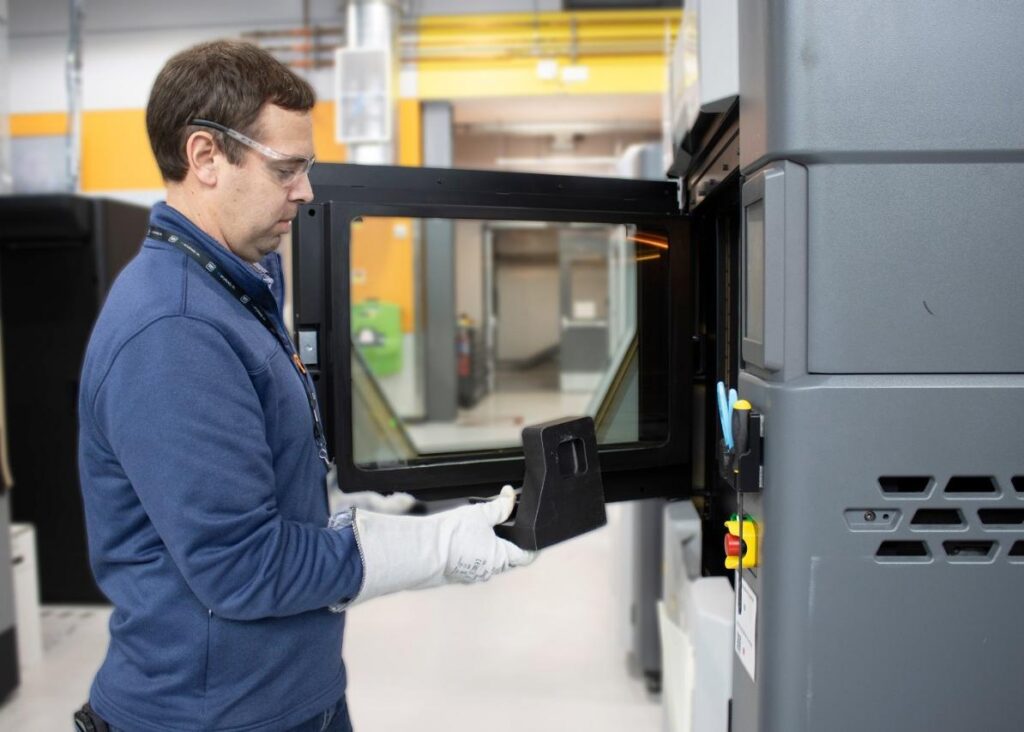
General Motors (January 2025 company archive; crop).
Ford, General Motors and Rivian are using 3D printing for more than design models, with company accounts showing the technology moving into factory tools, assembly aids and selected vehicle parts. Heading into November, the clearest recent example is Rivian’s assessment of a new large-format printer for production-support work, announced by supplier Stratasys in September.
The business case is often a small but urgent problem: a worker needs a fixture to hold a part, an engineer needs a new prototype, or a low-volume vehicle needs a shape that is difficult to make with conventional tooling. Printing builds an object layer by layer from a digital design. That can let a manufacturer change a tool without first commissioning a new mold or waiting for a machined replacement.
Stratasys said September 9 that Rivian’s Plymouth, Michigan, operation and Toyota Production Engineering in Kentucky were assessing its F870 system ahead of commercial availability. The stated applications range from factory-floor tooling and manufacturing aids to advanced prototypes. This is an evaluation of a production-support platform, not an announcement that an entire vehicle will be printed.
The machine’s build space measures 1,000 by 610 by 610 millimeters, according to Stratasys. A larger heated chamber allows bigger fixtures, assembly tools and inspection gauges to be made as single builds. The supplier says its supported materials include carbon-fiber-reinforced nylon and other industrial plastics suited to factory tools.
Rivian’s approach combines printing with machining rather than treating them as substitutes in every job. In a May 2024 customer account published by Autodesk, Rivian engineer Jonathan Dankenbring described placing additive-manufacturing equipment inside the Normal, Illinois, factory to supply urgent jigs and fixtures on the same or next day. In one example, the team combined laser-cut pieces, machined pins and printed inserts to make 100 protective inverter covers within a week at $20 each.
Ford has also put employee requests at the center of its factory-printing program. When it opened a 12-printer center in Cologne in February 2023, it said employees could request installation aids through an app, including their own drawings or a description of the job. The company said small-quantity printing could save up to 80% compared with conventional injection molding. That is Ford’s estimate for those applications, not a claim that every printed part costs 80% less.
Speed also matters when the design keeps changing. In a January 2026 engineering account, Ford Racing powertrain chief engineer Christian Hertrich said advanced 3D printing had cut a prototype manufacturing window from 16 days to five in its Red Bull Powertrains work. The components included complex parts for combustion, charge-air and energy-recovery systems. Faster prototypes allow more rounds of testing before a final design is chosen.
GM’s examples show both sides of the technology: the tools that help workers build a car and the parts that remain in it. In its January 2025 manufacturing overview, GM said it had carried out more than 5,400 new additive-manufacturing projects in 2024. At Lansing Delta Township Assembly, the team used printing to rethink a hood-support fixture after workers had been using a 14-pound titanium-and-steel tool, above the plant’s 10-pound limit for a one-handed lift.
For low-volume production, GM said its hand-built Cadillac Celestiq contains more than 130 additively manufactured parts. Its April 2025 account identified the steering-wheel center as its largest 3D-printed production metal part at the time. The company also uses printed components in Cadillac Blackwing models, including a manual-shifter medallion.
Those examples describe a targeted manufacturing tool, not the replacement of a high-volume assembly line. The savings depend on the material, the shape, the number of pieces needed and the testing required for the job. A lightweight fixture used inside a plant and a metal part installed in a customer’s car face different demands. The practical gain is the ability to choose printing where it solves a specific time, cost or design problem, while keeping conventional methods for the rest.
JBizNews Desk | New York
© JBizNews.com. All rights reserved. Unauthorized reproduction or redistribution is strictly prohibited.