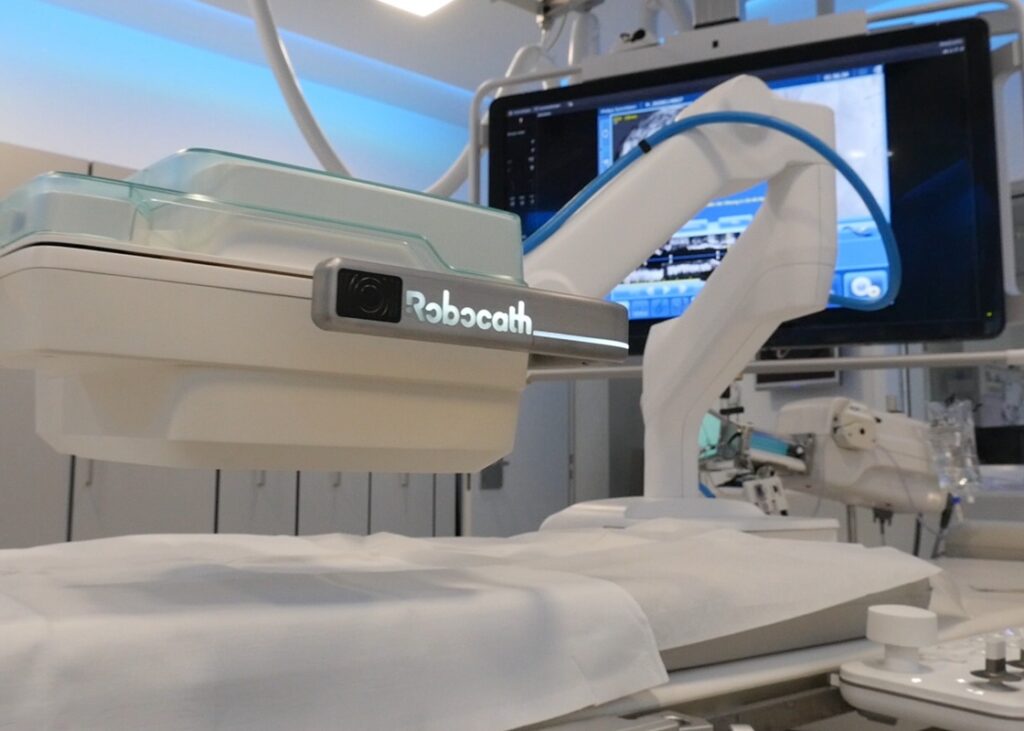
R-one equipment (archive): Robocath (crop).
Stereotaxis on Monday, November 2, reported preliminary results from a 20-patient French pilot study of its Robocath subsidiary’s next-generation coronary-intervention robot, a day after the findings were presented at the TCT conference in San Diego.
The company reported 100% clinical success and 95% technical success in the first-in-human study. One procedure required conversion to manual operation. The findings come from a prospective, single-center pilot, not a controlled comparison establishing that the robot is better than conventional treatment.
Dr. Mohammed Nejjari and Dr. Franck Digne conducted the study at Centre Cardiologique du Nord in Saint-Denis, France. It enrolled patients undergoing percutaneous coronary intervention, or PCI, for coronary artery disease, according to the company’s announcement.
All 20 patients met the study’s clinical-success criteria, which the release described as minimal residual narrowing after PCI. In 19 procedures, physicians completed the intervention robotically without switching to manual operation. Clinical and technical success therefore measure different outcomes.
Stereotaxis reported no device-related adverse events through 30 days of follow-up. The company also said the procedures included lesions across several levels of complexity. A small pilot with short follow-up cannot establish how often uncommon complications might occur in wider use.
Nejjari presented the findings on November 1 during TCT’s session on innovations in robotics for transcatheter heart interventions. A manuscript has been submitted for publication and is under review. The announcement is not a report of completed peer-reviewed publication.
Robocath’s next-generation system builds on its first-generation R-One platform. Stereotaxis said the newer system adds the ability to handle up to five interventional devices simultaneously. That description comes from the manufacturer and does not establish improved patient outcomes.
Stereotaxis Chief Executive David Fischel said the company planned to advance the technology toward regulatory submissions. The study announcement does not constitute FDA approval, and its initial results do not establish superiority over other approaches.
JBizNews Desk | Health
© JBizNews.com. All rights reserved. Unauthorized reproduction or redistribution is strictly prohibited.