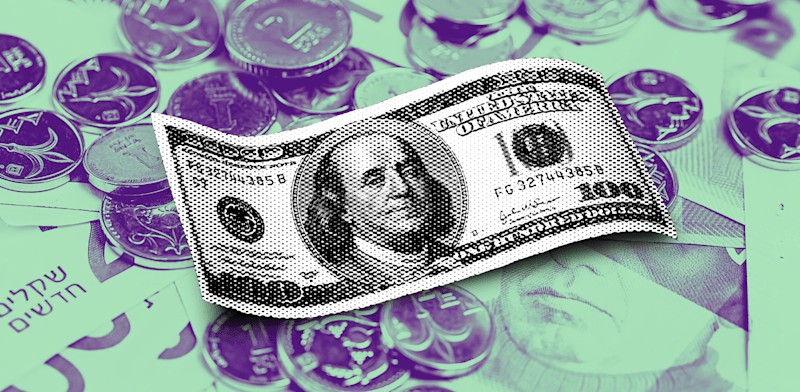
Photo: Shutterstock via Globes (currency archive)
The shekel fell to its weakest level against the U.S. dollar since late March on Tuesday, as political uncertainty in Israel and concerns about the next phase of the Iran conflict weighed on the currency, Globes reported.
The Bank of Israel published November 3 representative rates of NIS 3.1570 per U.S. dollar, up 0.67% on the day, and NIS 3.5306 per euro, up 0.392%. These official representative rates are distinct from the earlier interbank quotes below; they are reference rates, not mandatory transaction prices.
In its November 3 report published at 2:40pm Israel time, Globes put the dollar at NIS 3.154 in afternoon interbank trading, up 0.51%, and the euro at NIS 3.515, up 0.14%. A higher shekel-per-dollar exchange rate means the shekel is weaker. These are the report’s timestamped market figures, not a current live quote.
Globes said the shekel had weakened 3.42% against the dollar over the preceding month and 1.58% over the previous five days. Analysts interviewed by the publication pointed to a combination of interest-rate expectations, declines in U.S. technology shares and uncertainty over Israel’s next government.
Globes also described the dollar as roughly 4.5% stronger against the shekel since October 27. That comparison is attributed to the publication, rather than calculated from the Bank of Israel’s November 3 representative rate.
Political and security risks add pressure
Yossi Menashe, founder and co-CEO of Altshuler Shaham Financial Services, told Globes that differing interest-rate paths in Israel and the United States were one factor. He also cited uncertainty surrounding the U.S. elections and policy toward Iran as adding a risk premium.
Some local investors had taken short-term positions favoring the dollar to hedge U.S. election risk, Menashe said. Bank Hapoalim chief financial markets strategist Modi Shafrir separately pointed to the previous day’s Nasdaq decline, uncertainty over coalition formation versus another Israeli election, and the possibility of renewed action against Iran.
Those explanations are analysts’ assessments of the currency’s move, rather than proof that any single event drove the entire change. The report describes a market reacting to several overlapping domestic and international risks.
Exporters and consumers face different effects
A weaker shekel can help businesses that receive revenue in dollars but pay a substantial share of wages and operating expenses in shekels. Eytan Kleinman, a managing partner at Long Road, told Globes that such companies could benefit as dollar income converts into more local currency.
For households and import-dependent businesses, the same move can increase the shekel cost of overseas travel, imported products and online purchases priced in dollars. The benefits are therefore uneven across the economy.
Menashe cautioned that further significant depreciation could feed imported inflation and complicate the Bank of Israel’s policy choices. That was a warning about a possible consequence, not an announcement that the central bank has changed interest rates.
JBizNews Desk | Tel Aviv
© JBizNews.com. All rights reserved. Unauthorized reproduction or redistribution is strictly prohibited.