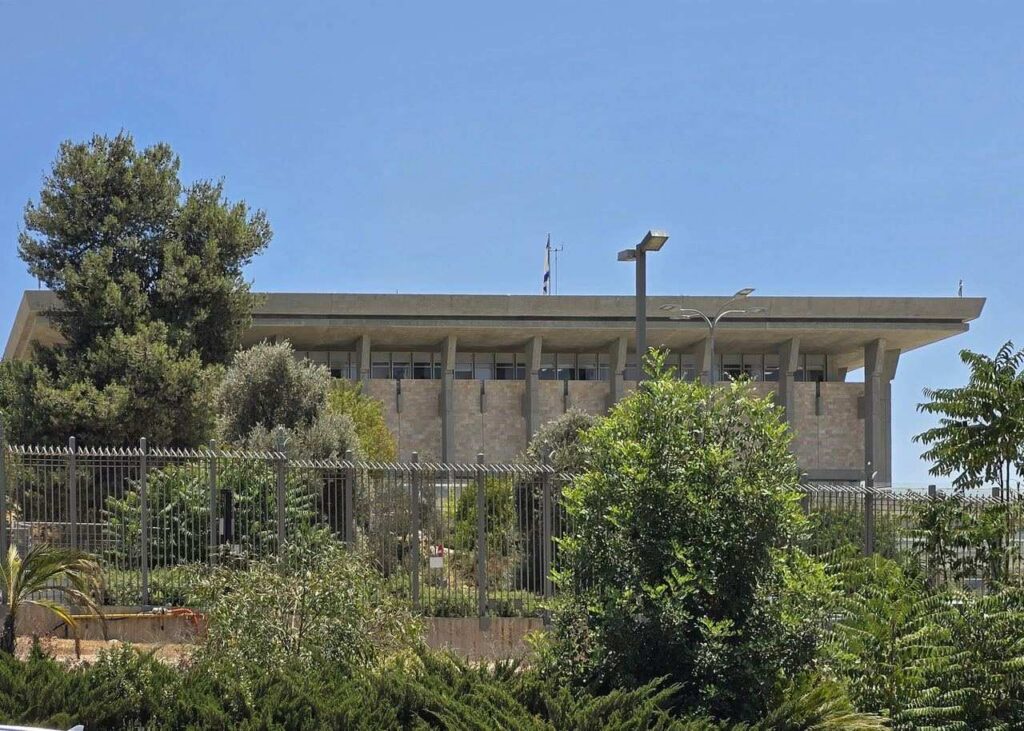
Photo: Israel Preker / PikiWiki Israel, CC BY 2.5 (Knesset archive, July 2025; cropped)
Israel and Kazakhstan signed an agreement to prevent double taxation on Monday following more than a decade of negotiations, in a move aimed at facilitating bilateral investment and expanding economic cooperation.
The agreement was signed during the tenth meeting of the Israel-Kazakhstan Joint Economic Commission in Jerusalem, co-chaired by Ze’ev Elkin, representing the Finance Ministry, and Kazakhstan’s Deputy Prime Minister Zhaslan Madiyev, according to the Foreign Ministry.
The Foreign Ministry organized the meeting, which brought together representatives from 12 government ministries, including nine Kazakh deputy ministers. In addition to the taxation agreement, the two countries signed memoranda of understanding on artificial intelligence, labor, and cybersecurity, as well as a joint declaration on space cooperation and the commission’s official protocol.
Israel, Kazakhstan expand economic cooperation in AI, energy, water technology
The agreements represent a further step in strengthening economic relations between Israel and Kazakhstan, Central Asia’s largest economy, as both countries seek to expand cooperation in technology, infrastructure, and strategic industries.
Discussions at the commission focused on energy, water technologies, innovation, agriculture, investment, critical minerals, science, healthcare, and industrial standardization. The countries also identified shared challenges involving climate change, desertification, and water resource management, areas in which Israeli technological expertise could support Kazakhstan’s development priorities.
The agreement on double taxation is expected to make cross-border business activity easier by establishing a framework for determining taxation rights and reducing the risk of the same income being taxed in both countries. However, the precise provisions and implementation date have not yet been publicly detailed.
Elkin welcomed the agreement, calling it a significant achievement after years of diplomatic and economic discussions.
“Relations between Israel and Kazakhstan have gained momentum over the past year, especially following the visits of the foreign minister and the president,” he said. “The visit of the senior delegation led by Kazakhstan’s Deputy Prime Minister, Zhaslan Madiyev, is an important opportunity to expand cooperation between the two countries.”
Elkin said the commission reflected a shared commitment to strengthening economic ties, noting the unusually large Kazakh delegation and the broad range of government agencies involved.
“We are working to advance cooperation in artificial intelligence and innovation, water, agriculture, and energy, which will contribute to the economies of both countries,” he added. “I am especially pleased to sign the double taxation agreement, after more than a decade of negotiations, which will ease the burden on companies and investors and open new economic opportunities.”
Kazakhstan deputy prime minister makes highest-level visit to Israel in decade
Madiyev, who also oversees Kazakhstan’s national artificial intelligence development program, is the highest-ranking Kazakh official to visit Israel in the past ten years, the Foreign Ministry said.
He arrived at the head of an economic delegation comprising more than 50 senior government officials and representatives of state-owned companies, including deputy ministers and regional governors. The visit came approximately six months after President Isaac Herzog traveled to Kazakhstan in April 2026, and nine months after Foreign Minister Gideon Sa’ar visited Astana in January.
During his visit, Madiyev met with Herzog, Sa’ar, Foreign Ministry Director-General Eden Bar Tal, and senior representatives of Israeli government agencies. The meetings were intended to build on earlier diplomatic engagements and identify opportunities for cooperation between public institutions and private companies.
The two countries also convened their first joint working group on water management, led on the Israeli side by the Israel Water Authority. The working group was established following a decision reached during Sa’ar’s January visit to Astana.
Kazakhstan’s extensive territory and varied climate have made efficient water management a national priority, particularly in agriculture and infrastructure. Israeli expertise in irrigation, water monitoring, and reducing water loss could provide opportunities for cooperation as Kazakhstan works to modernize its systems.
Israeli, Kazakh companies explore investments in critical minerals, cybersecurity
Alongside the diplomatic meetings, the Foreign Ministry and Israel Export Institute organized a bilateral business forum, in cooperation with the Israel Innovation Authority and the Manufacturers Association of Israel.
The forum brought together Israeli companies and members of the Kazakh delegation to explore opportunities in advanced technology, industry, and infrastructure. A separate roundtable focused on critical minerals, a sector of growing importance to global manufacturing, battery production, and renewable energy technologies.
Additional meetings involved Israeli organizations working in innovation, space technology, artificial intelligence, and cybersecurity. Kazakhstan’s government also reported that seven commercial documents were signed during the business forum, while discussions addressed direct air connections and possible visa-free travel arrangements.
The visit follows efforts to establish deeper technological ties between the countries. During Herzog’s April visit, he toured Kazakhstan’s alem.ai artificial intelligence center, where he was received by Madiyev and met representatives of the country’s technology sector, as previously reported by The Jerusalem Post.
Kazakhstan’s Abraham Accords membership strengthens strategic ties with Israel
The economic agreements also carry diplomatic significance in the context of Kazakhstan’s participation in the Abraham Accords.
Kazakhstan announced its accession to the US-brokered framework on November 6, 2025, following a telephone conversation involving US President Donald Trump, Prime Minister Benjamin Netanyahu, and Kazakh President Kassym-Jomart Tokayev. The development expanded the initiative’s reach into Central Asia, where Israel has maintained diplomatic relations with Kazakhstan since 1992.
Although the two countries already enjoyed established diplomatic ties, Kazakhstan’s participation in the accords created an additional framework for economic engagement, technological partnerships, and regional cooperation.
In September 2026, Kazakhstan participated in a meeting of Abraham Accords countries and partner organizations in New York, where discussions focused on expanding practical cooperation between participating states. The meeting underscored Kazakhstan’s potential role in connecting Israel and its regional partners with markets across Central Asia and the broader Eurasian region.
Elkin expressed confidence that the Abraham Accords would help deepen bilateral economic cooperation, particularly in sectors where Israeli technology and Kazakhstan’s natural resources could complement one another.
Kazakhstan’s uranium, copper and lithium resources attract strategic interest
Beyond the agreements signed in Jerusalem, Kazakhstan’s economic importance lies in its substantial natural resources, energy production, and geographic position between Europe and Asia.
Dr. Anat Hochberg-Marom, a geopolitical analyst, highlighted these factors in a recent commentary examining Kazakhstan’s growing role in the Abraham Accords and the wider international economy.
Hochberg-Marom described Kazakhstan as Central Asia’s largest and most stable economy, citing a gross domestic product of approximately $301 billion and a 2025 growth forecast of 5.6%. These figures reflect the historical estimates cited in her analysis rather than updated 2026 economic data.
She also noted Kazakhstan’s role as the world’s leading uranium producer, accounting for roughly 40% of global output in 2024, as well as its production of copper and zinc and its significant tungsten and lithium resources.
These minerals have become increasingly important to international supply chains, particularly as governments and companies seek to secure materials used in batteries, renewable energy infrastructure, aerospace, and advanced manufacturing.
Kazakhstan’s position between Europe, Asia opens new markets for Israeli companies
According to Hochberg-Marom, Kazakhstan’s geographic position offers opportunities extending beyond bilateral trade with Israel.
As a major energy producer and transit country connecting Asia and Europe, Kazakhstan could play a larger role in regional logistics, manufacturing, and international supply chains. Its participation in the Abraham Accords could provide an additional platform for cooperation with Israel and other participating countries.
The analyst suggested that expanding regional partnerships could help attract further international investment into Kazakhstan’s technology and industrial sectors, particularly in fields undergoing rapid modernization.
She pointed to investment initiatives involving approximately $1.1 billion in critical minerals development, including tungsten and lithium, as well as a reported $2 billion technology initiative involving OpenAI and Nvidia to develop artificial intelligence infrastructure.
Hochberg-Marom also cited approximately $70 billion in historical US investment in Kazakhstan’s oil sector over three decades, arguing that new technology and mineral projects could support efforts to diversify the country’s economy beyond traditional energy production. She presented the investment figures in her analysis, and they should not be treated as confirmation of newly signed agreements during Madiyev’s visit.
The broader economic relationship reflects growing interest in cooperation that combines Kazakhstan’s natural resources and industrial capabilities with Israeli innovation in water management, digital technology, agriculture, and cybersecurity.
For both governments, the next challenge will be translating the agreements signed in Jerusalem into commercial projects and sustained investment.
Madiyev emphasized that practical implementation, rather than the signing ceremonies themselves, would determine the value of the partnership.
“It is important for us that cooperation is not limited to exchanging experience and signing documents,” he said. “It should result in concrete projects, new expertise, investments and technologies that are implemented and put to work in Kazakhstan.”
Originally published by The Jerusalem Post