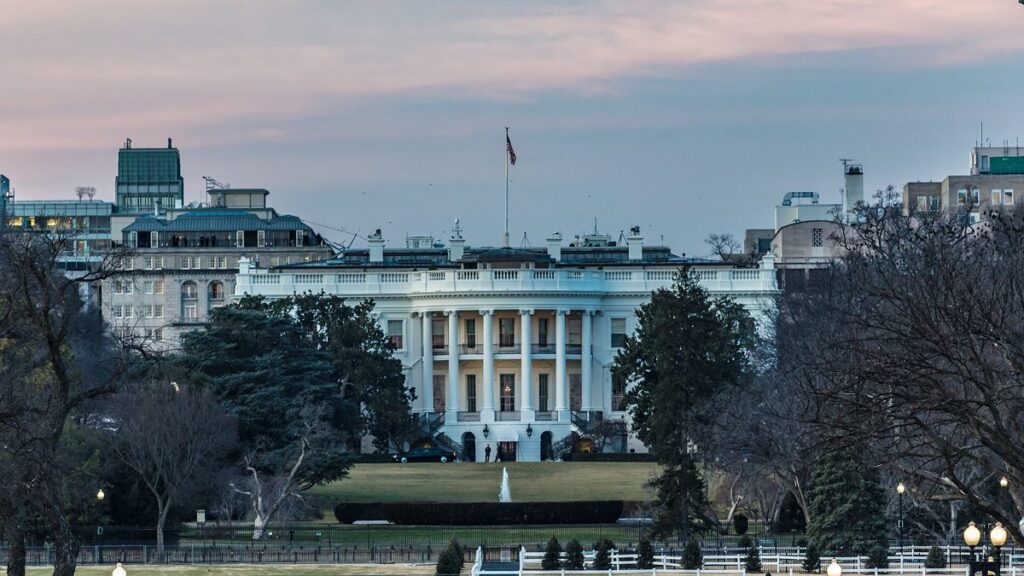
Photo: James McNellis / CC BY 2.0 (The White House at dusk, January 2017 archive)
Updated November 4, 2026, 1:29 a.m. EST
Democrats won control of both the U.S. Senate and the House of Representatives in Tuesday’s midterm elections, results that end Republican control of Congress and set up divided government for the final two years of President Donald Trump’s term.
The Associated Press called the House for Democrats early Wednesday, declaring unified Democratic control of Congress. The AP, NBC News, CBS News and the Fox News Decision Desk had earlier called Senate control, while NBC, CBS, ABC, the Fox News Decision Desk and Decision Desk HQ had projected the House before the AP’s call.
A media call is not an official certification, and counting continues in individual races. The size of each majority remains unsettled, and the new majorities take office only when the next Congress convenes in January.
What changed in the election
Republicans entered Tuesday controlling the White House and both chambers of Congress. NBC News reported that Democrats flipped Republican-held Senate seats in Iowa, Kansas, Ohio, North Carolina, South Carolina and Texas, and took the House as well. NBC noted that no minority party had flipped control of both chambers on a single night since 2006, when then-President George W. Bush called his party’s midterm defeat “a thumping.”
The House has 435 voting seats, with 218 needed for a majority when all are filled, and every seat was on the ballot. The Senate has 100 seats, with roughly a third contested in each cycle. A chamber-wide call is different from the running count of individually called races: either party can still win specific uncalled seats even after control of the chamber is called.
What it means for American voters
The NBC News Exit Poll found that 43 percent of midterm voters said one reason for their vote was to express opposition to Trump, and 71 percent of voters, including 41 percent of Republicans, said Congress has not done enough oversight of his administration. The poll identified affordability, corruption, immigration and the war in Iran as key issues.
For households, the practical answer is that nothing changes immediately. The election does not by itself change anyone’s taxes, health insurance premiums or benefits. Under the Constitution, legislation must pass both chambers and be presented to the president, who can sign or veto it. Divided government generally means that major changes require negotiation between the parties rather than one party acting alone.
What it means for Trump and the White House
Trump remains president and keeps the veto pen. Overriding a veto requires two-thirds majorities in both the House and Senate, according to the Senate’s explanation of the Constitution. What changes is the other end of Pennsylvania Avenue: Democratic majorities would control which bills reach the floor, who chairs committees and what gets investigated.
Trump responded to the results Tuesday night on social media, writing, “I wasn’t on the Ballot and if I was, we would have won IN A LANDSLIDE!” In a phone interview with The New York Times, he said he was “absolutely willing” to accept the results and work with Democrats, adding, “We’ll probably work something out.” Reuters also reported the remarks.
The message to the administration
The Associated Press described the outcome as a widespread repudiation of Trump and the Republican Party that reached deep into their most loyal territory, noting that Democrats made incursions into states Trump carried in all three of his presidential campaigns. In several of those states, Trump had handpicked Republican nominees.
Democratic leaders read the result as an instruction on costs and accountability. “What we’re going to do is lower costs, end all this rampant corruption and end the chaos. Plain and simple,” Sen. Chuck Schumer of New York, the Senate Democratic leader, told NBC News before the election when asked about his priorities if his party won. NBC’s correspondents wrote that neither side appeared in a mood to compromise, setting up potential clashes between the legislative and executive branches in the next two years.
Committees, subpoenas and oversight
Committee control is one of the biggest practical changes. As the House’s own guide explains, committees review bills and oversee federal agencies, programs and activities. A new majority chooses the chairs and sets the agenda.
NBC identified Reps. Robert Garcia of California, the senior Democrat on the Oversight Committee, and Jamie Raskin of Maryland, the senior Democrat on the Judiciary Committee, as central figures in the oversight Democrats plan. Reported areas of interest include immigration enforcement by ICE and the Department of Homeland Security, the president’s family business dealings, pardons and White House renovation projects. House Democratic leader Hakeem Jeffries has said the party is not focused on impeaching Trump but has not ruled it out; Trump was impeached twice in his first term and acquitted both times by the Senate. These are reported plans for future investigations, not findings of wrongdoing.
Spending, taxes and the cost of living
CBS reported that Jeffries has identified priorities that include reversing Medicaid cuts, extending Affordable Care Act premium tax credits, changing tariff policy and ending the Iran war. These are proposals, not enacted changes: revenue bills must originate in the House, pass both chambers and be presented to the president.
Control also does not erase Senate procedure. The Senate explains that ending a legislative filibuster generally requires 60 votes, so a simple majority cannot advance every bill on its own. NBC reported that Republicans may try to move pieces of their agenda, including a party-line budget reconciliation bill and a debt limit increase, during the lame-duck session before the new Congress takes over.
Judges and appointments
Senate control carries a separate consequence that House control does not: confirmations. The president nominates federal judges and senior executive officials, and the Senate provides advice and consent. Trump would continue to choose nominees, but a Democratic Senate could confirm them, decline to act or reject them, including for any Supreme Court vacancy that might arise.
“Well, given the history of Trump nominees, I think it is slim to none that we would support a nominee from this administration,” Sen. Richard Blumenthal of Connecticut, a Judiciary Committee Democrat, told NBC News before the election. No vacancy exists today, and the election does not guarantee any particular confirmation outcome.
The 2028 presidential race
NBC reported that the results could recast the fight for the 2028 Republican presidential nomination, in which Vice President JD Vance is the presumed front-runner. Midterm results are often read as an early signal for the next presidential cycle, though the 2006 precedent NBC cited also shows that a midterm rebuke does not settle the following presidential race on its own.
One shift drawing attention is among Latino voters, who helped propel Trump’s 2024 comeback. An NBC News poll released Sunday showed Democrats holding a 27-point lead among Latino voters this cycle, a marked contrast with 2024, when Trump lost the group by 7 points.
What happens next
Election officials continue counting and certifying individual races. NBC reported that Democrats are expected to hold leadership elections the week of November 16, when Jeffries is expected to become his party’s nominee for speaker. He must still win 218 votes on the House floor when the new Congress convenes, which according to the House Clerk normally happens at noon on January 3 of an odd-numbered year. If elected, Jeffries would become the country’s first Black House speaker and second in the line of presidential succession. Schumer is expected to return as Senate majority leader.
On the Republican side, NBC reported that the futures of Senate Majority Leader John Thune of South Dakota and Speaker Mike Johnson of Louisiana are uncertain, with rank-and-file Republicans likely to debate new leadership after the defeats. Between election night and January, the outgoing Congress keeps its current powers, and the size and cohesion of the new majorities will matter as much as their party labels when close votes arrive.
JBizNews Desk | Washington
© JBizNews.com. All rights reserved. Unauthorized reproduction or redistribution is strictly prohibited.