Isabelle Huppert is petite, slight, and in her mid-seventies, but somehow, she dominates every scene she is in on the big screen, and that’s never been truer in her latest movie, The Richest Woman in the World, directed by Thierry Klifa, which opens in theaters in Israel on Thursday.
This oversized presence serves her well as she plays Marianne, a cosmetics heiress who comes under the sway of an unscrupulous, much younger photographer, Pierre-Alain (Laurent Lafitte), who eventually bilks her of close to $1 billion.
The plot is based on a real scandal that involved Liliane Bettencourt, the heiress to the L’Oreal fortune, in the late 1980s.
The real story was a political as well as a personal affair, and it ended up involving several members of the French government, but the movie concentrates on Marianne, her immediate family, and Pierre-Alain.
While it paints a convincing portrait of a vain, isolated woman who could be manipulated by such a man, it’s hard to care about such self-involved, unpleasant characters, precisely because they are depicted so believably.
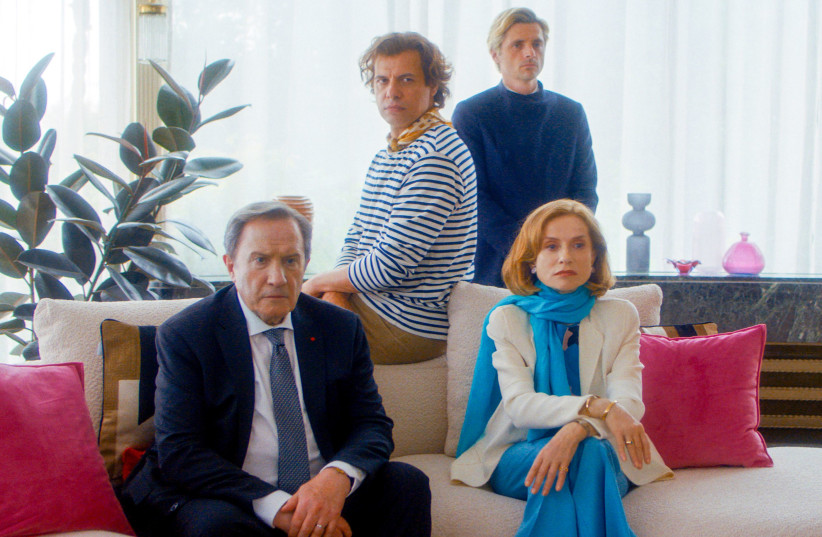
If Marianne were shown to be more vulnerable, she might be more likable. But this isn’t a story about likable people, and in that way, it’s thematically reminiscent of HBO’s hit series, Succession.
It brought to mind the famous exchange between F. Scott Fitzgerald, who once wrote, “Let me tell you about the very rich. They are different from you and me,” to which Ernest Hemingway responded, “They have more money.”
The Richest Woman in the World is the story of a family where that money gives Marianne, who is always impeccably coiffed and made up, the confidence to turn her back on her family when a stranger flirts with her, both insulting her and complimenting her.
Even though she knows well that he is gay, she comes to believe that he genuinely loves her.
In the opening scenes, Marianne’s face looks pinched, and she complains of back pain as she eats breakfast and learns her schedule from her loyal and straightforward butler, Jerome (Raphael Personnaz).
She and her husband, Guy (Andre Marcon), a retired politician, seem to take each other for granted in the familiar way of long-married couples, but it is she who is in charge when she goes to a board meeting of the cosmetics company and orders a change in production and strategy.
Meanwhile, her repressed daughter, Frederique (Marina Fois), has arranged an interview for her with the magazine, Selfish, a play on the publication, Self, wanting her mother and the company to stay in the public eye and, it is implied, continue making money that she will inherit
The mousy Frederique is married to an observant Jew, Jean Marc (Mathieu Demy, the son of filmmakers Jacques Demy and Agnès Varda), and they are trying to raise their son to be as unspoiled as possible given all their money.
Background story makes the film more complex
Another important background story is that Marianne’s father was accused of funding pro-Nazi Fascist groups during World War II and that one of the reasons she was attracted to Guy was that he was a Resistance hero.
These strands make the story more complex, although the plot about collaboration and antisemitism is raised but never really developed. But at its core is about how the flamboyant, unrepentantly egotistical Pierre-Alain takes over Marianne’s life, and most of this, while it all seems quite plausible, is cringe-inducing.
Had any other actress played the lead, this movie would likely have been unwatchable, but fortunately, because it’s Huppert, she creates a kind of suspense, hinting all the time that a moment of self-awareness is coming, where Marianne may take some responsibility for all the pain she causes her family, and even show remorse.
No other actress could have made this character as interesting to watch. It’s a reminder that in a career that has spanned more than 150 roles, most of them leads, Huppert is always the most interesting thing about every movie in which she has starred.
From her breakthrough role in Claude Goretta’s The Lacemaker nearly 50 years ago, she has been an important part of French cinema.
But the movies in which she appears cannot always do justice to her talent, and that is the case with The Richest Woman in the World, which makes you wonder whether the point is just that a billionaire and her money are soon parted.