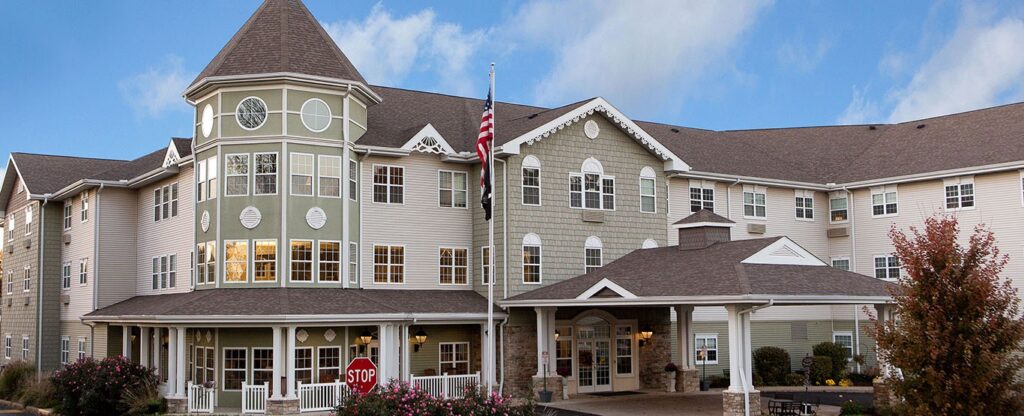
Photo: NHP / company portfolio archive
National Healthcare Properties is buying more places for older Americans to live while selling the medical-office side of its business. More residents and higher revenue per occupied unit are helping its senior housing properties, but a much larger share count means a key earnings measure is lower on a per-share basis.
The New York-based real estate investment trust reported November 4 that it bought 22 senior housing communities containing 1,381 units for $300 million during the third quarter. A further $26 million purchase after quarter-end brought its year-to-date acquisitions to 25 communities for about $424 million.
The shift puts more of the company’s future in assisted living and memory care, where performance depends on filling rooms, collecting resident payments and managing care-related operating costs. It is also working to sell its remaining outpatient medical facilities, but several of those deals have not closed.
More occupied rooms, more property income
At senior housing properties included in its same-store comparison, average occupancy reached 86.7%, up 2.2 percentage points from a year earlier. Revenue per occupied room rose 4%.
Same-store cash net operating income increased 13.6%, and the margin reached 24.3%. That measure tracks property operations before several corporate and financing costs; it is not the same as the company’s net profit.
The company raised the midpoint of its full-year same-store senior housing cash operating-income growth outlook by one percentage point. The result points to stronger operations at comparable properties, rather than growth coming only from buying more buildings.
The acquisition pipeline is not all completed business
National Healthcare Properties said it has signed purchase agreements for about $240 million of additional senior housing acquisitions. A further $148 million is covered by nonbinding letters of intent.
Together, those proposed transactions involve 1,385 units, primarily assisted living and memory care. Signed agreements remain subject to conditions, due diligence and regulatory approvals. Letters of intent also require final agreements. Neither category should be counted as completed purchases.
Three of the communities bought during the third quarter introduced Priority Life Care as an operating partner. The other 19 are managed by existing partners, the company said.
Medical-office sales are moving in stages
In September, the company completed the first 30 sales in an 86-property outpatient medical portfolio transaction, receiving about $198 million. It used part of the proceeds to repay $119 million of secured term loans.
The remaining 56 properties in that deal are expected to close in the fourth quarter for about $331 million, with a $219 million loan assumption involved. Those sales are still pending.
The company has also signed an agreement to sell another 40 outpatient facilities for about $531 million before expenses and adjustments, and a nonbinding letter of intent for its final four. It expects those transactions to complete its exit from outpatient medical properties, but warns there is no assurance the pending deals will close.
Stronger buildings do not erase the earnings pressure
Normalized funds from operations were 19 cents per diluted share, down 29.6% from a year earlier. Standard funds from operations were 13 cents per share, down 43.5%. FFO is an industry earnings measure that adjusts net income for items including real-estate depreciation and certain property-sale gains or losses. It is not a cash-flow measure and does not necessarily represent cash available to spend.
Total normalized FFO rose to about $13.6 million from $7.8 million, even as the per-share figure fell. The diluted share count used for the calculation rose to about 73.2 million from 28.5 million. That distinction matters: the business generated more total normalized FFO, but it was spread across many more shares.
The company reported net income attributable to common shareholders of 24 cents per share. Debt outstanding, net of discounts and issuance costs, was about $851.2 million at September 30.
For investors and senior housing operators, the contrast is the point: occupied rooms and property income are improving while the company reshapes its assets and financing. The completed purchases, pending sales and per-share earnings need to be read separately rather than bundled into a single growth number.
JBizNews Desk | New York
© JBizNews.com. All rights reserved. Unauthorized reproduction or redistribution is strictly prohibited.