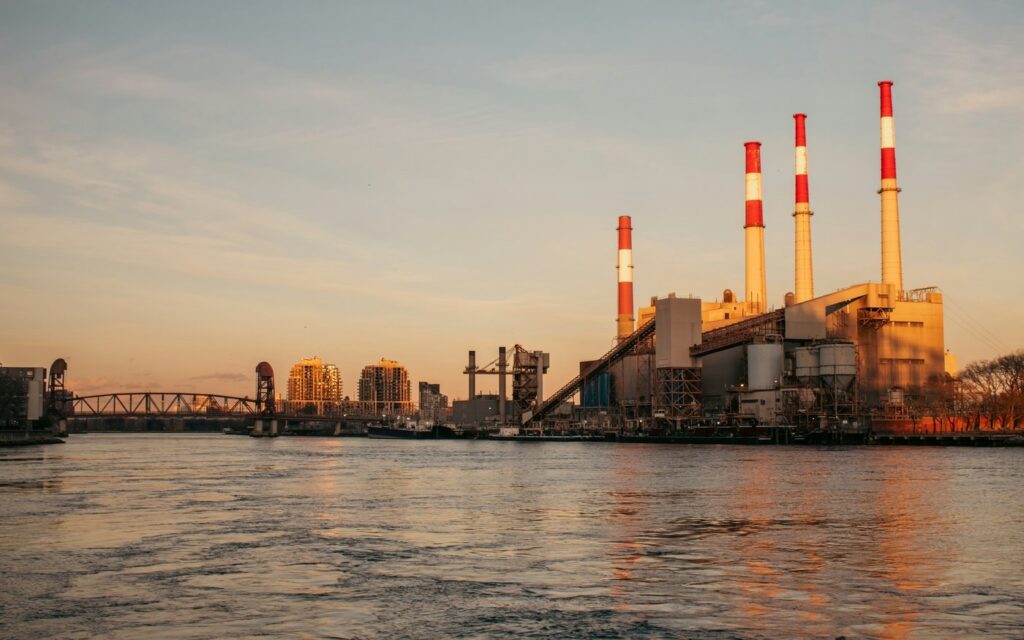
Ravenswood Generating Station in Queens, seen from Roosevelt Island. Generic power infrastructure, not a pictured Trump administration action or an affected facility. Photo: Zoshua Colah / Unsplash.
WASHINGTON, Nov. 5, 2026 – President Donald Trump’s energy policies face expanded congressional scrutiny when Democrats take control of Congress in January, with the Iran war, Venezuela’s oil sector, critical-mineral investments and canceled energy projects among the expected priorities, CNBC reported Thursday.
Control of congressional committees will give Democrats subpoena power to compel testimony and documents. That change takes effect with the new Congress; the report does not announce new subpoenas issued Thursday.
Rep. Frank Pallone, the New Jersey Democrat likely to chair the House Energy and Commerce Committee, said the panel intended to pursue an aggressive oversight agenda. The plans raise questions for energy companies and investors about the durability of government deals, project cancellations and investment priorities, but investigations are not findings of wrongdoing.
Iran war: legislation faces a likely veto
House Democratic leader Hakeem Jeffries, likely to become speaker in January, and Rep. Ted Lieu, vice chair of the House Democratic caucus, said Democrats would seek legislation to end the Iran war, according to CNBC. Jeffries has said they would pass a war-powers resolution, which Trump would be expected to veto. Whether Democrats would also try to restrict war funding remains unclear.
The dispute matters to households and businesses because the conflict has pushed up fuel costs. CNBC reported that GasBuddy petroleum analyst Patrick De Haan forecast gasoline could fall below $4 a gallon in the following week and diesel below $6 by Thanksgiving if falling crude prices continued. Those are forecasts, not current pump prices or guaranteed outcomes.
CNBC also cited a contrasting assessment from Rapidan Energy President Bob McNally, a former energy adviser to President George W. Bush, who said the odds still favored military escalation. The election result does not itself establish that the war will end.
Venezuela oil: legal authority and revenue questions
Democratic lawmakers have sought an accounting of Venezuela’s oil revenues and questioned the legal basis for the U.S. government’s deal with North American Blue Energy Partners, known as NABEP, CNBC reported.
According to the report, Washington took control of Venezuelan oil exports after ousting Nicolás Maduro in January, and the Pentagon acquired a stake in NABEP to develop Venezuelan reserves. The administration’s deal is described as giving the United States control over 65 billion barrels of oil; that is the reported deal claim, not an independently verified measure of reserves secured.
House Democrats warned industry participants in January of potential legal exposure to Venezuelan creditors. In September, Democratic senators questioned Defense Secretary Pete Hegseth and Energy Secretary Chris Wright about the deal’s legal basis. Those concerns are lawmakers’ positions, not court rulings invalidating the agreement.
Critical minerals: government stakes and conflict allegations
The administration has defended government equity investments in critical-mineral companies as a national-security response to competition from China. Democratic senators have raised conflict-of-interest concerns about investment bank Cantor Fitzgerald’s involvement in some deals, according to CNBC.
Commerce Secretary Howard Lutnick previously led Cantor. He divested his personal interest after entering the Cabinet and transferred control to his sons, CNBC reported. Lutnick has rejected the allegations as baseless, saying he did nothing wrong and would answer lawmakers’ questions.
A July letter from Democratic senators demanded that the federal government preserve records concerning deals involving 14 companies, according to CNBC. It was a records-preservation demand, not a finding that those companies violated the law.
USA Rare Earth, one of the companies named, warned in a March securities filing that the unusual structure making the government a shareholder could expose it to litigation, political scrutiny and changes in federal priorities, CNBC reported.
Canceled projects: almost $8 billion under scrutiny
Democrats are expected to question nearly $8 billion in canceled energy projects in states that backed Kamala Harris in the 2024 election, CNBC reported. Wright has told Congress the cancellations were not based on politics. Several House Democrats have alleged that he gave false testimony; the Energy Department denies that allegation.
The report also describes the Interior Department’s roughly $1 billion agreement with TotalEnergies to cancel an offshore wind project and end future U.S. offshore-wind investment, with the company agreeing to invest in natural gas instead.
Reps. Jared Huffman and Jamie Raskin, the senior Democrats on the House natural resources and judiciary committees respectively, called that agreement unlawful and opened an investigation in April. That investigation is already underway, not newly launched Thursday, and their characterization is an allegation rather than an adjudicated finding.
The incoming Congress can demand information and challenge policies, but presidential veto power remains a constraint on reversing legislation. For energy businesses, the immediate development is the prospect of stronger oversight in January, not a completed reversal of the administration’s deals.
JBizNews Desk | Washington
© JBizNews.com. All rights reserved. Unauthorized reproduction or redistribution is strictly prohibited.