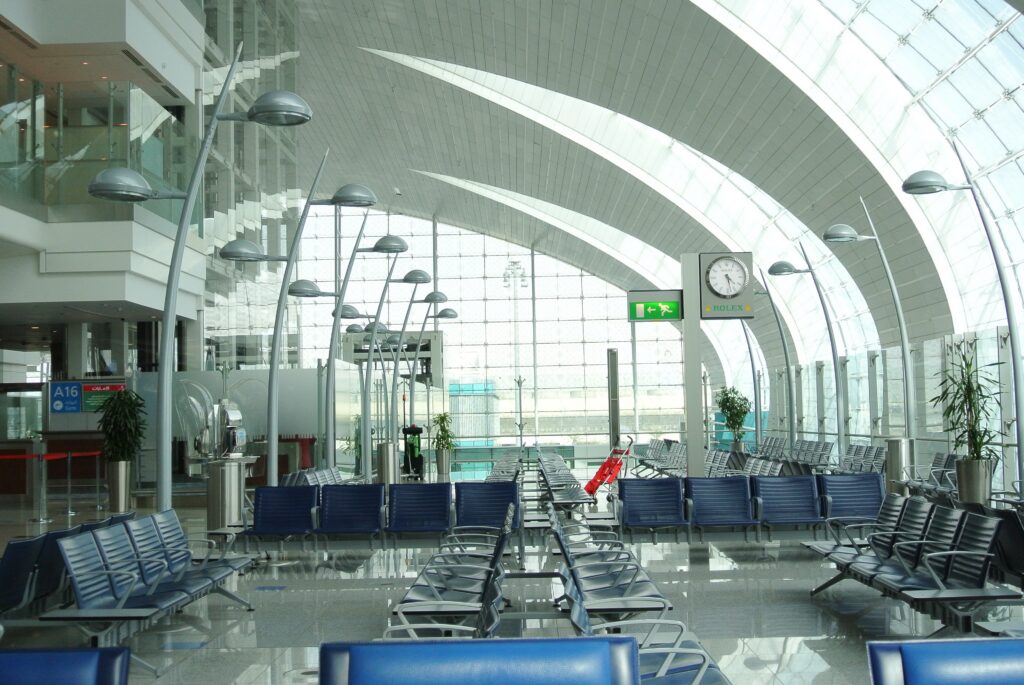
Dubai terminal file photo: PxHere (CC0)
The Gulf’s major aviation hubs benefit from being within a few hours’ flight of much of the world’s population. That same geography leaves them close to Iran’s missiles, The Wall Street Journal reports in an analysis of the region’s transport network.
For airlines and businesses, the concern reaches beyond a single airport. The Gulf’s connecting hubs link passengers and cargo moving between Europe, Asia, Africa and other markets. A disruption at a transfer point can affect a journey whose starting point and destination are both outside the region.
Connectivity is the business model
Dubai Airports described the geography in a 2011 release about an Oxford Economics study: Dubai sits at the intersection of Europe, Asia and Africa, within eight hours’ flying time of two-thirds of the world’s population. That longstanding position underpins its hub strategy.
Earlier attacks showed the exposure
In reporting updated March 1, 2026, CNN documented an evacuation at Dubai International Airport and reported that airport officials confirmed damage to a concourse and injuries to four staff.
The business risk is the possibility of interrupted connections and cargo schedules, together with the difficulty airlines face when planning routes through a region exposed to military escalation.
What travelers should check
Travelers connecting through a Gulf hub should use their airline’s current flight-status and travel-advisory notices for a particular journey. Companies moving time-sensitive cargo should confirm the operating route and delivery schedule with their carrier.
JBizNews Desk | Global Business
© JBizNews.com. All rights reserved. Unauthorized reproduction or redistribution is strictly prohibited.