For five Jewish women from Latin America, the challenge facing Jewish leadership is not simply how to bring people together, but how to ensure everyone has a place at the table.
Speaking to The Jerusalem Post on the sidelines of the Voice of the People council’s gathering in Budapest, the women reflected on the obstacles they have faced in their own communities, the importance of finding belonging in an increasingly divided Jewish world, and the need to ensure that women’s voices are not lost.
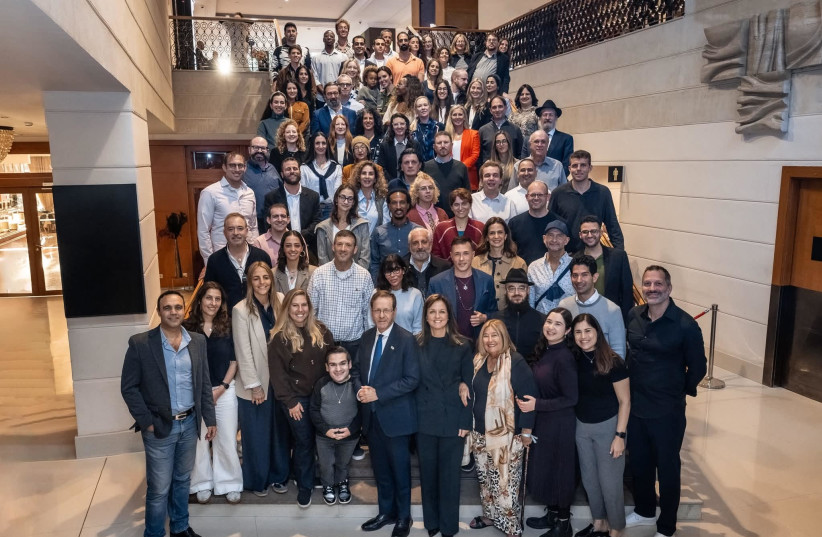
The five are members of the inaugural council of Voice of the People, President Isaac Herzog’s global Jewish leadership initiative, which brought together 150 participants from Israel and Jewish communities around the world. The council concluded its first term in Hungary in October.
For Judith Romano, the council has shone a light on how diverse the Jewish community is, something that Jews in smaller Diaspora communities do not always get to bear witness to.
Mexican native Romano is the founder and president of Mitz Enterprise, an organization focused on social development, and also runs empowerment programs for women in Mexico, including Jewish women.
Voice of the People celebrates diversity across Jewish communities
“Voice of the People has shown me a broader spectrum of what the Jewish world looks like,” she told the Post. “It’s given me the opportunity to meet with a lot of people who are very different from myself, and it’s given me a whole family of friends.”
Arielle Shturman Waiss concurred. “When you come here, and you see the diversity within the Jewish people, you actually understand how lucky we are and how rich the Jewish people is. What makes the Jewish people so rich is that we are so diverse but that we still come back to our base, which is being Jewish, having Jewish values, being a good person within Judaism, so that’s really beautiful.”
Shturman Waiss, from Mexico City, is a doctor now undergoing her OB-GYN residency. She is also the founder of ConCiencia Project, an initiative focused on science-based sexual and reproductive health education.
For Shturman Waiss, the realization about Jewish diversity was deeply valuable, as she said sometimes she has felt she did not have a place where she belonged. “I feel like many times, at least I’m going to speak from what I know from a small community in the Diaspora, you feel like you don’t have a place to be because you don’t fit the mold, and now I have that place.
“It’s our job as part of the council to go back home and recreate these diverse spaces, because from diversity comes cultural richness,” she added.
All five women spoke of the need for connection, in a world marked by growing divisions and conflict.
“We’re living in a rushed world with a lot of distortions; we don’t even know what’s real and what’s fake,” said Shoshana Turkia Trinllan, a Mexico City-based cognitive behavioral therapist involved with Gimmel, a Mexican LGBT Jewish organization. “Having the opportunity to see eye-to-eye with a person that you would never normally see makes that connection possible.
“If connection exists, then possibility exists. So, for me, Voice of the People is the new source of hope for Jewish people.”
This connection could be the key to solving future challenges, Romano added.
“I think we’re going to be confronting very big challenges in the future and for the next generations, and these kind of settings gives us more tools in order to, as a team, find possible solutions on how to deal with them and confront them.”
Challenges aside, Turkia Trinllan stressed the importance of remembering the beauty of Judaism and the way it unites.
“If we talk about Judaism in terms of the antisemitism and the wars, we’re taking out the beauty of Judaism and what is more beautiful than being together. And joy, it’s not a little thing. It’s a very important thing. And it’s one of the roots of our tradition, of our wisdom.
“We as leaders must have more sources of joy or hope and imagination for the present and the future.”
Jewish community embraces greater inclusion following October 7
Turkia Trinllan linked this to the period following the October 7, 2023, Hamas attacks, describing how her own community has become more inclusive even as antisemitism strained relationships elsewhere.
“If you ask LGBT people, they will tell you, ‘I lost my family, I lost my communities, I lost my elected family because of antisemitism.’ That’s true. Pain is true. But what you put on the table is also important. After October 7, my kids have more opportunities to participate within the community, even though they have two mothers, and that’s a miracle. Ten years ago, that wasn’t possible in my community.”
For Jessica Landes, a Jewish studies teacher and director of education at a Jewish community center in Chile, the events of October 7 also changed how she understood her own responsibility to speak up. Originally from Rio de Janeiro, Brazil, she has lived in Chile for more than a decade.
Landes reflected on how October 7 had made her recognize the importance of speaking up, despite having previously preferred to keep a low profile.
“I have always kept a low profile, thinking I don’t have much to share. And suddenly, I understand that I need to share, and I have a perspective from where I live. It’s important to tell my story. When I was hearing the stories of others during the council, I was shocked, because there are so many amazing people. And suddenly, I understand that I am one of those voices,” Landes said.
Building on the idea of raising one’s voice, Romano said that the council has shown the necessity of inclusive leadership within individual communities.
“I think that the council can also represent a shining example of how to go forward within our own communities, in our own nucleus, in the sense that it has shown us a path.
“We have to open the doors. We have to listen to every kind of thinking, to every kind of knowledge. We have to look within the diversity of our own communities and create special spaces for these to flourish.
“So what I see is an example of how diversity can get enriched by listening to each other and create very well-contained spaces where everybody can have a space to be themselves, share themselves, be listened to, and from there bring more propositions on how to move into the future and the challenges that we’re going to be facing.”
Turkia Trinllan called the new movement the beginning of a new cultural paradigm.
“This council, it’s an egalitarian council. You get as many women as men on the table. LGBT people are included in the conversation. People with disabilities are included within the conversation. This is a seed for a cultural shift in terms of Jewish leadership.”
Breaking barriers for Jewish women in leadership
For the five women, however, the inclusivity they experienced within Voice of the People does not necessarily reflect the realities of leadership in their own communities.
Although women hold leadership positions across the Jewish world, the five described persistent barriers to having their voices heard, particularly in Latin American communities where they said men continue to dominate many leadership spaces.
Asked what advice they would give to women seeking leadership roles, especially those from Latin America, the council members emphasized the importance of confidence, perseverance, and mutual support.
“I would bet that Mexico is one of the communities that has the fewest women leaders,” said Shturman Waiss. “It’s amazing how often we bump into the glass ceiling. But the wisdom that lies within the women inside the Jewish community is amazing.
“I feel like I not only have the job to talk as a woman, but also as a young woman, because I’m one of the youngest people here [at 25]. Many times, and I think maybe it’s unconscious, society makes us feel like we can’t do something. It’s rooted within us. It’s something that is planted in women when we’re born.
“And so I just want to tell women that they can. Number one: age doesn’t matter. Because sometimes when you’re young, you feel like, what am I going to be teaching people? But your voice matters because age doesn’t matter. And second of all, every time this voice comes out saying you can’t push against the glass ceiling, just say to yourself, ‘Yes, I can do it, and I’m going to prove everybody [wrong].’
“As women, we have a lot of things that we can do better than men. But let’s be honest, we can’t do everything the same as men. It’s biology, it’s truth. But we can do it our way.”
For Deborah Apeloig, a communications consultant with more than two decades of experience and the creator of Tikkun Talks, overcoming those barriers requires a sense of purpose and determination. Tikkun Talks is a platform that invites changemakers, thought leaders, and community voices from various backgrounds to discuss acts of repair, bridge cultural gaps, and fight hate with light and education.
Apeloig had two pieces of advice for women leaders in the Jewish community.
“First is to follow your tikkun and do everything with purpose. And when you do it with purpose and with clarity, doors open and things happen, and people reach out, and you reach out. You make things happen when you have a purpose. And women have a competitive advantage in terms of purpose.
“And second is: staying in the room even when it’s hard.“
Jewish leaders urge continued representation in the UN and LGBTQ spaces despite antisemitism
Since October 7, and with antisemitism, people, for example, who work at the UN, and all the spaces where maybe you’ve been building your career in the environment, in the LGBTQ cause, in the UN, and all those more left-leaning causes that were like spitting out antisemitism. I keep telling people, I know your mental health is first. But stay in the room because we still need Jews in the UN. We still need Jews in the LGBTQ cause. We need to stay in those rooms even when it’s hard. And we have enough resilience. We cannot leave those spaces. Because then our voices will not be heard.”
Her message was echoed by Landes, who argued that having something to say is not enough if women do not feel confident expressing it.
“It’s difficult because women have often been told to shut up. But men, no matter what, will say it with confidence. Women need to too; they won’t receive [the message] if you say it without confidence.”
Apeloig chipped in: “One concrete change I want to advance is how we recognize and value women’s leadership in our Jewish communities. Women have always been extraordinary contributors, often giving generously of their time, talent, and expertise. But we need to move beyond the assumption that women’s contributions belong primarily in the volunteer or pro bono space.
“Volunteering and professional leadership are both essential, and both deserve recognition. Through Tikkun Talks, I’m committed to helping drive that shift by bringing strategic communications, innovation, and meaningful partnerships to Jewish organizations not simply as a contribution to a cause I deeply believe in, but as professional expertise that creates measurable impact.
“If we want stronger, more inclusive Jewish leadership, we must not only give women a seat at the table; but we must recognize the value they bring to it.”
Turkia Trinllan had a simple message to convey: “Sister, you’re not alone. Find other women.
“Most of the women are in deep need of expression. The contrary of depression is expression. And connection. We need to be together. So it’s not enough that you stay in the room; it’s not enough that you put your boundaries; you need a full group of women. And if you don’t find anybody, be that woman to another woman. And be that person to another person. And I’m betting that the next generation will see the women of Zion rising up, the women of Am Israel rising up, and bringing back the blessing that we’re missing right now, for our people.”