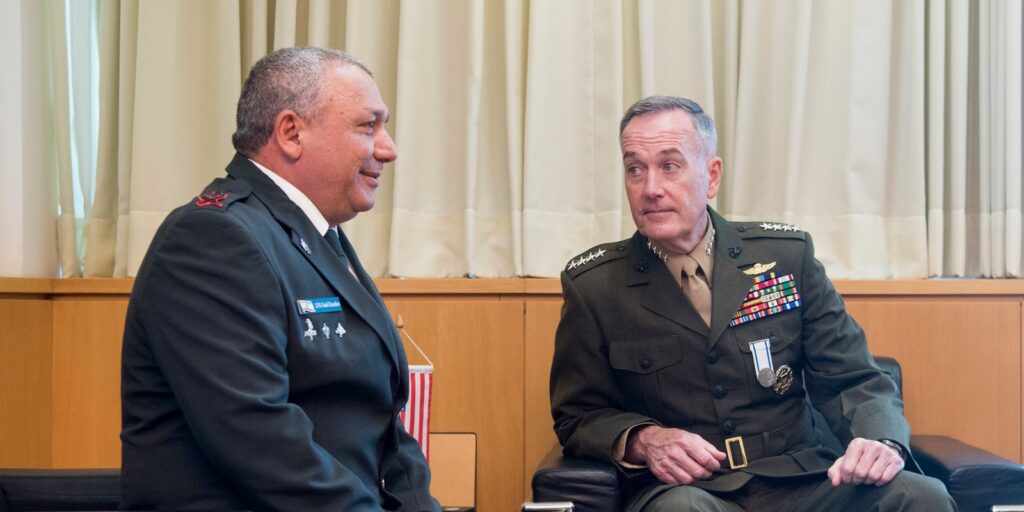
Archive: Dominique Pineiro/U.S. Navy/DVIDS
Gadi Eisenkot said Friday that negotiations to form a national emergency government in Israel had made significant progress, outlining his plan for a minority government built on the four Change bloc parties with outside support from Arab and ultra-Orthodox parties.
“I intend to fulfill the mandate the people have given me, and the mandate the president is expected to entrust to me, with a profound sense of responsibility,” the Yashar party leader and former military chief said in a statement posted on X. President Isaac Herzog said Thursday he will announce on Sunday which lawmaker he tasks with forming the next government; no mandate has been assigned yet.
Eisenkot said his team had held dozens of hours of talks with opposition parties, making what he called “significant progress and breakthroughs.” He proposed swearing in a government “as quickly as possible, based on the four Zionist parties of change and reform,” with any party or Knesset member willing to accept his four principles joining “either immediately or gradually”: recognizing Israel as a Jewish and democratic state; upholding the values of its Declaration of Independence; requiring military, national or civilian service for all; and recognizing Hamas as a terrorist organization while committing to dismantling its military and governing capabilities.
The outside backing of Arab and ultra-Orthodox parties is Eisenkot’s proposal; such support has not been secured. Israel’s Oct. 27 election left no bloc with the 61 seats needed for a Knesset majority.
Joint List leader Ahmad Tibi said in a Friday interview that Eisenkot’s four principles do not apply to the Joint List, because it would stay outside the coalition. “Some of his supporters will be inside the coalition, and we will be outside the coalition as a safety net,” Tibi said. He said he does not expect the ultra-Orthodox and religious parties to join Eisenkot, so Eisenkot will need the Joint List and Ra’am, a combined 19 Knesset members. “We do not want Netanyahu to remain prime minister,” Tibi said.
“Israel is facing a real, tangible and dangerous emergency,” he wrote, arguing that the current government “threatens the very foundations of Israeli democracy” while military fronts remain open – his characterization of the stakes as Prime Minister Benjamin Netanyahu remains in office.
He also warned that anyone who tries to “undermine or sabotage the formation of a government for personal rather than substantive reasons” would be remembered by history as having “failed to act to save Israel in a time of emergency,” adding, “They will not be forgiven” – remarks widely seen as directed at Yisrael Beytenu chairman Avigdor Liberman, who this week reversed his position and voiced support for a government that includes ultra-Orthodox parties, even if it requires compromises on military conscription.
Eisenkot said another election would only prolong political uncertainty and leave Netanyahu in office as caretaker prime minister.
JBizNews Desk | Jerusalem
© JBizNews.com. All rights reserved. Unauthorized reproduction or redistribution is strictly prohibited.