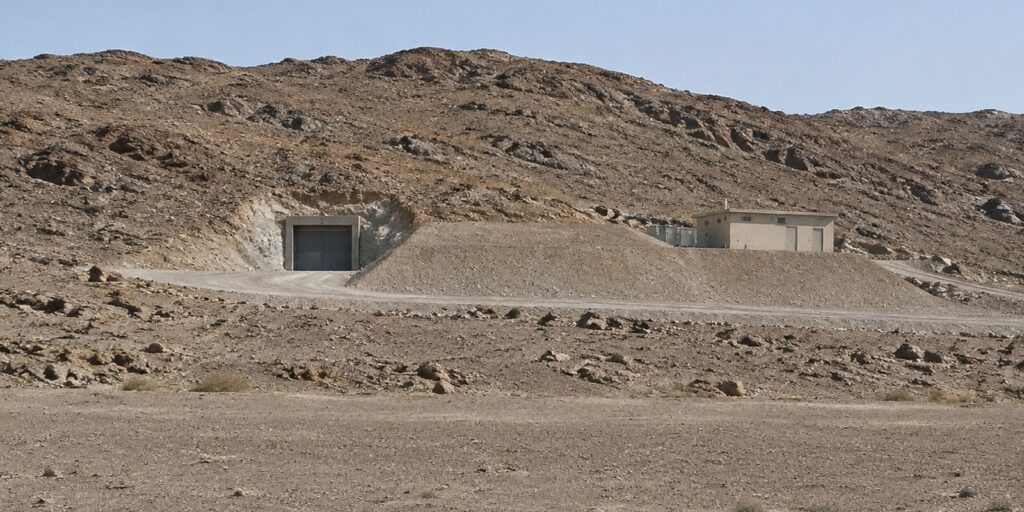
Satellite images taken in November show digging and new buildings at two major Iranian missile sites and apparent repairs at at least 12 other military sites, analysts say.
The analysts, at the British intelligence company MAIAR, reviewed the images for a new report. They also pointed to new construction and excavation outside tunnel entrances near the city of Qom, close to the Fordo underground uranium enrichment complex, which the U.S. and Israel have bombed several times.
What the images show
MAIAR analysts said digging and new buildings are visible at the Garmdareh military base in Karaj, near Tehran, and at the Shahroud base in the north.
Sam Lair, a research analyst at the Foreign Policy Research Institute, said the Karaj images appear to show “a new portal for an underground facility.” Analysts at Janes said a new facility appears to be under construction at Karaj, with tunnel entrances and structures that could mean an expansion of nearby damaged or destroyed missile bases, or could be for storage or other purposes.
At the other sites, the images appear to show repairs. New roofs have been built on destroyed buildings at the Kermanshah missile base in western Iran. At the Parchin military complex, east of Tehran, damaged buildings and debris have been cleared, and an underground bunker at the Taleghan 2 facility appears to have been repaired and reinforced with concrete.
What analysts say it means
Jim Lamson, a former CIA analyst who focused on Iran, said the digging near Shahroud could be related to missile production, and that the Islamic Revolutionary Guards Corps is probably trying to move production underground. A MAIAR analyst said Iran has “a pattern of moving infrastructure underground to protect them from further strikes.”
Mark Cancian, a military analyst at the Center for Strategic and International Studies, said activity on military assets would show Tehran is bracing for further attacks. “The purpose is to better defend itself against future attacks,” he said. “It also indicates a priority on rebuilding military capability rather than rehabilitating the economy.”
Sean O’Connor, a Janes analyst, said the construction is unlikely to be an effort to deceive foreign intelligence agencies because that would be costly and might achieve little.
A Pentagon spokesperson has said the U.S. “destroyed up to 90% of Iran’s drone, ballistic missile, and naval industrial base.” Iran says it still has large stockpiles of missiles, and state TV this week broadcast footage it said showed dozens of missiles at the entrance to an underground facility in southern Iran.
Background: Pickaxe Mountain, September 2026
In an analysis published Sept. 9, the Center for Strategic and International Studies said its satellite imagery could neither refute nor substantiate an Israeli intelligence claim that Iran moved uranium centrifuges into Pickaxe Mountain, a large underground tunnel complex about 2 kilometers south of Natanz. It said the facility’s depth is difficult to assess: some open-source estimates put it at 80 to 100 meters, but those rely on measuring piles of excavated dirt, which does not show a tunnel’s internal design.
JBizNews Desk | Tehran
© JBizNews.com. All rights reserved. Unauthorized reproduction or redistribution is strictly prohibited.