Skyways / Company press photo
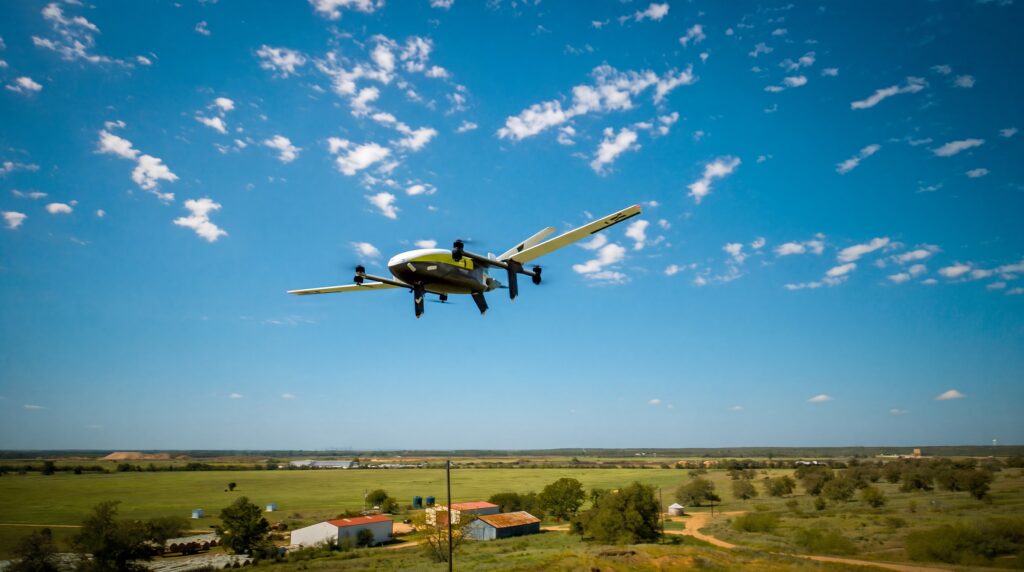
Skyways announced in Austin, Texas, on November 9 that it has launched Skyreach, a long-range autonomous cargo aircraft, and started production, with flights for existing defense and commercial customers scheduled to begin in December 2026. The announcement puts the company’s latest aircraft into a production phase, but it does not say those customer flights have already begun.
The company release describes Skyreach as the production platform behind a $37 million AFWERX STRATFI award announced in June 2025. That award, from the U.S. Air Force, is intended to support full-rate production. It is not new financing or a new $37 million contract announced today.
The aircraft combines battery-powered vertical takeoff and landing with fuel-powered cruise. A generator recharges its batteries in flight, reducing the need for ground charging equipment or battery changes. Skyways lists compatibility with JP-5 and Jet A-1 aviation fuels, a seven-cubic-foot payload bay and a maximum gross takeoff weight of 360 pounds. The bay can carry cargo, including temperature-controlled items, or equipment for sensing, surveillance and communications.
Payload and range involve a trade-off. Skyways quotes more than 1,300 miles of one-way range with 10 pounds of cargo, compared with more than 280 miles carrying 80 pounds. Its 100-pound capacity is the combined load of fuel and payload, not a promise to carry 100 pounds of cargo for 1,300 miles. The company also quotes more than 18 hours of maximum flight time. These are the manufacturer’s stated specifications, not independently verified performance results reported here.
“Built on Skyways’ eight years of real-world operational experience with V2, Skyreach is our most capable platform yet,” said co-founder and chief executive Charles Acknin. He said the company’s ambition is to deploy a network of more than 1,000 autonomous aircraft for defense and commercial customers within five years. That is a deployment goal, not a disclosed backlog of 1,000 ordered aircraft.
Skyways says it has finalized the production design, advanced flight-qualification testing and begun production in Austin. The company says the platform, previously developed as V3 Block 2, draws on thousands of autonomous missions. It lists the aircraft as Group 3, or Group 2 with a waiver. That classification is not evidence of unrestricted commercial flight permission, and the announcement does not detail approvals for every proposed customer mission or operating area.
The commercial pitch is to move cargo or mission equipment without runways or extensive ground infrastructure, including in shipboard and remote environments. That could help serve locations where conventional deliveries are difficult or helicopters are costly. Skyways’ claim of roughly one-tenth the cost of a helicopter is a company comparison; the announcement does not give the mission assumptions, independent cost analysis or customer pricing needed to test it.
The next milestones are the planned December customer flights and a production operation that can deliver repeatable aircraft at scale. Skyways does not identify the customers due to receive the first Skyreach flights, disclose order quantities or give a current production rate. Those gaps matter when judging how quickly an autonomous-aircraft launch can become a larger logistics business.
JBizNews Desk | Austin, Texas
© JBizNews.com. All rights reserved. Unauthorized reproduction or redistribution is strictly prohibited.