Photo: Ajay Suresh / Wikimedia Commons / CC BY 4.0
NEW YORK, N.Y. – American households put the average chance that unemployment will rise over the next year at 45.3% in October, the highest reading since April 2020, the Federal Reserve Bank of New York said in a survey released Monday. Inflation expectations were unchanged, while consumers saw a greater risk of missing a debt payment.
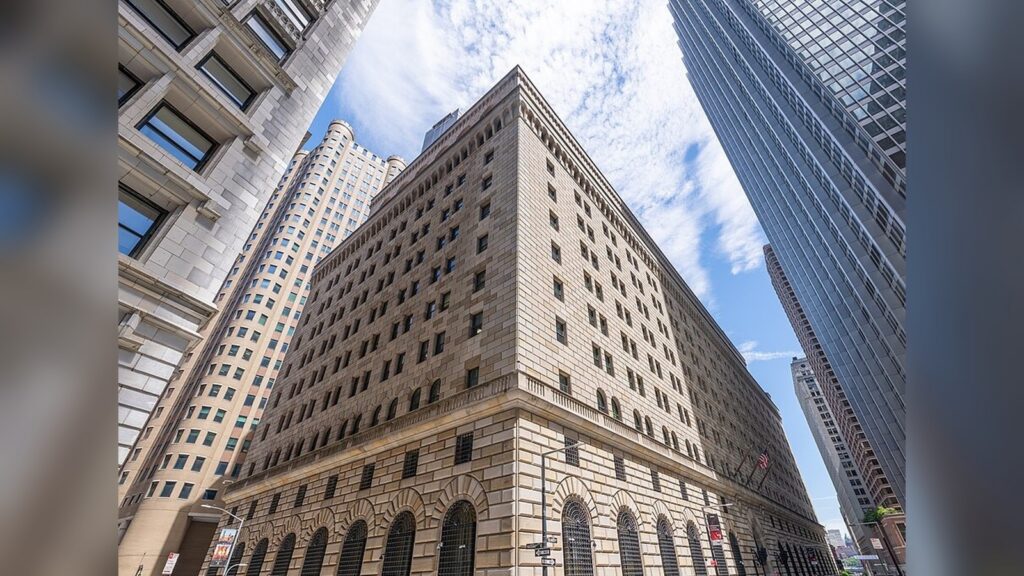
The photograph shows the New York Fed building in May 2026, cropped to the facade; it is not a scene from the survey release.
The November 9 release describes what people expected during October, not a new measurement of the unemployment rate. The survey was conducted October 1-31 among a rotating, nationally representative internet panel of about 1,300 household heads. Its results show a mixed labor-market outlook: more concern about unemployment and job loss alongside improved confidence in finding another job.
The average perceived chance that the U.S. unemployment rate will be higher a year from now rose 1.4 percentage points to 45.3%. The increase was driven by respondents without a college degree, the bank said in its October release.
That figure is an average of the probabilities respondents assigned to a future rise in unemployment. It does not mean 45.3% of Americans are unemployed, that the unemployment rate is expected to reach 45.3%, or even that exactly 45.3% of respondents predicted an increase.
People put their own average chance of losing a job in the next 12 months at 13.9%, up 0.4 percentage point from September. Despite the increase, the measure remained below its trailing 12-month average of 14.3%. The average perceived chance of finding a job if the current one were lost rose 0.4 percentage point to 46.5%, its highest level since November 2025.
Those two readings matter together. Households became somewhat more concerned about losing work, but also more hopeful about finding replacement work. The survey therefore does not describe an across-the-board collapse in labor-market confidence. Expected voluntary departures moved the other way: the average perceived chance of quitting fell 0.5 percentage point to 19.4%.
Inflation expectations held steady at every horizon covered in the headline results. The median expected inflation rate was 3.9% one year ahead, 3.3% three years ahead and 3.0% five years ahead. These are consumers’ expectations, not actual inflation readings or the Federal Reserve’s own forecasts.
Stable overall expectations did not mean every household cost looked unchanged. The median expected rise in rent over the coming year increased 0.9 percentage point to 7.7%. Expected medical-care cost growth edged up to 9.3%, while expected college-cost growth rose to 7.6%. Expected food-price growth held at 5.5%, and the expected rise in gasoline prices fell 0.6 percentage point to 4.2%.
The rent figure measures an expected price change, not a report that rents have already risen 7.7%. It nevertheless shows why an unchanged overall inflation outlook can coexist with concern about particular expenses that weigh heavily on household budgets.
Debt-payment concerns also increased. The average perceived probability of missing a minimum debt payment over the next three months rose 1.6 percentage points to 13.8%, the highest level since December 2025. That is a measure of expected risk, not an observed delinquency rate or evidence that 13.8% of households have already missed a payment.
Expected household-income growth slipped 0.1 percentage point to a median 3.0%, remaining within the narrow 2.8%-3.1% range seen since June 2025. Expected household-spending growth fell 0.2 percentage point to 5.3%, still above its trailing 12-month average of 5.0%. The survey did not establish why respondents changed their answers or whether those expectations will translate into actual spending.
There were some more positive signals. Households’ assessments of their financial position compared with a year earlier improved slightly, while their expectations for their position a year ahead were roughly unchanged. Perceptions of credit access and expectations of future credit availability also changed little.
The survey program follows respondents for up to 12 months, with roughly equal numbers entering and leaving the panel each month. That structure helps track how the same people’s views change over time. It remains a survey of beliefs and uncertainty, not a substitute for official employment, inflation or loan-performance data.
For businesses and policymakers, the main message is a tension rather than a single verdict: inflation expectations are steady, but concern about future unemployment and debt payments has increased. Improving job-finding expectations temper that picture. The release does not announce an interest-rate decision or establish how the Federal Reserve will respond.
JBizNews Desk | New York, N.Y.
© JBizNews.com. All rights reserved. Unauthorized reproduction or redistribution is strictly prohibited.