Suburbs still win the self-storage race, but a surprising group of metros is heading downtown.
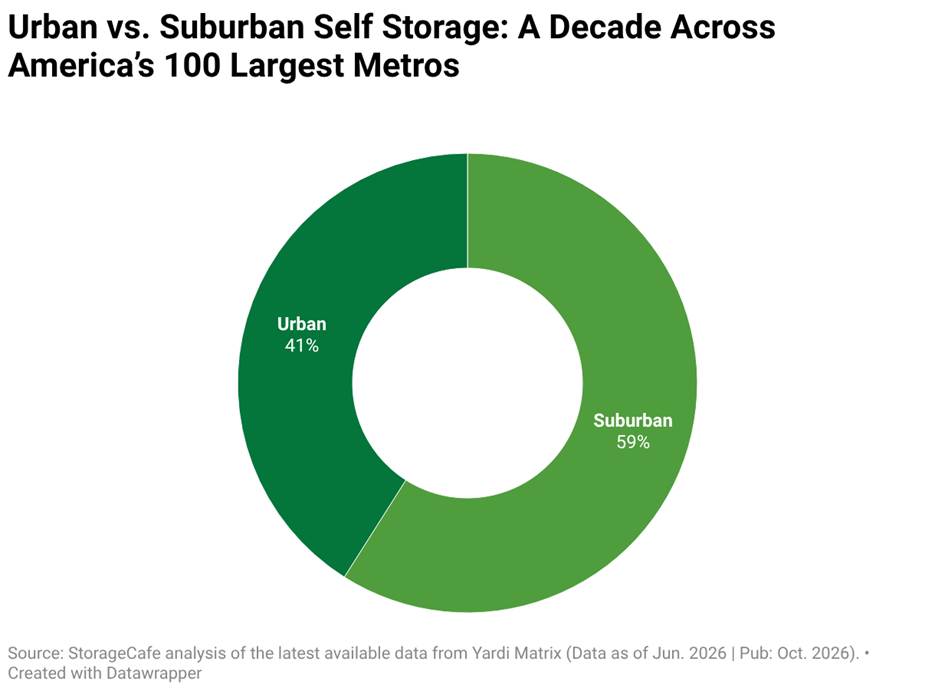
Self-storage development continued on a mostly suburban path over the past decade (2016 to 2025), with 59% of all new construction delivered during that period, amounting to 261 million square feet, located outside city centers.
Although urban self-storage is attractive, with population density and smaller living spaces creating extra demand, there are significant hurdles to building it, including but not limited to the scarcity of suitable land plots and, in many cities, strict zoning laws.
Even so, among the country’s 100 largest metro areas, 41 delivered at least 50% of their inventory in high-density urban areas over the past decade. StorageCafe’s latest study on urban vs. suburban self-storage development analyzed both sides of the coin: where suburban self-storage dominates, and where urban self-storage is taking flight.
The New York metro area leads in sheer square footage of suburban self-storage.
The New York metro area delivered a remarkable 25.8 million square feet of self-storage over the past 10 years, with 69% of it located in the suburbs — hardly surprising given New York City’s zoning laws and land availability and costs. In fact, the almost 8 million square feet of urban self-storage delivered here in the same period can be considered an impressive achievement for the sector, considering the headwinds.
The Atlanta metro area ranks second nationwide for suburban self-storage, with close to 15 million square feet delivered between 2016 and 2025, compared to about 3.3 million square feet in city centers. The significant growth of Atlanta’s suburban population acted as a major motivator for this trend. Dallas-Fort Worth-Arlington rounds out the national podium for suburban self-storage deliveries, but the situation is a lot more balanced: 14.6 million square feet went online in the suburbs, compared to 10 million in city centers. Other metro areas where suburban self-storage leads in sheer square footage include Houston, Chicago and Phoenix.
Changing the lens to suburban deliveries as a share of total deliveries, we notice Boston, where almost the entirety of the 7.9 million square feet of new space over the past decade went to the suburbs. The situation in Detroit is quite similar, with 95% of the 6.5 million square feet built over the past 10 years being suburban.
Midsize metro areas are where urban self-storage thrives.
As we have already seen, suburban self-storage is the rule and the status quo: a significantly higher share of what’s being built in the country’s largest metro areas actually goes to the suburbs. However, there are certain metro areas where urban development leads, and, as our analysis shows, many of them are midsize but fast-growing and located in the Sun Belt and Mountain West regions.
The Las Vegas metro area takes the top spot, with 96% of its 6.5 million square feet of decade deliveries located in urban areas, while the pipeline looks the same: every square foot planned or under construction is urban. Where centrally located land is sitting underused, storage can find room without going head-to-head with homebuilders.
Colorado Springs, Colorado, ranks second, with 89% of its new space (over 2.1 million square feet) delivered in urban areas, and 91% of the pipeline pointing the same way. Wichita, Kansas, follows at 86%, with close to a third of its urban inventory being less than 10 years old. Neither is a city anyone would call a skyline, which says a lot about where urban storage is actually being built: in downtowns that are filling up with new apartments, not necessarily in big-city cores. “Developers build where demand and available land overlap. In the largest metros, land costs and zoning tend to push that overlap to the suburbs, while in midsize metros it is often downtown,” said Victor Maghear, StorageCafe market analyst.
El Paso, Durham-Chapel Hill and Tucson have delivered 80% or more of their new space in urban areas (85%, 81% and 80%, respectively), and all three have a large institution at the center: major universities in the second two and a big military presence in the first. Students, researchers and service families rent, move often and rarely enjoy spare closets, which is exactly the kind of customer that keeps self-storage units turning over.
Zoning rules shape the map as much as demand does. El Paso allows storage in apartment districts, while Cape Coral, Florida, which delivered over 3 million square feet of urban space (83% of its total), revised its land development code in 2024 in a way that pointed new facilities toward established urban areas and mixed-use developments.
Scranton-Wilkes-Barre, Pennsylvania, is flipping the local balance as more people are moving into downtown buildings. Its total existing inventory is 62% suburban, yet 81% of what was built in the last decade went urban.
Urban inventories grew the most in Northeastern metros
There’s another way to look at the urban trend: how much of a metro’s current urban self-storage was built in just the last 10 years. By that measure, the Northeast comes out on top.
In Providence, Rhode Island, about 66% of the urban self-storage inventory was delivered in the past decade, followed by Worcester, Massachusetts, at 63% and New Haven, Connecticut, at 52%. In Albany-Schenectady-Troy, New York, the figure is 48%, and two-thirds of the 500,000 square feet in the pipeline are urban, so the momentum isn’t fading.
Numbers this high mean there was very little urban storage to begin with, and downtown housing revivals have created demand almost from scratch. The same logic applies far from the Northeast. In Huntsville, Alabama, where the urban population grew faster than the suburban population — by more than 20% in a decade — half of the urban inventory is new.
San Antonio, Austin and Los Angeles are changing course in the pipeline
San Antonio delivered 82% of its new space in urban areas over the past decade, but its pipeline is now split 51% urban and 49% suburban, with growth along the Interstate 35 corridor toward Austin adding suburban renters. Austin, at the other end of that corridor, shows a similar move: urban areas received 51% of its deliveries over the decade; however, the majority (76%) of the 1.3 million square feet planned or under construction is suburban.
Los Angeles moves in the opposite direction. Urban areas received 44% of the space delivered over the past decade, but now they account for 54% of what is planned or under construction: nearly 1.8 million square feet of space, the largest urban pipeline in the country.
Suburban storage may remain the default across America, but wherever downtowns are repopulating, self-storage is making its way back to the cities.
The post Self-storage stays suburban – except where it doesn’t appeared first on Market Share.