
UN aid sent to victims of the coastal massacre and Alawites displaced by sectarian violence in Syria is being redirected to the same Sunni militias responsible for the attacks, some of which are affiliated with the new Sharaa regime, several displaced families told The Jerusalem Post.
Sharing photos of armed gangs patrolling UN aid distribution points, as well as posts by SARC aid workers that supported the massacre of ethnic and religious minorities in Syria, a Syrian source said the situation was becoming increasingly desperate.
The Post was asked not to share images taken inside and around aid sites, as the individuals feared being identified and targeted for speaking to Israeli media.
SARC is one of several major Syrian organizations responsible for distributing UN aid in the country. The source claimed that, by relying on an organization biased against Alawites, whose aid workers had expressed support for massacres, international organizations were failing both to ensure that aid reached its intended recipients and to ensure that displaced communities could safely access the resources they needed.
R., speaking on behalf of her family and two other families she shared a two-room apartment with in rural Hama after being displaced by the attacks in Latakia.
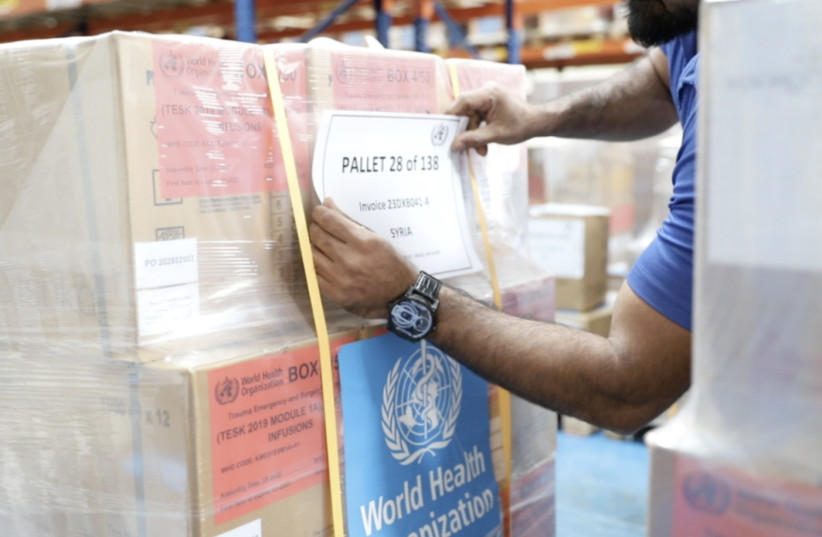
Alawites accused of Assad affiliation
She said that her family had been told by their community leader to register at the SARC center to receive assistance with mattresses and blankets. However, when she arrived at the center, gangs and individuals wearing Amn al-Aam (Syrian General Security) uniforms accused them of being remnants of the former regime and denied them aid. R. insisted that neither she nor her family members had served in or been affiliated with the Assad regime in any way.
“We went to the center, and then when we entered the center of the SARC plant, [we] saw the army of Jolani (Sharaa)… They started to tell [us] that, ‘You are Alawites, you are, you are linked to the old regime, you are criminals,’ and these kinds of things,” she recounted. “So even though we registered our name and the staff told us, ‘We will call you to come and take some assistance,’ after a while, the UN with the SARC, they came to the community, and they started to distribute to the Bedouins who actually looted and stole the houses, and not for the Alawites.”
She said that both her family and their neighbors saw their names replaced on the list of aid recipients with those of local militias or people whose family members were affiliated with SARC, a claim the source said they had also observed.
R. said that her family had submitted multiple complaints to UNHCR, though the agency did not confirm whether it had received the complaints in its response to the Post.
A UNHCR spokesperson said that they did not have information about specific complaints but that anyone with concerns about possible misconduct by UNHCR staff or associated entities should contact the agency’s Inspector General’s Office.
The spokesperson added that UNHCR’s non-food item assistance in Syria was distributed according to assessed humanitarian needs and established eligibility criteria, without distinction based on religious, ethnic, or other community affiliations.
“Our aid has reached diverse communities across Lattakia and Tartous, irrespective of their religious, ethnic, or any other backgrounds; these include IDPs and returnees (both refugees and IDPs), as well as Syrian households affected by emergencies,” the spokesperson said, adding that aid recipients were identified through assessments, household visits, and eligibility verification, with distribution lists checked for duplication and implementation monitored through field visits and recipient feedback.
Any concerns identified through these processes were reviewed and cross-checked to ensure adherence to humanitarian principles, they continued.
Alawites faced increasing persecution, massacres following fall of Assad
The Assad family was ethnically Alawite, as were many of the soldiers who served in the military before Damascus fell to Ahmed al-Sharaa’s Hay’at Tahrir al-Sham in December 2024. Since then, Syria’s ethnic and religious minorities have faced continued persecution and large-scale massacres.
A UN investigative team confirmed last year that war crimes were likely committed by members of both the interim government’s forces and other parties during the coastal massacre in March 2025, which resulted in the deaths of around 1,400 people, the majority of whom were Alawite civilians.
R. had witnessed the violence, and her cousin was killed during the attacks.
“A year ago, the entire village was looted, and some of their neighbors actually had their houses burned completely. So they were forced to leave the entire village they used to live in, and the Bedouins actually came to take it,” she said, explaining that militias forced her to flee again after she arrived in Hama, where they burned and looted more homes.
UNHCR, SARC complicit in violence, Alawite Syrian says
T. began his interview with the Post by swearing that he had never had any connection to the Assad regime. During a video call last week, he also showed the reporter the rough bandages wrapped around his foot, which had been shot while he attempted to flee the massacre in Jableh, Latakia, and reach a Russian military base for safety.
“All the old people who are disabled, they couldn’t move… These people who were unable to walk… they stayed in the houses while we saw that they were killed,” he said. “They actually were not able to move or to be displaced, so they were killed. And I was injured.”
He said that he had personally witnessed his community hand over all its weapons, only months before militias wearing the country’s official military uniforms began the attacks.
T. said he believed that UNHCR and SARC were complicit in the violence, describing how aid delivered to his neighborhood in front of cameras was allegedly stolen by the same militias that shot him just two hours after the delegations had left.
He described the aid distribution efforts as little more than a photo opportunity, saying that the lack of protection around distribution sites had cost his family dearly. T. said that his paternal uncle was killed while attempting to collect UN aid in town.
“They brought Bedouins in front of the cameras under the United Nations. They started to distribute some food to the Bedouins…, and later on, they gave all the assistance to those Bedouins. So, in front of the United Nations, they were giving to other people,” he said. “We have not received anything from the UN or the SARC, and my family and our neighbors were attacked.”
T. also said that he had registered for aid with the UN under the guidance of Latakia’s Al Mukhtar (local governor), but had not received any assistance.
“The current situation is very bad. Alawites who worked in government, including doctors and other employees, were kicked out of their jobs. We are now jobless and have no money. Not only that, but they looted our houses, burned our land, and cut down our olive trees,” he said.
“They destroyed everything we had to eat or earn a living from. All of this happened in front of the entire world. International reporters and television networks documented everything, but they did nothing.”







