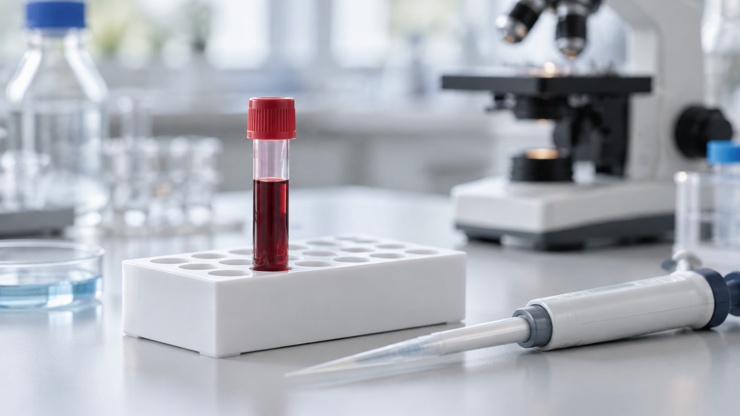
Israeli researchers have reported promising results from an experimental blood test designed to identify breast cancer at an early stage and help assess the risk of the disease returning. The findings are an early research result, not evidence that the test can replace mammograms or is ready for routine screening.
The study, published Wednesday in Nature, grew out of work in the laboratories of Prof. Efrat Shema at the Weizmann Institute of Science and Prof. Guy Ron at the Hebrew University of Jerusalem, in collaboration with physicians at Kaplan Medical Center in Rehovot. Their approach examines chemical marks on proteins associated with DNA, along with other proteins circulating in blood, to look for patterns linked to breast tumors.
The method, called EPINUC, measures multiple signals from less than one milliliter of blood plasma. Rather than searching only for tumor DNA mutations, it examines features of nucleosomes, the protein structures around which DNA is wrapped, and combines them with other blood markers.
In one analysis, researchers studied preoperative samples from 77 women with luminal breast cancer and 30 healthy women. An expanded 29-parameter panel achieved an area under the receiver operating characteristic curve, or AUC, of 0.95, including among women with early-stage T1 tumors.
AUC describes how well a model distinguishes two groups across different thresholds. It does not mean that a screening test correctly detected cancer in 95 out of every 100 women. The study’s results therefore should not be read as a 95% cancer-detection rate in the general population.
The team also pooled 188 samples across medical centers, using 75% to train a model and the remaining 25% to test it. That analysis produced an AUC of 0.96. The researchers described these results as retrospective, an important limit when judging whether a test will work in a wider screening program.
Samples collected before surgery, followed by at least five years of clinical follow-up, also revealed differences between patients whose cancer returned and those who remained disease-free. Those findings suggest a possible way to study recurrence risk; they do not show that the test prevents cancer from returning.
The work points toward a potential additional tool for detecting and understanding breast cancer. Prospective studies in larger, more varied populations would be needed to establish how it performs in routine care, including its false-positive rate and how it might be used alongside existing screening.
JBizNews Desk | Jerusalem
© JBizNews.com. All rights reserved. Unauthorized reproduction or redistribution is strictly prohibited.