The United Nations Climate Change Conference (COP31), taking place in Antalya, Turkey, has brought together leaders from around the world to discuss climate change. However, the summit is also becoming an important diplomatic gathering, with leaders using the opportunity to hold bilateral meetings, strengthen regional relationships, and discuss conflicts that have little direct connection to the environment. It looks to be more about networking than climate.
The conference, which began on November 9 and continues until November 20, comes amid growing global developments and tensions, including the US war with Iran, Russia’s invasion of Ukraine and conflicts across the Middle East. These developments have increasingly overshadowed the climate agenda, even as UN officials warn that the world is failing to make sufficient progress in addressing global warming.
Turkey has sought to use the summit to position itself as a center of international diplomacy. According to Turkey’s Anadolu Agency, 102 leaders representing 95 countries and seven international organizations were expected to attend COP31. The participants include 37 heads of state, 35 heads of government, eight vice presidents, and numerous other senior officials. Representatives from 196 countries and the European Union are expected to participate in the broader conference.
The scale of the gathering provides Turkish President Recep Tayyip Erdogan with an opportunity to meet leaders from across the world and showcase Turkey’s diplomatic influence. It appears this now overshadows the climate agenda. Images from the summit showed Erdogan posing for a group photograph with visiting leaders. After the photograph, he was seen linking arms with Azerbaijani President Ilham Aliyev and speaking with him.
The meetings with the leaders illustrate how international summits have become opportunities for informal diplomacy, particularly among leaders who already maintain close bilateral relationships.
Syria is front and center. It has also used COP31 to demonstrate its growing diplomatic engagement. Syrian President Ahmed al-Sharaa attended the conference with his wife, Latifa al-Droubi. The couple met Emine Erdogan, the wife of the Turkish president, in an encounter described in Syrian coverage as having humanitarian and social dimensions.
Syria’s opportunity to demonstrate return to regional, international diplomacy
For Syria, which has been seeking to expand its diplomatic relationships following the fall of the Assad regime, participation in international gatherings offers an opportunity to demonstrate its return to regional and international diplomacy. This is important also, as Droubi has not participated in many international meetings like this.
Iraq has also used the conference for diplomatic engagement. According to the Iraqi News Agency, Iraq’s president met Erdogan and UN Secretary-General Antonio Guterres on Wednesday on the sidelines of COP31. These meetings highlight the importance of the summit as a venue for bilateral discussions, particularly for countries in the Middle East that are working with on changing their relationships and upgrading ties.
Iran, meanwhile, used the climate conference to raise issues directly connected to its conflict with the United States and Israel. Iraq itself has many internal crisis. The conference is a place to showcase Iraq as a stable state.
Iranian President Masoud Pezeshkian called for compensation for environmental damage allegedly caused by US and Israeli military strikes. “We expect the global community to establish a genuine and meaningful link between climate commitments in times of peace and responsibility in times of war, to document and assess the environmental damages caused by military aggressions and to develop compensation mechanisms,” Pezeshkian said, according to Arab News.
His remarks show how the climate conference has become another platform for countries to advance positions related to ongoing conflicts. Iran is clearly making inroads here even as the US tries to isolate the country. Alongside Brazil and others, it shows how US influence can’t isolate Iran.
Iran’s demands come amid continuing tensions with Washington and Israel. Tehran has sought to pretend that the environmental consequences of military operations is part of the wider international debate over climate responsibility. However, the growing prominence of geopolitical disputes has also raised concerns among leaders who believe climate change is being pushed aside.
Brazilian President Luiz Inacio Lula da Silva criticized the declining attention given to climate issues at major international gatherings. He recently won re-election. “Climate change disappeared from the speeches and documents of global leaders at the G7 and G20 meetings, forums that bring together the world’s biggest greenhouse gas emitters. This concern turned into silence,” Lula said Wednesday, according to Turkey’s TRT.
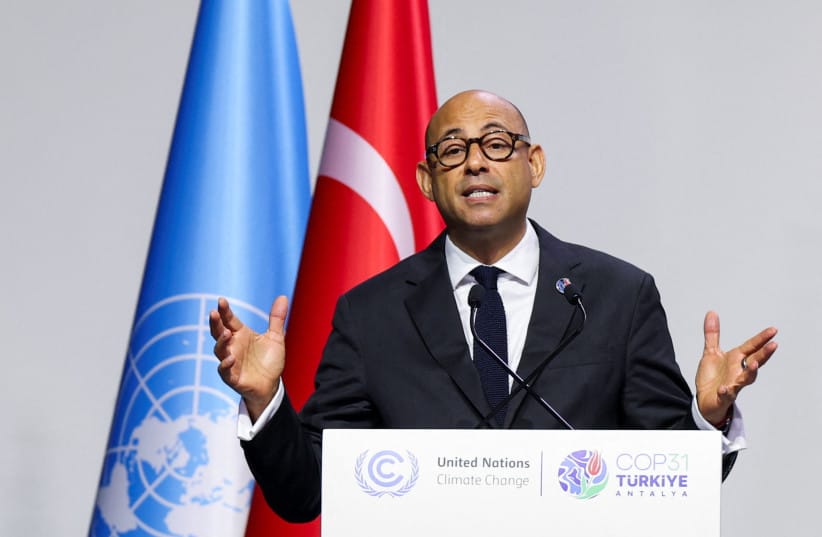
UN Secretary-General Guterres delivered a speech as well. “The brutal truth is that the climate crisis is outrunning us,” Guterres told world leaders in Antalya, according to AFP. He criticized the influence of fossil fuel companies and called for stronger international action. Despite these warnings, expectations for major breakthroughs at COP31 appear limited. In fact, the UN leader is supposed to be replaced soon. This could be his last soapbox to stand on.
AFP reported that several prominent world leaders are absent from the summit. US President Donald Trump is not attending, while Chinese President Xi Jinping is represented by Vice President Han Zheng. Indian Prime Minister Narendra Modi is also absent. Several major European leaders, including French President Emmanuel Macron, German Chancellor Friedrich Merz, and Italian Prime Minister Giorgia Meloni, are not attending.
British Prime Minister Andy Burnham is apparently the only leader from a G7 country scheduled to address the summit. The absence of some other Western leaders from the world’s largest economies is clear. “It is a shame that some of the bigger European leaders aren’t coming. We need Europe to be showing up strongly at this COP,” Cosima Cassel, a climate diplomacy expert at E3G, told AFP.
The European Union’s top climate official, Wopke Hoekstra, acknowledged that “expectations are not necessarily high” for the conference,a report noted. Turkey has sought to advance its own climate initiatives. Erdogan has called for a “fair” energy transition that recognizes the different development needs and energy security concerns of individual countries.
The proposal reflects Turkey’s effort to present itself as a bridge between developed and developing economies, while also advancing its broader diplomatic role. The contrast between the formal climate agenda and the diplomatic activity surrounding COP31 is obvious. This is more about networking than climate.
For leaders from Iraq, Syria, Iran and other countries, the summit offers an opportunity to engage with counterparts, raise political grievances and strengthen relationships. For Turkey, it provides a platform to demonstrate its ability to convene leaders from across competing geopolitical blocs.
COP31 will be remembered more for the diplomatic conversations taking place on its sidelines than for the meagre climate commitments made inside the conference halls.