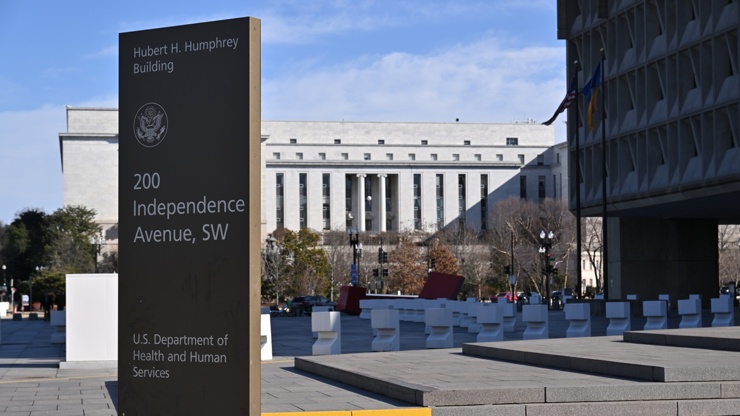
HHS headquarters sign in Washington, photographed February 7, 2025. Photo: G. Edward Johnson / Wikimedia Commons, CC BY 4.0; cropped.
The U.S. Department of Health and Human Services has selected 40 teams for about $3.7 million in prizes for working artificial-intelligence prototypes aimed at Lyme disease, other complex chronic conditions and the financial burden of illness.
The awards, announced November 9, are part of the TOPx HHS Tech Sprint for AI and Invisible Illness. HHS expanded the competition’s overall prize pool from $2 million to $3.8 million, citing the quality of submissions and public interest. The projects use AI and federal open data to address problems such as delayed diagnosis, fragmented care and costs that patients and families struggle to document.
The announcement concerns working prototypes. It does not announce regulatory approval of a diagnostic test or treatment, or establish that the winning tools have improved clinical outcomes.
Two $1 million grand prizes
HHS named LasaClinical: Reducing the Diagnostic Delay in Women’s Health, and Health Worth as the two grand-prize winners, each receiving $1 million.
Five teams will receive first-place awards of $200,000 each, six will receive second-place awards of $50,000 each, and 27 will receive impact awards of $15,000 each, according to the department. HHS said another $50,000 in People’s Choice awards would be announced later this year after public voting and final approval.
The competition drew 171 submissions. Forty-six teams advanced to Phase 2, where participants developed tools across three areas: Lyme Innovation, Invisible Illness and Cost of Illness.
Those categories extend the competition beyond identifying disease. They include helping patients coordinate care, communicate their needs and make the human and economic burden of chronic illness easier to measure.
Federal data, privately owned tools
The challenge is led by the HHS LymeX Innovation Accelerator with the National Institutes of Health Office of Research on Women’s Health and the Federal Chief Data Officers Council. HHS said submissions went through nonfederal expert evaluation and federal review under published criteria.
The NIH challenge page says participants can use publicly available datasets across federal agencies, including information found through Data.gov and HealthData.gov. Participants retain their other intellectual-property rights, but must grant the federal government nonexclusive licenses to publish submissions and use the solutions under the challenge rules.
That structure makes the competition a prize program for developing and demonstrating tools, rather than an announcement that the federal government is buying or deploying all the winning products.
HHS Secretary Robert F. Kennedy Jr. said the goal is to “shorten the path to diagnosis, improve care, and help patients reclaim their health.” The awards recognize prototypes intended to pursue those goals, not evidence that those goals have already been achieved.
The NIH challenge page directs the public to the Invisible Illness Patient-Centered Innovation Ecosystem to explore submissions and participate in the program.
Sources: HHS November 9 announcement; NIH challenge description.
JBizNews Desk | New York
© JBizNews.com. All rights reserved. Unauthorized reproduction or redistribution is strictly prohibited.