
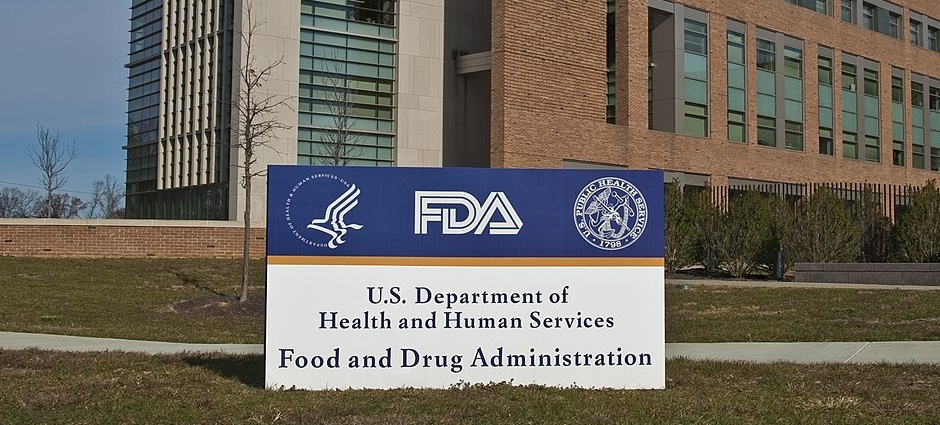
FILE: FDA sign at the agency’s White Oak campus in Silver Spring, Maryland, November 24, 2010. Photo: U.S. Food and Drug Administration, public domain; cropped.
The Food and Drug Administration is proposing to move a group of cancer treatment-selection tests into a less burdensome regulatory category, while keeping premarket review and adding specific safeguards for accuracy and interpretation.
The proposal, published November 12 in the Federal Register, covers immunohistochemistry, or IHC, test systems used with an approved cancer medicine. These tests detect protein expression in patient specimens and can help clinicians decide which patients may benefit from a particular treatment.
FDA would reclassify the covered devices from class III, which requires premarket approval, to class II with special controls. Manufacturers would instead need clearance through the agency’s 510(k) premarket notification pathway before marketing a device. The proposal does not exempt the tests from FDA review.
Comments are due January 11, 2027. The change is not final and does not take effect with the publication of the proposal.
What Would Change for Test Makers
FDA said a 510(k) submission is generally less burdensome and more cost-effective than a premarket approval application, and typically has a shorter review timeline. The agency expects reclassification could encourage more manufacturers to develop these tests and improve patient access.
Those are the agency’s expectations, not measured savings or guaranteed reductions in waiting times. The proposal does not set a price reduction for laboratories, insurers or patients.
The covered group spans 12 device product codes and includes both companion diagnostics essential to the safe and effective use of an approved medicine and other tests that provide information about a medicine’s benefits or risks.
FDA cited its experience with the technology, data from earlier premarket approvals, published research and postmarket safety information in support of the change. The agency reviewed data from 14 original premarket approvals available for use under federal law.
Accuracy Safeguards Would Remain
The proposed special controls include clinical and analytical performance testing, risk-mitigation procedures, user-training requirements and labeling. Clinical evidence would need to show acceptable performance using data representative of the intended patient population.
Analytical testing would address measures such as precision, sensitivity, specificity and specimen stability. Labeling would explain that qualified or trained readers should interpret results alongside other laboratory or pathology findings, clinical information and proper controls.
FDA identified false-positive and false-negative results, test-system failures and misinterpretation as risks that can affect treatment choices. Reclassification would change the review pathway, not eliminate those risks or the requirement to address them.
The proposal is specific to IHC-based systems used with approved oncology therapies. It is not a blanket change for every cancer diagnostic or every kind of companion test.
FDA proposes that any final order become effective 30 days after its publication. No final-order publication date has been set in this proposal.
Source: FDA proposed order, docket FDA-2026-N-12508.
JBizNews Desk | New York
© JBizNews.com. All rights reserved. Unauthorized reproduction or redistribution is strictly prohibited.