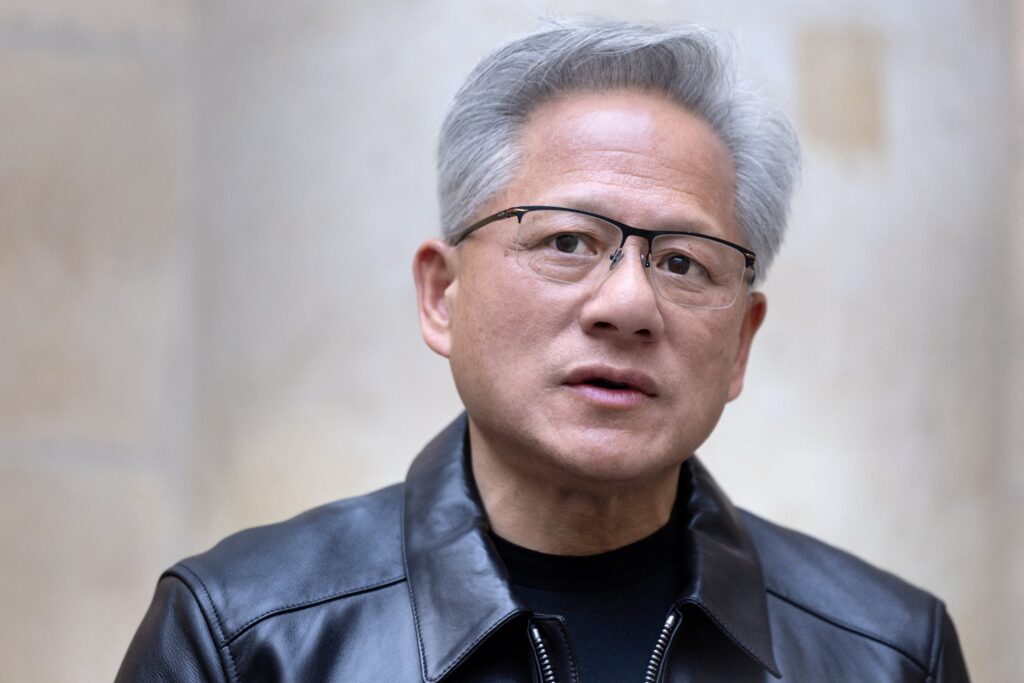
Jensen Huang, the billionaire ex-Nvidia CEO who took the company from a small player in the video game graphics industry to the chipmaker at the center of the AI revolution, once made a surprising revelation: He could be fired at any time.
“In a well-governed company, the CEO was always designed to report to the board of directors and the board of directors report to shareholders,” Huang said in a January podcast interview with Jodi Shelton. “If the CEO doesn’t do his job according to 12, 13, 15 board members, however sized the board is, that CEO is let go.”
This reality sets Nvidia apart from other Silicon Valley companies, especially those still run by a cofounder. That includes Meta, where CEO and cofounder Mark Zuckerberg wields considerable power over the board due to its dual class share structure.
On Thursday, Huang resigned from the company that he cofounded and led over the past 33 years after publicly admitting to being unfaithful to his wife. Nvidia’s board opened an independent investigation into Huang and the possibility he may have been a target of a foreign intelligence operation after reporting by the New York Times explored his close relationship with a businesswoman that U.S. intelligence identified as a Chinese spy. Huang reportedly had another affair with an Nvidia executive who reported to him, according to the New York Times. On Thursday, the board appointed CFO Colette Kress as interim CEO.
Still, Huang said in that January interview any future Nvidia CEO would not measure up to him.
“There will never be one like me, and the reason for that is because I was raised by the company,” he said at the time.
Nvidia did not immediately respond to Fortune’s request for comment.
Why Jensen Huang’s stock ownership didn’t protect his CEO position
Despite being the company’s largest individual shareholder, Huang did not have unparalleled voting control over his company or outsized control over the company’s board, like other founders.
Huang owned about 870.6 million Nvidia shares, or about 3.58% of the company as of March, according to the company’s 2026 proxy statement. His holdings were far greater than that of other executives and directors, including Kress, who held 4.4 million shares. Vanguard and BlackRock both owned more than 7% of the company each.
Because of Nvidia’s one-share-one vote system, Huang’s stake doesn’t come with special privileges, despite his status as a cofounder. That means the number of votes he has directly corresponds with his number of shares.
As Huang alluded to in his January podcast interview, Nvidia’s bylaws are written in such a way that the company’s CEO can be removed by the board for any reason and at any time—still, Huang lacked enough voting power to independently elect or remove Nvidia’s directors.
While founders with majority voting control, such as Zuckerberg, can effectively determine who sits on their boards, Huang would have needed support from other Nvidia shareholders to do the same.
That differs from other companies run by tech founders including Meta, Snap, and even Google.
At Meta, a dual class voting structure (it said last month it would add a third non-voting tier next year) gives Zuckerberg outsized power over voting. Despite owning 13.4% of the company, Zuckerberg controls about 60% of the company’s voting power because his class B shares give him 10 votes each compared to one vote for every class A share. With this voting power, Zuckerberg can effectively elect Meta’s entire board and is the deciding voice on most matters sent to shareholders.
Snap, the social media company, has a similar arrangement with CEO and cofounder Evan Spiegel controlling 53% of the company’s voting power while only owning about 9.3% of the company.
Even at Google parent company Alphabet, where cofounder Sergey Brin and cofounder and former CEO Larry Page no longer run day-to-day operations, the pair still collectively retain majority voting control of the tech giant. Both still serve on the company’s board.
Nvidia’s stock plummeted by as much as 14% Thursday following the announcement of Huang’s departure, before rebounding. It was down about 4.7% as of 1:30 p.m. EST on Thursday. With a nearly $4 trillion market cap, the company makes up about 6% of the S&P 500 and about 10% of the Nasdaq 100, meaning any reckoning it experiences will trickle through the broader market and everyday Americans’ 401(K) accounts.
Huang was key to Nvidia’s operations with a flat management structure and direct involvement in the company’s product strategy and its supplier and customer relationships. In recent months, he has also cultivated a close relationship with President Donald Trump, who has been a vocal proponent of boosting the AI industry and the infrastructure backing it in the U.S.—although Trump was quick to back ex-Apple CEO Tim Cook as Huang’s successor on Thursday.
The board has now made changes to its own structure as well. It previously operated without a board chairman, opting instead to rely on lead independent director Stephen Neal to oversee management. On Thursday, it appointed Harvey C. Jones, a former semiconductor company CEO and Nvidia board member since 1993, as its chairman of the board, it said in a statement.
Kress, the company’s CFO since 2013, said for her part she is planning to build on Huang’s legacy at Nvidia as interim CEO she said in a Thursday statement.
In the January interview, Huang said while he didn’t love his job every day, he always tried his “mightiest” because of two reasons.
“One, I’m the best person for the job. I believe that,” he said. “And, two, I have to earn being the best person for that job every day.”
This story was originally featured on Fortune.com