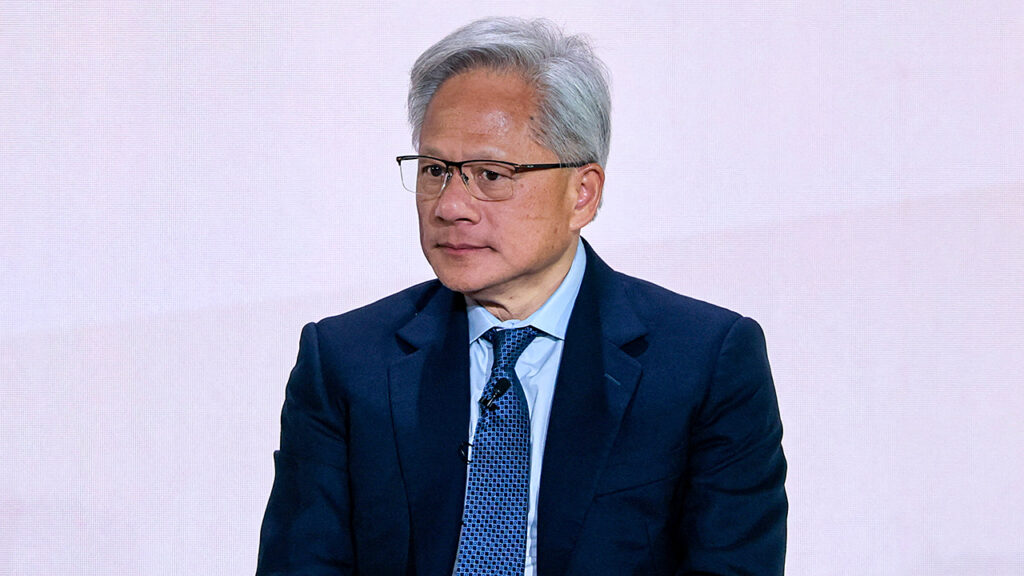
The resignation of Jensen Huang as CEO of Nvidia on Thursday roiled the company’s stock, as investors and analysts assessed the path forward for the AI giant.
Huang, who co-founded Nvidia in 1993, resigned following reports of two extramarital affairs, including a relationship with a Chinese businesswoman whom U.S. authorities suspect of spying for Beijing which prompted a board investigation. Nvidia announced that veteran chief financial officer Colette Kress will serve as interim CEO.
Nvidia shares slumped roughly 14% from Wednesday’s closing price, hitting an intraday low of $148.80 per share, before paring those losses. As of early afternoon, Nvidia stock was down just 4.3%.
Bret Kenwell, eToro U.S. investment analyst, said Huang’s leadership made Nvidia the “crown jewel of the AI trade” and he was “more than a CEO – he was part of the investment thesis,” which will prompt greater investor scrutiny of the company’s earnings report next week.
NVIDIA CEO JENSEN HUANG RESIGNS AMID INVESTIGATION INTO RELATIONSHIP WITH ALLEGED CHINESE SPY
Kenwell said, “Nvidia’s earnings already demand close attention, but they will be under an even brighter spotlight next week as shareholders and AI investors look for stability amid the uncertainty. Investors will be looking to Nvidia for a fresh read on demand and a reason to regain confidence.”
While other tech companies may look to capitalize on the situation, he said the “leadership questions do not erase Nvidia’s position as a best-in-class technology company during a transformational period for the sector.”
TRUMP SAYS ‘THERE IS ONLY ONE MAN’ TO REPLACE JENSEN HUANG AS NVIDIA CEO
James McCann, senior economist for investment strategy at Edward Jones, noted that tech and AI market segments have been increasingly volatile, with the Nasdaq delivering gains or losses greater than 1% in seven of the past 10 trading days.
“Uncertainty around the leadership of Nvidia risks adding to this sharp price action given Huang’s important role as a face of the AI boom, the lack of a clear succession plan at Nvidia, and the financial role this huge company has played in backing other parts of the AI sector,” McCann said, adding that Nvidia’s stock moves in the wake of Huang’s resignation reflected those concerns.
“Despite this uncertainty, the corporate fundamentals around the giant chipmaker are unchanged, and it remains to be seen if a shift at the top of the organization will have a material effect on strategy and execution going forward,” he said.
McCann added that the firm continues to recommend that investors avoid over-concentration risks among tech companies and should instead “look to hold a well-diversified exposure across large and midcap U.S. stocks, in the context of their financial goals and risk tolerance.”
SILICON VALLEY IS ‘A CENTER FOR ESPIONAGE,’ FORMER FBI AGENT WARNS AFTER NVIDIA SPY SCANDAL
Dan Ives, partner and senior managing director at Yorkville Ives, said Huang’s resignation marks the end of the perception that he was the “Godfather of AI, the rock star viewed as the face of the AI boom.”
Ives explained that Huang’s ouster allows the board of directors to “rip off the Band-Aid and take Nvidia into its next chapter without him after this dark moment for Jensen and Nvidia.”
He said the firm – has a price target of $225 a share along with an outperform rating for Nvidia stock – continues to have a bullish outlook for the company, in part because it “remains the clear leader in GPU chips for the AI Revolution. They are roughly 2-3 years ahead of the nearest competitor and the demand trajectory the next few years is not changing because Jensen is gone.”
Ives added the company already has a strategic roadmap built around its next family of chips that Nvidia hopes will continue to power the AI boom.
He noted that the outlook assumes headwinds and scrutiny related to business dealings with China and any loopholes in export controls, though that is a “dynamic already being factored into the stock at current valuation in our view.”