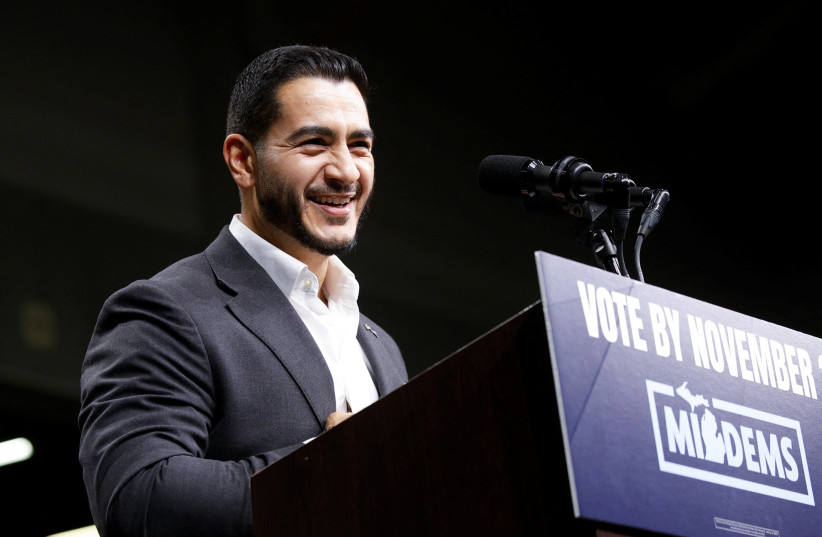
Abdul El-Sayed’s victory in Michigan’s US Senate race should raise uncomfortable questions for Israelis.
A progressive Democrat who has opposed American military assistance to Israel and campaigned alongside controversial commentator Hasan Piker has won a closely contested election.
For many Israelis, the troubling question extends beyond his victory: How can Jewish Americans support politicians whose positions are so sharply at odds with Israel’s interests, sometimes explicitly invoking their Jewish identity to justify that support?
The phenomenon extends beyond Michigan. Support for progressive politicians such as New York’s Mayor Zohran Mamdani reflects a broader ideological transformation within segments of American Jewry.
From political figures such as Chuck Schumer and Brad Lander to influential cultural personalities, progressive identity increasingly shapes political choices, often taking precedence over traditional solidarity with Israel.
For Israelis who consider the Jewish state central to Jewish identity, this can feel like betrayal. Yet for many progressive Jewish Americans, no contradiction exists. Understanding why requires recognizing that Israelis and Jewish Americans increasingly approach Jewish identity through fundamentally different frameworks.
For Israelis, Jewish identity is inseparable from sovereignty, national self-determination, and physical security. Threats from Iran, Hamas, and Hezbollah are everyday realities. A strong Jewish state represents the ultimate guarantee against the vulnerability that defined centuries of Jewish history.
For progressive Jewish Americans, however, Jewish identity often translates into a different political commitment. Healthcare, education, climate change, minority rights, and opposition to President Donald Trump and the Republican Party form their moral center of gravity.
Israel is judged through this ideological lens, and support becomes conditional upon its adherence to progressive expectations.
This difference extends to the meaning of Jewish safety itself. Israelis generally understand security through military strength and national independence.
Progressive Jewish Americans increasingly seek protection through political alliances with other marginalized communities, believing that solidarity against discrimination offers the strongest defense against antisemitism.
The difficulty arises when those alliances include movements and activists openly hostile to Israel or even opposed to Zionism.
Here lies the deeper ideological divide. Israelis overwhelmingly understand Zionism as the Jewish people’s legitimate movement for national self-determination.
Parts of the American progressive Left, however, increasingly interpret the conflict through an oppressor-versus-oppressed framework. Israel becomes the powerful oppressor, while Palestinians are incorporated into a broader narrative of systemic injustice.
Within this worldview, accusations of apartheid and Jewish supremacy have entered mainstream progressive discourse. Opposition to Israel, and sometimes Zionism itself, can consequently be presented as an expression of Jewish moral responsibility.
It would be a mistake to attribute this divide exclusively to Prime Minister Benjamin Netanyahu. Progressive activists frequently associate Netanyahu with Trump, making him an obvious political adversary.
Yet Israeli leaders such as Gadi Eisenkot, Naftali Bennett, and Avigdor Liberman hold national security positions that differ little from Netanyahu’s on fundamental questions of Israel’s survival.
Replacing Netanyahu will therefore not necessarily resolve the underlying disagreement.
American partisan politics reinforces this transformation. For Jewish voters who consider the Democratic Party their political home, opposition to Trump may outweigh serious reservations about a Democratic candidate’s positions on Israel.
Cultural shift among American Jews
American Jewry is certainly not monolithic. Many Jewish Americans remain deeply committed to Israel and actively challenge anti-Zionism. Nevertheless, the willingness of some Jewish progressives to support candidates sharply critical of Israel reflects a cultural shift that Israelis can no longer ignore.
The implications extend beyond any particular election or government. For a growing segment of American Jewry, Israel is becoming less an indispensable expression of Jewish identity and more a moral liability.
Israelis must recognize that the divide is increasingly ideological, rather than simply political. The two largest Jewish communities in the world may share a history and a peoplehood, yet increasingly disagree about what Jewish solidarity means. Their votes are merely the political expression of that deeper transformation.
Dr. Irwin J. Mansdorf is a researcher at the Jerusalem Center for Security and Foreign Affairs (JCFA).