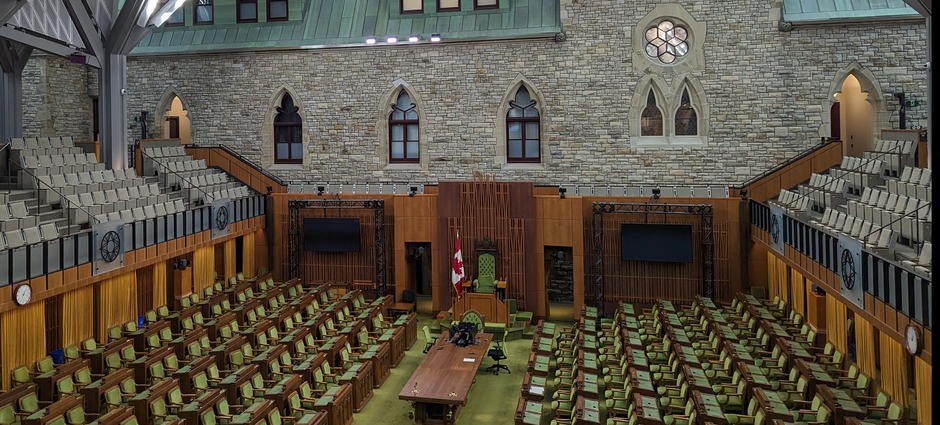
Canada’s House of Commons chamber at West Block, September 2023. Archive photo: Takipoint123 / Wikimedia Commons, CC BY-SA 4.0. Cropped and resized; adapted image under the same license.
Canada’s new federal tax and spending measures absorb 96% of the additional fiscal room projected since the spring, leaving little cushion against a weaker economy, the Parliamentary Budget Office said in a review released Tuesday, November 17.
The independent parliamentary office said Budget 2026 adds C$151.5 billion in measures over the five fiscal years from 2026-27 through 2030-31, against C$158.3 billion in improved budget capacity from economic and fiscal developments. That leaves C$6.8 billion of the improvement to reduce projected deficits over the period.
The figures describe changes in forecasts, not money already collected and sitting in a government account.
Better revenues, but most room committed
In its economic and fiscal assessment, the PBO said stronger revenue results and lower projected direct program expenses improved the starting point for the budget.
Without new measures, the deficit for 2026-27 would have been C$43.8 billion, it estimated. With the new tax and spending measures, the budget projects a C$62.3 billion deficit, still below the C$65.3 billion forecast in the Spring Economic Update.
The office cautioned that higher energy prices account for much of the improvement in the economy’s nominal dollar value, the broadest measure of the tax base. A sharper fall in those prices could reverse some of the benefit. Expected gains from business investment and productivity also depend on results that have not yet materialized.
A narrow margin for the deficit target
The government projects it will meet both of its fiscal anchors: a declining deficit relative to gross domestic product and an operating budget balanced by 2028-29.
But the PBO’s assessment of those targets identifies a tight margin. If the 2027-28 deficit were about C$2 billion larger than projected, the deficit-to-GDP ratio would stop declining. The budget’s own downside scenario adds C$3.6 billion to that year’s deficit and misses that anchor.
The starting year matters. The deficit ratio rises from 1.2% in 2025-26 to 1.8% in 2026-27. The budget assesses its declining-ratio target from 2026-27; the PBO said it would not be met if measured from the previous year.
The operating balance is projected to return to surplus in 2027-28, one year before the target. That calculation uses the government’s broad definition of capital investment, which includes some tax incentives. The PBO said applying a narrower definition consistent with national accounts would leave the operating balance in deficit throughout the five-year forecast.
Borrowing is larger than the deficit
The PBO also distinguished annual deficits from the government’s cash borrowing needs. The budget projects a cumulative C$764.7 billion financial requirement over five years, compared with C$288.7 billion in deficits.
The difference includes loans, investments and capital purchases paid for up front but recognized differently in the budget accounts. The financial requirement excludes refinancing maturing debt, so it is not a measure of total gross borrowing.
For businesses and taxpayers, the exposure is to financing costs as well as the headline deficit. The budget projects public debt charges rising to C$85.5 billion in 2030-31. Higher interest rates or weaker growth could leave less room to absorb future shocks, even while the government’s baseline forecast meets its stated targets.
JBizNews Desk | Ottawa
© JBizNews.com. All rights reserved. Unauthorized reproduction or redistribution is strictly prohibited.