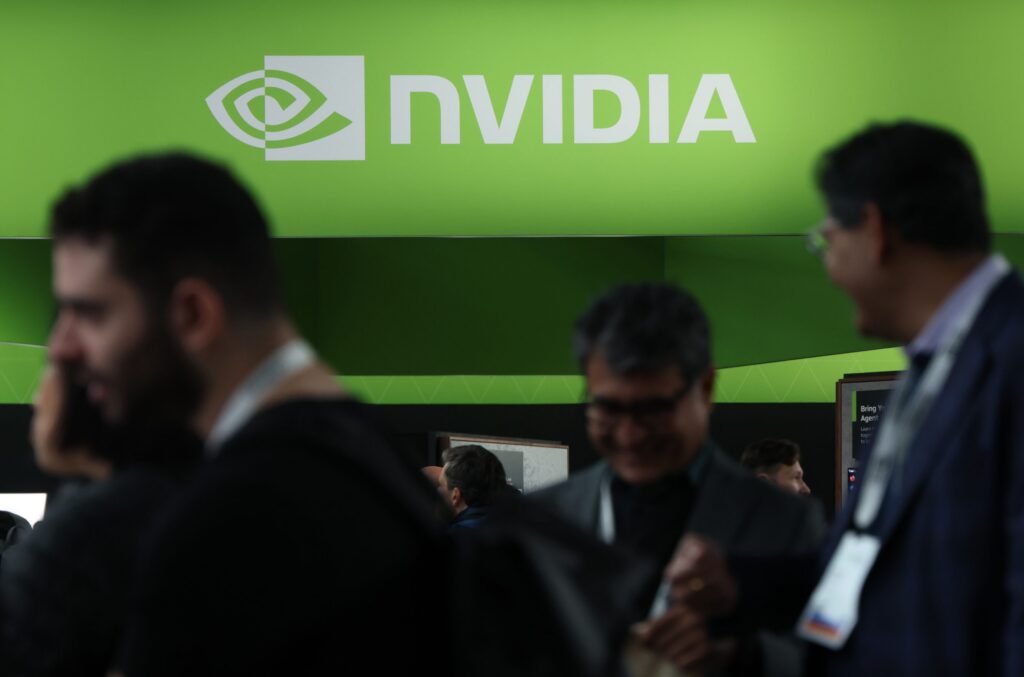
Morgan Chittum here. Nvidia posted quarterly results late Tuesday that handily beat earnings and revenue expectations—just days after Jensen Huang resigned as CEO following reports of extramarital affairs. The upheaval sent the stock to its lowest level in well over a year. The better-than-expected fiscal third quarter may give public-market investors a reprieve. But a massive question still hangs over the AI-pilled private markets, where Nvidia poured billions into investments and financing under Huang’s leadership: Will Colette Kress, the longtime CFO now serving as interim CEO, match his appetite for bankrolling the AI boom?
Before we get to that, the numbers deserve their due: Nvidia had a very good quarter. Revenue for the three months ended October 25 came in at $115.8 billion, more than double the $57 billion recorded a year earlier and above analysts’ expectations of around $109 billion. Adjusted earnings per share were $2.68, topping estimates of $2.48. The company forecasted fourth-quarter revenue of $130 billion, plus or minus 3%—a range that clears analysts’ $125 billion estimate even at the low end. Management also raised its growth forecast for the fiscal year ending in January 2028 to 75%, from 70%.
Stratospheric revenue growth, insatiable demand for chips. It’s almost business as usual for the world’s leading AI chipmaker. “Our momentum is real. Our demand is accelerating. Our supply is growing. Our customers and our partners are with us, and employees are committed. We’ve got this,” Kress said.
There’s more to the Nvidia story than blowout earnings, though. Over 33 years as CEO, Huang turned Nvidia into what some have characterized as the “central bank of AI.” It gets at the idea that Allie explored last week: Huang is AI’s ultimate key man. Under his leadership, Nvidia’s share of the global market for AI and data center GPUs swelled to north of 80%. The company also invested in 126 startups this year alone, including heavyweights like Anthropic and OpenAI. Not to mention its announced $13 billion acquisition of leading open-source repository Hugging Face.
And that’s before you get to all the financing Huang has championed. In August, Nvidia announced a memorandum of understanding—essentially a preliminary agreement—with some of Wall Street’s biggest firms: Apollo, BlackRock, Blackstone, Brookfield Asset Management, Goldman Sachs and KKR. The goal is to raise more than $500 billion in third-party capital for AI infrastructure. Those talks are still underway, Reuters reported Monday, with no indication from Nvidia of a pause. But with its chief dealmaker gone, will Kress keep the money moving?
Although earnings didn’t give us an explicit answer, Kress hinted at a more measured approach than Huang’s. The ex-CFO, who held the job for more than 13 years, said she was proud of Nvidia’s role in supporting the broader AI ecosystem. But she also said the company would “remain thoughtful” and “disciplined” in committing capital, adding that Nvidia is “rigorously evaluating” future guarantees, investments and commitments. Last week, The Wall Street Journal reported, citing people familiar with the matter, that Kress had questioned some of Nvidia’s dealmaking under Huang.
One thing Kress won’t have to worry about, however, is Huang returning to the top job.
Hours before Nvidia reported Tuesday, Huang said he’d love to have his old job back if the board asked. Board chair Harvey Jones said on the earnings call that there were no plans to reinstate him. So Huang won’t be taking the helm anytime soon—at Nvidia, at least.
See you tomorrow,
Morgan Chittum
X: @morgan_chittum
Email: morgan.chittum@fortune.com
Submit a deal for the Term Sheet newsletter here.
Joey Abrams curated the deals section of today’s newsletter.
This story was originally featured on Fortune.com