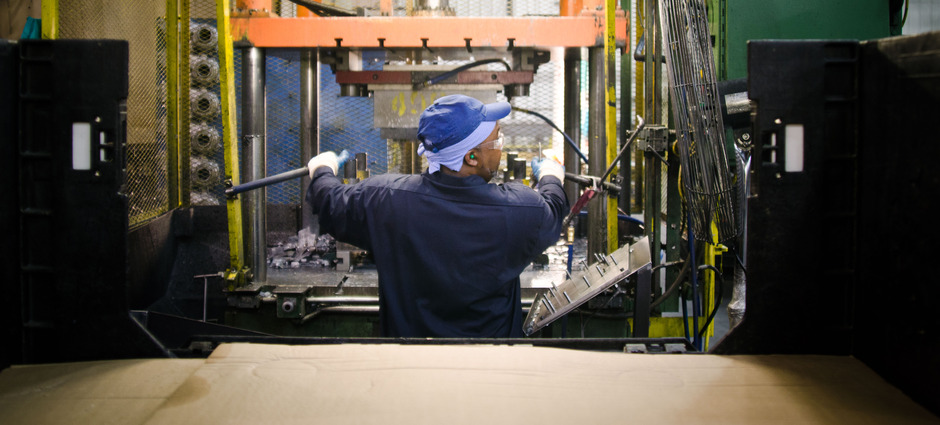
Archive photo: A worker at Port City Castings in Muskegon, Michigan, on July 20, 2011. Illustrative image, not a 2025 scene. Photo: Lance Cheung / USDA via Wikimedia Commons, CC BY 2.0. Cropped and resized.
Private industry employers reported 2.4 million nonfatal workplace injuries and illnesses in 2025, down 3.0 percent from 2024, the U.S. Bureau of Labor Statistics reported Wednesday. It was the third consecutive annual decrease and the lowest count in a data series going back to 2003.
The decline was driven mostly by a steep drop in reported illnesses, which fell 26.1 percent to 109,400 cases, bringing illness cases below their 2019 level. Respiratory illness cases fell 67.6 percent. Injuries, which make up the bulk of the total, declined 1.5 percent to 2.3 million cases.
The incidence rate of total recordable cases was 2.3 per 100 full-time-equivalent workers, unchanged from 2024. The illness rate fell to 10.2 cases per 10,000 full-time-equivalent workers, from 13.9 in 2024. On the same basis, the respiratory illness rate fell to 1.6 from 5.1.
Health care and social assistance recorded the most cases of any private-industry sector, 535,500, down 3.3 percent, at a rate of 3.2 per 100 full-time-equivalent workers. Retail trade cases fell 5.9 percent to 319,600, and manufacturing cases fell 8.5 percent to 304,200. Cases also declined in construction and in mining. Within manufacturing, transportation equipment plants reported 49,500 cases, down 13.2 percent.
Cases involving days away from work numbered 842,500, a rate of 0.8 per 100 full-time-equivalent workers. Another 558,300 cases involved days of job transfer or restriction, a rate of 0.5 per 100 full-time-equivalent workers.
Two corners of the logistics economy moved in opposite directions. Warehousing and storage cases fell 5.5 percent to 72,800, driven by fewer injury cases. Couriers and messengers went the other way, up 11.4 percent to 75,200 cases, as cases involving job transfer or restriction jumped 47.5 percent to 29,500.
Cases also rose in two smaller sectors: educational services, up 13.5 percent to 42,000, and real estate and rental and leasing, up to 41,400 cases from 34,700, with the rate rising to 2.0 cases per 100 full-time-equivalent workers from 1.6.
Nursing and residential care facilities reported 9,800 illness cases, down 60.0 percent, as respiratory cases in those facilities fell to 5,100 from 21,200. Injury cases and the injury rate in the sector were essentially unchanged.
The estimates come from the BLS Survey of Occupational Injuries and Illnesses, which is built from the injury and illness logs employers are required to keep under Occupational Safety and Health Administration recordkeeping rules. The 2025 estimates are the first compiled under the 2022 North American Industry Classification System, and BLS cautions that industry-level comparisons with earlier years should be made carefully, particularly in retail trade and information, where classifications changed substantially. Figures for mining operators in coal, metal and nonmetal mining use preliminary fourth-quarter data from the Mine Safety and Health Administration.
A separate BLS release covering fatal workplace injuries in 2025 is scheduled to follow; a date has not been announced.
JBizNews Desk | Washington
© JBizNews.com. All rights reserved. Unauthorized reproduction or redistribution is strictly prohibited.