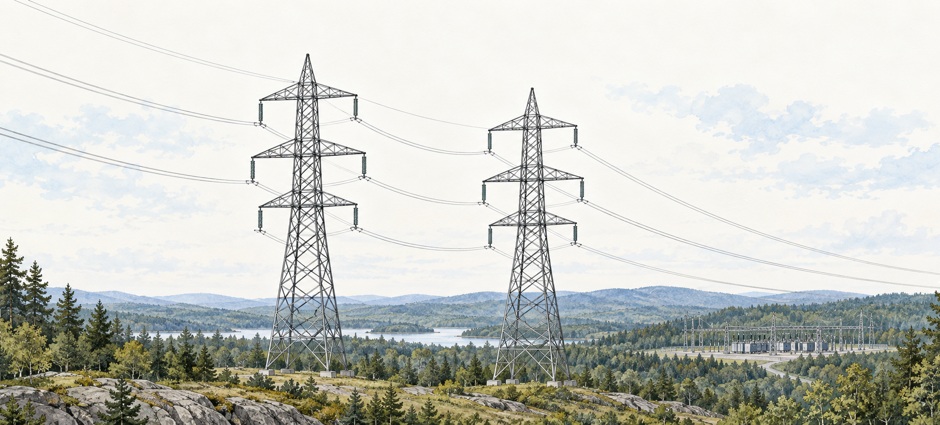
Electricity infrastructure concept.
New York’s electric grid could fall short of the resources needed to meet statewide demand reliably starting in 2033, according to a final planning assessment that calls for new supply and other measures before growing electricity use and aging power plants erode the system’s remaining cushion.
The New York Independent System Operator’s 2026 Reliability Needs Assessment, dated Nov. 17, identifies a statewide resource deficiency of about 225 megawatts in 2033, growing to about 1,850 megawatts by 2036 under its base-case assumptions.
The assessment also identifies separate, transmission-constrained needs in New York City and the Lower Hudson Valley beginning in 2032. Those local needs overlap with the statewide problem and should not be added together as independent shortages.
The findings describe future planning risks, not a current statewide power shortage or a prediction that blackouts will occur on particular dates. New generation, changes in demand and other measures could change the outcome.
Demand growth and aging plants narrow the margin
The study includes approximately 2,700 megawatts of large electricity loads that have progressed sufficiently to enter the forecast: about 1,700 megawatts from data centers and 1,000 megawatts from industrial facilities. That is a subset of more than 14,000 megawatts of large-load development requests, not an assumption that every proposed project will connect.
It also accounts for 1,471 megawatts of planned generation retirements, including 517 megawatts of New York Power Authority small gas plants after 2030. Separately, its aging-generation assumptions leave approximately 2,600 megawatts of nameplate capacity unavailable by 2036, concentrated largely in New York City and Long Island.
The figures are planning assumptions about available resources and reliability, not a count of plants that have already shut down.
Downstate constraints emerge earlier
In New York City, the modeled summer need starts at about 400 megawatts for seven hours in 2032 and grows to about 1,850 megawatts for 15 consecutive hours on the peak-demand day in 2036. The Lower Hudson Valley’s modeled summer need grows from about 130 megawatts for two hours in 2032 to about 1,950 megawatts for seven hours in 2036.
Those periods describe modeled resource deficiencies under the study’s conditions. They are not forecasts of the length of future power outages.
NYISO measures needs using an always-available capacity benchmark. The amount of actual infrastructure required depends on where resources are located, how long they can operate, fuel availability and other characteristics. A megawatt of a particular proposed project does not necessarily remove a megawatt of the modeled need.
Solutions need development time
Transmission improvements can help move electricity to constrained areas, but NYISO says in-state transmission alone cannot resolve the statewide resource deficiency. Potential responses include new generation, modernizing existing plants, energy storage, dependable demand reductions, flexible large loads, additional transmission and imports.
One sensitivity illustrates how demand can change the result: if all new planned data-center loads could reduce consumption during peak periods, the modeled statewide need in 2036 would fall from approximately 1,850 megawatts to 850 megawatts. That scenario reduces the need rather than eliminating it.
The broad findings were already discussed in draft form in a Nov. 11 NYISO update. The final assessment is a planning step toward evaluating solutions, not an announcement that those solutions have been built.
NYISO’s separate Nov. 12 winter assessment found adequate capacity for the coming winter under forecast conditions, while warning that extreme cold and fuel availability could create operational risks. That near-term outlook is distinct from the longer-term needs identified in the new report.
JBizNews Desk | New York
© JBizNews.com. All rights reserved. Unauthorized reproduction or redistribution is strictly prohibited.