Gen Z calls it “aura farming.” Live Nation calls it “being there.” The hottest idea in the AI economy belongs to a Marxist critic who wrote his ideas in exile, never saw a royalty, and died tragically—a total obscurity in his own time.
Walter Benjamin was obsessed with the subject of the “aura” in the 1930s, and he thought mass reproduction would kill it.
“That which withers in the age of mechanical reproduction is the aura of the work of art,” he wrote. “Even the most perfect reproduction of a work of art is lacking in one element: its presence in time and space, its unique existence at the place where it happens to be.”
His 1935 essay, “The Work of Art in the Age of Mechanical Reproduction,” was barely seen during his lifetime, and picked up increasing steam in the ensuing decades, at first in leftist European journals and then its 1968 English translation. Hannah Arendt, a great journalist and critic in her own right, who coined the phrase “the banality of evil” and covered Adolf Eichmann’s trial for the New Yorker, selected it for the collection Illuminations, and wrote the introduction.
The German-Jewish critic fled Germany in 1933 and spent most of the rest of the decade in exile, much of it in Paris, working on an unfinished history of the city’s 19th-century glass-roofed shopping arcades, forerunners of the mall. (He was really into arcades.) In September 1940, he crossed the Pyrenees into Spain with a small group of refugees. Franco’s police told them they would be sent back to France, and the next morning Benjamin was found dead in his hotel in Portbou. His death was officially ruled a suicide, although locals have long questioned that. The rest of his group was allowed to continue into Spain the next day.
Now Benjamin is moving from the lecture hall to the analyst notes and earnings calls.
Live Nation CEO Michael Rapino had a Benjamin-ian quote earlier this month.
“In a world of endless screens and AI-generated everything, the one thing that can’t be replicated is being there,” he said on Nov. 5, as the concert giant reported third-quarter revenue of $10.1 billion, up 19% from a year earlier, on fan attendance of 61 million, also up 19%. Through October, it had sold 170 million tickets—already ahead of all of last year.
“In a world of endless screens and AI-generated everything, real-world experiences become even more valuable,” a spokesperson for Live Nation told Fortune. “You can’t stream or replicate the energy of thousands of fans singing together as they watch their favorite artist. Being there in person is irreplaceable, and that’s driving global demand for live music.”
For executives and investors, the aura is becoming one of the few things AI can’t make cheaper, and money is following it into live seats, sports teams, and the top of the art market: anything with a time and a place attached.
Dictionary.com defines the TikTok trend of “aura farming” as “doing things with deliberate coolness, confidence, or mystique.” It went viral in 2025 with a video of an Indonesian boy dancing on the bow of a racing boat.
Defining ‘aura’
Benjamin’s argument starts with the original. Authenticity, in his definition, is everything a thing carries “from its beginning, ranging from its substantive duration to its testimony to the history which it has experienced.”
A copy can carry the image but not that history: “The presence of the original is the prerequisite to the concept of authenticity,” he wrote.
He split art’s value in two. “Cult value” belonged to the original made for ritual, which he wrote “would seem to demand that the work of art remain hidden.” “Exhibition value” belonged to whatever could be shown to as many people as possible.
“In photography, exhibition value begins to displace cult value all along the line,” he wrote.
With generative AI pushing exhibition value close to zero—a chatbot can turn out a passable image, song, or article in seconds—the premium moves to whatever exhibition can’t deliver. Cult value and exhibition value are therefore differentiators in the AI economy.
Aura is valuable in AI world
The art market shows the split. Global art sales rose 4% to an estimated $59.6 billion in 2025, still below their 2022 peak, according to the Art Basel and UBS Global Art Market Report 2026. At auction, growth was concentrated at the top. The value of fine-art lots over $1 million rose 21%, and sales above $10 million rose 30%, while sales under $50,000 fell 2%. Online sales, where art is seen as an image on a screen, fell to $9.2 billion, their lowest level since 2019.
Sports show it, too. A franchise is about as close to Benjamin’s “testimony to the history which it has experienced” as anything that trades. Private equity deals for teams went from 50 in 2018 to 192 in 2025, according to a Goldman Sachs Private Wealth Management report Fortune covered in October. The Los Angeles Lakers were valued at $360 million in 2000 and sold at a $10 billion valuation in 2025, per PitchBook data reported by Fortune’s Term Sheet. Streaming now holds about 20% of the sports media market, up from 8% in 2021, Goldman’s report further found.
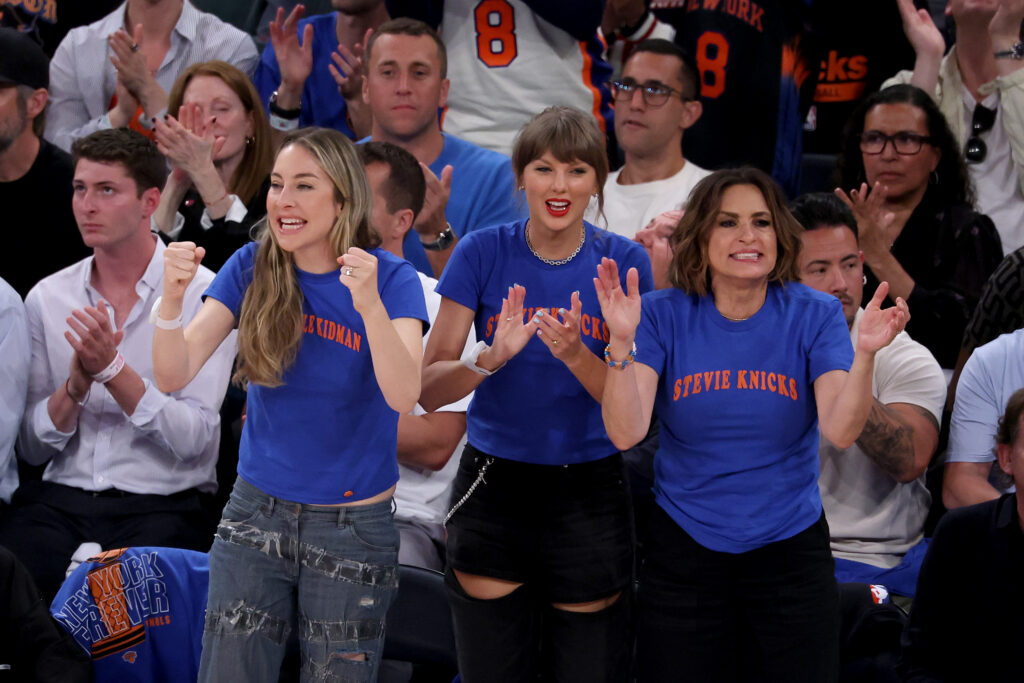
There are only 30 NBA teams and a fixed number of courtside seats, and the New York Knicks historic title in 2026, their first in 53 years, came with eyewatering price tags. On TickPick, the cheapest seats for Games 3 and 4 at Madison Square Garden went for $3,876 and $3,609, the most expensive NBA Finals tickets on record, Inc. reported. The aura was just too valuable.
Taylor Swift showed how far fans will go for the real thing. Her Eras Tour grossed an estimated $2.2 billion across 149 shows from November 2022 to December 2024 and sold just over 10 million tickets, the Associated Press reported, citing Pollstar—the highest-grossing tour of all time. It got big enough for the Federal Reserve to notice. In its July 2023 Beige Book, the Philadelphia Fed passed along a contact’s report that May had been the city’s strongest month for hotel revenue since the pandemic began, “in large part due to an influx of guests for the Taylor Swift concerts in the city,” as Fortune reported. Sports and music tourism is on track to double to about $1.5 trillion by 2032, according to a report Fortune covered in 2024.
In women’s sports, game-day revenue went from 11% of the business in 2022 to 30% in 2026, while sponsorship fell from 64% to 45%, according to Goldman’s report.
Benjamin wasn’t an aura farmer himself. He thought losing the aura could free art in a Marxist sense, making it accessible to every common man and woman. Mass reproduction, he wrote, “emancipates the work of art from its parasitical dependence on ritual.” He was writing as a man of the left, about politics more than prices.
Recorded music is the original case of mechanical reproduction, and streaming made it close to free, yet what has happened to the industry since illustrates the pull of aura. U.S. vinyl sales grew for a 19th straight year in 2025, passing $1 billion for the first time since 1983, according to RIAA data reported by Music Week. Vinyl brought in more than three times the revenue of CDs. The top seller was Swift’s The Life of a Showgirl, at about 1.6 million copies.
Broadway grossed $1.91 billion in the 2025-26 season, up 1% even though the season before ran a week longer, on 14.6 million admissions, the Broadway League said.
And writing, the thing AI copies most easily, now comes with a certificate. The Authors Guild launched a “Human Authored” mark in January 2025 for books whose text was written by people, and opened it to the public in March 2026 at $10 a book for nonmembers.
“Readers have the right to know if a text was written by AI or a human,” the Guild said. That’s Benjamin’s “presence of the original,” sold as a $10 sticker.
Rapino’s betting that it keeps speeding up. Live Nation expects nearly 180 million fans in 2026, and Rapino said the company is “on track to deliver another record year and sustain double-digit growth for years to come.” Benjamin’s essay is still free to download.
This story was originally featured on Fortune.com