

By Matthew Maunder
This is part two of a two-part series. Read part one on how AI is reshaping CRE’s traditional talent pyramid by increasing productivity and changing staffing needs, forcing firms to reconsider how they develop junior professionals and build a pipeline of future leaders.
AI changes what becomes valuable.
When analysis becomes abundant, the premium moves toward knowing what to do with it.
In CRE, that means judgment, commercial instinct, negotiation, client trust, origination, creativity and accountability should become relatively more important — not less.
That sounds positive for young professionals. Instead of spending years collecting information, they can move sooner toward higher-value work.
But there is a catch: you cannot simply tell someone to exercise judgment earlier. Judgment is generally the result of accumulated experience.
Removing low-value work is easy. Accelerating the development of high-value judgment is much harder.
The industry therefore faces a paradox: AI allows firms to expect more sophisticated thinking from junior professionals at exactly the same time that it may remove some of the experiences through which that sophistication was historically developed.
Don’t Protect the Busywork
The wrong response would be to preserve inefficient work because it has educational value.
Nobody should require an analyst to manually perform a task for four hours if technology can do it reliably in 30 minutes.
The answer is not to protect the old apprenticeship. It is to replace it deliberately.
Historically, talent development could happen as a byproduct of getting work done. In an AI-enabled organization, development will increasingly need to become an explicit part of the operating model.
Give Junior Professionals Deliberate Reps
If people encounter fewer repetitive tasks, firms need to increase the quality of their exposure.
A junior employee who uses AI to build an initial underwriting model should still be required to understand the assumptions, challenge the output, explain what could invalidate the investment case and compare the recommendation with what actually happens.
The objective shifts from producing more models to learning more from each model.
Move Judgment Earlier
AI should allow junior professionals to spend less time assembling information and more time interpreting it.
Instead of asking, “What does the analysis say?” managers should increasingly ask: What surprised you? Which assumption matters most? What could make this wrong? What would you recommend? What would change your recommendation?
That turns AI-generated capacity into accelerated development rather than simply additional output.
Make Apprenticeship Explicit
CRE has historically relied heavily on proximity and observation. Young professionals learned by sitting beside experienced ones, participating in meetings and gradually being given more responsibility.
That model becomes less reliable when technology allows experienced employees to complete more work independently.
Senior professionals therefore need an explicit role in developing people — not merely reviewing their output. Deal reviews, investment post-mortems, negotiation debriefs, client-meeting exposure and structured coaching should become part of how firms operate.
Change What Advancement Rewards
Career progression also needs to evolve.
If AI can perform more of the technical production associated with early career stages, promotion cannot simply reward mastery of producing that work faster.
Firms should distinguish between an employee who can operate AI tools and one who can use those tools to improve decisions.
The differentiators become critical thinking, judgment, commercial awareness, client impact, domain expertise and accountability.
AI proficiency matters. But AI proficiency alone is unlikely to create the next generation of CRE leaders.
The Next Talent Model
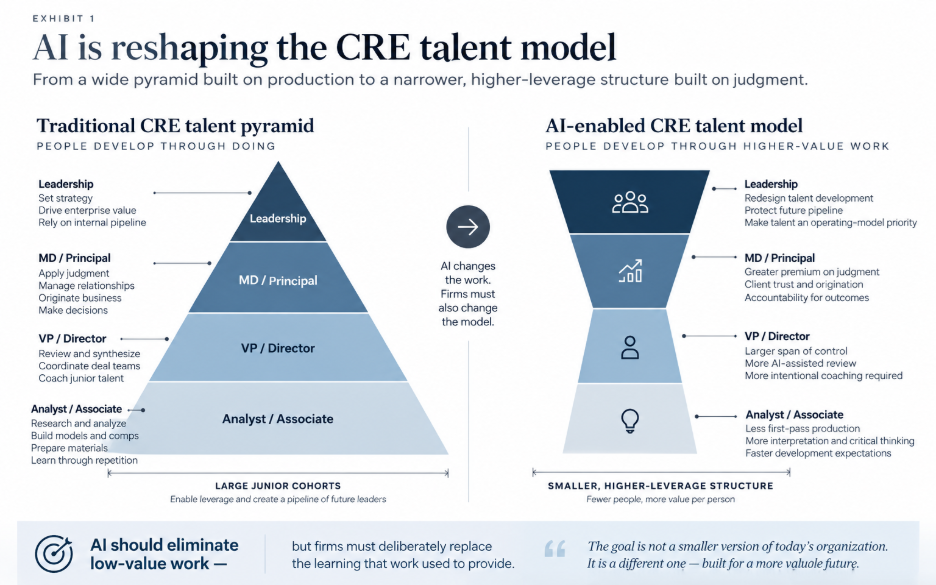
The future CRE organization may ultimately look less like a traditional pyramid and more like a narrower, higher-leverage structure.
That does not necessarily mean fewer opportunities for young professionals. It could mean better ones.
Junior employees could participate in meaningful analysis sooner. Experienced professionals could devote more time to clients, decisions and coaching. Firms could develop people based on demonstrated judgment rather than time spent completing repetitive tasks.
But that outcome will not happen automatically.
There is a meaningful difference between automating work and redesigning an organization around automation.
The firms that merely introduce AI may become more efficient. The firms that rethink how people learn, advance and create value alongside AI could build something more important: a talent system capable of producing the next generation of leaders.
CRE should absolutely eliminate work that technology can perform better. It just cannot afford to eliminate the learning with it.
Supplementary Exhibit
Source: Matthew Maunder.
About the Author
Matthew Maunder is Founder & Principal of Valent Advisory and former Global Head of Strategy & Operations at Colliers International. He has 17+ years of experience spanning Colliers, Strategy& (PwC) and RBC, focused on enterprise strategy, transformation, performance improvement and value realization.
Reference Note
Bisnow, “AI Rush Brings New Tools For CRE Analysts And Angst Over Job Expectations,” May 30, 2025. Referenced in the article to illustrate how AI can compress underwriting, market analysis and deal-deck preparation work.
The post AI Is Changing CRE’s Talent Pipeline. Firms Must Rethink How They Develop Future Leaders [part two] appeared first on Market Share.





