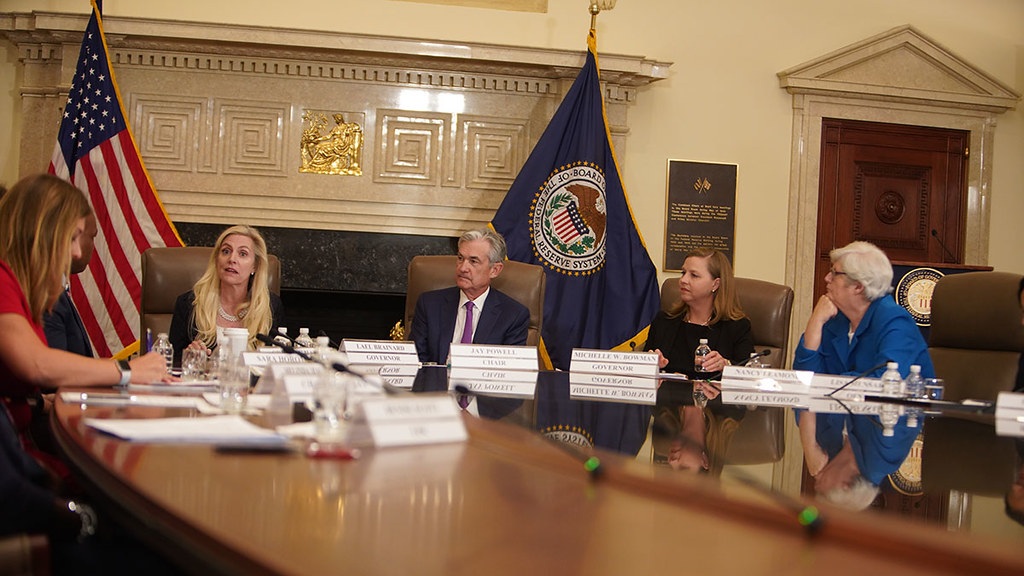
Federal Reserve / Wikimedia Commons
AI-related debt is on track to exceed $800 billion this year, Federal Reserve Vice Chair for Supervision Michelle Bowman said Tuesday, warning that complex financing arrangements could magnify the economic fallout if revenue from artificial intelligence falls short of rising costs.
In a November 10 speech to the Council on Foreign Relations in Washington, Bowman said other obligations, including long-term leases, contract commitments and residual-value guarantees, have potential payments estimated at more than three times the amount of AI-related debt.
Those figures describe debt and potential contractual payments in her assessment, not realized losses or a forecast that every obligation will come due at once.
Bowman said AI revenues are rising quickly but do not yet cover the expense of maintaining existing models and developing new models and data centers. Companies have increasingly turned to credit and equity markets as capital spending has surged, she said.
She warned that off-balance-sheet liabilities and equity investments by technology suppliers in companies buying their products can make counterparty risk harder to assess. Her discussion did not name individual companies.
If AI-related revenue fails to keep up with sharply rising costs, Bowman said the result could be a sharp correction in AI companies’ share prices, higher financing costs and reduced access to credit. Such a shock would likely slow the AI buildout and soften economic activity and inflation, she said. She described a conditional risk, not a prediction that a crash is inevitable.
Bowman also said the largest U.S. bank holding companies have some exposure to AI financing, which is examined in annual supervisory stress tests. Life insurers, pension funds, private-credit investors and mutual funds also have exposure, she said, adding that most of these entities are well capitalized and have stable funding.
On inflation, Bowman said Tuesday’s consumer price index suggests that 12-month core personal consumption expenditures inflation “likely moved up further to 3.3 percent” in October. That is her estimate based on the CPI report, not a newly released October PCE figure from the Bureau of Economic Analysis.
With the labor market improving, Bowman said she is more attentive to inflation risks. At the same time, she said the benefits of additional policy tightening must be weighed against costs to interest-rate-sensitive sectors, including housing and smaller businesses.
Bowman supported the Federal Open Market Committee’s October decision to hold the federal funds target range at 3.75% to 4%. Tuesday’s speech announced no new rate decision and set no fixed course for December. She said policymakers would assess incoming data, the outlook and risks at each meeting.
JBizNews Desk | Economy & Business
© JBizNews.com. All rights reserved. Unauthorized reproduction or redistribution is strictly prohibited.