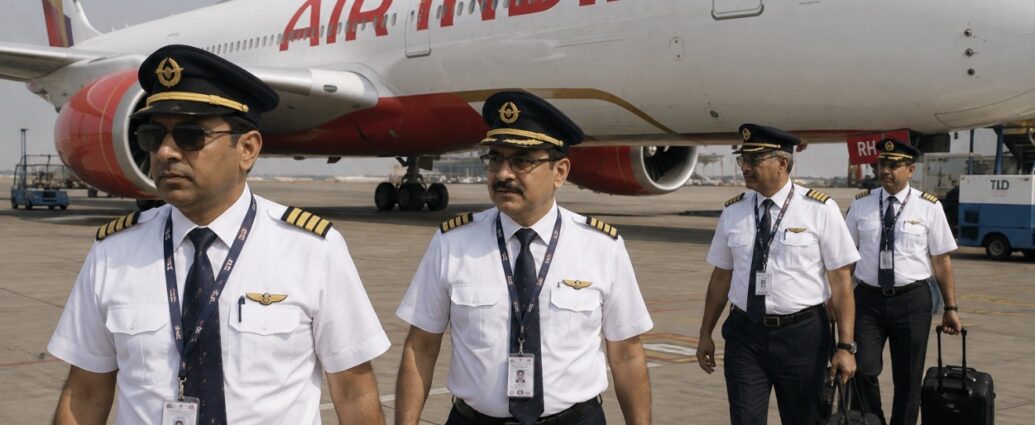
Air India began mandatory drug testing for every one of its pilots on Thursday, after the captain of an August 4 Phuket-Delhi flight tested positive for marijuana. More than 5,000 pilots at Air India and Air India Express are covered. Not a sample, not a spot check — 10 out of 10 pilots, one time.
India’s standing rule requires airlines to randomly test at least 10% of flight crew each year. That is 1 pilot in 10. Air India told pilots in a memo that it nevertheless felt it was important to go further. The random program continues under Directorate General of Civil Aviation guidelines, with Thursday’s screening layered on top as a one-time event.
American carriers run at more than double that rate, every year, permanently. The Federal Aviation Administration’s 2026 minimum is 25% of safety-sensitive employees randomly drug-tested annually, plus 10% for alcohol. That is 1 pilot in 4 for drugs and 1 in 10 for alcohol. Selections must be random, unannounced and spread across the calendar, so nobody can predict when the call comes. Board a Delta, United or American flight and there is roughly a 1-in-4 chance the captain was pulled for a surprise test in the past twelve months.
Run the math over a career and the gap widens. A U.S. pilot flying 20 years can expect about 5 random drug tests. An Indian pilot on the 1-in-10 rule can expect about 2.
The American net is also wider than the random pool suggests. Pilots are tested before hiring, after an accident, when a supervisor has reasonable suspicion, and on a follow-up schedule for years after any prior violation. The requirement covers flight attendants, dispatchers, mechanics, flight instructors, security personnel and air traffic controllers, not only the cockpit.
The tests Air India is running screen for substances and medications prohibited under aviation rules, and are being administered alongside training at the airline’s Gurugram academy, at briefing centers after flights, and at locations tied to pilots’ home bases.
The penalties separate the two systems most sharply. In India, a first confirmed positive does not automatically cancel a pilot’s license — the pilot is referred to a rehabilitation program and can return to flying after completing it. In the U.S., a verified positive or a refusal to test can cost the job and the certificate, and a second verified positive permanently bars that person from the safety-sensitive role. Marijuana counts even for pilots in states where it is legal to buy, because the program is federal.
Very little turns up. The FAA may hold the rate at 25% only if the industry-wide positive rate stays under 1%. In 2024 it came in at 0.816% — about 1 positive in every 120 tests. The alcohol violation rate was 0.131%, closer to 1 in every 800.
For U.S. travelers, the practical distinction is which carrier they are on. The federal testing rules apply to airlines certificated in the United States to operate under Part 121 or Part 135. A foreign carrier flying into Newark, Kennedy, Chicago or San Francisco sits outside that pool. Its pilots are tested under their home regulator — for Indian carriers, 1 in 10 a year, and rehabilitation rather than revocation on a first positive.
The incident that triggered the sweep is still open. Both pilots were pulled from the flying roster after mandatory post-flight screening, and India’s Aircraft Accident Investigation Bureau is treating the August 4 flight as a serious incident, with Airbus and France’s air safety investigation bureau assisting.
Air India carries reputational weight into this. The airline is still under scrutiny from the June 2025 Ahmedabad crash, and a marijuana-positive commander on a flight that also suffered a technical fault compounds it. Testing all 5,000-plus pilots at once buys a clean baseline the carrier can show passengers and regulators.
It does not move the standard. The 1-in-10 requirement remains the rule in India. Raising it would take the Directorate General of Civil Aviation, the way the FAA sets and reviews the American rate every December.
JBizNews Desk | New York
© JBizNews.com All Rights Reserved. Reproduction or distribution without written permission is prohibited.