
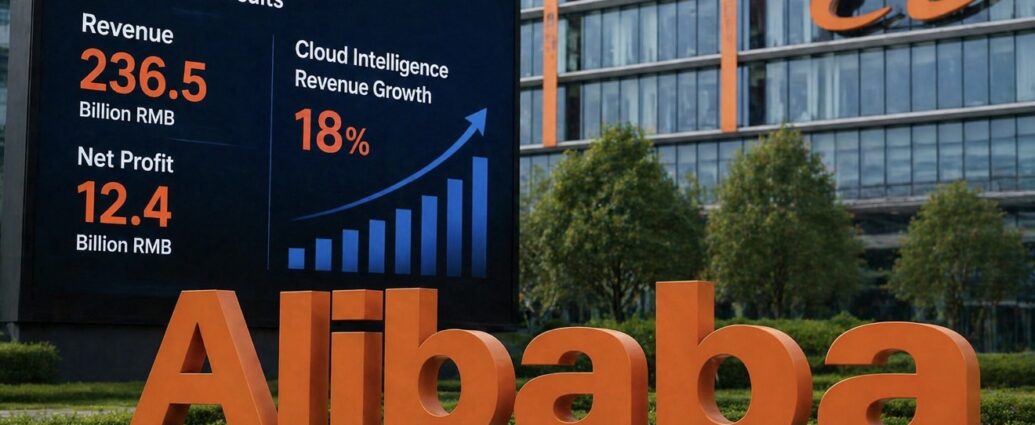
Alibaba Group Holding reported quarterly profit ahead of market expectations, giving investors a fresh sign that the Chinese technology giant’s push into cloud computing and artificial intelligence is gaining traction even as consumer demand in China remains uneven. According to Reuters and the company’s latest results filing, the group said revenue for the quarter ended March 31 rose to 236.45 billion yuan, while adjusted earnings beat analyst forecasts, helping lift its U.S.-listed shares in premarket trading and supporting sentiment around China’s internet sector.
In the earnings release, Alibaba Chief Executive Eddie Wu said the company delivered “solid results” and continued to execute against what he described as a “user-first, AI-driven” strategy, according to the company statement. The company said its cloud business returned to faster growth, with AI-related product revenue sustaining triple-digit expansion for a sixth straight quarter, a detail highlighted both in the official release and in reporting from Reuters and CNBC on the results.
The numbers matter because Alibaba has spent the past year trying to convince investors that its future lies less in low-margin online retail and more in digital infrastructure and enterprise technology. In its filing to the Hong Kong Stock Exchange, Alibaba said Cloud Intelligence Group revenue rose 18% year over year, while management attributed the acceleration to “public cloud” demand and wider adoption of AI services. Bloomberg reported that investors have increasingly treated the cloud unit as a key valuation driver, especially after the company stepped up spending on computing capacity tied to generative AI.
That shift comes at a delicate time for China’s broader economy. Retail spending and property activity have remained under pressure, and executives across the sector have signaled that consumers are still trading down. On the earnings call, as cited by Reuters, management said customer management revenue at Taobao and Tmall improved as monetization tools and software services gained traction, while the company also pointed to stronger order volume. Alibaba said its focus remains on improving merchant efficiency and user engagement rather than chasing headline growth at any cost.
International commerce also offered support. Alibaba said revenue from its international digital commerce business, which includes AliExpress, Lazada and Trendyol, continued to expand, though losses in some overseas operations remained a concern as the company invests for scale. Reuters noted that the international unit has become one of the company’s fastest-growing segments, reflecting management’s effort to diversify beyond mainland China. In the company statement, executives said they would continue “disciplined investment” in cross-border platforms, signaling that profitability, not just market share, will stay in focus.
Investors also paid close attention to capital allocation. Alibaba said it repurchased billions of dollars’ worth of shares during the fiscal year, extending a buyback program that management has used to bolster shareholder returns while the stock trades below historical highs. According to the company filing, the board has continued to authorize repurchases, and Bloomberg reported that the pace of buybacks has become an important support for the shares as Chinese technology valuations remain sensitive to policy and macroeconomic headlines. Management said in the release that the company remains committed to “enhancing shareholder returns.”
The market reaction reflected more than a simple earnings beat. Analysts have argued that Alibaba needs to show it can turn AI enthusiasm into durable revenue growth, especially after abandoning a full cloud spinoff and reshaping parts of its business structure over the past year. CNBC, citing analyst commentary after the results, said the cloud division’s acceleration and sustained AI demand offered one of the clearest positive signals in the report. At the same time, analysts quoted by Reuters said the company still faces stiff competition from rivals including PDD Holdings and JD.com in e-commerce, as well as from domestic cloud peers chasing enterprise AI spending.
Regulation remains part of the backdrop, even if it no longer dominates the investment case the way it did during Beijing’s earlier crackdown on internet platforms. Chinese authorities have recently struck a more supportive tone toward the private sector, and that has helped improve sentiment toward large platform companies. Reuters reported in recent coverage of China’s technology sector that officials have emphasized the role of digital platforms and AI in supporting growth, while companies including Alibaba have aligned their messaging more closely with national priorities around advanced computing and productivity.
For executives and investors, the next question is whether cloud and AI revenue can keep growing fast enough to offset a slower, more competitive domestic commerce market. Alibaba said in its results statement that it plans to keep investing in AI infrastructure and product development, and Eddie Wu has repeatedly described artificial intelligence as a “once-in-a-generation” opportunity for the company, according to prior public remarks cited by CNBC and Bloomberg. That makes the coming quarters critical: if enterprise demand for AI services holds up and retail margins stabilize, Alibaba could strengthen its case as one of China’s few large-cap technology groups with credible exposure to both consumption and next-generation computing.
JBizNews Asia Desk




