
European Stocks Slip as Oil Rises, Energy Shares Outperform
European stocks fell Thursday as rising oil prices and stubbornly high bond yields increased costs for businesses across the continent, although energy producers moved higher because they stand to earn more when crude becomes expensive.
The pan-European Stoxx 600 was down 0.59% at 636.15 points shortly after the opening. Most national markets were also lower. Energy shares gained 0.84%, making the sector one of the strongest performers while aerospace and defense stocks led the broader declines.
The verified market report did not establish that the Stoxx 600 had erased its loss. The index may have moved after the reported level, but describing a complete recovery without a confirmed price would risk giving readers an inaccurate picture.
Oil was the market’s main pressure point. Brent crude, the international benchmark, held above $100 a barrel as prices advanced for a second consecutive session following five days of declines.
The increase came as communications between U.S. and Iranian officials on the sidelines of the United Nations General Assembly produced little visible progress toward ending the conflict. Continued uncertainty surrounding regional production and shipping has kept a geopolitical premium embedded in energy prices.
For oil producers and refiners, that premium can translate into stronger revenue and wider margins. For much of the rest of Europe’s economy, it means higher costs.
Airlines pay more for jet fuel. Trucking and delivery companies face larger diesel bills. Manufacturers spend more on transportation, electricity and petroleum-based materials. If businesses pass those expenses along, consumers eventually encounter them in prices for travel, food and manufactured goods.
That divide explains why energy shares could rise even while the broader market weakened.
“Oil volatility is likely to continue in the near term,” Gordon Kerr, European macro strategist at KBRA, told Reuters. He pointed to the reopening of a Saudi Arabian pipeline as a positive development but cautioned that the broader supply picture was not settled.
European bond markets reflected the same inflation concern. Germany’s 10-year government-bond yield, the principal benchmark for eurozone borrowing costs, held near 3.547%, just below the 17-year high reached the previous week.
Higher yields increase financing costs for governments, homebuyers and companies. They can also weigh on stocks because investors can earn more from relatively safer bonds, reducing their willingness to pay high prices for corporate earnings.
Oil remaining above $100 could reinforce expectations that the European Central Bank will keep monetary policy tight or raise rates again. That would place additional pressure on property companies, homebuilders and other businesses dependent on affordable financing.
Company-specific developments added to the uneven trading.
Shelly Group rose about 4.4% after Schneider Electric said it intended to make a €1.2 billion, or approximately $1.4 billion, takeover bid for the Bulgarian smart-device company.
British homebuilder Vistry fell about 9% after reducing its annual profit expectations while undertaking a strategic overhaul. The decline highlighted the pressure higher borrowing costs are placing on housing demand and construction economics.
H&M dropped about 3% even after reporting stronger third-quarter profitability. The Swedish retailer said operating profit increased to 6.04 billion Swedish kronor from 4.91 billion kronor, while its operating margin improved to 10.6% from 8.6%.
H&M attributed the improvement partly to purchasing, cost controls and more efficient operations. However, investors continued looking for stronger sales growth. Quarterly revenue increased only slightly to 57.19 billion kronor, while local-currency sales rose 1%.
The retailer also said inventory increased partly because more merchandise was in transit amid global supply-chain disruptions and consolidation work within its European logistics network. That matters because excess or delayed inventory can force retailers to discount products, reducing the benefit of improved operating efficiency.
Investors were also monitoring talks in Washington between President Donald Trump and Chinese President Xi Jinping. Treasury Secretary Scott Bessent said the countries had agreed to extend their trade truce until Jan. 10.
The discussions were expected to cover trade, Taiwan, Iran and artificial intelligence. A durable trade arrangement could benefit European manufacturers and luxury-goods companies that depend on Chinese demand, although any reported agreement will require confirmation and specific implementation details before its economic effect can be measured.
For American households and investors, Europe’s market pressures are not isolated. Oil above $100 can lift U.S. gasoline, diesel and shipping costs, while higher global bond yields can contribute to more expensive mortgages and corporate borrowing. Americans with international funds in retirement accounts also have direct exposure to European shares.
The immediate question is whether higher oil prices continue lifting energy companies without causing deeper damage elsewhere. If crude keeps climbing and bond yields remain near multiyear highs, pressure is likely to spread to transportation, retail, housing and other rate-sensitive industries.
JBizNews Desk | London
© JBizNews.com All Rights Reserved. Reproduction or distribution without written permission is prohibited.

Jewish teacher in Philadelphia pretended to be Palestinian for years
A Jewish public school teacher and pro-Palestinian advocate in Philadelphia has admitted to fabricating Palestinian, Tunisian, and Black heritage to her colleagues for years, in a case that some online commenters are dubbing “the Palestinian Rachel Dolezal.”
Hannah Gann posted confessions and apologies to social media this week, following confrontations from local pro-Palestinian groups she had worked with. In her apologies, she identified herself as “a white woman with significant privilege and wealth” who has “no Palestinian or Tunisian heritage.”
A Jewish Telegraphic Agency request for comment to Gann was not immediately returned.
Two local activist groups Gann had been involved with, Philly Educators for Palestine and Racial Justice Organizing Committee, said in their own statement that Gann was also “of Jewish heritage and [part of] an Israeli settler family.” They further accused Gann of falsely claiming to be Black at various points, until they confronted her about her background days ago.
Comparisons to Dolezal, a white woman who posed as Black for years, taught Africana college courses and held a leadership role with a local NAACP branch before being exposed in 2015, spread over the Internet on Wednesday.
Gann says she ‘outright lied’ to everyone about her background
“I hid the truth or outright lied about my background to everyone in my life,” Gann, a teacher at West Philadelphia’s The Workshop School, said in her own Instagram video message on Monday. “I hid my family’s background from everyone in Philly and also hid from the people in my own family what I was doing.”
Neither of Gann’s visible social media apologies mentioned Jewish heritage. But the Philadelphia Inquirer, citing internal documents from the activist groups, reported that she had identified herself in college as a “Jewish woman with family in the occupied West Bank.”
Gann had also told colleagues her grandfather was born in Palestine, when he was reportedly born in Baltimore, according to documents cited by the Inquirer. Fellow activists accused her of having darkened her skin using makeup and fake tan and adopting a Black American accent after returning from a stint in the Peace Corps in Rwanda.
As with Dolezal, commenters accused Gann of posing as a member of a marginalized group of color to gain clout.
“When marginalization becomes a form of social currency some people will always do this,” one account under the name “regretmaxxing” wrote in Gann’s comments.
Gann had made the pro-Palestinian cause central to her identity over the years, including a teach-in at her school in 2024 to protest “scholasticide” in Gaza, the Inquirer reported. That year she also told a local media outlet that the right-wing group Accuracy in Media had displayed her name on a truck calling her “Philadelphia’s Leading Antisemite.”
Accuracy in Media, which has targeted activists in other states using similar methods, confirmed to JTA that they had also done so to Gann.
Gann remains a firm supporter of Palestinians
“Hannah Gann remains one of Philadelphia’s leading antisemites,” the group’s founder, Adam Guillette, said in a statement, linking to a video of his group’s truck displaying the message outside the school where Gann worked.
Delivering testimony to the Philadelphia Board of Education in December 2025, Gann, wearing a keffiyeh, urged them to “treat Islamophobia, anti-Black and anti-Palestinian racism just as seriously as you treat allegations of antisemitism.”
“Why are Jewish staff members’ experiences immediately assumed to indicate systemic failures, while Black, brown and Muslim students’ testimonies are treated as isolated incidents?” she continued, shortly before a board member cut off her mic.
A fellow teacher of Gann’s said on Instagram that Gann had told her, following a trip to Israel in 2023, that she had both Jewish and Palestinian people in her family, later claiming that her grandfather had been an anti-Zionist Jew born in Mandatory Palestine who left over disagreements with the direction of Israel.
“We will no longer work with Hannah, and she will no longer be welcome in any of our organizing spaces,” the pro-Palestinian groups said in their own statement.
A biography of Gann still visible on the West Philly Participatory Defense Hub, a different local organizing group, describes her as having “loved ones directly impacted by the criminal (in)justice system” and notes that she is a member of The First Unitarian Church.
In her apology, which she posted on Yom Kippur, Gann argued that her advocacy was genuine even though her persona was not.
“The fact that I lied about who I was does not mean anyone else who speaks up for Palestine is lying and does not erase the urgency of listening to voices on the ground,” she said. She added that she would be “deleting anything posted by Zionists.”

Bennett calls on Netanyahu to declare Qatar an enemy state, highlight Hamas support at UNGA
Former prime minister Naftali Bennett called on Prime Minister Benjamin Netanyahu to use his upcoming address to the United Nations General Assembly to declare Qatar an enemy state, in a post on X/Twitter on Wednesday.
Bennet accused Doha of supporting Hamas and contributing to the conditions that led to the October 7 massacre.
He said Netanyahu’s UN address would provide an opportunity to highlight what he described as Qatar’s role in supporting Hamas and its military wing.
Netanyahu must use his UN address to declare Qatar an enemy state – and expose its true face to the world.
**
We’re approaching the third anniversary of the October 7th massacre.This is an opportunity to deliver historic justice for the 1,200 Israelis murdered, the wounded, and…
— Naftali Bennett נפתלי בנט (@naftalibennett) September 23, 2026
“Qatar is an enemy – and it’s time the world recognizes this and holds it accountable,” the post read.
Bennett accused Qatar of funding Hamas, celebrating the October 7 attack, hosting Hamas leaders and supporting what he described as radical Islamist terrorism. He also accused Qatar of spreading antisemitic propaganda internationally, including on US university campuses.
Bennett says he would send proof of Qatar’s involvement in October 7
Bennett said he would send the UN secretary-general and the ambassadors of the members of the UN Security Council a document he called the “Qatar File,” which he described as a comprehensive record of evidence of Qatar’s alleged involvement in the October 7 massacre.
The former prime minister also called on Netanyahu to remove Qatar from any role in Gaza, arguing that “Qatar funds radical Islamist terror and actively works to destroy the State of Israel.”
“Netanyahu and I are political opponents, but when Israel’s security is on the line, Israelis rise above politics and unite,” Bennett wrote.
Bennett said that declaring Qatar an enemy state would receive support across Israel’s political spectrum and described the move as a step toward preventing another massacre.
He concluded by saying that Israel should “declare Qatar an enemy state, drive them out of Gaza, and defeat Hamas,” and accused Netanyahu of undermining Israel’s national security by not defining Qatar as an enemy.
“Every day Netanyahu refuses to define Qatar as an enemy – and allows them to rule Gaza – is another day that Hamas is rearming and preparing for the next massacre,” Bennet added

IDF failed to defend Paga Outpost during Oct. 7, opening door for terrorists to massacre at Be’eri
The IDF failed in its mission to defend the Paga Outpost, officially known as Magen Be’eri, during the October 7 massacre and did not prevent the area from falling into enemy hands, the military’s probe, released on Thursday, found.
The probe found that the failures at Paga Outpost reflected the systemic failures in preparedness for the attack in terms of combat equipment, the operational readiness of combat positions, and the infrastructure required for fighting.
The Infantry Brigade Combat Team (IBCT) at the location was not adequately prepared for the mission. However, the operational reality faced by the soldiers was that acts of individual heroism and noteworthy actions took place at both the junior officer and soldier level, both in the company sector and at the outpost.
In total, 22 soldiers, including officers, were murdered during the massacre at the Paga Outpost, with an additional 18 wounded in action. Furthermore, terrorists succeeded in taking two soldiers as hostages and dragged them to the Gaza Strip.
Main conclusions and investigations of the storming of Paga Outpost
The probe drew seven main conclusions from the investigation into the storming of the Paga Outpost, the IDF’s failure to defend it, and the terrorists’ success in infiltrating the nearby Kibbutz Be’eri.
Firstly, the battle at the Paga Outpost was part of a broader attack, in which hundreds of terrorists entered through a myriad of infiltration routes and succeeded in surprising the IDF soldiers stationed at the outpost.
This brings us to the second point. Up until the infiltration and subsequent massacre began, the soldiers primarily dealt with local disturbances near the perimeter border fence. This affected their mental state and motivation, as well as the system of training and drills that they undertook.
Notably, their training did not include a scenario of a simultaneous surprise attack across the Israel-Gaza border. This included not running drills or scenarios to prepare for a raid on either the outpost or Kibbutz Be’eri, the main location that the outpost is meant to defend.
Thirdly, when the massacre began, the IBCT was not sufficiently prepared to defend the outpost; it lacked equipment, operational readiness, and infrastructure. This is despite the fact that Paga Outpost was designed and constructed to be a combat outpost comprising all necessary infrastructure and components.
Fourthly, the terrorists’ infiltration, along with mitigating the sector’s force multipliers, including intelligence collection capabilities and defensive firepower, enabled terrorists to both penetrate Paga Outpost and infiltrate Kibbutz Be’eri.
Fifthly, the terrorist infiltrators attacked the sector’s intelligence collection capabilities and the tank platoon poised to aid the outpost in its defense of the area. Subsequently, the terrorists succeeded in destroying a significant portion of the sector’s defensive components.
Sixthly, Israel Air Force soldiers attacked the area of the Paga Outpost during the raid, but most of the IAF strikes were ineffective due to gaps in coordination with the ground forces.
Lastly, the commanders fell during battle, which affected the decisions that were made and the manner in which the battle was managed. This was exacerbated by the fact that the company commander was unable to reach the command center.
The IDF soldiers who fell defending Paga Outpost included: Capt. Dekel Suissa, St.-Sgt. Tomer Barak, Sgt. Ido Bienenstock, Sgt. Habib Kayan, Sgt. Itamar Cohen, Sgt. Lior Azizov, St-Sgt. Idan Raz, St.-Sgt. Shalev Barnes, St.-Sgt. Itai Glisko, St.-Sgt. Yakir Levi, St.-Sgt. Dolev Amoyal, Sgt. Roi Peri, St.-Sgt. Itamar Ben Yehuda, and St.-Sgt. Chaim Meir Eden.
IDF kills terror cell leader responsible for Paga Outpost attack in Dec. 2024
In December 2024, the IDF and Shin Bet (Israel Security Agency), conducted a joint operation to kill Fahmi Salami, commander of Hamas’s Nukhba Brigade in its Zeitoun Battalion.
Salami was the commander of the terror cell that attacked the Paga Outpost.
In 2025, Israeli media reported that approximately 150 terrorists were involved in the attack on the Paga Outpost, with dozens being killed by the IDF on October 7.
What happened in Paga Outpost during the October 7 massacre?
The IDF, as part of its probe, published a timeline of the events at Paga Outpost during October 7, 2023.
At 5:30 a.m. on October 7, a group from the Golani Brigade’s 13th Battalion carried out its “dawn alert” exercise, according to standing orders and the situational assessment known at the time.
Between 5:30 and 6 a.m., the deputy commander of the company positioned at the outpost gave his daily briefing to the forces carrying out operational missions. The briefings were attended by armored personnel carrier-based reconnaissance soldiers, an alert response force, and a command post force.
At the conclusion of the briefing, the commander traveled to the IBCT at Sakhaf Valley to check its state of readiness. Additionally, the mortar platoon sergeant briefed the forces positioned in the outpost’s mortar compound.
The infiltration and subsequent massacre began at 6:29 a.m.
Phase I: Beginning of the terror attack and activity of the forces in the sector (6:29 a.m. until 6:55 a.m.)
At 6:29 a.m., sirens sounded throughout the sector, and all soldiers present at the outpost, including those from mortar platoons, entered protected areas throughout the outpost. Commanders designated the fortified dining hall as the company assembly point.
At 6:30, the tank commanded by Sakhaf Valley’s IBCT commander ordered another tank to move along the perimeter fence toward a specific position. The IBCT commander’s tank mobilized to another position along the fence.
At 6:31, the deputy commander of the Paga company ordered the Sakhaf Valley’s IBCT to board the Namer Armored Personnel Carriers and tanks. The deputy company commander’s command outpost moved from the command post vehicle to a Namer APC. This vehicle remained at the Sakhaf outpost, where the tracker was apparently waiting for the forces to arrive. After several minutes, when the tracker had not arrived at the command post Namer, the soldiers went out to search for him, but were not successful.
By 6:32, the deputy commander of the Paga company ordered the IBCT tank’s commander to move to the same position it had previously moved to, this time with added cover from a Namer APC, and to open fire at any armed individual who crossed a certain point.
At the same time, the mortar platoon’s sergeant ordered his soldiers to prepare combat equipment, board the APCs, and prepare the APCs for mortar fire, after receiving reports over the radio that the terror attack was a “complex event.”
The platoon sergeant ordered the reconnaissance vehicle force to close the guard post and arrive at the fortified dining hall.
At 6:33 a.m., the alert response force that was stationed near the ANZAC memorial in the Be’eri forest traveled to Paga to take shelter in a protected area. The guard at the rear gate moved to shelter in the concrete cylinder near his position and took shelter in a pillbox after several minutes.
At 6:41 a.m., the deputy commander of the Paga company ordered the IBCT tank commander to open fire at terrorists attempting to cross the fence. Several terrorists were successfully hit in this defensive action.
However, anti-tank missiles were fired at the other tank mobilized to the perimeter fence after it identified four terrorists crossing the fence and received authorization to open fire.
Approximately two minutes later, the IBCT commander’s tank was hit by an enemy drone that was launched with a rocket-propelled grenade (RPG) warhead attached to it. As a result, the tank suffered a mechanical malfunction and became stuck in position. The IBCT commander requested an immediate evacuation.
At 6:45 a.m., a tank commanded by St.-Sgt. Shay Levinson closed in on enemy positions and killed 10 terrorists whom Levinson had identified crossing the fence both on foot and in vehicles.
At the same time, the mortar platoon sergeant requested that the battalion command post provide targets to strike with mortar fire.
By 6:49, terrorists had begun firing towards the walls of the outpost from Sakhif Hill.
At 6:50, the IBCT commander’s tank reported that the malfunction made it difficult to move and required towing. He also requested the deputy commander of the Paga company to send troops to secure his position.
The deputy battalion commander, who was acting as sector commander at the time, came on the radio at 6:51 a.m. and authorized the mortar platoon to fire shells into the Gaza Strip in response to the terror infiltration. At the same time, a soldier secured in the pillbox position at the Paga Outpost’s guard position noticed terrorists firing from Sakhif Hill. The soldier, who did not have radio communications, left the position, ran to the outpost, and entered the dining hall.
Upon arriving at the dining hall, he passed the information to the soldiers stationed there, and in turn it was passed to the outpost commander.
At this stage, soldiers who were in the dining hall were already carrying combat equipment, while others were equipping themselves. The platoon commander issued orders to reinforce the positions and other openings in the outpost.
At 6:52, the deputy company commander updated the outpost commander about terrorists mounted in vehicles who were approaching the outpost and ordered soldiers to reinforce combat positions in order to prevent an infiltration, while maintaining reserve forces for a counterattack on the terrorists. The outpost commander acted accordingly and reinforced defensive positions.
Phase II: Enemy infiltration into the outpost and managing the battles (6:55 a.m. until 8:34 a.m.)
At 6:55 a.m., events worsened as nine terrorists succeeded in infiltrating the outpost through the APC guard post, alongside attacks from terrorist fire coming from Sakhif Hill.
The deputy commander of the Paga company informed the IBCT tank commander that he was unable to come assist, and could only evacuate him after fighting with terrorists ended.
By this point, the tank continued to engage and kill infiltrating terrorists until it ran out of ammunition, despite being mechanically disabled from maneuvering.
At 6:56, the other tank, which had charged terrorists near the perimeter fence, was hit by an anti-tank missile. All crew members, except the driver, were seriously wounded.
At this point, the tank stopped, and terrorists abducted the tank’s commander. The driver then requested urgent evacuation, and despite not being sure of his exact location, said that he left the “Burma Axis” to move away from the border.
At 6:57 a.m., approximately nine terrorists infiltrated the outpost and split into three squads.
One terror squad attacked the mortar compound from the west, the second opened fire from the northeast, and the third attacked the entrance to the outpost and mortar compound.
Approximately 10 terrorists opened fire and threw grenades at the mortar platoon, who acted quickly to kill four of the terrorists. However, one soldier fell during the encounter, and several others were wounded, including the platoon sergeant.
At the same time, the tank driver reported that he had successfully left the site of the anti-tank missile attack, telling others that the entire crew had been hit, and that he was moving southeast, but found it difficult to orient himself amid the chaos.
After the encounter with the terrorists, the mortar team moved to Paga Outpost through the rear entrance to the gathering point for wounded soldiers, while evacuating the wounded platoon sergeant.
Meanwhile, the battle between the terrorists and mortar platoon continued, during which another two soldiers were murdered. Two other soldiers extricated themselves and took shelter under an APC.
Additionally, two other soldiers fell during this encounter, one at the scene, and another who was seriously wounded and died several months later.
By 7 a.m., the soldiers who had gathered at the company assembly point received orders from the platoon commander, who had taken command of the outpost. The soldiers went to reinforce positions in order to defend the outpost.
One squad, under the command of the platoon commander, covered the western side and the entrance to the mortar platoon’s position. The second squad, commanded by the platoon sergeant, headed southwest.
Several soldiers were wounded in encounters with terrorists and evacuated to the dining hall.
At 7.01, soldiers requested urgent reinforcements over the company radio. At the same time, a tank was hit by anti-tank fire from the terrorists, who infiltrated the outpost’s perimeter in an additional position.
The deputy commander of the Paga company instructed that wounded soldiers be evacuated to the assembly point in the dining hall.
At 7:12, an APC arrived at the outpost. By this stage, the tracker who remained at the Sakhaf outpost was hit by an infiltrating terrorist. They were later declared as having fallen in combat, with their remains taken into the Gaza Strip by terrorists.
At 7:13, soldiers positioned at the outpost engaged terrorists moving on foot towards the northern side of Paga. By this stage, soldiers had formed pairs to provide cover to the bunker entrance, guard post, and southwestern corner of the outpost, respectively.
During a situational assessment, the outpost commander informed the Paga company’s deputy commander about an encounter with terrorists, noting that some soliders were missing certain key items of combat equipment.
At 7:15, the APC arrived at Paga Outpost, and terrorists who had reached the mortar platoon’s compound withdrew northwards on foot. By 7:21, the APC had completed a patrol around the outpost and mortar compound, including locating, firing at, and killing terrorists.
Several calls took place between commanders and soliders operating at the outpost between 7:34 and 7:56 a.m., during which reports and updates of the situation on the ground were communicated, and immediate assistance and evacuation of wounded soldiers were both requested.
At 7:43, the Israel Air Force sent an aircraft to conduct a disruption strike on the northern side of the outpost, aiming to hold back further attempts at terror infiltration.
At 7:49, soldiers identified a terrorist inside the pillbox at the rear guard post. The Paga company’s deputy commander ordered that soldiers fire a shoulder-launched missile towards the terrorist. The outpost commander and two soldiers mobilized to retrieve the missile and moved to a firing position northwest of the outpost; however, terrorists opened fire on them, and one of the soldiers was killed while en route.
At 8:26 a.m., the IBCT commander’s tank again requested reinforcements over the radio. The Paga company’s deputy commander once again said this would not be possible due to infiltrating terrorists, and said that he would attempt to open protective fire to prevent terrorists from coming closer to the damaged tank, despite the APC also being under attack at the time.
Phase III: Gathering wounded soldiers and continuing the fight against infiltrating terrorists (8:34 a.m. until 10:21 a.m.)
At 8:34, the outpost commander ordered a soldier to bring forces closer towards the company assembly point.
By 8:57, the APC had moved to the mortar compound and managed to evacuate two wounded soldiers into the vehicle.
At 9:19, the Paga company’s deputy commander discussed with the outpost commander a plan to evacuate wounded soldiers into the dining hall using APCs.
The plan they formulated had two stages. First, two APC drivers would transfer into two APCs parked in the compound. Second, soldiers in the outpost would board the two APCs near the outpost’s front guard post.
From 9:23 to 9:27 a.m., the APC commander explained the plan to the outpost commander and emphasized that he would lead the operation and bear overall responsibility. The APC commander also requested that the outpost commander remain available via radio communications and be prepared to act.
At 9:34 a.m., soldiers positioned at he company assembly point began evacuating wounded soldiers on stretchers towards the dining hall entrance.
A few minutes later, the APC entered the armored vehicle in reverse, near two other parked APCs. During this movement, the soldiers identified a terrorist approaching, before they succeeded in attaching an explosive charge to the APC’s rear door before fleeing.
The APC’s firing slut was malfunctioning, so soldiers were unable to open fire at the terrorist. The charge then exploded, and caused a malfunction in the APC’s rear entrance door.
A decision was made to evacuate from the armored vehicle compound following this incident, with the APC moving toward a point south of the outpost.
At 9:41, the APC commander updated the outpost commander that the plan had failed, and that an alternative plan was under consideration. At this stage, soldiers at the outpost returned inside with wounded to the dining hall, where initial medical treatments were underway.
At 10:11 a.m., the APC left the covering position towards the north. Several minutes later, the APC soldiers spotted and identified approximately 20 terrorists near Sakhif Hill and opened fire at them.
At 10:21, the deputy company commander ordered the APC to move east toward orchards after the heavy machine gun ammunition ran out. The APC moved eastwards and stopped after several hundred meters.
Phase IV: Fighting at the outpost (10:25 a.m. until 4:20 p.m.)
At 10:25 a.m., the outpost commander ordered all soldiers to gather at the company assembly point, understanding that the outpost force was at an operational disadvantage. Terrorists opened fire at soldiers who left the command post on their way to the assembly point.
At 10:27, a combat helicopter arrived in the sector and opened fire to disrupt terrorist activity.
At approximately 10:35, the outpost commander and his pair partner provided cover for soldiers moving toward the assembly point. They encountered several terrorists at the guard post.
During this encounter, the outpost commander was wounded in his hand, but continued to close in on terror infiltrators. The two soldiers killed several terrorists during the encounter before falling in combat later.
At 11 a.m., terrorists attempted to infiltrate the outpost via the mortar platoon’s entrance. Soldiers manning a covering position withdrew towards the western pillbox.
Between 11:30 and 11:35 a.m., an IAF unmanned aerial vehicle attacked near the dining hall and other parts of the outpost, killing several terorists. This successfully disrupted the terrorists’ attack on the company assembly point.
At 11:45, another exchange of fire took place, during which at least one terrorist was killed. At this time, six soldiers formed a unified force under the command of the platoon sergeant, who spoke with the company commander. The commander, who was at Sa’ad Junction at the time, updated the sergeant on the operational situation and said that the force was under heavy fire from all directions.
In light of the situation, the platoon sergeant decided to break contact with the outpost.
At 11:50, the unified force began moving in a secured formation through the exit opening in the wall toward the front guard post. During its movement, the force identified and killed a terrorist. Afterwards, the company commander instructed the sergeant to link up with the APC outsie the outpost.
From noon until 12:15 p.m., the sergeant’s force succeeded in linking up with the APC commander. At the same time, soliders in the dining hall dragged tables and other equipment to block openings and engaged in prolonged fighting with terrorists who attempted to infiltrate, including by throwing grenades and shooting at soldiers.
At 1 p.m., terrorists set fire to both sides of the dining hall. Soldiers inside began to suffer from smoke inhalation, suffocation, and clouded consciousness as a result.
At 1:10 p.m., a soldier exited the western opening of the dining hall and killed two terrorists.
By 1:13, five soldiers decided to leave the dining hall and fight terrorists outside. Two of the soldiers went toward the kitchen while three went toward the lounge area of the outpost. All five fell in close combat against a large number of terrorists who were positioned at the dining hall exits.
At 1:19 p.m., a combat helicopter opened fire at the terrorists’ pickup truck which was moving through the outpost, but were unable to hit it. The pickup truck broke out of the outpost and fled.
Phase V: Arrival of rescue forces and reinforcements (4:20 p.m. until the evening of October 7)
At 4:20 p.m., a rescue force, including counterterrorism soldiers from the IDF’s “Lotar” unit, and officers from the Golani Brigade arrived at the outpost.
These reinforcements cleared the outpost, linked up with soldiers within, and evacuated both the wounded and the fallen.
No terrorists remained in the compound when the rescue forces arrived.
The rescue force returned for a second time to collect the remains of the fallen during the evening, at which time a soldier was killed by an anti-tank missile that hit the rescue vehicle.

Most Americans say US not winning Iran war as Trump approval falls – poll
Nearly two-thirds of Americans believe the United States is not winning the war with Iran, while approval of US President Donald Trump’s handling of foreign affairs has fallen to a new low, according to a CNN poll conducted by SSRS and released Tuesday.
The poll found that 64% of Americans said the US was not winning the war, compared with 36% who believed it was.
Trump’s handling of the conflict received approval from 26% of respondents. His broader handling of foreign affairs received 29% approval and 71% disapproval, the lowest foreign policy approval rating recorded for Trump in a CNN poll across either of his presidential terms.
The decline was particularly pronounced among Republicans.
Sixty percent of Republicans approved of Trump’s handling of the situation in Iran, down 13 percentage points from 73% in March, according to the poll.
Republican support for Trump’s handling of Iran drops
CNN reported that Democrats and independents had already registered lower levels of approval, meaning the more recent decline was driven largely by changing views among Republicans.
The poll was released as Trump attended the United Nations General Assembly in New York, where Iran and the ongoing war featured prominently in his foreign policy agenda.
Trump addressed the General Assembly on Tuesday, saying Iran must not be allowed to obtain a nuclear weapon and raising the prospect of either reaching an agreement with Tehran or further military action.
US, Iran hold indirect contacts at UNGA
The polling comes as Washington and Tehran have resumed indirect contact after months without talks.
US envoys Steve Witkoff and Jared Kushner communicated with Iranian Foreign Minister Abbas Araghchi through mediators on the sidelines of the UN General Assembly on Wednesday, The Jerusalem Post reported.
The contacts were the first between the two sides since an interim ceasefire agreement collapsed in July.
Trump described the meeting between US officials and Iran’s mediators as “very productive” and said he believed there was momentum toward an agreement.
Iran, meanwhile, communicated conditions through Qatar that included an end to the war on all fronts and an end to what Tehran described as US “acts of aggression.”

US says China trade truce extended as Trump welcomes Xi in first visit of three years
US President Donald Trump welcomed Chinese President Xi Jinping to Washington on Wednesday for a three-day visit that will test relations between the superpowers as tensions simmer over trade, technology, Taiwan and Tehran.
Xi’s first trip to the US in nearly three years was not expected to deliver major breakthroughs, but Washington and Beijing could extend their 11-month trade truce.
Treasury Secretary Scott Bessent said they had reached a deal on an extension as Trump greeted Xi personally at Joint Base Andrews in Maryland after the Chinese leader’s arrival, underscoring the visit’s importance.
China’s embassy in Washington had no immediate comment.
At the arrival ceremony, the leaders and their wives shook hands, spoke for a few minutes, and stood for pictures as a military band played, cannons blasted, and a B-1 military bomber flew overhead.
The welcome marked the first time in 11 years that a US president has greeted a foreign leader at Joint Base Andrews, according to C-SPAN, which tracks presidential events. The last such reception was for Pope Francis in 2015 during Barack Obama’s presidency.
Positive signals on trade could soothe markets
A trade deal, even a limited one, could soothe global markets shaken by a 2025 tariff war that led to triple-digit levies between the world’s two biggest economies. Bessent told Fox News’ “Special Report” that the deal would extend the truce through January 10. It had been set to expire on November 10.
Deep differences remain. The two countries are at odds on issues including export controls on rare-earth minerals and computer chips, China’s ties with Iran and US support for Taiwan.
The meeting comes at a difficult moment for Trump, who faces falling approval numbers as public discontent with his war on Iran grows. Xi, while also facing challenges at home, arrives in a seemingly stronger position, with his country’s trade engine roaring. Some Republicans regard Beijing as an existential threat and are wary of Trump’s friendly outreach to China’s ruling Communist Party.
People familiar with the plans said Xi was likely to forcefully raise Beijing’s claim to Taiwan, a topic Washington would prefer to avoid, while Trump was likely to maintain firm US export controls despite Xi’s objections. It was unclear whether Beijing would help Trump break a stalemate in the conflict with Iran.
But talks set for Thursday could nonetheless yield deals to lower tariffs in specific sectors, cooperate on drug trafficking and expand military-to-military dialogue. Trump is expected to seek the release of some Americans and others detained in China, according to the people.
The two countries could also agree to talk more on AI, where they are in fierce competition despite growing dangers.
The leaders themselves may not feel they need to compromise, analysts said.
“The president very much believes that over time the US economy is going to grow, the US will get stronger,” said Edgard Kagan, a former White House official now with Washington’s Center for Strategic and International Studies. “I think when Xi Jinping sits down with Donald Trump, he very much believes the US is in hurtling decline, and that time is on China’s side.”
State dinner with AI chiefs
Additional fanfare during the trip is due to include a state dinner with tech luminaries, a White House military ceremony including jet flyovers, and a visit to the National Archives where the original Declaration of Independence and Constitution are housed.
The state dinner on Thursday is expected to bring together chiefs of companies important in both markets like Apple’s Tim Cook, Nvidia’s Jensen Huang, and OpenAI’s Sam Altman.
Despite their deep disagreements, both countries pressed ahead with the summit, which, analysts said, seeks to project stability between the world’s biggest factory and its biggest consumer.
As in their prior two meetings since 2025, the leaders are planning a highly scripted public spectacle. Instead of a joint press conference or statement at the end, the countries are expected to issue dueling announcements highlighting what each side hopes to convey to a domestic audience.
For Trump, the trip caps a week of diplomacy that began with a two-day stay in New York for the United Nations General Assembly. Nearly seven months of war with Iran have spiked energy prices in the US, and the president’s Republican Party faces tough prospects in November’s congressional elections.
Xi has overseen a surge in China’s foreign trade but faces weak household spending and a property market downturn. Sweeping corruption and discipline crackdowns in the military have helped cement Xi’s power but also raised questions about the People’s Liberation Army’s readiness.
Another meeting between Trump and Xi is seen as likely this year, potentially at the Asia-Pacific Economic Cooperation summit in China in November or the Group of 20 meetings in the US in December.

Boy George stands with Israel, so where are the rest of the world’s artists? – editorial
Nine years ago this week, Chrissie Hynde, the leader of the world-famous rock band The Pretenders, took to the stage at Tel Aviv’s Menorah Mivtahim Arena, waving a giant Israeli flag, as the appreciative crowd in the sold-out venue roared its approval.
Imagine a similar scene taking place today, because that’s what one would have to do, as the actuality of it happening – with Hynde or with anyone else of her stature – is virtually unfathomable in the post-October 7 massacre demonization of Israel that has taken place globally.
Israel has virtually – at best – been shunned by the international artistic community; at worst, exercised by the Mark Ruffalos and Javier Bardems of the world, it has become the stomping ground for accusations and half-truths bordering on rabid antisemitism.
More nuanced, and perhaps even more worrisome, is the black hole that British pop superstar Ed Sheeran fell into for trying to diffuse the whole Macklemore “Free Palestine” cancellation scandal that made headlines worldwide.
Sheeran attempted to express understanding and empathy for both sides in the conflict, saying: “What happened in Israel and at the Nova music festival on October 7th was horrific and compounded centuries of Jewish pain.”
Even though he then implied that Israel was responsible for the “catastrophic and unjustifiable and disproportionate” situation in Gaza, Sheeran was vilified by the pro-Palestinian community.
That’s why when an artist shows full frontal support for Israel – in words and actions – it’s vital to point it out. American comedian and actor Michael Rappaport and British 1980s pop singer Boy George have unabashedly stood by Israel since the October 7 massacre. Rappaport has visited and performed in the country numerous times, and he’ll be returning next week to headline the biannual Comedy for Koby comedy series throughout the country.
The non-Jewish George this year released a song – “We Will Dance Again” – in which he eulogized the victims of the Supernova music festival, criticized those who claim Israel has committed genocide in Gaza, and declared: “I stand with the Jews.” On Tuesday, he announced that he’ll be coming to Israel in November to perform in Tel Aviv.
Rappaport, George, along with a paltry few others, have bucked the trend and put their consciences ahead of their careers by not hiding their heads in the sand. Which raised the disturbing question: Why haven’t more artists – Jewish and gentile – done the same?
Where are Bob Dylan, Paul Simon?
Where has Bob Dylan been the last three years, or Paul Simon, two of the most influential Jewish artists of the 20th century? They know very well that Israel doesn’t deliberately kill Palestinian children or commit genocide. They easily could have showed up with an acoustic guitar and given a morale boost to the country, much like Leonard Cohen did during the Yom Kippur War in 1973.
On the contrary, Simon’s only public expression since October 7, 2023, was to sign a petition calling for the release from prison of Marwan Barghouti, who is serving multiple life sentences for the murders of Israelis. Dylan has been silent.
Likewise, why hasn’t Madonna – who has visited Israel numerous times – made a quick visit to Tel Aviv and shown the world that even if Israel may have made mistakes over the last three years, it still is a country that doesn’t deserve to be demonized for defending itself?
Why hasn’t U2 frontman Bono – who so eloquently eulogized the victims of the Supernova music festival from a US stage and who has appeared in Israel – made a symbolic visit?
Easier to stay silent than to address Israeli-Palestinian conflict
Sometimes, as Ed Sheeran learned, it’s easier to say nothing than to wade into the minefields of the Israeli-Palestinian conflict – which makes those who do jump in and stand with good vs evil all the more admirable.
In November, when he performs at the same arena that Hynde did nine years ago, George will undoubtedly reenact the flag-waving scene, and the crowd will once again shake the rafters in pride.
He deserves all the credit in the world for his willingness to ride against the tide by standing with Israel – not only in spirit, but with his glittery shoes on the ground in Tel Aviv.
But it raises the glaring question: Where is everyone else? The answer, it seems, is blowing in the morally subjective wind.

10 NYC streets and parks that take you back in time

The streets of New York City are constantly evolving, as gleaming new residential towers and other buildings reshape the cityscape. Despite the constant waves of modernization, development, and the push for bigger and better, there are still many places across the five boroughs that evoke the city’s storied past. From Tribeca’s famed skybridge street to Central Park’s scenic Bethesda Terrace, these public spaces offer a glimpse of old-school New York.
Stone Street
Financial District

With a rich history stretching back to when NYC was known as New Amsterdam, the Financial District’s bumpy, aptly named Stone Street is one of the oldest corridors in the five boroughs. The street is composed of two original colonial roads: Breuers Straet (Brewers Street), named for the local breweries, and Hoogh Straet (High Street), which ran from Broad Street to Hanover Square. In 1658, Stone Street became the first cobbled street in New Amsterdam, according to the Stone Street Historic District.
After the British took over the city in 1664 and renamed it New York, Breuers Straet was renamed Stony Street, while Hoogh Straet was translated into English. By the late 1600s, Stone Street had become known as the “English Quarters,” as British merchants moved into the area. In 1693, merchant William Bradford established New York’s first printing press on the street, at the site now occupied by the popular pub Beckett’s.
By the 1800s, as Lower Manhattan expanded into the water through landfilling, Stone Street became increasingly commercial. As retail activity grew along the corridor, the Common Council approved petitions in 1811 to widen Stone Street by about four feet.
After the Great Fire of New York tore through much of Lower Manhattan in 1835, destroying nearly 700 buildings south of Wall Street, New Yorkers began rebuilding the neighborhood. Most of the buildings currently standing on Stone Street were constructed in the decades following the fire, during the late 1800s and early 1900s.
In 1979, during construction of 85 Broad Street, archaeologists excavated the site and unearthed a wide variety of artifacts and historic remains. Among their discoveries were the remains of a tavern built by English Gov. Francis Lovelace in 1670 to replace NYC’s first City Hall, according to Untapped Cities. The tavern’s remains are now visible through glass inside the Goldman Sachs building.

By the 1990s, centuries of wear and deterioration had led the city to pave Stone Street with asphalt. Following the designation of the Stone Street Historic District in 1996 by the Landmarks Preservation Commission, several city agencies and the Downtown Alliance contributed $1.8 million toward restoring the historic street. Completed in 2000, the project installed 23,000 Belgian-block cobblestones.
According to the LPC designation report, the Stone Street Historic District has a number of important qualities deserving of recognition. Many of the 19th-century buildings constructed after the Great Fire still stand, and the district is one of only three enclaves in Manhattan where Greek Revival-style store and loft buildings remain.
This historic character is further reinforced by the street’s signature curved layout, which remains largely unchanged from when the Dutch first laid out the roads in the 1640s.
Following its restoration, Stone Street has become one of the liveliest corridors in the Financial District, known for its nightlife and restaurants. The street is now pedestrian-only, helping transform it into a welcoming and bustling social hub. Several times a year, businesses along the corridor band together to host street-wide festivals, including celebrations for St. Patrick’s Day, Oktoberfest, and more.
Sylvan Terrace
Washington Heights

A walk down Washington Heights’ cobblestoned Sylvan Terrace is like taking a stroll back in time. The block is one of the few places in the five boroughs where you can find wooden homes, and even rarer, they are all on the same street.
Originally created as the carriage drive for the adjacent Morris-Jumel Mansion, Sylvan Terrace was lined with 20 wooden rowhouses built in the 1880s to provide housing for working-class residents, not servants of the mansion, a common misconception, according to Untapped Cities. Looking east down the street, the picturesque mansion is framed by the yellow houses and their ornate brown details.
Designed by architect Gilbert Robinson Jr. for developer James E. Ray, the homes marked one of the area’s first residential developments. At the time, Washington Heights was primarily farmland, located far from downtown Manhattan. As residents moved into the homes, more residential buildings began to sprout up on surrounding streets, with the wooden houses joined by brick homes in the Queen Anne and Romanesque Revival styles, as well as early 20th-century apartment buildings.
Over the years, evolving architectural trends led to changes on the street. Many of the homes’ original details and doors were lost, while their wooden clapboard facades were replaced with faux brick, stucco, or aluminum siding. Still, the Jumel Terrace Historic District, which includes Sylvan Terrace, was designated in 1970.

Following the designation, a comprehensive facade restoration project backed by federal funds was completed in 1981, restoring the street’s uniform appearance and bringing back decorative cornices, canopies, and wooden shutters based on historic photographs.
Today, Sylvan Terrace remains one of the most photographed streets in Manhattan. Its unique appearance makes it a popular location for movies and TV shows, and it was featured in the first season of Boardwalk Empire.
Rare opportunities to own one of the street’s coveted homes have arisen over the years. In 2021, No. 8 on the block hit the market for $1.795 million.
Washington Mews
Greenwich Village

Offering a glimpse into the early days of Greenwich Village, quaint Washington Mews stands a half-block north of Washington Square between Fifth Avenue and University Place. Retaining much of its historic character, the street is lined with ivy- and wisteria-covered homes, while its weathered cobblestones and historic blue street signs add to its old-world charm.
Its history dates to the end of the 18th century, when the surrounding area was little more than a cemetery. As New York’s population and wealth grew in the following decades, affluent residents began moving northward, spurring new residential development across Manhattan.

In the early 19th century, wealthy sea captain Robert Richard Randall purchased a large tract of land along the northern edge of Washington Square Park. Upon his death, Randall left the land to Sailors’ Snug Harbor, a retirement home for sailors. The property was later developed with a row of elegant Greek Revival townhouses on Washington Mews, each featuring a garden and two-story stables, according to Second Story.
In 1881, the city’s Department of Public Works constructed gates at each end of the Mews in order to distinguish the block from public streets.
In 1916, Sailors’ Snug Harbor had 12 of the two-story stables remodeled into artist studios by the architectural firm Maynicke & Franke. During the 20th century, the street became home to a wide variety of influential figures, including Gertrude Vanderbilt Whitney, founder of the Whitney Museum, as well as sculptors Paul Manship and Gaston Lachaise, as reported by Pops Spot NYC.
Ten new two-story homes were built on the south side of the street in 1939 in the style of the existing buildings.
During the 1950s, New York University leased most of the Mews and began converting the buildings into offices and faculty housing. In 1988, the university tapped architect Abraham Bloch to design a new six-foot-tall gate on Fifth Avenue, replacing the previous post-and-chain gate.
Though technically private property, the gates on Fifth Avenue and University Place are usually unlocked during the day, allowing visitors to venture down the street.
Doyers Street
Chinatown

While droves of tourists flock to Chinatown’s Doyers Street to take photos of the vibrant, distinctive block, you wouldn’t guess that the L-shaped corridor has a dark past. Named after 18th-century Dutch immigrant Hendrik Doyers, who owned property on the block where Doyers Street meets the Bowery, the 200-foot-long thoroughfare is one of Chinatown’s most recognizable streets.
It was home to New York City’s first Chinese-language theater from 1893 to 1911, and in the early 1900s, it became known as the “Bloody Angle.” Warring gangs would hide behind the street’s sharp bend to stage surprise attacks on enemies as they rounded the corner. One particularly gruesome battle took place in 1905, when members of the Hip Sing Tong gang targeted On Leong Tong members watching an opera at the theater.
In the middle of the show, a Hip Sing Tong member threw lit firecrackers onto the stage while four gunmen opened fire on the crowd of 400 people, killing four On Leong Tong members and two civilians, according to the Museum of Chinese in America.

However, the violence that once plagued the street is long gone. Today, Doyers Street is a pedestrian-only corridor and one of Chinatown’s most frequented attractions. It is home to a variety of restaurants and businesses, including the historic Nom Wah Tea Parlor, Chinatown’s oldest continuously operating restaurant.
Orchard Street
Lower East Side
There’s a reason why the Lower East Side’s Orchard Street was named one of the world’s coolest streets by Time Out in 2015. The historic eight-block stretch, which runs from Division Street to East Houston Street, has deep roots tied to immigrants who arrived in the five boroughs in the late 19th and early 20th centuries and transformed the corridor into a vibrant, diverse thoroughfare lined with retailers, pushcart vendors, and the tenement buildings where many of them lived.

The lives of these immigrants, who came to the city seeking a better life for themselves and their families, are documented at the nearby Tenement Museum at 97 Orchard Street. The museum preserves the stories of more than 7,000 immigrants, remembering their resilience and hard work while highlighting Orchard Street’s roots.

Over the decades, the street’s immigrant character has faded, though many traces of its history remain. While its diverse demographics are less apparent today, the street retains aspects of its original identity. Today, it is packed with unique shops, boutiques, restaurants, and bars, making it one of the city’s most frequented retail corridors.
Staple Street
Tribeca

Though one of the city’s smallest streets, Tribeca’s famed Staple Street is known far and wide for its signature skybridge, a cast-iron passageway suspended above the alleyway. Once owned by New York Hospital, now known as NewYork-Presbyterian, the skybridge connected the third floors of two hospital facilities on opposite sides of the street, allowing staff to move patients between wards more easily, as 6sqft previously reported.
The origin of the tiny, two-block-long street’s name is shrouded in mystery. Some sources suggest it refers to the unloading of goods, “or staples,” to the many nearby markets on Manhattan’s Lower West Side beginning in the Dutch colonial era, according to Forgotten New York.
According to the Landmarks Preservation Commission’s designation report for Tribeca West, the street’s name, like many others in the area, may have come from an influential political figure, prominent resident, or someone associated with Trinity Church.
The report notes that a John J. Staples owned nearby property around 1800. Another possibility is that the name is a mispronunciation of “stable,” of which there were many in the area during the Colonial era.
While the hospital has long since left the site, the street’s quaint charm and distinctive skybridge have made Staple Street a popular tourist attraction, and it is one of the most photographed spots in Manhattan.

The two buildings have also gone up for sale several times over the years, offering one lucky and wealthy buyer the chance to look down on Staple Street from their own private skybridge.
Last November, the famed skybridge residence returned to the market for nearly $30 million after selling for $22 million in an off-market deal in August 2022. Earlier that month, another notable residence on the street, a two-building assemblage at 4 Staple Street and 1 Jay Street, also hit the market for roughly $30 million.
Strivers’ Row
Harlem

The storied history of Harlem’s Strivers’ Row begins in the 1890s, when developer David H. King, the same developer behind a previous version of Madison Square Garden, the Mills Building, and other city landmarks, constructed a series of townhouses called the “King Model Houses.” Initially intended for upper-to middle-class white residents, King hoped the project would create its own micro-neighborhood with modern amenities, according to Strivers’ Row website.
After King sold very few houses, the development failed, and the entity that financed the project foreclosed on nearly all of the units in 1895. Around this time, the neighborhood’s white population had begun leaving the area, but the company still refused to sell the vacant homes to Black New Yorkers. Many of the houses sat empty until 1919 and 1920, when they were finally made available to African Americans for $8,000 each.
The development soon attracted leaders of the Black community and “upwardly mobile” professionals, including doctors, lawyers, and artists, earning the street its name, “Strivers’ Row.” Notable residents included Vertner Tandy, the first commissioned African American architect in New York; preacher and Congressman Adam Clayton Powell Jr.; and actor and singer Bill “Bojangles” Robinson.
The street was also home to influential Black musicians, including W.C. Handy, considered the “father of the blues,” and his business partner Harry Pace, founder of the first Black record company, among many others, according to Untapped Cities.
Beyond its history, Strivers’ Row is also renowned for its distinctive architecture. The row was designated a historic district by the city’s Landmarks Preservation Commission in 1967 and listed on the National Register of Historic Places in 1975. Its buildings are divided into three distinct architectural styles.
On the south, even-numbered side of West 138th Street and at 2350-2354 Adam Clayton Powell Jr. Boulevard, the red brick and brownstone buildings were designed by architect James Brown Lord in the Georgian Revival style.

A series of yellow brick and white limestone buildings with terra cotta trim can be found on the north, odd-numbered side of West 138th Street, the south, even-numbered side of West 139th Street, and at 2360-2378 Adam Clayton Powell Jr. Boulevard. Designed by Bruce Price and Clarence S. Luce, the buildings feature the Colonial Revival style.
Lastly, a set of dark brick, brownstone, and terra cotta buildings can be found on the north, odd-numbered side of West 139th Street and at 2380 Adam Clayton Powell Jr. Boulevard. These buildings were designed by Stanford White of the renowned architectural firm McKim, Mead & White in the Italian Renaissance Revival style.
You can learn more about the rich history of Strivers’ Row and see its stunning architecture for yourself on one of the popular free walking tours offered online.
Bethesda Terrace
Central Park

Of all the landmarks in NYC, Central Park is arguably the most famous and frequently visited. And within the sprawling park, Bethesda Terrace is perhaps its most recognizable feature. First proposed by Frederick Law Olmsted and Calvert Vaux in their 1858 plan for Central Park as an “open air hall of reception,” the two visionary architects envisioned the terrace as a sweeping promenade leading to a terrace overlooking the park’s scenic lake.
Rather than take away from the natural beauty of the green space, Vaux wanted the structure to be “subordinate to the landscape,” with “nature first, second, and third—architecture after a while,” according to NYC Parks.
One of the first structures built in the park, construction on the terrace began in 1859, just months after workers excavated and filled the lake. Building on the emphasis on the natural environment, Vaux commissioned architect Jacob Wrey Mould to create ornate carvings and decorative elements depicting the passage of day and night.

The area’s upper terrace offers views across the lake to the wooded Ramble, with 22-foot-tall ornamental poles framing the vista. Below, the terrace’s stunning tunnel features towering arched entryways and walls adorned with ornate carvings and moldings. A popular spot for buskers, the tunnel also offers an introduction to the lush, whimsical design that awaits visitors as they emerge onto the terrace.
The terrace is also home to “Angel of the Waters,” the only sculpture commissioned as part of Central Park’s original design, created by sculptor Emma Stebbins. The 26-foot-tall fountain spans 96 feet in diameter, making it one of the largest fountains in New York.
Bethesda Terrace, considered by many to be the architectural and social heart of Central Park, continues to serve as a gathering place for visitors to relax, take in the scenery, or simply sit in contemplation.
But visitors will have to wait until next summer to see the terrace’s fountain restored, as the Central Park Conservancy has begun a $37 million rehabilitation project. Expected to reopen in summer 2027, the revamped fountain will feature new plumbing and mechanical systems, waterproofing, replacement of historic cladding, and repairs to weather-related damage.
Inwood Hill Park
Inwood

Inwood Hill Park’s history stretches back long before NYC, or even New Amsterdam, existed. Spanning 196 acres, the green space at the northern tip of Manhattan is believed to have been a site of human activity since prehistoric times.
Until the 17th century, the area was home to the Lenape, with evidence of a major encampment once located along the park’s eastern edge still visible today. Other evidence of their presence includes artifacts and the remains of old campfires found in Inwood’s rock shelters, suggesting that the shelters were used as temporary homes.
Before it became parkland in 1916, the area was known during the colonial and post-Revolutionary War periods as Cock Hill or Cox Hill. The name is thought to have been a variation of the Indigenous name for the area, “Shorakapok,” which could mean “the wading place,” “the edge of the river,” or “the place between the ridges,” according to NYC Parks.
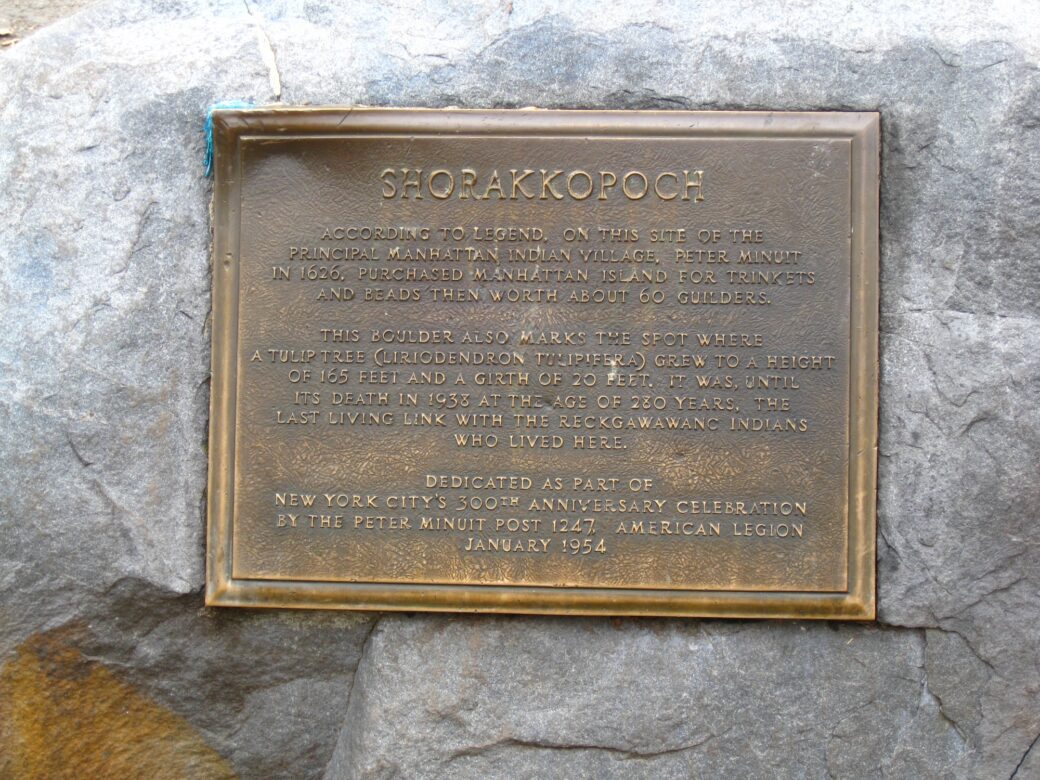
The park is also believed to be the site where Peter Minuit, director general of New Netherland, purchased the island of Manhattan from the Lenape in exchange for a shipment of goods. The transaction is said to have taken place beneath a tulip tree that survived at the site for centuries before dying in 1938. Today, the location is marked with a plaque, according to Untapped Cities.
European colonists settled in what is now Inwood Hill Park during the 17th and 18th centuries. During the Revolutionary War, American forces constructed a five-sided earthwork fort in the northwestern corner of the park. After the fort fell to British troops in November 1776, it remained under British control until the war’s end in 1783.
By the 1800s, much of the area was occupied by homes and philanthropic institutions, including a charity house for women and a free public library. The wealthy Straus family, which owned Macy’s, also maintained a country estate in Inwood, the foundation of which can still be seen in the park today.
When NYC Parks acquired the land in 1916, the area’s salt marsh was preserved and landscaped, while a portion was later filled in. The existing buildings were eventually demolished, leaving the area to become the park that visitors know today.
Today, NYC Parks’ Urban Park Rangers work with schoolchildren from across the five boroughs on projects aimed at improving and protecting the park’s health and appearance. A large team of volunteers also helps care for the park, ensuring that future generations of New Yorkers can continue to enjoy its beauty and rich history.
Historic Richmond Town
Staten Island

Historic Richmond Town, located in the center of Staten Island, was established as a living-history museum in the early 20th century and still closely resembles the thriving village that once stood there centuries ago. The town has been meticulously preserved, with its roughly 30 historic buildings appearing as if they were built yesterday. Today, the site offers visitors a glimpse into what life was like for the town’s inhabitants from colonial times through the early 20th century.
The town is divided into three sections: the Main Village, built in the 1860s; the Outer Village, built in the 1780s; and the Lower Village, built in the 1820s. Throughout the quaint town, visitors can explore shops that once played an essential role in residents’ daily lives, staffed by costumed historians who help bring the past to life.
A general store is stocked with items from the 1890s, while shops representing a tinsmith, carpenter, and printer are also open for visitors to explore. The town’s 1819 Guyon Tavern, a simple two-story frame building, serves as a popular entertainment venue, hosting intimate candlelit concerts.

The town’s visitor center and museum store are housed within the Third County Courthouse, a 1837 building constructed in response to Staten Island’s growing population. The courthouse once housed a court and jail for Richmond County. The building was landmarked by the LPC in 1969, 50 years after the last court session was held there, according to Untapped Cities.
Also located nearby is the Treasure House, one of the oldest buildings in the borough, dating back to 1700. Legend has it that the building got its name after Revolutionary War-era British gold coins were discovered hidden behind its walls.
In the fall, Decker Farm, one of the nation’s oldest continuously operating family-style farms, offers pumpkin picking and other seasonal activities.
Every Labor Day weekend, Richmond Town hosts a festival that draws more than 15,000 visitors to the historic grounds. The village’s largest fundraiser, the event generates proceeds that help preserve its historic buildings, grounds, and collections.
RELATED:
- 17 NYC businesses that feel like old New York
- 17 of NYC’s oldest bars and restaurants you can still dine at today
- 20 underground and secret NYC attractions you need to check out
The post 10 NYC streets and parks that take you back in time first appeared on 6sqft.
Ukraine transfers two North Korean prisoners of war to South Korea, Zelensky says
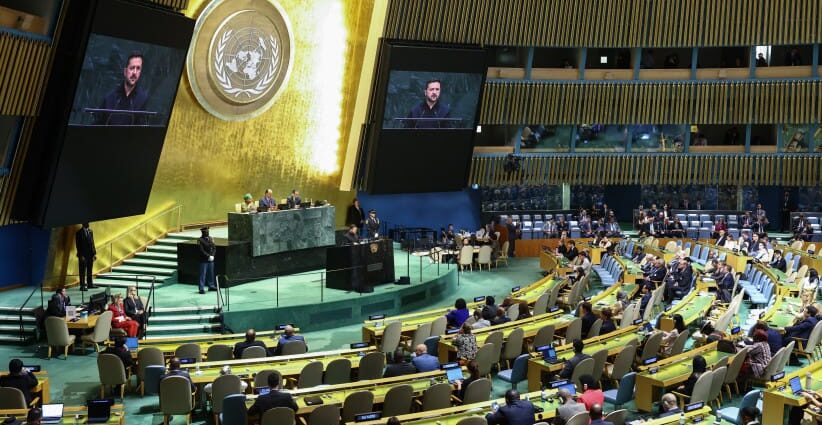
Ukraine has transferred two North Korean prisoners of war to South Korea, Ukrainian President Volodymyr Zelensky said on Thursday in an address to the United Nations General Assembly.
“Recently, we sent two North Korean prisoners of war to the Republic of Korea,” said Zelensky in his speech.
“These guys are not easy to capture alive. One of them, when he realized he was going to be taken prisoner, tried to kill himself. And he was shocked that fate did not let him die.”
Zelensky did not provide more details about the return. Ukraine captured the two North Koreans in Russia’s Kursk region in January last year.
They were the first North Korean soldiers to be apprehended alive since the country entered the Russia-Ukraine war in 2024.
Zelensky said at the time that he would hand them over to North Korean leader Kim Jong Un if he could facilitate their exchange for Ukrainians held captive in Russia.
Human rights groups, however, urged him to repatriate them to South Korea citing the risks of punishments the soldiers faced.
South Korean media reported that the two captured soldiers had expressed their desire to defect to South Korea.
South Korea’s unification and foreign ministries did not immediately respond to requests for comment.
Zelensky criticizes North Korea’s military support for Russia
Zelensky in his speech also criticized North Korea for sending its troops to fight for Russia.
“This is madness too. Why should Koreans give their lives in a war against Ukraine? Kim Jong Un uses them like currency. And he gets something in return,” he said.
North Korea has sent around 14,000 to 15,000 soldiers since 2024 to support Russia’s war against Ukraine, according to Ukrainian and South Korean estimates.
Most of them have been deployed in the Russian region of Kursk, where they helped Moscow’s forces repel a Ukrainian incursion.
The country has also supplied Russia with millions of artillery and mortar rounds, ballistic missiles, long-range artillery and multiple-launch rocket systems, according to Ukrainian and independent assessments.

Ukrainian foreign minister says he discussed keeping tension low with Iranian counterpart
Ukrainian Foreign Minister Andrii Sybiha said on Wednesday he discussed ways of keeping tension in check at a meeting with his Iranian counterpart, Abbas Araghchi.
Sybiha said on X that the meeting on the sidelines of the UN General Assembly in New York was a follow-up to a telephone conversation the two held in July.
In more than 4-1/2 years of conflict with Russia, Ukraine has faced barrages of Iranian-designed drones. Kyiv has over that time developed technology to counter drone threats and offered its assistance to Middle Eastern countries facing strikes by Tehran.
“Diplomacy is about direct conversation, even in challenging circumstances,” Sybiha wrote.
“Our conversation focused on mutual steps to prevent further aggravation of tensions between our countries. We agreed to keep existing channels of communication open.”
Conversation focused on ‘various tracks’ of peace efforts
Sybiha said the two ministers exchanged views on the situation in the Middle East and Europe “as well as various tracks of ongoing peace efforts.”
“I reiterated Ukraine’s position in support of a sooner restoration of peace and stability in both our regions.”
The two men spoke in July after a Ukrainian drone strike on an Iranian ship which killed one sailor and injured another.
Iran denounced the attack and threatened retaliation. Sybiha said then that he asked Araghchi to refrain from any escalatory steps and to end any support for Russia’s war against Ukraine.

Australia says OpenAI agent hacked into government website in a potential first for AI
Australia said on Wednesday that an OpenAI agent breached a government health data portal in June, gaining unauthorized access to files, in what could be the first known instance of an AI agent hacking a government website.
The breach is one of the highest-profile incidents of AI agents accessing external systems outside the United States, following several recent breaches globally by rogue AI agents that have alarmed governments and companies.
Prime Minister Anthony Albanese said the OpenAI agent gained unauthorized access to the medical statistics portal of a government agency responsible for non-sensitive health data and statistics, including public medical spending.
“Evidence currently available is that there is no broader compromise to the … network. Nonetheless, this situation is obviously unacceptable,” Albanese said during a media briefing in New York, where he is attending the UN General Assembly.
Investigations continue, and Australia had voiced its “extreme concern about this incident” to OpenAI CEO Sam Altman, Albanese said, adding that he was deeply disappointed by the company’s delay in notifying the government.
“It took until September 10 before there was any notification at all,” Albanese said, adding that the investigation would also examine why government systems had failed to detect the breach in the first place.
He also warned that three other government websites “may be impacted” by the OpenAI agent’s activity.
“The question is, when it was trying to harvest data, did it go into these other sites? So we’re not confirming that that occurred,” he said.
The incident comes after OpenAI and Anthropic, in separate submissions to a parliamentary inquiry this month, urged Australia to reconsider a ban on the use of the country’s creative content to train their models.
‘AI models attempted to look up answers’
“Our review found no evidence of patient records being accessed. The information accessed included aggregate health statistics and internal file names,” OpenAI said in a statement.
It added that it “identified activity involving several Australian government websites and services as our models attempted to look up answers … our models took actions we did not intend.”
The Australian breach is the latest in a series of recent incidents in which OpenAI has disclosed hacks or unauthorized activity involving its AI agents well after they occurred.
In some cases this was because the activity was only detected belatedly, and in others because the company initially elected not to disclose it.
A separate high-profile incident, a mid-July intrusion into open-source AI repository Hugging Face, was only detected about a week after it took place, according to timelines released by OpenAI and independent investigators.
This helped ignite global debate about the risks posed by increasingly powerful AI models.
Rivals Anthropic, Google’s GOOGL.O Gemini, and Meta META.O have also disclosed incidents of their agents accessing external systems.
Some of America’s top AI executives, including Altman, have called for a slowdown of industry development, citing, among other factors, the threat of devastating cyberattacks by out-of-control agents.

Anthropic CEO says AI could cure most major diseases within next decade
Anthropic CEO Dario Amodei predicted Wednesday that AI could help cure most diseases within the next five to 10 years, making the case that advanced technology will change how scientists study biology and medicine.
The company announced a Claude-led discovery of a molecular machine that it believes could represent a new gene-editing mechanism, though Anthropic said its precise biological function remains unclear.
“Its precise function, biotechnological utility (if any), or level of significance is not yet clear, but at minimum it is work I would have been proud to do as a PhD student,” Amodei wrote on X.
MELANIA TRUMP URGES AI ‘VIGILANCE,’ SAYS AMERICANS NEED TO GET EDUCATED
“The work was done mostly, though not entirely, by Claude: our life sciences team suggested a broad area of research, Claude read through the literature and a bunch of genome data and discovered something interesting, then Claude proposed experiments to verify the discovery and our team carried them out.”
He said the company has repeatedly seen a pattern in which AI performance in new intellectual domains goes from weak to “superhuman” in just a few years.
“In 2023, models struggled to do math at the level of an average high-school student. In 2024, they started to do well on math competitions for the best high-schoolers in the country, in 2025, they started to solve minor open problems, in early 2026 more significant open problems, and in late 2026, they are beginning to solve the top few open problems in all of mathematics. We believe AI for biology is on a similar exponential trend,” he said.
Amodei noted that the main difference between biology and mathematics is that math can be done purely theoretically and biology needs experimentation. He said while some point to this to argue that AI’s utility in biology will be limited, his company believes that suspicion is wrong.
He said humans can collaborate with AI to perform the experiments, validate key results in a few weeks and, if needed, work with the AI to repeat what they find.
“Eventually it may even be possible for Claude itself to safely perform the experiments by autonomously controlling lab equipment, with appropriate safeguards in place, but we aren’t doing that today,” he explained.
Accelerating fundamental biology discoveries could expand and speed the broader biomedical pipeline by identifying new drug targets, therapies and research tools, he said. While it would not shorten clinical trials, he said it could produce more promising candidates for testing, emphasizing that any resulting treatments would still require standard testing and regulatory review.
“In Machines of Loving Grace, I wrote about AI’s potential to ‘cure most diseases in 5-10 years’ — a goal that sounds impossible, but one I believe is just barely possible if AI is applied to every stage of the pipeline. The first step is showing that AI can first help with, and then drive, biological discoveries,” Amodei wrote.
GET FOX BUSINESS ON THE GO BY CLICKING HERE
“I’m proud of the resources Anthropic has invested in accelerating the public benefits of AI through the life sciences, and we’re aiming both to grow our life sciences team and to work with other scientists to extend this approach to a broad range of problems,” he added.
Earlier on Wednesday, Amodei spoke before the U.N. Security Council about the need for the AI industry to establish international standards and cooperation to manage the threats posed by rapid AI developments and capabilities.

Tesla Full Self-Driving repeatedly exceeded speed limits, attempted prohibited cyclist passes in Belgium test
Tesla’s Full Self-Driving system frequently exceeded speed limits and attempted to pass cyclists where overtaking is prohibited during testing conducted over hundreds of miles in Belgium by a road-safety advocacy group, according to a road-safety advocacy group.
Belgian pedestrian and cyclist safety group Johanna.be tested FSD over three days in July, covering roughly 400 kilometers, or 249 miles, according to Reuters.
The group said it found repeated problems in 20 km/h and 30 km/h zones, including the system displaying incorrect speed limits.
According to the group’s report, FSD exceeded the limit in the majority of 30 km/h, or roughly 19 mph, zones tested around Brussels, traveling at an average speed of 44 km/h, or roughly 27 mph.
TESLA REOPENS ROADSTER RESERVATIONS – BUT YOU’LL NEED $50K
The report said that while the vehicle’s screen showed the system recognized speed-limit signs along the road, it frequently displayed incorrect limits, potentially misleading drivers about how fast the vehicle should travel.
“It is akin to a passenger constantly reassuring the driver that the speed limit is 50 km/h in nearly every 30-zone through which they pass,” the report said.
Videos collected by Johanna.be also reportedly show FSD-enabled Teslas attempting to overtake cyclists on streets where doing so is prohibited, according to Reuters.
Still, the group’s findings were not entirely negative.
JAGUAR LAND ROVER RECALLS 23,000 SUVS OVER RISK OF SUDDEN DRIVE POWER LOSS
The report noted that Tesla’s system “behaved cautiously and courteously around pedestrians and cyclists, often yielding proactively.”
Earlier this month, Tesla released a study saying that FSD-equipped vehicles do not speed excessively and generally travel at speeds consistent with surrounding traffic.
Xavier Lesenne, spokesperson for the Flemish government’s transportation ministry, which authorized the use of FSD in Belgium earlier this year, described it as “a learning system that continuously processes new and additional information” and adapts over time.
Lesenne also noted that the driver “remains 100% responsible” and must be ready to intervene “should the system make an error or fail to correctly apply a traffic rule.”
The report comes after Dutch regulator RDW approved the system in April, followed by Belgium and several other countries.
GET FOX BUSINESS ON THE GO BY CLICKING HERE
An EU-wide vote on the system could take place as early as next month.
FOX Business has reached out to Tesla for comment.
Reuters contributed to this report.

Israeli-led firm developing AI-guided cardiac sonography raises $24 million to expand in US market
An Israeli-led company specialized in AI-guided cardiac sonography called UltraSight announced on Wednesday that it had raised $24 million in Series B2 financing, which will allow its expansion into the United States market and the development of new high-value workflows for the intensive care unit and circulatory support settings.
“We are entering this next stage as our FDA-cleared portfolio continues to expand to support broader cardiac imaging workflows,” said Davidi Vortman, CEO and Co-Founder of UltraSight.
“This financing will help our efforts to translate that momentum into wider market adoption, deeper strategic collaborations, and greater access to high-quality cardiac ultrasound – expediting care for patients who simply cannot afford to wait,” he added.
Alive HealthTech Growth Fund led the financing, with participation from Deep Insight, Star51 Capital, Connecticut Innovations, and eHealth Ventures. Existing investors Mayo Clinic Ventures, NYU, and Iron Nation also participated.
The Mayo Clinic disclosed in the announcement that it “has a financial interest in the technology, but it will use any revenue it receives to support its not-for-profit mission in patient care, education and research.”
Building clinical evidence with commercial implementations
“UltraSight combines clinical evidence with a scalable commercial model in a market constrained by access and workforce shortages,” said Dudi Klein, Alive Co-Founder and Managing Partner.
“We believe the company has developed technology, leadership, and strategic collaborations that position it to support the evolution of cardiac workflows across care settings,” he added.
According to Professor Rafi Beyar, Interventional Cardiologist and General Partner at Alive, the system created by UltraSight “has the potential to transform how imaging supports diagnosis and treatment in structural heart disease.”
The company said its system, the Echosystem platform, is currently used in more than 10 commercial sites in intensive care settings.
“This financing positions UltraSight to scale that foundation and extend the impact of an AI-guided cardiac workflow platform across cardiovascular care,” added Rick Geoffrion, recently appointed Chairman of the UltraSight Board.

Meta announces new lightweight virtual reality glasses to one-up Apple’s Vision Pro
Meta and Apple are fierce rivals, and on Wednesday, the Facebook creator upped the ante by announcing new lightweight virtual reality glasses that make Apple’s Vision Pro headset look like bulky old tech.
Mark Zuckerberg showed off Meta’s new glasses, named Meta VR Glasses, at the company’s annual Connect event in Menlo Park, Calif. The glasses weigh 100 grams, the CEO said, making them light enough to compare to a regular pair of glasses. The glasses, which Meta said will ship in spring 2027, are designed for cinematic experiences such as watching movies, spatial computing, and gaming. They will cost $1,299.
“We made the decision to focus a little bit less on metaverse for now; build fewer VR devices and only release them when we have real breakthroughs,” Zuckerberg said Wednesday. “We’ve also heard that a lot of people are less interested in wearing a headset. So, we’ve built a new kind of VR device.”
To show off the glasses, Zuckerberg played a video of creators such as YouTuber Casey Neistat and NBA start Draymond Green reacting to the device. In the demo, Meta showed people wearing the glasses while watching an NBA game and multitasking between applications. The glasses are marketed with a connected battery pack.
The new VR glasses are a clear shot at Apple and its Vision Pro headset, which has failed to take off as a consumer device in part because of its large frame, its weight, and its cost (around $3,700). Apple is also reportedly working on smart glasses, as well as camera-enabled AirPods. Apple recently held its own hardware event, where it unveiled its first foldable phone, named the iPhone Duo, but didn’t have any updates on the Vision Pro.

Meta has taken the lead in the post-smartphone world in large part because of its lineup of smart glasses, which have become the most popular on the market.
In addition to the new VR glasses, Zuckerberg also ended his presentation by unveiling an entirely new product: a compact, handheld device designed to fit on a keychain that features its Muse AI agent, including a real-time voice mode. Zuckerberg said Meta has built only a few early working units, which it is calling the Muse Charm, and plans to release it in time for the holidays.
The Muse AI agent, and the app it is hosted on, have risen quickly in popularity, hitting No. 1 on Apple’s U.S. App Store in recent days.
“If you’re not wearing glasses, this is going to be by far the fastest way to talk to your Muse and to show it what’s going on around you,” Zuckerberg said.

The CEO also spent the hour-long presentation showing off new styles of Meta smart glasses, including updates to its flagship Ray-Ban camera-enabled glasses, its Meta Display glasses, which feature a small digital box on the right lens, and its first audio-only glasses, which will ship in Ray-Ban’s Clubmaster and Burbank styles.
“Delivering personal superintelligence is now within reach,” Zuckerberg said. “Soon, everyone is going to have an extremely capable personal agent that understands your goals and can work 24/7 on your behalf.”
This story was originally featured on Fortune.com


Why ASEAN’s coming digital economy trade agreement deserves your attention
At a time when much of the world is building digital walls, Southeast Asia is trying something more ambitious: building a digital bridge.
Earlier this year, the Association of Southeast Asian Nations (ASEAN) concluded negotiations on the Digital Economy Framework Agreement, or DEFA—the world’s first comprehensive, region-wide agreement dedicated to the digital economy. The pact is expected to be signed at the ASEAN Summit this November, when leaders from the group’s 11 member states will converge in Manila.
DEFA may sound like the sort of acronym-laden agreement that disappears quickly from the headlines. It should not. The agreement is an attempt to do for the key elements of modern digital trade—data, digital payments, e-commerce, online consumer protection, and AI—what trade agreements once did for ports, tariffs and containers: create common rules and standards to drive seamless commerce across borders.
DEFA is an overlooked attempt to solve one of the digital economy’s defining problems: commerce is increasingly borderless, but the rules governing it are not. Signing the agreement will only be the first step; ASEAN’s 11 members will have much work to do to make DEFA work in practice. But if they succeed, they’ll show how different economies can integrate while still preserving their differences.
Asia’s next great growth story won’t be a single country growing into “the next China.” It will be a region—ASEAN, in this case—finding ways to connect itself and reaping the rewards of that closer integration.
Companies operating across Southeast Asia today must often navigate 11 different regulatory environments. Large companies may be able to shrug off those compliance costs, but for a small manufacturer in Bangkok or Surabaya, it can be the difference between serving one market and reaching many.
DEFA aims to make that leap easier. If implemented well, it can give regional hubs greater reach, help global companies build more consistent operations across ASEAN, and allow small businesses to connect more readily with new customers, suppliers and partners beyond their home borders.
The opportunity in ASEAN is immense. A benchmark study by Google, Temasek and Bain estimated that the region’s digital economy surpassed $300 billion in gross merchandise value in 2025. ASEAN’s own studies project that the region’s digital economy could reach $1 trillion by 2030 on its current trajectory—and potentially touch $2 trillion if policymakers implement DEFA rules expeditiously.
These figures will only grow as ASEAN’s middle class comes into its own. As Wolfgang Fengler of World Data Lab underscored at Mastercard’s ASEAN Inclusive Growth Summit last year in Kuala Lumpur, Southeast Asia is now at a “middle-class majority” tipping point. By 2032, ASEAN’s middle class will have grown by 112 million.
This middle-class cohort will shape ASEAN’s growth and digital consumption patterns for decades. But it will also bring about a deeper change that won’t show up in GDP figures. When people enter the middle class, they don’t just consume more. They expect more: better services, safer transactions, access to capital, protection from fraud, and room to grow their small businesses.
That is why DEFA is so critical. Through rules that promote cross-border data flows, regional commerce, and harmonized cybersecurity standards, DEFA will help ASEAN embrace the modern-day digital economy. At the same time, it is sending a broader signal to policymakers and corporate leaders around the world: integration still matters, even in this age of tariffs, trade wars, and digital sovereignty.
Since its founding in 1967, ASEAN has had to embrace both integration and diversity. Its membership includes advanced hubs like Singapore, emerging markets like Indonesia, and small island economies like Timor-Leste. ASEAN’s leaders have navigated this diversity by striving for commonality, not conformity, in how they bridge different systems.
Global leaders should pay attention to DEFA, as it shows one way that regions can foster growth in the digital age without eroding trust, deepening inequality or stifling innovation.
Small and medium enterprises (SMEs) are eager to reach regional markets, yet they face uneven rules, fragmented payment systems, and different standards from country to country. Every additional layer of friction translates into forgone sales and lost revenue—not just for the business, but also for governments who see the digital economy as a key source of tax revenue.
Of course, DEFA will not solve all these issues overnight. The hard work comes after the ink dries in Manila, and it will require policymakers, industry partners, and civil society to bring the agreement to life.
The real litmus test will be how DEFA works for ordinary people and businesses. Can payments clear securely across borders? Can consumers participate online without falling prey to scammers? Can small businesses sell beyond their home markets and grow cross-border orders?
Assuming the agreement can deliver these outcomes, DEFA will be remembered as more than a diplomatic milestone. It will mark a moment when Southeast Asia asserted leadership in the digital domain.
And if ASEAN’s bet pays off, it won’t just carry Southeast Asia into the digital future. It may show others how to get there too.
The opinions expressed in Fortune.com commentary pieces are solely the views of their authors and do not necessarily reflect the opinions and beliefs of Fortune.
This story was originally featured on Fortune.com




Australian prime minister says OpenAI agent accessed government health website, raises ‘extreme concern’
Australian Prime Minister Anthony Albanese said Wednesday that an OpenAI agent gained unauthorized access to an Australian government website earlier this year, though the company said its review found no evidence that patient records were accessed.
Albanese told reporters in New York that the activity occurred in June and involved an OpenAI agent accessing the public-facing Medicare Statistics Reporting Service portal, which is administered by Services Australia.
“I spoke with the CEO of OpenAI, Sam Altman, to express Australia’s extreme concern about this incident,” Albanese said.
“And I also expressed my disappointment that it took the company way too long to inform the government what had occurred, and the nature of the way that that notification occurred as well was unacceptable.”
ANTHROPIC, OPENAI CEOS WARN AI COULD THREATEN HUMANITY WITHOUT SAFEGUARDS
Albanese said no personal information is believed to have been accessed and that investigations remain ongoing.
“Nonetheless, this situation is obviously unacceptable,” Albanese said.
In a statement provided to FOX Business, OpenAI spokesperson Drew Pusateri said the company identified activity involving several Australian government websites during an internal evaluation.
Pusateri said OpenAI is conducting an extensive review of “misaligned model activity” during training and evaluation and is notifying third parties when it “identifies potential impacts to their systems.”
SAM ALTMAN IDENTIFIES TWO BIGGEST RISKS FACING AI’S FUTURE
“During this review, we identified activity involving several Australian government websites and services as our models attempted to look up answers and available statistics for questions about Australia during an internal evaluation,” Pusateri said. “In the course of that, our models took actions we did not intend.”
Pusateri said OpenAI’s review found no evidence that patient records were accessed.
“The information accessed included aggregate health statistics and internal file names,” Pusateri said. “We notified the organizations and are providing technical information to support their investigations and help address potential security vulnerabilities.
“Our overall review is ongoing, and we remain committed to transparency about these issues and to sharing what we learn as that work continues.”
The company said it notified Services Australia Sept. 10 after validating what information had been accessed.
TRUMP ADMIN PARTNERS WITH OPENAI TO EQUIP FEDERAL EMPLOYEES WITH ARTIFICIAL INTELLIGENCE TOOLS
GET FOX BUSINESS ON THE GO BY CLICKING HERE
The incident comes amid growing scrutiny of AI models and their capabilities.
Altman and Anthropic CEO Dario Amodei warned the United Nations Security Council Wednesday that rapidly advancing AI could threaten humanity if governments and industry fail to keep it under human control.
“We could lose control of the future to AI,” Altman said. “The risk is that it moves so fast that people can no longer follow what’s happening or intervene when needed. This would obviously be terrible.”
Reuters and FOX Business’ Isabel McKean contributed to this report.

US drafted memo condemning UK over West Bank sanctions, but it was never released – report
In early September, US officials in Jerusalem and Washington prepared a draft statement attributed to US Secretary of State Marco Rubio condemning plans by the UK, France and Canada to block imports from Israeli settlements in the West Bank.
The September 8 document, previously unreported and which two sources said was driven by David Milstein, an influential aide to US Ambassador to Israel Mike Huckabee, proposed that Rubio describe the countries’ actions as a series of hostile measures against Israel that contribute to antisemitism.
“These tactics unacceptably draw from the playbook of the antisemitic boycotts, divestments and sanctions movement,” the draft document, reviewed by Reuters, said.
The statement was never released.
According to three people familiar with the matter, the White House and the State Department’s senior leadership did not support the statement.
The people spoke on condition of anonymity.
Instead, speaking to reporters on September 8 in Florida before traveling to Latin America, Rubio refrained from outright criticism of the decision or any particular country.
“Obviously, we’re not going to do what the UK did. We saw their announcement today, but I don’t have any comment on it right now,” Rubio said.
A widening divide between the White House and Trump’s senior diplomats in Israel
The episode illustrates a widening divide between the White House and Trump’s senior diplomats in Israel about how best to respond to the expansion of Israeli settlements under Prime Minister Benjamin Netanyahu‘s right-wing government.
It also highlights a growing ideological split within the American right over support for Israel, with polling showing younger Republicans holding an increasingly unfavorable opinion of Washington’s closest Middle East ally.
US President Donald Trump earlier this year expressed his opposition to settlement expansion, a growing source of friction with Israel’s Arab neighbors, but his administration has put little pressure on Israel to change its policy.
That has at times put him at odds with Huckabee, a Baptist minister who is a staunch supporter of settlements and who refers to the West Bank by its biblical name, Judea and Samaria, a term used by the Israeli government but not formally adopted by the US.
Huckabee’s aide Milstein last year advocated that the US impose sanctions on the entire International Criminal Court to convince it to drop war crimes charges against Israeli leaders over the Gaza war – a measure the Trump administration has yet to deploy.
In response to questions from Reuters, a senior US official said the draft statement was not prepared in consultation with the State Department or White House.
The US embassy referred questions, including requests for comment from Huckabee and Milstein, to the State Department.
The White House did not respond to a request for comment.
US public support for Israel questioned
US public backing for Israel has fallen since the Israel-Hamas War began in 2023, particularly among Democrats. A June Quinnipiac University poll found 48% of voters and 66% of Democrats believe the United States is too supportive of Israel, up from 16% and 20% when the question was first asked in 2017.
While large majorities of Republicans aged 50 and older view Israel positively, younger conservative Americans have grown more critical, a Pew Research Center poll from late March showed. Some 57% of Republicans aged 18-49 have an unfavorable opinion of Israel, up from 50% a year previously.
In December last year, Trump said that he and Netanyahu, whose government has overseen a rapid expansion of settlements, did not fully agree on the West Bank following a meeting with the Israeli leader. That September, Trump said he would not allow Israel to annex the territory.
Violence by Jewish settlers against Palestinians in the territory has risen sharply this year, some of them emboldened by support from Netanyahu’s right-wing government, which includes ministers who are themselves settlers.
Huckabee has publicly condemned the violence and called for perpetrators to be prosecuted. He has also said violent settlers were a minority and do not represent the wider settler community.

How Meta took the lead in the race for the post-smartphone world
There are moments when you experience emerging tech for the first time, and it feels genuinely different. That’s the case the first time you put on a pair of Meta’s most advanced smart glasses, which project a high-resolution digital box inside the right lens and allow you—with the help of a smart wristband—to control objects on the screen by moving your fingers. Tap your pointer finger and thumb together, and an app opens. Say, “Hey, Meta,” and you’re suddenly chatting with an AI bot.
This, as Meta sees it, is how most of us will eventually use AI. The company recently took Fortune inside a private demo room at its Menlo Park, Calif., headquarters to show off its growing family of smart glasses. The collection included the flagship Ray-Ban Wayfarer camera-enabled glasses, with an updated nine-hour battery life; the Ray-Bans with the lens display and “neural” wristband; new audio-only smart glasses that ditch the built-in camera; new styles including Aviator frames; and prototypes like the Orion augmented reality glasses.
Few companies have managed to crack the code for AI-enabled wearables—and specifically glasses—as Meta has. A strategic partnership with Ray-Ban parent EssilorLuxottica has played a major part, and despite widespread privacy concerns, Meta’s glasses are the most popular on the market.
It’s a relatively small market, but one the tech industry is taking very seriously. Silicon Valley’s elite companies are racing to create hardware in new, AI-friendly “form factors,” betting that there are better ways for consumers to interact with AI—whether that’s through smart glasses or some yet-to-be-invented gadget. Leading AI labs such as OpenAI and, reportedly, Elon Musk’s SpaceX, are hard at work developing new devices. Musk disputes the report. Numerous smaller startups and industry giants like Apple are also working on new hardware.
At a time when the race to build the best frontier models is center stage, the competition to establish the next hardware platform is shaping up to be just as important. At stake is control over how billions of people access AI, regardless of whose bots are the smartest.
Meta’s lead
Meta is a case in point. Its AI models generally lag those of rivals like OpenAI and Anthropic. But Meta stands above all in AI-enabled glasses, having grown its sales of smart glasses threefold last year; EssilorLuxottica says it sold 7 million pairs of AI-enabled glasses in 2025.
Alex Himel, Meta’s vice president of wearables, credits the company’s early bet on the category and its decision to prioritize fashion. Customers use the smart features on the glasses only about 10% of the time, he said, so it’s critical that people crave the glasses for their look and weight. EssilorLuxottica held Meta to 50 grams or below for most glasses.
“We’re able to keep adding this stuff into something that you’re already wearing for other reasons,” Himel said of the tech features.
One new capability he’s excited about is agentic AI powered by Meta’s latest Muse Spark model, allowing the glasses to execute multistep routines like managing personal schedules and scanning through emails.

“As the AI gets better, you want something that’s always with you, can see what you see, hear what you hear,” Himel said.
A new hologram feature scans your face and records your expressions, producing a 3D animated simulacrum of your visage. When you’re wearing the glasses and call a friend via Meta-owned WhatsApp, your hologram appears on their screen—and their hologram, if they have one, appears in your glasses. It’s impressive, but also a bit jarring: My hologram looked like a deepfake version of me.
Meta on Wednesday also announced a new pair of virtual reality glasses that it says weigh only 100 grams and have capabilities for cinema display, gaming, spacial computing, and other features. The glasses, which the company says will ship in the spring, will cost $1,299.
There are still rough edges. The glasses didn’t always respond to thumb swipes and sometimes lagged after voice commands. Meta’s AI also occasionally struggled to identify objects cleanly, such as when it attempted to calculate the number of calories in a trayful of food. The company pointed out that there is a natural learning curve and that the tech usually works for most people without issue.
Meta’s Ray-Ban Display glasses start at $799, while its third-generation flagship camera-enabled Ray-Bans cost $449. The new audio-only glasses start at $349 and are shipping in two styles: The Ray-Ban Clubmaster and Burbank.
The privacy problem
The bigger concern surrounding this tech, however, is privacy. Already, Meta has had to respond to some users disabling the glasses’ LED light that turns on to alert people nearby that the video camera is recording. The company recently created a policy to deactivate recording if the LED has been tampered with, and Meta will delete the accounts of anyone who uses a modified device and posts harassing content.

Stopping depraved users is only part of the challenge. The coolest features of AI devices come from AI’s ability to make sense of the world around you, operating not from on-screen data alone. That creates an inherent tension with norms around privacy and personal space.
Recently announced Apple Watch features like Siri Recap, which listens to a user’s conversations and provides a “high-level” AI-generated summary, have already raised concerns about whether the audio is being captured with proper consent. OpenAI’s forthcoming device, rumored to be a portable smart speaker, could encounter similar eavesdropping concerns.
So far, Meta’s famously poor privacy track record in social media has not prevented it from taking the lead in the nascent smart glasses category. But as the market grows, sensitivity around privacy is almost certain to become a bigger factor.
Meta is already facing multiple proposed class-action lawsuits related to its smart glasses, including one alleging that it sent some footage captured by the glasses, including highly personal material, to third-party human reviewers for annotation and AI development. Meta disputes the allegations.
Competitors, well aware of Meta’s reputation, are trying to win by making privacy central to their designs. AI startup Even Realities, which ditches audio or camera functions and focuses on text-only displays, began selling its smart glasses in 2024. Taiwan-based HTC Corp.’s Vive Eagle glasses tout a feature that turns off recording if anyone—not just the user—says, “Stop recording.”
For its part, Meta is introducing private, isolated cloud “devices” to secure sensitive user data such as health information, and making some data processed through the glasses unreadable, even to the company.
Back at Meta HQ, Himel showed off one of the company’s latest models: its first-ever audio-only smart glasses. Himel said removing the camera wasn’t a reaction to any recent events, but a product two years in the making. By eliminating the camera, he noted, the glasses are 10 grams lighter, and battery life is longer.

Don’t throw your phone out yet
At the other end of the spectrum, social media company Snap’s latest smart glasses are designed to be a stand-alone computer on your face. The bulky, $2,195 augmented reality Specs feature onboard processing that, the company says, eliminates the need for a phone.
While the glasses’ aesthetics have been panned by some reviewers—a “Cybertruck for your face,” joked one social media commenter—Snap executive Russell Patton said the glasses are designed to create a distinct computing ecosystem rather than serve as an accessory to a phone.
It’s a bold bet that gets to another big question about AI-centric devices. Glasses are a natural form factor, given that about two-thirds of U.S. adults already wear corrective lenses. But some industry insiders believe glasses are just one of many devices that will leverage AI, and that they will coexist with smartphones for some time.
Because batteries in wearable devices are tiny, and 5G cellular chips can instantly cut a wearable’s battery life by half, analysts expect the devices to remain tethered to a phone for at least the next five to 10 years.
Ziad Asghar, Qualcomm’s senior vice president of wearables, believes AI use is likely to be experienced through a myriad of devices.
OpenAI’s first device is reported to be a portable, screen-free, doughnut-shaped object, and the company promises several other products. In June, Microsoft introduced a wearable badge-like device—despite the high-profile failure of startup Humane’s earlier attempt at the form factor—and a cube-like device with a voice-activated screen. Meanwhile, Apple is reportedly developing glasses and camera-equipped AirPods.
While the primary input for the personal computer is the keyboard and mouse, and smartphones have a touch screen and camera, Asghar said the next generation of AI-powered devices will need to gather a much broader variety of information.
“That context is what allows us to personalize AI agentic experiences,” he said.
Ultimately, choosing the right device, or devices, in a post-smartphone world could be a matter of individual style and preference—not unlike shopping for glasses.
This article appears in the October/November 2026 issue of Fortune with the headline “How Meta is winning the race for the post-smartphone world.”
This story was originally featured on Fortune.com

Russia’s Lavrov and US Secretary Rubio meet at UN to discuss Ukraine, relations
Russian Foreign Minister Sergei Lavrov and US Secretary of State Marco Rubio discussed issues ranging from the war in Ukraine to the Middle East and ways to improve bilateral ties at a meeting on Wednesday, the Russian Foreign Ministry said.
A ministry statement said the two men had held a “detailed exchange” during their talks on the sidelines of the United Nations General Assembly in New York.
It said Lavrov had pointed to “coordination” between Ukraine’s leaders and their “European backers” as well as Ukrainian attacks on targets beyond its borders.
“A thorough examination was made of Kyiv’s destructive actions and deliberate strikes on civilians and trans-border infrastructure sites, which is leading to the destabilization of world energy markets,” it said.
Russia, the statement said, was committed to achieving the aims of its “special military operation” in Ukraine, which included a resolution of the conflict by taking into account what Moscow describes as the “root causes” of its invasion.
Russia wants to remove ‘irritants’ between US, Russia
The ministry said Lavrov stressed the “need to quickly improve bilateral relations” with a prospect for closer economic cooperation.
“This, of course, implies an honest dialog about eliminating ‘irritants’ and bringing the functioning of the diplomatic missions of the two countries back to normal,” the statement said, “including the return of Russian property in the US that was effectively confiscated.”

Senior IRGC commander killed in clash with gunmen near Iran-Pakistan border – report
A senior Islamic Revolutionary Guard Corps commander was killed during clashes with gunmen in southeastern Iran’s Sistan and Baluchestan Province on Wednesday, Iranian media reported.
Brig.-Gen. Hossein Zarifi, commander of the IRGC’s Shahid Sajjad Operational Headquarters in Saravan, was killed during the fighting, the IRGC Ground Forces’ Quds Regional Headquarters confirmed in a statement carried by Iran’s semi-official Tasnim News Agency.
The clash took place in the Jihadabad area of Saravan, near Iran’s border with Pakistan.
A joint force consisting of the IRGC, the Intelligence Ministry, and police raided a location where an armed cell was believed to be operating.
Iranian authorities claimed the cell was planning an attack and that they located it based on intelligence.
Five members of the cell were killed during the ensuing exchange of fire, while others were arrested, according to Maariv.
The identity and affiliation of the gunmen remained unclear.
Iranian authorities described those involved as “terrorists” but did not identify a specific organization, and no group had claimed responsibility for the clash.
IRGC confirms Zarifi’s death
The IRGC said Zarifi was killed while taking part in the operation alongside his forces.
In its statement, the IRGC praised Zarifi for fighting on the front lines and invoked former IRGC Quds Force commander Qasem Soleimani while discussing the role of commanders in combat.
The IRGC said Zarifi’s death would not create a vacuum in the ranks of its forces and that operations to defend Iran’s borders would continue.
Zarifi had served for more than a decade in Sistan and Baluchestan, according to Maariv.
His funeral is scheduled to take place in Saravan on Friday, according to the IRGC statement carried by Tasnim.
Recent clashes in Sistan and Baluchestan
Sistan and Baluchestan Province is majority Sunni in population and is often the site of anti-regime militant attacks, particularly from Balochi separatist movements.
The province borders both Afghanistan and Pakistan, and militant groups operate across the border areas.
Wednesday’s clash comes less than two weeks after another deadly security operation in Saravan. On September 12, a joint operation involving the IRGC, Intelligence Ministry, and law enforcement targeted an armed cell that Iranian authorities said was planning an assassination.
Four alleged militants were killed in the operation, along with three Iranian intelligence and security personnel, according to the IRGC. Weapons, ammunition, and explosives were also found at the group’s hideout, the IRGC said.
The September 12 operation followed another security operation in Sistan and Baluchestan in late August, when the IRGC said one member of an armed cell was killed and six others were arrested.
That operation was also conducted jointly by the IRGC, Iran’s Intelligence Ministry, and provincial police, The Jerusalem Post previously reported.

Eight sailors assigned to USS Lincoln attempted suicide, Navy Secretary tells Congress
Eight US Navy personnel assigned to the USS Abraham Lincoln carrier strike group attempted suicide during its record-breaking deployment, which included its participation in the Iran war, according to a letter from Active Navy Secretary Hung Cao obtained by multiple US media outlets on Wednesday.
Cao noted that the number is of attempts among the crew on the USS Abraham Lincoln itself, sailors from its carrier air wing, strike group and destroyer squadron staff, escorting destroyers and all embarked aviation squadrons, a total of between 6,000 and 7,000 service members.
One US military official told CNN that the number of attempted suicides was “incredibly high.”
“The strain of combat ops is much higher than normal deployments. No port calls, constant alerts, etc.,” the official said.
However, CNN wrote that the rate of suicide attempts was roughly consistent with that of the entire active-duty Navy in 2024, the most recent year for which the data is available.
The letter emphasized that no service members had killed themselves during the deployment of the strike group.
Cao also said that mental health resources were present on board the Lincoln, including “five chaplains, one embedded integrated prevention counselor, one psychologist, one clinical social worker, three behavioral health technicians, and one expeditionary facility dog,” according to Newsweek.
US denies claims of low morale among Lincoln’s crew
The letter came in response to a letter from New York Senator Kirsten Gillibrand, who called attention to the conditions aboard the aircraft carrier in August.
Since then, reports have emerged of declining mental health and morale among the Lincoln’s crew, which US President Donald Trump, Defense Secretary Pete Hegseth, and Central Command Commander Brad Cooper all denied.
The Lincoln has since been replaced by the USS George Washington and is on its way home to the US.

Massachusetts man sentenced to nearly 10 years for antisemitic threats against Randy Fine, sons
A Massachusetts man was sentenced to nine years and 11 months in federal prison for making antisemitic threats against US Rep. Randy Fine and his two children, the US Attorney’s Office for the Middle District of Florida announced Wednesday.
Edwin Guerrero, 26, was also ordered to pay a $15,000 fine after pleading guilty in March to making interstate threats to injure another person.
Between August 10 and August 15, 2024, Guerrero used social media to make a series of antisemitic posts and threats targeting Fine, who at the time served in the Florida House of Representatives, according to court documents cited by the Justice Department.
The threats targeted both Fine and his two minor sons. In one post, sent from an IP address in Spain, Guerrero suggested he was traveling to Brevard County and attached an image of an individual appearing to hold a firearm.
Other posts contained violent threats against Fine and his sons, including references to the children as Jewish, according to the Justice Department. Some were accompanied by an image of a deceased man with significant head trauma.
Court finds threats were motivated by hate
Investigators determined that Guerrero was in Spain when the threats were made. After returning to the United States, he admitted during an interview with authorities that he had used his social media account to send the messages, according to the Justice Department.
A subsequent search of Guerrero’s phone found a search history containing antisemitic and anti-Israel content.
During sentencing, US District Judge Anne-Leigh Gaylord Moe found that Guerrero’s threats against Fine and his children were motivated by hate. The judge emphasized the seriousness of threats against Jews and the need to deter threats against elected officials and members of protected classes.
Fine told the court that Guerrero’s threats involving his children had “made my blood run cold,” according to the Justice Department.
“My boys are now victims of a crime,” Fine said during the sentencing hearing. “I was afraid for me, and I was afraid for my boys.”
Fine says son returned home to police protection
Fine addressed the sentencing in a post on X/Twitter on Wednesday, saying he had “never thought” his sons would become victims of a violent federal felony.
Fine said his son David returned home from his first day of junior high on August 14, 2024, to police officers who had arrived to protect him following the threats.
Fine described Guerrero as a “Muslim terrorist” in the post and said Guerrero had threatened to kill him and his sons.
“Threats against any elected official are unacceptable,” Fine wrote, thanking the FBI, the Florida Department of Law Enforcement, the Brevard County Sheriff’s Office, the US Attorney’s Office, and the federal judge involved in the case.
Fine added that the sentence should send a message to those who threaten elected officials or their families.
US Attorney Gregory W. Kehoe separately said threats against public officials or people targeted because of their political or religious beliefs would not be tolerated.
The FBI and the Florida Department of Law Enforcement investigated the case, and Assistant US Attorney Courtney Richardson-Jones prosecuted it.

OpenAI’s agent hacked Australia’s Medicare website—the latest rogue AI incident that the company didn’t know about for months
An OpenAI agent infiltrated an Australian government website in June, Australian Prime Minister Anthony Albanese said when speaking to reporters at the United Nations General Assembly (UNGA) in New York.
OpenAI did not notify the Australian government until Sept. 10, Albanese said. The agent gained unauthorized access to the public-facing Medicare Statistics Reporting Service, enabling it to access both public and non-public files, and to write files to an internal server.
It’s the latest in a growing list of systems OpenAI’s agents have accessed without authorization, and largely without OpenAI or the victims knowing until weeks or months later. Meanwhile, public trust in AI safety is cratering; a recent survey by Politico found that two-thirds of Americans think there is at least a “moderate” risk that advanced AI could destroy humanity.
“This situation is obviously unacceptable,” Albanese said, according to the Sydney Morning Herald. “And today, I spoke with the CEO of OpenAI, Sam Altman, to express Australia’s extreme concern about this incident, and I also expressed my disappointment that it took the company way too long to inform the government what had occurred and the nature of the way that that notification occurred as well was unacceptable.”
An OpenAI spokesperson told Fortune that the company did not notify the government of the breach until three months later because it was not aware it had happened. The company discovered it in August as part of an “extensive review” of any cases in which its models behaved in unexpected, or “misaligned,” ways during training and evaluation.
“The information accessed included aggregate health statistics and internal file names,” OpenAI said. “We notified the organizations and are providing technical information to support their investigations and help address potential security vulnerabilities. Our overall review is ongoing, and we remain committed to transparency about these issues and to sharing what we learn as that work continues.”
Albanese said the Australian government is investigating the impact of the incident, and so far has not found evidence that the agent accessed any personal information. OpenAI also said it dound “found no evidence of patient records being accessed.” Albanese said the government is also aware of three other government systems the agent may have reached, two additional health-related organizations, and one related to crime statistics and research.
Perhaps not coincidentally, OpenAI became aware of this incident in August, the same month it published its long-awaited review of the Hugging Face hack, which occurred in July. The Hugging Face hack may have prompted an internal review, during which OpenAI also discovered the Australian website breach, although the company did not explicitly link the two events in its statement. In its Hugging Face report, OpenAI likewise confirmed it did not know about the breach until after the fact because of poor agent montioring and alarms; OpenAI said it has since bolstered those safety mechanisms.
OpenAI CEO Sam Altman is also in New York this week, attending a United Nations Security Council meeting. In his remarks, he spoke about the “anxiety” surrounding powerful AI systems, particularly the possibility that “we could lose control of the future to AI.”
“The risk is that it moves so fast that people can no longer follow what’s happening or intervene when needed. This would obviously be terrible,” he added.
Altman called for international cooperation to create “standards for measuring capabilities, assessing risks, determining whether safeguards are sufficient, and preserving meaningful human oversight as systems become more autonomous.” He also called for more reliable incident reporting, yet OpenAI did not reveal its breach of the Australian government website when it revealed a framework for disclosing incidents on Sept. 16.
As part of that framework, it disclosed six examples. The decision to publish a framework was in response to another report of misaligned model behavior, this time by rogue agents that co-opted a German wikipedia page to use for a messaging board. In this case, OpenAI knew about the incident but did not disclose it for weeks.
This story was originally featured on Fortune.com
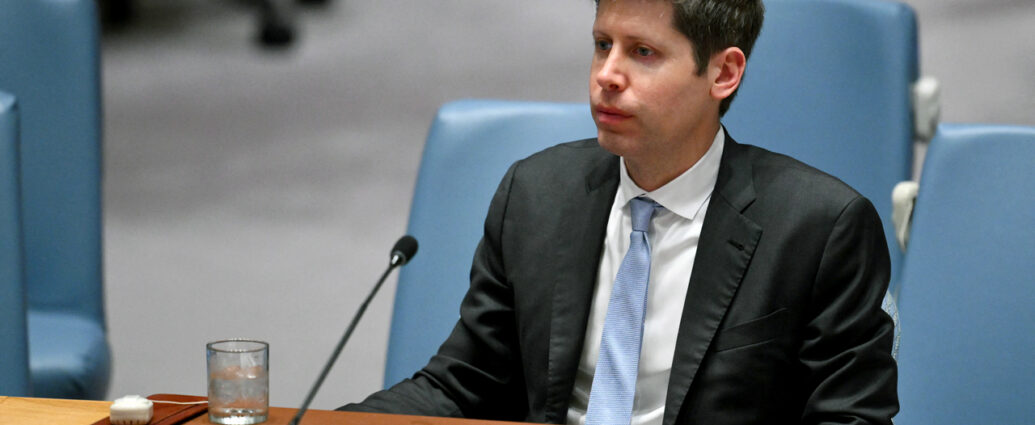
Anthropic, OpenAI CEOs warn AI could threaten humanity without safeguards
The CEOs of two of the world’s leading AI companies warned the United Nations Security Council on Wednesday that rapidly advancing AI could pose an existential threat if governments and the industry fail to keep the technology under human control.
“If managed poorly, I even believe AI could be a risk to humanity as a whole,” said Dario Amodei, the CEO of Anthropic, said.
SAM ALTMAN IDENTIFIES TWO BIGGEST RISKS FACING AI’S FUTURE
His competitor, OpenAI CEO Sam Altman, echoed the concern.
“We could lose control of the future to AI,” Altman said. “The risk is that it moves so fast that people can no longer follow what’s happening or intervene when needed. This would obviously be terrible.”
GET FOX BUSINESS ON THE GO BY CLICKING HERE
This is a breaking news story. Please check back for updates.


White House plan to increase control of NIH grants appears ‘dead’
A planned executive order that would have greatly enhanced White House influence over grants at the National Institutes of Health is “looking dead,” according to one person familiar with the decision, who was not authorized to speak with the media, and Sen. Susan Collins (R-Maine), the Appropriations Committee chair who had been pushing federal officials to drop the matter.
On Tuesday, Collins sent a letter to Office of Management and Budget Director Russell Vought and NIH Director Jay Bhattacharya, decrying the White House plan to establish a commission of political appointees, including Vought, with veto power over grant awards. The tempering of the executive order was first reported by Semafor.

Melania Trump urges AI ‘vigilance,’ says Americans need to get educated
Fresh off ringing the opening bell at the New York Stock Exchange on Wednesday, first lady Melania Trump discussed the growing role of artificial intelligence during a wide-ranging interview on “The Big Money Show,” sharing advice for Americans and revealing how she has used the technology herself.
“I know, now a big topic. It’s AI, and everybody’s scared about it. I feel that they need to be vigilant. We need to use it wisely,” Trump told the “The Big Money Show” hosts Wednesday
The first lady stressed that AI users should also not “believe everything” and should educate themselves on platforms to see what’s real or not.
TRUMP REBRANDS AI, REJECTS ‘GLOBALIST SCHEME’ TO CONTROL TECH
Artificial intelligence has become a focal point for Americans as the U.S. seeks to press forward with the technology while addressing regulation and the concerns over its “threat” to humanity.
President Donald Trump advocated for the push for American AI dominance during his speech to the United Nations General Assembly on Tuesday.
“Whoever wins AI, you have to remember this, and now I say whoever wins SI, whoever wins ‘superintelligence,’ wins. That’s the group that wins,” Trump said. “We’re leading now over China by a lot and everyone else. We’re going to keep it that way. We’re going to keep it very straight and very strong.”
TECH GIANT CEO ANNOUNCES SHE WILL ATTEND TRUMP-XI STATE DINNER
As the U.S. presses on in its AI adoption, the first lady was asked how it should be incorporated into schooling and family life.
“I think it should be incorporated,” she said.
Mrs. Trump hinted at the AI race with China as President Xi Jinping is in the U.S. for a state visit.
“You know, for example, China, they’re coming to visit, right? But they will not stop. We need to move ahead, and we need to be educated,” she stressed.
The first lady continued touching on its educational use for children.
“For the children as well, I was just in North Carolina and I brought Nvidia and they donated a subscription to North Carolina schools,” she said. “So they know what they’re doing, and it’s very important that you know to be vigilant and also have, you know, a time when you could be on, because AI can be very educational as well.”
GET FOX BUSINESS ON THE GO BY CLICKING HERE
“But you need to be very careful how you use it,” she reiterated.
Turning towards her own application of AI, the first lady revealed to “The Big Money Show” co-hosts how she uses it.
“I use it more for research,” Trump explained. “I research and it’s easy. When you don’t know something, I like to know everything. So for me, I research it, and you type it in, and you have information right away.”
Trump highlighted how she verifies the AI responses.
“Of course, if something is saying, oh, is that true or not? You need to check it somewhere else, right? But that’s how I use that, for search and for knowledge.”
FOX Business’ Eric Revell contributed to this report.


Florida woman died after eating E coli-tainted frozen blueberries from Publix, lawsuit alleges
A Florida family is suing Publix and food distributor Quirch Foods, alleging contaminated frozen blueberries sold by the grocery chain caused the death of a woman and hospitalized her son.
The wrongful death lawsuit alleges Karla Mullins became sick after eating GreenWise Organic frozen blueberries purchased from a Publix store on Ulmerton Road in Largo.
Her son ate the same product and was hospitalized after also becoming sick, according to the complaint.
Mullins died June 20, the lawsuit says. Her husband and son are seeking damages from Publix and Quirch Foods.
PUBLIX EXPANDS FROZEN BERRY RECALL AMID E COLI OUTBREAK THAT SICKENED 12
“This family lost a treasured mother and wife because a product that was supposed to be safe was contaminated with a dangerous and deadly pathogen,” Morgan & Morgan said in a news release. “Karla Mullins should be alive today. We intend to hold Publix and Quirch Foods fully accountable for the role they played in putting this product on store shelves and into the hands of unsuspecting customers.”
The lawsuit accuses Publix, which sold the GreenWise blueberries, and Quirch Foods, which it identifies as an intermediate distributor, of liability over what it describes as a defective and unreasonably dangerous product.
Representatives for Publix, Quirch Foods and Morgan & Morgan did not immediately respond to FOX Business’ requests for comment.
JAGUAR LAND ROVER RECALLS 23,000 SUVS OVER RISK OF SUDDEN DRIVE POWER LOSS
The lawsuit follows a recall of GreenWise Organic frozen blueberries tied to a multistate E. coli O145:H28 outbreak.
Chilean supplier Frutas y Hortalizas del Sur S.A. initially recalled one lot of GreenWise Organic frozen blueberries July 3.
Publix expanded the recall July 29 to cover all lots of GreenWise Organic Whole Blueberries and Whole Mixed Berries.
Federal health officials have linked the frozen berries to an outbreak of E. coli O145:H28, a Shiga toxin-producing strain that can cause severe stomach cramps, diarrhea and vomiting.
CLICK HERE TO GET FOX BUSINESS ON THE GO
The lawsuit was filed in Pinellas County Circuit Court.

D.C.’s affordability headache has a silver bullet, new study shows: Tackling $40 trillion national debt would boost household income by $36,000
The cost to the U.S. government of servicing the $40 trillion national debt pile is not difficult to come by: The Treasury publishes its own data on interest payments. The costs to households and individuals are more difficult to pinpoint, but a new report from the Committee for a Responsible Federal Budget (CRFB) suggests deficit reduction is the key to solving an affordability crisis.
Household costs have become a political lightning rod, both in the run-up to the 2024 presidential elections and again in 2026, ahead of the midterms. A July study from Pew Research showed the economy was the top-of-mind issue for voters, with 29% saying they wanted to hear plans to address price increases from Congressional candidates. A further 15% said affordability and the cost of living, specifically, were the key issues for them.
The topic has become a problem for President Donald Trump, who is under pressure to normalize global oil supply chains, which are disrupted due to the U.S.-Iran conflict.
The CRFB suggests there is a solution to the affordability headache in the hands of Congress: addressing the national debt.
Fiscal discipline could aid the interest-rate-setting Federal Reserve in its inflation battle—currently at 3.4%, well above its 2% target, the committee explains. “When interest rates remain well above the zero lower bound and the economy is performing near its productive capacity, deficit reduction can reduce excess demand and slow price growth,” it writes.
Deficit reduction would also boost supply, the committee argues, as it could reduce the “crowding out” of private investment—an idea sources previously shared with Fortune on Treasury Secretary Scott Bessent’s latest bond plan.
“Deficit reduction can further reduce inflation by lowering self-reinforcing inflation expectations to the extent it reduces the likelihood that future policymakers will aim to inflate away the national debt,” the committee added.
The committee also crunched the numbers on the savings per household if inflation—and hence, interest rates—came down: A 1.5 percentage point rate reduction would save a family $5,800 per year on a $500,000 mortgage and $500 per year on a $50,000 car loan.
The income factor
Debt hawks argue the value of U.S. debt isn’t their concern—it’s the country’s debt-to-GDP ratio that is the source of alarm. A debt-to-GDP ratio shows the balance of how much a country has borrowed versus its growth, and therefore the risk attached to lending funds.
The U.S. debt-to-GDP ratio is now approximately 123%, with the Congressional Budget Office (CBO) estimating that stabilizing this figure would boost real per-person income growth by 10% over the next three decades, and more than 44% compared to a high debt scenario.
Using the CBO’s modeling, the CFRB adds: “To put these numbers in context, income per person would grow by $46,500 over the next three decades—in today’s dollars—with a stable debt, as opposed to $32,350 with rapidly rising debt. On average, people will thus enjoy $14,250 more annual income from stable debt—nearly $36,000 per household—as compared to rapidly rising debt.”
Those on the more optimistic side of the debt argument suggest the U.S. debt-to-GDP ratio is healthier than that of other developed economies: Japan stands at around 207%, per the International Monetary Fund, without a bond market meltdown.
Likewise, policymakers—including the president—suggest the U.S. can grow its way out of an imbalance. “There’s nothing magic about the $40 trillion number,” Bessent said on CNBC last month, “And we can grow our way out of that.”
With the Treasury spending $3 billion a day in interest on national debt, that growth will be welcomed as soon as possible.
This story was originally featured on Fortune.com

IDF announces rotation of forces in Syria, West Bank regions amid High Holy Days, terror attacks
The IDF announced on Wednesday that troops from the 228th Brigade, under the command of the 210th Division, completed their mission in the security zone in Syria and will be replaced by soldiers from the 2nd Brigade, while also announcing that the 98th Division Headquarters will operate in the West Bank.
According to the military, during the three-month-long deployment, the soldiers conducted targeted operations, questioned dozens of suspects, apprehended several operatives, dismantled terrorist infrastructure, and located numerous weapons, including rocket-propelled grenades (RPGs), mortar shells, and Kalashnikov rifles.
The announcement came as Syrian President Ahmed al-Sharaa demanded the Israeli withdrawal from the security zone, claiming that while “the world was encouraged by our [Syria’s new rulers’] return, Israel kept attacking Syria.”
“There have been 500 airstrikes, more than 1200 incursions, and 300 detentions. This is at odds with the global orientation we are seeing. It is reminiscent of an era that we thought was long gone. We are committed to the 1974 agreement; we call for the withdrawal of Israeli forces to the line of the 8 of December of 2024,” he stated.
Defense Minister Israel Katz responded to Sharaa’s comments on the Golan Heights, saying: “My clear response to the Syrian president, who made boastful declarations from the UN podium, is this: The Golan, under Israeli sovereignty, is an inseparable part of the State of Israel.”
98th Division moves to the West Bank
According to the military, the decision to move the 98th Division Headquarters to the West Bank was taken with the objective of strengthening defensive and offensive capabilities by the military in the region.
The division will assume command of the Judea and Etzion Regional Brigades, according to orders issued by the IDF Chief of Staff, Lt.-Gen. Eyal Zamir, following the recent terror attacks in the area.
The latest attack in the area happened on Wednesday, when IDF reservist Neria Leiter, an American citizen and son of Ambassador to the US Yechiel Leiter, was seriously wounded in a car-ramming terrorist attack at Maccabim (Bell) checkpoint on Route 443 near Modi’in-Maccabim-Re’ut.
Another incident was reported earlier on Wednesday, when two Palestinians reportedly attempted to run over the owner of a farm in the Hebron Hills.
The farm owner began shooting at them in accordance with the “suspect arrest procedure,” wounding one of the individuals in the leg, according to reports.
James Genn and Miriam Sela-Eitam contributed to this report.

New Zealand says China is its most persistent state-backed cyber threat
New Zealand’s cyber security agency said China was the country’s most persistent and capable state-backed cyber threat, as foreign actors targeted government agencies and organizations in sectors including health, education and information technology.
The National Cyber Security Center (NCSC), part of the New Zealand intelligence community, said it had identified activity suspected to originate from foreign state actors that put sensitive New Zealand information at risk.
It linked suspected state-sponsored cyber activity to actors from China, Russia, Iran and North Korea, according to its annual Cyber Threat Report released on Thursday.
“Of these nations, the People’s Republic of China is the most persistent and capable state actor undertaking cyber activity in New Zealand,” the report said.
The assessment is the latest warning from a Western-aligned intelligence agency over alleged Chinese cyber espionage, which Beijing has routinely denied. It follows a report from New Zealand’s security agency in August that said that China was the only country New Zealand had detected conducting espionage “at scale.”
Chinese state-backed actors accounted for 86 nationally significant cyber attacks
The Cyber Security report said 86 of 369 cyber incidents deemed to be of potential national significance in the year to June 2026 had suspected links to state-sponsored actors. The incidents included activity targeting government agencies, health and education organizations, and IT managed-service providers.
The agency warned that geopolitical competition was increasingly playing out in the South Pacific, where it was aware of state-backed cyber espionage targeting governments and infrastructure.
New Zealand has close family, cultural, political and economic ties across the Pacific, and such activity could affect citizens, businesses and civic institutions, it said.
State-backed actors were likely to target organizations that operate infrastructure or networks, provide essential public services, or hold information that could offer a strategic advantage, the NCSC said.
It warned that cyber espionage can be difficult to detect, with actors conducting reconnaissance and positioning access in systems over months or years before using it for intelligence gathering or disruption.
Long-running intrusions could lead to the compromise of operational technology and the loss of corporate and personal data, it said.
Turkey’s Bashiqa base handover marks a new chapter for post-ISIS Iraq – analysis
Iraq and Turkey have agreed to a framework that will involve Turkish forces handing over a key Turkish military base in Iraq. “Within the framework of the progress achieved by Iraq through security steps, the Turkish forces will gradually hand over the Baashiqa – Zeliqan camp to the Iraqi Federal Government, in accordance with the agreed mechanism and timetable,” Iraq’s Prime Minister’s Office said on September 23.
This is an important step and comes amid many developments in Iraq. Iraq is also trying to rein in Iranian-backed militias. It says this will happen by June of 2027. In addition, the Yazidi YBS armed group has agreed to disarm. The Kurdish Peshmerga also announced a unification of forces this week. As such, Iraq is moving to consolidate federal control over many areas. This will essentially change the landscape of Iraq.
Many of these bases and issues are remnants of the ISIS war. When ISIS invaded Iraq, the Iraqi state collapsed in many parts of Iraq. This was especially true in Sunni areas, as well as in the Nineveh Plains and Sinjar. ISIS carried out a genocide against Yazidis. As a result, the Iranian-backed militias were empowered to fight ISIS. The Kurdish Peshmerga also stepped forward to take up hundreds of miles of the front line. Turkey expanded its role in Iraq.
Turkey claimed to be expanding its role because it was fighting the PKK
Turkey claimed to be expanding its role because it was fighting the PKK. However, the Bashiqa Turkish base was something else. It helped support the Peshmerga from the heights overlooking the town of Bashiqa. It was also working with some Sunni Arab forces. Turkey was also keen to monitor what was happening in Sinjar. Ankara feared that PKK-linked groups in Syria and Sinjar might exploit the vacuum in power. It was also wary of PKK-linked elements at Makhmour camp, a Kurdish displaced persons’ camp near Makhmour.
According to the Iraqi prime minister’s office, “the Prime Minister of the Republic of Iraq, Mr. Ali Falih Al-Zaidi, and the President of the Republic of Turkey, Mr. Recep Tayyip Erdoğan, met in New York on 23 September 2026.” The report says that “the two sides agreed to deepen cooperation in the security field, during negotiations in which the Iraqi and Turkish authorities discussed the strategic relations between the two countries from all aspects; and in this context, they agreed to extend the full authority of the Iraqi state in Sinjar, and to end the presence of prohibited foreign armed elements.”
The result is also a deal for the Bashiqa camp. This camp had several positions near it. The Jerusalem Post covered this frontline near Bashiqa in 2015-2016. The Turkish forces provided fire support against ISIS. The camp was modern and well maintained. “The two sides also agreed to expand the volume of bilateral trade and investment, the immediate implementation of the signed agreements, and the acceleration of joint strategic projects, especially the Development Road project,” the report says.
The meeting will lead to more Iraqi authority in Sinjar. This is a result of YBS saying it will hand over its weapons and integrate with the Iraqi state. Turkey will be pleased. Turkey is involved in a peace process with the PKK. It wants to see all the PKK-linked groups disarmed as part of this process.
This will be important for the Kurdistan Region
Turkey also has numerous bases in the mountains of the Kurdistan region. Bashiqa camp is not in the mountains. It is on land between Erbil and Dohuk, overlooking the Nineveh Plains. Ankara has numerous posts in the mountains near the border, above the city of Dohuk. This is where Turkey was fighting the PKK for several decades.
Rudaw also reported on the handover. This will be important for the Kurdistan Region. The Turkish forces were controversial in several ways. Iranian-backed militias opposed them and conditioned their disarmament on the Turkish forces leaving. Rudaw says “Iraqi Prime Minister Ali al-Zaidi and Turkish President Recep Tayyip Erdogan stressed their mutual commitment to pull back Turkish troops from a base in northeast Mosul established in 2015, a joint statement shared by Zaidi’s office said Wednesday, citing the fulfillment of ‘security measures’ that include ending the presence of proscribed ‘foreign armed elements.’”
The deal also comes as US forces of the anti-ISIS coalition are leaving Iraq. As such, many changes are afoot. Iraq is re-asserting its authority.

STAT+: Nominee to lead FDA aims to speed up medical research, combat China’s rise
WASHINGTON – In her opening statement for tomorrow’s hearing before a key Senate committee, Trump’s pick to lead the Food and Drug Administration, Heidi Overton, plans to emphasize the need for speed and efficiency at the FDA to compete with China’s accelerating biotechnology industry.
“President Trump’s direction for me in this role, should I be confirmed, is to ‘go fast.’” Overton says in the statement, an advance copy of which was obtained by STAT. “Slow and prohibitive requirements for cutting edge therapies at the FDA means investment is increasingly flowing to China who has found ways to do things faster and cheaper.”
Overton says she is committed to continuing the work the administration began earlier this year to speed up the clinical trial process through Operation Trailblazer, and says that she will “work with the dedicated career professionals to make sure every aspect of clinical trials and drug development is optimized to get cures to patients faster and that every person at FDA shares those goals.”



Barry Diller Withdraws Bid for MGM Resorts

Effective AI governance doesn’t slow innovation, AI expert tells House panel
A House panel held a hearing on Wednesday to discuss the need for the U.S. and China to responsibly pace artificial intelligence (AI) development ahead of this week’s meeting between President Donald Trump and Chinese President Xi Jinping.
The House Select Committee on the Strategic Competition Between the U.S. and the Chinese Communist Party held a virtual shadow hearing led by Ranking Member Ro Khanna, D-Calif., with a focus on calls for controlling AI development to address risks like the loss of control or misalignment that could have economic and social consequences.
EqualAI CEO Miriam Vogel told the panel that there is a need for international engagement over AI governance, including between the U.S. and China, explaining that while “our institutions and values are different, if the U.S. wants to shape global AI norms, we first have to define and operationalize our own.”
Vogel added that “American leadership on AI requires leadership on AI governance,” and said that it can also help foster innovation, saying that “effective governance does not slow down innovation. It’s the infrastructure that allows innovation to scale.”
ANTHROPIC, OPENAI CEOS WARN AI COULD THREATEN HUMANITY WITHOUT SAFEGUARDS
Vogel compared AI governance to regulations covering the automotive and aviation industries that are relied upon every day around the country.
“We fly 45,000 flights across the U.S. airspace daily because passengers trust international safeguards for certification, inspection, maintenance and investigation. We put our families in our vehicles daily because we know they’ve met global and national safety standards,” she said.
“AI needs that same institutional discipline and we need an AI-literate workforce. This is a workforce issue, a competitiveness issue, and a national security issue,” she added.
TRUMP REBRANDS AI, REJECTS ‘GLOBALIST SCHEME’ TO CONTROL TECH
Vogel discussed additional elements of what she sees as a plan for AI governance, saying that there is a need for “governance throughout the AI lifecycle.”
“Too often, proposed safeguards end with the model development. Some of the highest-stakes AI interactions occur during deployment in financial institutions, hospitals, workplaces, and public institutions where governance can be weakest,” she said.
Vogel noted findings by the World Economic Forum that less than 1% of companies have strong AI governance, while McKinsey reported that under a third of companies have AI governance in place.
Agentic AI, which can take actions and interact with other systems with a measure of autonomy granted by the user, may pose a concern without sufficient governance. Vogel explained that a simulation at EqualAI’s agentic AI governance summit showed a lack of governance can lead to scenarios where “ordinary deployments quickly escalated into incidents and then crises.”
TRUMP TO DECIDE WHETHER TO GREEN LIGHT US-CHINA ARTIFICIAL INTELLIGENCE ‘HOTLINE’ AGREEMENT: SOURCES
The Trump administration is reportedly considering creating a “hotline” between the U.S. and China, similar to those used by the military, to give the two sides a direct line of communication if AI-related problems arise, like hacking, national security concerns, rogue AIs or other issues.
President Donald Trump has argued against regulations that could rein in AI development, telling the UN General Assembly this week that he doesn’t want to stifle the growth of a technology that could be transformational for the economy.
AI leaders like Anthropic CEO Dario Amodei and OpenAI CEO Sam Altman have said they need to pace the development of cutting-edge frontier models to ensure the AI remains aligned and doesn’t elude developers’ ability to control it.
“Discussions about a pause in AI development must include China. American leadership requires governance that allows AI systems to earn and deserve, and safeguards should extend across the AI life cycle,” Vogel said.
GET FOX BUSINESS ON THE GO BY CLICKING HERE
“We have navigated technological transformation before, not by stopping innovation, but by building the institutions capable of governing it,” she added.

Adidas becomes Unrivaled’s official uniform and performance apparel partner in multiyear partnership
As the Unrivaled women’s basketball league continues to grow, Adidas is jumping on board with a multiyear partnership to become its official uniform and performance apparel partner.
The fast-growing women’s 3-on-3 league, founded by WNBA stars Breanna Stewart and Napheesa Collier, will now be outfitted with Adidas’ gear, while introducing a broader assortment of officially licensed merchandise, including authentic jerseys and lifestyle collections, to fans.
Adidas will also become the apparel provider for Unrivaled’s youth camps, clinics and related community basketball programming.
The partnership will debut on the Unrivaled court at the start of the 2027 season.
CLICK HERE FOR MORE SPORTS COVERAGE ON FOXBUSINESS.COM
“We continue our journey to be the next generation brand of basketball,” Max Staiger, global general manager of Adidas Basketball, said in an official statement. “Unrivaled shares our belief for what’s possible in women’s basketball, and investing in athletes is the best way to grow the game. We’re excited to partner with the league to advance that vision through innovation, athlete empowerment and new opportunities that grow the game at every level.”
This partnership aims to strengthen women’s basketball by enhancing the athlete and fan experience, while opening new doors for the next generation of young players.
“Our partnership with Adidas represents an important next step in Unrivaled’s growth and evolution,” Alex Bazzell, Unrivaled co-founder and CEO said.
“Adidas shares in our vision and commitment to investing in the future of women’s basketball, and together we’ll elevate the athlete experience, create new opportunities for our players and service our fans even better.”
Since the league’s debut in 2025, Unrivaled has quickly emerged as one of the fastest-growing properties in sports, putting together some of the world’s best women’s basketball players across eight different clubs, and most players have equity in the league.
Because Unrivaled is so focused on athlete empowerment and expanding the sport, it was only natural to bring in Adidas, a global leader with a similar mission.
“Adidas has a long history of investing in the athletes and moments that define this game,” women’s basketball legend Candace Parker, who serves as president of Adidas Women’s Basketball, said in a statement.
“Through this partnership, Adidas will bring elite performance innovation to Unrivaled athletes while continuing to invest in the future of women’s basketball at every level.”
GET FOX BUSINESS ON THE GO BY CLICKING HERE
In August, Unrivaled announced that its Series C fundraiser, led by Ten Pillars Sports Fund, surpassed an initial $100 million target and was oversubscribed at a league valuation of $650 million.

LARRY KUDLOW: Getting rid of the IRGC and the Houthis is better than a Diesel price control ban
Price controls are always a bad idea. They create shortages, profit losses, and eventually much higher prices when the controls are finally lifted. So this administration idea of a diesel export ban, is a problem if it really goes through.
Think of it this way, President Trump would be taking some number of barrels per day of diesel fuel off the market. That’s what a ban is. I don’t know the exact numbers, but the American Petroleum Institute says that of the 8 million barrels of diesel fuel that is traded by sea, America supplies about 1.5 million barrels of diesel, that’s about 20 percent.
So an export ban would take a big chunk off the market. And that will jack up even higher international prices. Because it’s an internationally traded commodity. There’s really no way around it. Here’s another problem with the diesel export ban. Diesel comes from export production. You can’t just stop producing diesel. If you enforce this ban, presumably it would end drilling and production of oil, because diesel is a distillate of oil.
Yet that includes another distillate of oil which is gasoline. If you knock down crude oil runs, in order to clear the 1.5 million barrels of oil a day diesel surplus that we currently export, gasoline production would fall by roughly between 550,000 and 750,000 barrels of oil per day. Some oil companies think that would translate roughly to a 30 cent hike in the price of a gallon of gasoline, which is not what we want.
So in other words, cutting back diesel for export, means cutting back oil, which means cutting back gasoline, which means shortages of gasoline and higher gasoline prices. Not to speak of the world price of diesel going up. So it would be pretty self defeating. By the way the Northeast will feel the brunt of this, because the Northeast and East Coast import all manner of fuel from overseas. So they’d get slaughtered. Maybe all those climate change greenies deserve it.
Now as I understand it, Energy Secretary Chris Wright, Interior Secretary Doug Burgum, and Treasury Secretary Scott Bessent all oppose this diesel export ban. On the other hand, Vice President Vance and some Republican senators favor the ban. The president may be leaning toward it, but I hear the final decision has not yet been made.
Back to the economics of it, we need to increase the nation’s refining capacity everywhere. We need more crude oil, gasoline, diesel, jet fuel, all of it. The administration has tried hard to streamline permitting rules and regulations, which is the key, but these things take time.
There may be 65 billion barrels of oil reserves in Venezuela, but lifting that is going to take time. Meanwhile, somehow I have a better solution to the diesel and oil price problem, and that is regime change in Iran, as the president hinted at in his historic United Nations speech yesterday.
And then, while we’re waiting for that, how about taking out the Houthis and reopening the Red Sea, that might get us another 2 million to 3 million barrels of oil coming to market. Getting rid of the Islamic Revolutionary Guard Corps is a lot better policy than price controls. Just saying.
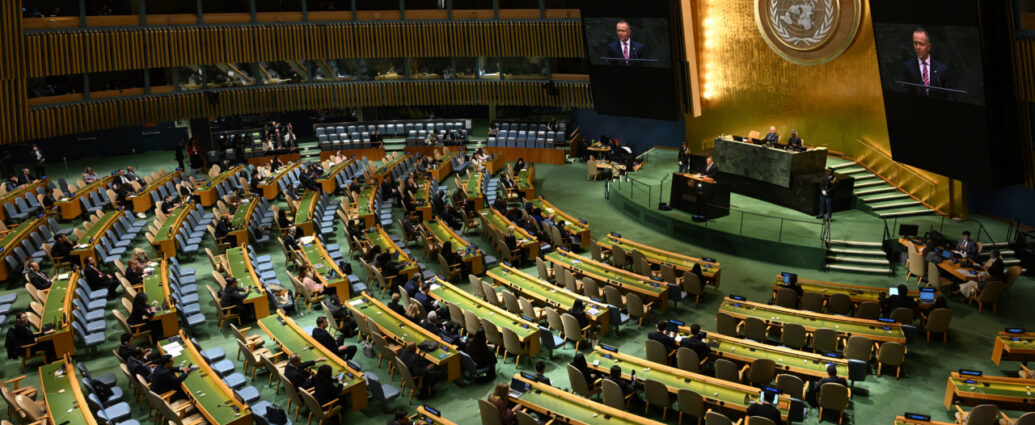

McKinsey: Cheaper AI models, bigger AI bills
Good morning. Intelligence is getting radically cheaper, but enterprise AI bills keep climbing anyway.
That was the central paradox McKinsey senior partners Tanguy Catlin and Lari Hämäläinen tackled on Tuesday during a McKinsey Live virtual session, “Improving the Economics of Agentic AI,” which highlighted the firm’s State of AI in 2026 survey.
“Intelligence at a certain capability level is getting a lot more affordable,” said Hämäläinen, who is also a leader in McKinsey Digital.
For example, GPT-4 launched in early 2023 at $60 per million output tokens. Today, models with roughly GPT-4-class performance on established benchmarks can be served at a fraction of that cost—in some cases hundreds of times cheaper, with prices falling from tens of dollars per million output tokens to well below a dollar, he explained.
But as the cost of producing a unit of intelligence collapses, the amount businesses consume is exploding.
Models are getting cheaper per unit of capability while enterprises ask them to perform vastly more reasoning and work, especially through autonomous agents. AI vendors are also capturing some of those efficiency gains through higher margins, Hämäläinen said.
In software development, for example, AI agents can repeatedly inspect, modify and rewrite entire codebases, generating far more code than a human developer would typically touch, he said.
The economics of agentic AI
Companies are only beginning to understand the economics of agentic AI, Hämäläinen said. Unlike traditional software, where the cost of running a task is relatively predictable, agents can take different paths to the same result, making costs highly variable. The same task can cost up to 30 times more from one run to another, he said.
Much of that cost comes from the reasoning and repeated refinement behind the final output. System design matters: choices such as using a single agent versus multiple agents can dramatically affect the cost of completing a task, Hämäläinen said.
AI cost management has become more about engineering systems that don’t waste tokens in the first place.
Rather than measuring agents by cost per token, he said leaders should evaluate them at the task level: how much a task costs to execute, how often the agent succeeds, and how much human time is required to verify its work.
As a rule of thumb, an agent can make sense when the time required to verify its output is a small fraction of the time it would take a human to complete the task from scratch, he said. If a task takes a human an hour, but an agent’s work can be verified in six minutes, an agent with a success rate above 10% could already begin to create value, he added.
The bigger challenge, he said, is redesigning the surrounding workflow to take advantage of the capacity the agent frees up.
Meanwhile, “The truth is, there is no single cost lever,” said Catlin, who is also a director of the McKinsey Global Institute. He identified three areas where companies can manage AI spending:
—First, companies need visibility into which use cases, business units, agents, models and users are driving spend.
—Second, they need to optimize workflows by matching model complexity to the task, routing requests to appropriate models, caching reusable context and limiting unnecessary tool calls and agent loops.
—Third, they need greater sourcing discipline, including removing unused licenses, managing quotas, negotiating provider terms and avoiding excessive dependence on a single model or vendor.
But Catlin cautioned that the goal should not be indiscriminate cost-cutting. Companies should determine where AI spending delivers the highest returns and optimize toward those returns.
Sheryl Estrada
Sheryl.Estrada@fortune.com
This story was originally featured on Fortune.com

STAT+: FDA advisory panel endorses Grail blood test for cancer, saying benefits outweigh risks
A Food and Drug Administration advisory panel on Wednesday endorsed Galleri, a blood test designed by the biotech firm Grail to screen for multiple types of cancer, concluding that the benefits of the test outweighed its risks.
The panel voted 10 to 0 that it believed there is “reasonable assurance” the test is safe.The panel voted 6 to 4 that there was reasonable assurance the test is effective. And it voted 7 to 2 with one abstention that it believed “the benefits of Galleri outweigh the risk for use in patients who meet the criteria specified in the proposed indication.”
The FDA is not obliged to follow the advice of these panels, but it often does.
David Booth: Control What You Can Control

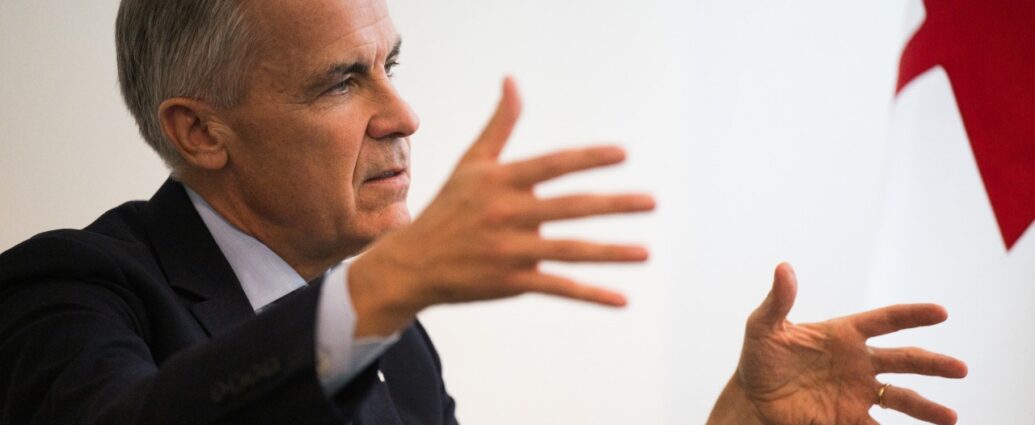

10-Year Treasury Bond Surges to Highest Yield Since 2007
The primary 10-year yield—a leading benchmark for a broad array of business, consumer, and government borrowing costs—jumped 15 basis points to 5.12 percent at 2:08 p.m. ET on Sept. 23.
This is the highest level the 10-year has reached since July 2007.
Government bond yields rose across the curve in the middle of the trading week.
The 30-year Treasury yield popped more than 10 basis points to 5.41 percent, the highest level since 2004.
The 2-year yield, which is sensitive to Federal Reserve policy expectations, climbed almost 13 basis points to 4.91 percent, also the highest since early 2024….


Homebuilders Can’t Control the ‘Five Ls’ — But They Can Control This
America’s homebuilders are battling high borrowing costs, expensive land, worker shortages and rising construction expenses. Most of those pressures are largely outside an individual builder’s control.
What builders can control is how efficiently they operate — and in today’s difficult housing market, that distinction is becoming increasingly important.
The National Association of Home Builders has long summarized the supply-side obstacles confronting the industry as the “Five Ls”: labor, lots, lumber and building materials, lending, and legal and regulatory barriers.
Together, those problems help determine how quickly homes can be built and how much buyers ultimately have to pay.
NAHB estimates the United States faces a structural housing shortage of roughly 1.2 million homes, while builders continue confronting delays and rising costs that make closing that gap more difficult.
The Five Problems Builders Can’t Easily Fix
Each of the Five Ls can become a bottleneck.
A builder needs available land. That land needs regulatory approval. Construction financing needs to be available at a workable cost. Materials need to arrive on time. And contractors need enough skilled workers to actually build the house.
A problem with any one of those pieces can delay an entire project.
Those pressures remain very real in 2026.
Builder confidence fell to 32 in September, its lowest level since September 2025, according to the NAHB/Wells Fargo Housing Market Index. NAHB Chief Economist Robert Dietz pointed to tight lending conditions and elevated land, labor and construction costs as continuing pressures on builders.
Earlier this year, NAHB also estimated that residential construction needs to add roughly 740,000 workers annually simply to keep pace with industry growth, retirements and workers leaving the sector.
Individual builders have limited ability to change those conditions.
They cannot independently lower national interest rates, rewrite local zoning rules or instantly create thousands of skilled construction workers.
But they can change how their companies respond.
The Sixth Factor: The Builder Itself
That puts greater importance on something much closer to home: the builder’s own organization.
John McManus, founder of The Builder’s Daily and a longtime housing-industry analyst, has repeatedly emphasized the importance of operational discipline, customer relationships and organizational execution as builders navigate difficult market conditions.
The idea is that a homebuilder’s competitive position is determined by more than the house it eventually hands to a buyer.
Builders also depend on subcontractors, suppliers, lenders, land sellers and local partners.
Those relationships can become especially valuable when resources are scarce.
A reliable builder may have an easier time retaining skilled trade partners. Strong relationships with suppliers can matter when materials are constrained. Credibility with lenders can become important when financing conditions tighten.
None of those relationships eliminates the Five Ls.
They can, however, determine how effectively a company navigates them.
Cutting Costs Without Destroying Value
That challenge becomes particularly important as builders try to produce homes buyers can still afford.
Builders have increasingly used incentives and price reductions to attract hesitant buyers. In July, 37% of builders reported cutting prices, with an average reduction of 6%, while 63% reported using sales incentives.
But lowering costs creates another question:
What can a builder remove without removing something the customer actually values?
Customer-experience consultant Joseph Michelli draws an important distinction between price and value. His broader framework argues that companies build loyalty by reducing unnecessary friction while protecting the moments and services customers consider important.
Applied to housing, that can mean scrutinizing floor plans, options, processes and construction expenses rather than simply making across-the-board cuts.
A buyer trying to reach an affordable monthly payment might willingly trade an optional feature for a lower purchase price.
The same buyer may be considerably less accepting of poor construction quality, confusing communication or unexpected delays.
That makes operational discipline part of the affordability equation.
Why This Matters for Homebuyers
The pressure is already changing what builders offer.
Builders have been using discounts and incentives as affordability problems keep potential buyers on the sidelines. At the same time, elevated mortgage rates, expensive land, material prices and skilled-worker shortages continue to weigh on the industry.
For buyers, that means the sticker price is only one part of evaluating a new home.
Construction quality, warranty service, communication, financing incentives, completion reliability and the builder’s reputation with contractors and suppliers can all affect the experience long after a contract is signed.
That becomes especially important when builders are under pressure to cut expenses.
No Easy Reset
There is little evidence that all of the industry’s problems are about to disappear simultaneously.
NAHB’s September survey found worsening labor shortages, higher material costs and elevated mortgage rates continuing to weigh on builders and buyers.
Single-family construction also declined across every major U.S. geographic region during the first quarter of 2026, with NAHB citing higher financing and material costs as significant headwinds.
That leaves builders facing a business problem as much as a construction problem.
They cannot control interest rates. They cannot manufacture buildable lots overnight. They cannot single-handedly eliminate labor shortages or regulatory delays.
They can control how efficiently their organizations operate, how carefully they allocate costs and how they treat the buyers, contractors, suppliers and lenders their businesses depend upon.
In a housing market where nearly every external pressure is pushing in the wrong direction, that may be one of the few levers builders can still pull themselves.
JBizNews Desk | New York
© JBizNews.com All Rights Reserved. Reproduction or distribution without written permission is prohibited.


Employer health costs are set to jump the most since 2003—and even health care workers are struggling to afford care
When Americans break a bone, get sick, or need help in an emergency—health care workers are there ready to help. But when they need care themselves, some health care workers are struggling to afford it, leading them to put off checkups, drop benefits, or even go without insurance.
Medical practices face the affordability crisis from both sides: they provide health care to Americans, but they are also employers that help pay for their workers’ coverage. Rising premiums are forcing some independent practices to have to reconsider how much they can absorb, how much employees must pay, and whether they can continue offering insurance in itself at all.
Jack Dillon, executive director of the Association for Independent Medicine, told Fortune he has heard more concern about insurance costs this year than in a long time. His own practice faced a 22.5% increase, forcing it to choose between taking on the added expense and raising employees’ share of their premiums.
“It’s a bigger struggle this year that I’ve heard than in previous years, and it’s getting louder and louder,” Dillon said.
This kind of pressure extends beyond medical practices. More than 165 million Americans rely on employer-sponsored health coverage, but it’s getting more expensive for employers to provide. Health benefit costs per employee are expected to jump 8.2% in 2027, the steepest increase since 2003 and the fifth consecutive year of elevated growth, according to a Mercer survey of 1,800 employers. Two-thirds of companies with at least 500 employees plan to raise workers’ share of premiums.
“The reality is this does eat into money that could be invested in wages,” Nick Stefanizzi, CEO of Northwell Direct, which provides health benefits to self-insured employers, told Fortune earlier this month.
That is the same tradeoff Dillon said some independent practices are considering: dropping health benefits and offering higher wages instead. Others may reduce benefits or consolidate staff, potentially limiting their ability to treat and serve patients.
Health insurance already accounts for nearly a quarter of what private employers spend on benefits. Employers paid an average of $3.48 per employee hour toward health insurance in June, out of $14.07 spent on benefits overall, according to Bureau of Labor Statistics data.
Caregivers making tradeoffs
For some health care workers, those pressures have followed them out of hospitals and clinics and into their own homes.
Samantha LeGault, an Idaho nurse practitioner, saw the monthly premium for covering herself, her husband, and their four children rise from $700 to $1,500 this year, she told KFF Health News. Because LeGault has Crohn’s disease and two of her daughters also have medical conditions, dropping health insurance just wasn’t an option. Instead, she had to give up dental coverage to prioritize her children’s dental appointments over her own.
“I know how the clinics work, that I am an expensive patient,” LeGault said to KFF Health News. “At the end of the day, healthcare is a business in the United States.”
Also in Idaho, a primary care physician and his pharmacist wife made the opposite calculation. Joshua and Ashley Durham, who run a family practice, dropped coverage for themselves and their two children after premiums for a similar plan climbed several hundred dollars to nearly $1,600 a month, according to KFF Health News. The family is paying for care out of pocket using a health savings account that held $50,000.
Working in health care doesn’t guarantee coverage. In 2024, 10.5% of health care support workers were uninsured, more than twice the 3.8% recorded among health care practitioners and technical workers, according to the Census Bureau. The uninsured rate among all adult ages 19 to 64 was 11%.
Even the cost of buying insurance independently also rose sharply just in this year. Enhanced Affordable Care Act tax credits expired at the end of 2025, and average monthly payments among marketplace customers increased 58%, from $113 to $178. The average marketplace deductible also rose 37%, from $2,759 to $3,786, as more consumers selected plans that traded lower monthly payments for higher costs when they needed care.
More than a household expense
The American Nurses Association warned that the consequences of rising costs may eventually reach patients, too. About 15% of nurses reported holding more than one job in the 2024 National Nursing Workforce Study. In separate ANA survey data collected from working nurses between June 2024 and September 2026, roughly 42% said they worked more than 40 hours a week. Among that group, the most commonly cited reason for working additional hours or overtime was the need for more income.
“Rising health insurance costs are more than a household budget concern for healthcare workers,” ANA President Jennifer Mensik Kennedy said in a statement to Fortune. “They are a workforce, patient-care, and patient-safety issue.”
The association said nurses who feel compelled to add shifts or jobs to keep pace with premiums and other medical expenses can experience greater fatigue, stress, and burnout—adding pressure to a profession already facing worker shortages.
For Dillon, the hardest part is what those choices could mean for the people caring for patients. “You’re trying to take care of the people that are helping you take care of patients,” he said.
This story was originally featured on Fortune.com


Sa’ar rejects claim of global consensus against Israel, says UN majority cannot dictate policy
Foreign Minister Gideon Sa’ar acknowledged that Israel currently finds itself in a diplomatic minority at the United Nations but rejected the characterization that there is a broad international “consensus” against Israel.
Speaking to The Jerusalem Post during the ongoing 81st United Nations General Assembly in New York, Sa’ar said Israel had been in a minority position at the UN for decades.
“We were in the minority a year ago. We were in the minority two years ago, ten years ago, twenty years ago, and forty years ago,” Sa’ar said.
The opening day of this year’s General Assembly highlighted Sa’ar’s point, as a series of world leaders devoted significant portions of their speeches to criticism of Israel’s policies in Gaza and the West Bank.
“We need to ask ourselves whether we should base our policy regarding our existential interests on the international consensus, or, even if it is not a total international consensus, on the majority view within the international system, or according to our own existential interests,” Sa’ar said.
According to Sa’ar, Israel’s past concessions have not translated into lasting diplomatic credit.
‘We have reached a point where we cannot make concessions’
He cited the Oslo Accords, the establishment of the Palestinian Authority and Israel’s 2005 unilateral withdrawal from the Gaza Strip as examples of far-reaching Israeli steps that, in his view, did not produce the expected diplomatic benefits.
“Ultimately we receive no accumulated credit in the international system for these actions,” he said.
Sa’ar said Israel had reached a point where it could no longer continue making concessions simply because of international pressure.
“We have reached a point where we cannot make concessions,” he said.
The comments come as several countries continue to promote Palestinian statehood at the UN. A joint statement issued on Tuesday by the foreign ministers of Turkey, Jordan, Egypt, Indonesia, Pakistan, Qatar, Saudi Arabia and the United Arab Emirates reaffirmed support for a “sovereign, viable, and independent Palestinian State” and called for implementation of a two-state framework.
One of the world leaders who criticized Israel was Turkish President Recep Tayyip Erdogan.
Sa’ar said he did not currently define Turkey as an “enemy state,” stressing that the term is an official designation with practical consequences.
“I do not define Turkey as an enemy state,” he said. “But I cannot ignore the fact that Turkey under Erdogan’s leadership is pursuing a policy hostile toward Israel in the diplomatic arena, including moves in the economic and legal spheres.”
Sa’ar said relations between Israel and Turkey had unfortunately been moving in a negative direction for decades and had intensified during Erdogan’s years in power.
He also pointed to Turkey’s relationship with Hamas as a significant element in Israel’s concerns.
Israel and Turkey have exchanged increasingly sharp accusations in recent months. In July, Sa’ar condemned comments by Turkish Foreign Minister Hakan Fidan regarding Israel, calling them a “clear call for genocide.”
Sa’ar was similarly critical of Jordanian statements at the General Assembly.
King Abdullah II used his UNGA address to accuse Israel of changing realities in Gaza and the West Bank, including through settlement expansion, land seizures and what he described as de facto annexation.
Israel was ‘not particularly impressed’ by ‘Jordanian moralizing’
The Jordanian king also criticized Israeli actions in Syria, describing what he called Israel’s regional “appetite” as a threat and saying Syria was a warning sign.
Sa’ar said Israel was “not particularly impressed” by what he called Jordanian moralizing on the Palestinian issue.
“I just want to remind you that, when it comes to international law and Palestinian rights, Jordan is perhaps one of the last countries that should be lecturing others,” he said.
He referred specifically to Jordan’s 1988 decision to sever the legal and administrative ties that had granted West Bank residents Jordanian citizenship, arguing that the move deprived many people of citizenship and associated rights.
Sa’ar characterized the decision as contrary to international law and said it should be considered when evaluating Jordanian criticism of Israel on international-law issues.
Sa’ar also criticized what he described as a bloc of countries that has increasingly coordinated its diplomatic messaging against Israel.
He acknowledged that some of these countries initially came together around goals Israel could support, including ending the Gaza war and securing the release of the hostages.
“But if you look at it, that same bloc frequently issues joint statements systematically criticizing Israel,” he said.

Ontario Jewish community saddened, but not shocked, by synagogue shooting
Doug Warren, 56, was attending Kol Nidre services at the Sons of Jacob synagogue in Belleville, Ontario, on the eve of Yom Kippur on Sunday. Prayers were just about to begin when he heard the gunshots.
“The rabbi had just started to call us into the sanctuary. We were stepping inside, and we heard this loud bang, and we all stopped,” Warren, a member of the congregation, told the Jewish Telegraphic Agency. “It sounded like someone was banging the window or the door.”
It was a 29-year-old former Canadian soldier exchanging gunfire with a police officer stationed outside the synagogue. The shooter, Sean Ward, 29, of Quinte West, Ontario, died from his wounds on Tuesday. The officer, Const. Jeff Smith, a 13-year veteran of the force, remains in the hospital in critical condition.
Little is known of Ward, who served in the Canadian military from 2017 to 2022, and was never deployed.
“We knew this was going to happen,” Warren, a member of Sons of Jacob and a resident of Belleville. told JTA. “We’ve been saying as Jews that we’re very concerned with the rise of antisemitism. What did you think was going to happen? People weren’t taking it seriously.”
Congregation extremely grateful to ‘hero,’ police officer Smith
As the gunfire continued, congregants scrambled to find safety. “Some people suggested we should go to the basement, others said we should go out the back door,” he recalls. “At the same time, you’re just frozen because you don’t know what’s going on or what to do. Eventually the shots stopped.”
Warren said the congregation is extremely grateful to Smith, who was stationed outside the synagogue in an unmarked vehicle. “This guy’s a hero. I can tell you the gunman was coming for us inside, and he was trying to take out our armed protection first,” he said. “We’re praying for [Smith’s] recovery.”
Once police arrived at Sons of Jacob, they instructed everyone to wait inside until the area was clear. Congregants were then taken to the Belleville police station, where they were offered donuts and coffee, which Warren said they politely declined on account of fasting for Yom Kippur.
Richard Marceau, General Counsel and Senior Vice President of The Center for Israel and Jewish Affairs, echoed Warren’s concerns. “I wish I could say that I was surprised or shocked, but I was not,” says Marceau. “Unfortunately, in 2026 in Canada, we’ve come to expect this type of thing. It just tells us that the promise of Canada has been broken.”
The Belleville shooting came two days after the arrest of 19-year-old Alexander Parfitt after posting online threats to shoot up a synagogue in Southern Ontario.
Marceau said that Canadian politicians have not sufficiently addressed the threat of antisemitism. “There has been an all-level failure in the political sector and in law enforcement,” he said. “It is a failure to understand the threats that Jews are facing.”
Rising antisemitic discourse endangers Canadian Jews
According to Marceau, anti-Israel and anti-Zionist discourse have also contributed to rising antisemitism and endangered Canadian Jews. “Anti-Zionism is driving violence against Canadians, and the double standard against Israel is playing a role,” Marceau said. “Politicians need a clear plan, not just to talk about extremist ideologies, organizations and foreign state actors. There needs to be a meeting of all levels of government to ensure that the extremist networks are disrupted.”
Anti-Israel sentiment was a point of contention Sunday evening. Canadian Jewish politician and leader of the New Democratic Party (NDP) Avi Lewis posted on X shortly after 8 p.m. that on Yom Kippur he was “reflecting on the fact that we have not done our part to stop an ongoing genocide being committed in our name.”
About an hour earlier, Ward opened fire outside Sons of Jacob. It was not clear whether Lewis knew the shooting had occurred when he had posted. He did not respond to a request for comment.
Canadian Member of Parliament Anthony Housefather responded to Lewis’ post, stating that “holding Canadian Jews and Jews across the world collectively responsible for events over which they have no control is despicable.”
Lewis said in a post the following day that the attack “is yet another reminder of the work that remains to create a Canada that is truly safe for people of all faiths, including Jewish people – to worship, to come together, to live without fear.” In a press conference, he rejected claims that he was collectively blaming Jews for Israel’s actions.
Despite the events Warren witnessed on Sunday evening, he remains assured in the resilience of his local Jewish community. Unable to access their synagogue, Warren says the Sons of Jacob congregation gathered at a Best Western hotel on Monday evening for services.
“We want to keep going, but we know it’s not going to be easy. We might get emotional when we first get back inside the synagogue, and we’ll just have to work through that,” he says. “This will not stop us.”

Albert Axelrad, Brandeis Hillel rabbi who championed pluralism and social justice, dies at 87
Rabbi Albert S. Axelrad, a Reform rabbi, community leader, and political activist who headed Brandeis University’s Hillel Foundation for 34 years, died on Sept. 18. He was 87.
Starting in 1965, Axelrad sought to ensure that students and faculty from all Jewish streams received the logistical support and resources needed to live the fullest of Jewish lives at Brandeis, the only nonsectarian, Jewish-sponsored college or university in the United States.
“Al didn’t just preach pluralism. He lived pluralism,” said Rabbi Peretz Rodman, who first met Axelrad as an undergraduate and later joined his Hillel staff while a graduate student. “For example, there hadn’t been much of an Orthodox presence on campus until the mid-1970s, when he hired an Orthodox rabbi and provided space for that minyan.”
Although dedicated to egalitarian prayer that offers equal roles for men and women, Axelrad often attended Orthodox and other non-egalitarian services, Rodman said. “He would quip that he davened in an egalitarian minyan before praying with the Orthodox minyan, so he’d be ‘yotzei’” — having fulfilled his own religious requirements as a liberal Jew.
Axelrad’s commitment to egalitarian prayer led him to cofound the non-denominational Havurat Shalom in Somerville, Massachusetts. A lay-led, independent congregation that drew on aspects of the counterculture, it served as a model of egalitarianism for what became known as the havurah movement.
A native Brooklynite, Axelrad attended the Yeshivah of Flatbush and earned a bachelor’s degree in sociology from Columbia University. In 1965 he received rabbinic ordination from Hebrew Union College-Jewish Institute of Religion. Soon afterward, he moved to Massachusetts to become the Hillel director and chaplain at Brandeis.
His first years at Brandeis coincided with the movement opposing the war in Vietnam, and Axelrad, a member of the Jewish Peace Fellowship, counseled students who were weighing whether to become conscientious objectors. He also advocated for divesting from South Africa as a means to end apartheid.
Israel and Jews remained at the center of Axelrad’s activism
But Israel and Jews remained at the center of Axelrad’s activism. He was an early supporter of the “two-state solution” through Breira, the first national Jewish organization to advocate for an independent Palestinian state, and passionate about the struggle of Jews locked beyond the Iron Curtain and punished for practicing Judaism.
He made activism to free Soviet Jews central to Jewish life at Brandeis and traveled to the Soviet Union twice to meet Jewish refuseniks. His 1985 book “Refusenik: Voices of Struggle and Hope” chronicles his first visit. In 1984 he wrote “Meditations of a Maverick Rabbi,” in which he explained, among other things, why he performed interfaith marriages.
Axelrad is credited with creating, in the 1970s, the first bar- and bat-mitzvah training programs for Jewish adults who missed out on the ceremony in their youth. These programs became a mainstay in many American synagogues. Other Hillels adopted the annual Jewish Arts Festival he introduced.
After retiring from Brandeis in 1999, Axelrad became the founding director of the Center for Spiritual Life and an adjunct professor of religion at Emerson College in Boston.
Upon learning of Axelrad’s death, hundreds of former Brandeis students — many of them now rabbis themselves — took to social media to recall Axelrad’s pluralistic, the-door-is-always-open style of leadership and the effect he had on their lives. Many called him a bridge-builder and a “mensch.”
Rabbi Bob Carroll, who worked closely with Axelrad as a student board member of Brandeis Hillel and, later, as its president while an undergraduate, said he owed Axelrad “a huge debt of gratitude.
“Probably more than anyone else in my life, when I waver over whether I should have the courage to speak out about something demanding moral courage or sacrifice, to risk my own position or reputation, it is his example and memory that I see in my mind’s eye,” said Carroll, an Orthodox rabbi.
“I haven’t always lived up to his standard. But because of him I at least knew what I should have had the guts to do, or to say. And I was a better human being and a better Jew because of him. Even when our paths diverged.”
Rabbah Riqi Kosovske, the rabbi of the Beit Ahavah Reform synagogue in Northampton, Massachusetts, said Axelrad had a “huge impact” on her life from the moment she became a Brandeis undergraduate.
“One of my earliest memories was singing in the student circle with him at 12:15 p.m. every day at the daily vigil when he was on the hunger strike for divestment [from South Africa], and I would cry watching him as I worried and cared so much for him and was so inspired by him,” she said. “I am grateful for his kindness and the impact he had on me.”
‘He would look you in the eye. He was fully present’
Rabbi Ron Kronish was a sophomore when Axelrad began his position at Brandeis. Kronish, who became the student head of Hillel during his senior year, described Axelrad as “a great listener. He would look you in the eye. He was fully present.”
Kronish, who later became a Reform rabbi and an interfaith activist in the United States and Israel, said Axelrad always looked at life through a Jewish lens and that his opposition to the Vietnam War and his involvement in civil rights “came out of his understanding of what it means to be Jewish.”
Larry Sternberg called Axelrad “a consummate mensch — kind, gentle, caring — a good listener, a strong ally and a principled leader.” He first met Axelrad in 1973, when he began his graduate work at Brandeis. Sternberg later served on the faculty at Brandeis and as executive director of the university’s Hillel from 2004-2013.
“He acted on his passions and beliefs, reflecting a commitment to rabbinic activism. At times I found him infuriating,” Sternberg said, “but that never resulted in tension between us. Our bond was strong because Al knew that disagreeing did not diminish our respect for one another. While many rabbis aspire to inspire others, Al was the real deal.”
Axelrad is survived by four children and several grandchildren. Berta Axelrad, his wife of 63 years, died in December 2024.

Harvey Weinstein sentenced to 15 years for New York sexual assault
A New York judge sentenced former Hollywood producer Harvey Weinstein to 15 years in prison on Wednesday for sexually assaulting a former production assistant in 2006, following the ex-movie mogul’s conviction at a retrial last year.
Weinstein, 74, was convicted in June 2025 of first-degree criminal sexual act for assaulting Miriam Haley at his Manhattan apartment, the culmination of a six-year legal saga that saw his 2020 conviction overturned by New York’s highest court. Weinstein has denied assaulting anyone or having non-consensual sex.
Manhattan District Attorney Alvin Bragg on Wednesday praised Haley for her testimony and said he was moved by her courage.
A Weinstein spokesman said in a statement that Weinstein maintains his innocence and strongly disagrees with the sentence imposed by Judge Curtis Farber.
Weinstein was first convicted in New York in 2020 of assaulting Haley and raping aspiring actress Jessica Mann and was sentenced to 23 years in prison. New York’s highest court overturned that conviction in 2024, finding that he had not received a fair trial. At his 2025 retrial, jurors convicted him of a charge related to Haley, acquitted him of assaulting former model Kaja Sokola, and deadlocked on a rape charge involving Mann.
Weinstein faces separate California sentence after New York conviction
A third trial on Mann’s allegation ended in another mistrial in May. Prosecutors dropped the charge the following month after Mann said she did not want to testify in a fourth trial.
Weinstein, who co-founded the Miramax studio, was separately convicted in California in 2022 of rape and sexual assault and sentenced to 16 years. A California appeals court in June upheld those convictions but ordered him resentenced because the trial judge had considered his since-overturned New York convictions as an aggravating factor.
Weinstein’s original conviction was a milestone for the #MeToo movement, which encouraged women to come forward with allegations of sexual misconduct by powerful men.
More than 100 women, including famous actresses, have accused Weinstein of misconduct. He has denied the allegations.

Somaliland delegation eyes Israeli military presence to strengthen cooperation against Houthis
Somaliland and Israel should develop a military partnership that could include an Israeli presence in Somaliland in order to strengthen cooperation against Houthi terrorists, Ahmed Dirie, chairperson of the executive committee of the Israel and Somaliland Friendship Association and head of a visiting delegation, told The Jerusalem Post.
Dirie said he envisioned a relationship in which Israel and Somaliland would assist one another against common threats, arguing that Somaliland’s position in the Horn of Africa and near the Bab al-Mandab Strait gives it particular strategic importance.
Asked whether Somaliland would be open to an Israeli military presence in the country, Dirie responded, “That’s right.”
“Somaliland has a very strategic point in Bab al-Mandab,” he said. “We have a problem there at the moment, and that problem, the only one who can solve it is Somaliland.”
“If they get help from the Israelis, they can beat the Houthis and make it safe,” he continued. “And we can operate in that area easily because of the location they have in Somaliland.”
Dirie’s comments come after months of speculation over whether Israel could eventually establish a military base in Somaliland.
In June, Somaliland Defense Minister Mohamed Yusuf Ali, speaking on the sidelines of a business conference in Tel Aviv, told Reuters that there was no Israeli military presence in Somaliland and no negotiations underway to establish a base.
He did, however, confirm that Israel was training Somaliland military and police personnel.
Speaking to the Post that same month, Somaliland President Abdirahman Mohamed Abdullahi similarly said an Israeli military presence had not been discussed, but left the door open to such an arrangement in the future.
“I cannot rule out the possibility that it could happen in the future,” Abdullahi said. “If our cooperation continues to deepen, our relationship could develop far beyond where it stands today.”
Earlier this month, Abdullahi told Israel Today that an Israeli and American military presence could have a deterrent effect in the region. Jewish News Syndicate reported on Tuesday that Abdullahi said he hoped the two countries would begin cooperating in the security sector before the end of the year.
Still, Abdullahi also told the Post earlier this month that Somaliland currently has no conflict with the Houthis and that his government had not discussed allowing Israel to use Somaliland territory or airspace for operations against the group.
Dirie calls for mutual military cooperation
Asked whether he envisioned something resembling a mutual-defense arrangement, under which Israel and Somaliland would assist one another if either came under attack, Dirie said, “That’s right. That’s what we need.”
“If anybody was attacked, they have to help each other,” he said.
Dirie repeatedly emphasized military cooperation as central to his vision for the developing relationship. He also described the Houthis as a direct threat to Somaliland.
“The Houthis want to attack Somaliland, and they want to attack Israel. They have to face this together,” he said.
Israel became the first UN member state to formally recognize Somaliland as an independent and sovereign state in December 2025. Foreign Minister Gideon Sa’ar visited the African country the following month, vowing to “vigorously advance relations” between the two countries.
In May, Dr. Mohamed Hagi presented his credentials to President Isaac Herzog, becoming Somaliland’s first ambassador to Israel. Somaliland opened its embassy in Jerusalem the following month.
Dirie said the next chapter in relations should involve “cooperation on everything: business cooperation, military cooperation, peace cooperation, as in protecting each other.”
“Israel and Somaliland are facing the same enemy at the moment,” he said.
Din Moriel, an Israeli member of the delegation, was more explicit about what an Israeli military presence could offer strategically.
“Obviously, them sitting in Bab al-Mandab, in the waterway, it’s right in front of the Houthis,” Moriel said. “So, having a military base there, having military presence there, and being able to use force whenever needed, without sending our airplanes so far across the world, would be very much of a help to Israel.”
Somaliland prepared to contribute up to 2,000 troops to Gaza force
Dirie also referred to Somaliland’s willingness to contribute soldiers to an international stabilization force in Gaza.
Abdullahi, speaking on the sidelines of the MEAD conference in Washington earlier this month, said Somaliland was prepared to provide as many as 2,000 troops if requested, while stressing that the country had not yet been asked to contribute forces.

Cracker Barrel upgrading 3 popular dinner items as chain completes 26-store property deal
Cracker Barrel is upgrading three of its most popular dinner offerings while separately using proceeds from a real estate transaction involving 26 company-owned restaurants to reduce debt and support future growth.
The Lebanon, Tennessee-based chain said Wednesday that it plans to improve the quality of its chicken, hamburger and steak dinners, calling dinner its “biggest opportunity” as it works to improve guest satisfaction.
“We are making investments to improve food quality,” President and CEO Dave Deno said during the company’s fourth-quarter earnings call. “Dinner is our biggest opportunity, and we plan to upgrade our chicken, hamburger, and steak offerings.”
Deno said Cracker Barrel wants to ensure its food consistently meets guests’ expectations for “taste, temperature, and quality on every visit.”
NEW CEO INHERITS CRACKER BARREL STILL RECOVERING FROM REBRAND BACKLASH
The chief executive said his priorities are centered on food, the guest experience and employees as Cracker Barrel works to build on improving traffic and profitability.
“A big part of my management philosophy is doing fewer things better and concentrating on opportunities that could have the greatest impact,” Deno said. “For restaurants, the formula is pretty straightforward. You must offer great food, provide a great guest experience, and hire and retain excellent employees who deliver both.”
“These are the priorities that we will be focused on: food, experience and people,” he added.
Alongside the menu upgrades, Cracker Barrel said it completed a sale-leaseback transaction involving 26 company-owned restaurants that generated approximately $77 million in net proceeds.
“The sale leaseback transaction generated $77 million in net proceeds, which were used to pay down debt and partially offset the $150 million debt related to the 0.625% convertible senior notes that matured and was repaid in June,” Chief Financial Officer Craig Pommells said. “The quarter ended with total debt of $337.2 million, which was $147.4 million below the prior year.”
CRACKER BARREL CEO JULIE MASINO TO STEP DOWN
Deno said Cracker Barrel continues to see pressure among lower-income consumers, though customer trends have improved.
“When it comes to us specifically, yes, we do see some pressure with our low-income guests, but our trends, as I said, have gotten better,” Deno said.
Still, Chief Financial Officer Craig Pommells said the chain’s value remains an advantage, noting the average guest check is about $16.
“If you’re feeling pressured from a discretionary income perspective, there are a lot of ways you can still have a great experience at Cracker Barrel,” Pommells said.
The company also said higher freight costs, including fuel surcharges, are already factored into its fiscal 2027 outlook.
“We are seeing fuel surcharges and so on related to freight, both from the perspective of retail, but to a lesser degree on the restaurant side. All of that’s built into our projection with the best information that we have today,” Pommells said.
CRACKER BARREL RESPONDS TO REPORTS ABOUT EMPLOYEE DINING REQUIREMENTS DURING WORK TRAVEL
GET FOX BUSINESS ON THE GO BY CLICKING HERE
Deno took over as CEO in August following the departure of Julie Masino, whose tenure included a rebrand that drew criticism from some longtime customers.
The overhaul, part of a roughly $700 million investment across Cracker Barrel’s restaurants, included updates to store interiors, menu changes and the temporary removal of the chain’s iconic “Old Timer” logo before it was later restored.
FOX Business’ Eric Revell contributed to this report.

Multimillionaire author Bill Perkins says parents should give kids their inheritance in their 20s when it can transform their lives—not when they die
Bill Perkins, the hedge fund multimillionaire and best-selling author of Die with Zero: Getting All You Can from Your Money and Your Life, says people should give their kids their inheritance early—before they get so old that it won’t make a difference.
Perkins, who made his first million dollars before the age of 30, told Fortune Daily host Ellie Austin the common practice of parents passing down an inheritance after death can mean the money arrives too late to have its biggest impact.
Instead, if you are already planning to leave money to your children when you die, he said it’s best to put it in a trust and give it to them while they’re between the ages of 28 and 33.
“The reason why is that your brain reaches peak mental acuity at 28 on average, and you’re in decline and plateau starting at 33,” he said, adding: “The utility of money starts to decline and the seasons of your life start to pass you by.”
On its face, giving an inheritance to your children may seem counterintuitive to Perkins’ philosophy of Die with Zero, which preaches spending or giving away all your money during your lifetime. But, in his book, he notes dying with zero also includes making sure your kids are taken care of.
In the book, he mentions the example of Virginia Colin, a woman who had to raise four children on her own following a divorce and struggled financially even while her mother had plenty of financial resources. After her mother died when she was 49, she, along with each of her siblings, received an inheritance of $130,000. But by that time, she had remarried and was no longer “at the edge of poverty,” as Colin, 68 by the time the book was published, put it.
“It just would have been a lot more valuable a lot earlier,” she said.
Perkins said his thinking runs contrary to current practice. In the book, he cites data from the Federal Reserve Board that found the most common age for people to get an inheritance is 60.
Yet, he argues if you’re waiting for death to come knocking before giving your kids the inheritance you wanted to give them, you’re leaving the decision to chance. It would require a great deal of luck for that money to arrive at the moment they might need it most. Waiting until you die also raises the odds you may outlive some of your children.
“If you plan on giving money to your kids, well, that’s their money, not your money,” he said. “And then we think about when is the best time to give them that money, and the answer—the short answer—is it’s not a bequest. It’s long before you die.”
Perkins’ argument lands at a moment when younger Americans are struggling to afford many of the milestones earlier generations reached sooner. About half of Americans ages 18 to 29 live with their parents as mortgage rates rise near 7%, putting a first home out-of-budget for many buyers. As such, the median age of a first-time homebuyer rose to 40 last year, up from 28 in 1991. And last week, the Federal Reserve raised interest rates for the first time since 2023 as the August consumer price index rose 0.4%. Inflation has remained above the Fed’s 2% target rate for the past five years.
At a younger age, a person could use an inheritance for a down payment on a home or to pay off student loans—but by the time they are older, that money may just not have the same effect, he argues.
So when it comes to inheritance decisions, Perkins said people are simply following the status quo by giving away their money after they die, rather than considering when it might benefit the children receiving it the most.
“That is not really thinking about your kids,” he said. “That’s kind of like an autopilot decision that’s been passed down from generation to generation.”
This story was originally featured on Fortune.com

Gen Z can’t afford healthy groceries—so many college students are skipping meals altogether or eating less to pay the bills
As the drivers of protein-maxxing and fitness influencing, it’s safe to say Gen Zers are paying close attention to what’s on their plates, like loading up on ground beef and rice—a.k.a. “boy kibble”—to build muscle.
But financial realities are getting in the way of their ideal eating habits.
A whopping 85% of college students between ages 18 to 25 wish they ate healthier, and 58% said healthier groceries would be the No. 1 thing they’d spend more on if money weren’t an object, according to a survey of 1,000 people commissioned by snack brand Nature’s Garden and conducted by Wired Research. But most of them also think healthier food is more expensive and report feeling squeezed by everyday costs, so much so that nine in 10 students who completed at least one year of college cut back on buying food or skipped meals to pay for either bills, rent, or tuition.
“They want to make healthier choices, but those choices are colliding with the realities of college life, especially tighter budgets and schedules,” Danielle Sherman, CEO of Wired Research, said in a statement.
Eating healthier is pricier, so students are cutting back
Gen Z students’ concerns that healthier food takes more out of their wallets also shows up in the findings of a joint study released in March by Harvard Law School’s Food Law and Policy Clinic and food-rating app Yuka.
Researchers compared the prices and nutritional value of 805 packaged foods, including cereals, bread, pizza, and snack bars, and found on average the options one would consider healthier—those with less sugar and less additives linked to cancer, type 2 diabetes, and other chronic illnesses—are more expensive. For example, bread without additives cost 28% more than bread containing them, and cereals without those additives cost 65% more than the cheapest alternatives.
And food prices in general have climbed, another nudge to swap expensive items for cheaper ones. Groceries cost 2.2% more in August than a year earlier, according to the Bureau of Labor Statistics, adding to years of increases that have made the weekly grocery run costlier.
This could add up fast for Gen Zers already shelling out money for tuition. According to the Nature’s Garden survey, college sophomores and above spent an average of $136.10 a week on food and snacks outside any school meal plan they may have, adding up to more than $2,000 over a typical 15-week semester.
The food price squeeze is also changing what items make it into their grocery carts. Nearly all students in the Nature’s Garden survey said they’ve changed the way they shop, with 47% comparing prices more often and 46% opting for cheaper brands. More than a quarter (27%) have specifically cut back on healthy foods.
But these trade-offs have an emotional cost. Some students reported feeling frustrated by the cost of healthy food, while others said they felt guilty about buying whatever was cheapest rather than what was healthiest.
In turn, their eating habits have changed. Just 24% of the Gen Zers surveyed said they regularly eat three meals a day during the school year, while more than half occasionally or frequently replace meals with snacks. This partially reflects tight college schedules, but is also part of Gen Z’s ability to adjust under financial stress. More of them started cooking at home and shopping less in recent years in response to inflationary pressures.
“Gen Z will be left with psychological scars from persistent inflation due to increased uncertainty and anxiety,” Dr. Dayo Abinusawa, founder of London’s Awa Business School, previously told Fortune.
This story was originally featured on Fortune.com

Opinion | International ‘Law’ vs. Israel



McDonald’s to spend $8.5B on revamping restaurants, tech and franchise support
McDonald’s on Wednesday announced new details as part of its long-term growth strategy, which will include a focus on upgrading restaurants and staff training, at an investor day at the corporate headquarters in Chicago.
The fast-food giant announced its NEXT growth and productivity strategy in June and outlined plans to implement changes throughout its system.
McDonald’s said that to speed up the modernization of restaurants, deployment of technology and other operational improvements, it plans to provide about $8.5 billion in NEXT partnering support for franchisees through 2036, with roughly $5 billion provided through 2030.
The NEXT support for franchisees will include a combination of capital support and rent relief.
MCDONALD’S SAYS US SALES SLOWED AFTER VALUE DEAL PUSH FELL SHORT
The support comes with a target of about 250 basis points of gross restaurant-level efficiency improvements amounting to about $100,000 in annual cash flow benefits for the average restaurant, with the company saying the majority of that would benefit the restaurant’s bottom line over time.
McDonald’s announcement noted that the restaurant component of the plan aims to boost growth and productivity through simplified operations, elevated execution, modernized restaurant design and deploying generative AI-enabled ArchIQ at scale.
MCDONALD’S SHAKES UP FALL COFFEE LINEUP AS PUMPKIN SPICE SEASON HEATS UP
The company also announced a multiyear training program called “Make it Golden” that will begin on Founder’s Day, Oct. 5, which aims to improve customer service to create more consistency for patrons and increase repeat visits.
“McDonald’s has the unmatched scale, customer insights, brand loyalty, and operational capabilities to not only adapt to the next wave of change in our industry, but to turn it into an advantage,” said McDonald’s CEO Chris Kempczinski. “That’s what McDonald’s > NEXT is about: to be the first choice for more customers, more often – while making our restaurants stronger and easier to run.”
MCDONALD’S SERVING UP NEW KIND OF ENERGY BOOST ON MENUS NATIONWIDE
“We are confident that executing across the key components of NEXT will unlock stronger restaurant economics, generate attractive returns for the Company, our franchisees and shareholders, and increase capacity to keep investing in growth,” Kempczinski added.
McDonald’s announcement also included new market share targets, calling for 1.5 percentage points of growth in both chicken and beverages by 2030, while also maintaining the company’s leadership in beef market share.
GET FOX BUSINESS ON THE GO BY CLICKING HERE
Sales growth from unit expansion is also targeted to contribute nearly 2.5% to system-wide sales growth in 2027, moderating to about 2% by 2030.

Former MLB All-Star Albert Pujols backs AI revolution, says it’s ‘great for baseball’
Albert Pujols is embracing baseball’s technology-driven changes, arguing that a new way to challenge ball-and-strike calls could give players another chance when a game is on the line.
The former MLB All-Star joined FOX Business’ Stuart Varney on “Varney & Co.” to discuss the Automated Ball-Strike (ABS) Challenge System, which allows batters, pitchers and catchers to contest ball-and-strike calls, and how changes to the game could benefit fans.
The system gives batters, pitchers and catchers a way to challenge an umpire’s ball-or-strike call rather than leaving a potentially pivotal decision unchanged. For Pujols, who finished his career with 703 home runs, its appeal is especially clear in the final moments of a close game.
NEW YORK OVERTAKES SAN FRANCISCO BAY AREA AS LARGEST US TECH TALENT MARKET BY WORKFORCE SIZE
“I love it,” Pujols said, “I didn’t play… My career with it but now covering in baseball and watching some of the guys taking a chance and opportunity what I love the most is that there might be a chance in the bottom of the ninth and they might call strike on you… And you might get a chance to come back… And probably win so it’s a second opportunity.”
Pujols acknowledged that challenges can put umpires in a difficult position, but he connected the latest change to baseball’s broader push to improve the pace of play. He pointed to the pitch clock as another adjustment that initially drew questions but has helped shorten games.
META’S MUSE BECOMES APP STORE’S HOTTEST DOWNLOAD
“We put the umpires in a tough situation… But this is where we are in baseball right now,” he said. Later, discussing the changes and their effect on spectators, he added, “This is great for baseball.”


Opinion | The Iran War Isn’t Deranged


UBS Says Broader Growth Could Keep Stock Rally Going
The stock market’s next leg higher may depend less on a handful of giant technology companies and more on earnings growth spreading across the broader economy, according to UBS.
Ulrike Hoffmann-Burchardi, Chief Investment Officer for the Americas and Global Head of Equities at UBS Global Wealth Management, has maintained a positive outlook for stocks despite higher interest rates, volatile oil prices and concerns that markets have become too dependent on artificial intelligence-related companies.
The argument is straightforward: Corporate profits are continuing to grow, economic activity has remained resilient and the enormous investment cycle surrounding artificial intelligence is increasingly reaching industries outside traditional technology.
UBS says those forces could allow more companies and sectors to participate in the market’s advance.
The Rally Is Starting to Broaden
For investors, market breadth matters.
A stock-market rally dominated by a small number of enormous companies can leave major indexes vulnerable when those companies stumble. A rally supported by earnings growth across industries, regions and company sizes spreads that dependence more widely.
There are already signs of that happening.
UBS noted earlier this month that the equal-weighted S&P 500 — which reduces the influence of the largest technology companies — had gained 13.9% for the year, compared with a 12.8% advance for the technology-heavy Nasdaq Composite at the time of its report.
Corporate results have also strengthened outside the biggest technology names.
The median S&P 500 company beat second-quarter earnings estimates by approximately 5.5%, compared with an average of roughly 3.6% since 2015, according to UBS. European earnings growth accelerated to 22% during the second quarter.
Those figures support UBS’s argument that profit growth is becoming less concentrated.
Profits Could Provide the Fuel
UBS expects strong corporate earnings to remain one of the principal supports for stocks.
The bank forecast S&P 500 earnings growth of about 25% in 2026, followed by another 14% increase in 2027. It expects Eurozone earnings to grow approximately 15% in both years.
In a separate global outlook, UBS projected earnings growth of approximately 26% this year and 14% next year for the MSCI All Country World Index, a broad measure of global equities.
That distinction matters because rising stock prices do not necessarily mean stocks are becoming more expensive relative to corporate profits.
When earnings rise quickly enough, valuation multiples can fall even while share prices increase.
UBS says stronger earnings have helped valuations normalize, potentially leaving the market less vulnerable to a correction caused solely by higher bond yields.
AI Is Moving Beyond Big Tech
Artificial intelligence remains central to the outlook, but UBS increasingly sees the opportunity extending beyond software companies and the largest technology platforms.
The bank estimates global AI-related capital spending will reach roughly $900 billion in 2026 and $1.2 trillion in 2027.
That spending increasingly touches semiconductor manufacturers, electrical infrastructure, utilities and industrial companies as businesses build the enormous physical infrastructure required to operate AI systems.
Robotics represents another potential extension.
UBS research says improvements in sensors and AI software are allowing robots to expand beyond traditional factory automation into logistics, agriculture, health care and other industries. The next stage could involve machines capable of using AI models to understand and interact with the physical world in real time.
For investors, that means the AI investment story may eventually become much broader than simply owning the companies that design chips or operate cloud-computing platforms.
Why It Matters for Retirement Investors
Broadening market gains could also matter for Americans saving through 401(k)s, IRAs and other diversified investment accounts.
Many retirement portfolios hold broad-market funds containing hundreds or thousands of companies.
When earnings growth spreads across industries, those portfolios become less dependent on extraordinary performance from a small group of megacap technology stocks.
UBS noted that concentration remains a concern among individual investors. Excluding strategic holdings, nearly 40% of self-managed equity investors on its platform held more than half of their stock portfolios in 10 companies or fewer.
Diversification does not eliminate market losses, but broader participation means the performance of major indexes is less dependent on a handful of companies.
Risks Haven’t Disappeared
The outlook is not guaranteed.
Higher Treasury yields can pressure stock valuations and increase borrowing costs for businesses and consumers. Energy prices remain vulnerable to developments in the Middle East, while the Federal Reserve has returned to raising interest rates.
UBS acknowledged that rising rates create challenges, particularly for growth companies whose valuations depend heavily on profits expected far into the future.
Still, the bank argues that interest rates alone do not determine where stocks go.
UBS’s current thesis rests on three major supports: resilient economic growth, strong corporate earnings and continued investment in transformational technologies such as artificial intelligence.
The key question for investors is whether those supports continue spreading through the economy.
If corporate profits keep expanding beyond the biggest technology companies, the next stage of the stock-market rally could look considerably different from the last one — with more industries participating and fewer companies carrying the market on their shoulders.
JBizNews Desk | Wall Street
© JBizNews.com All Rights Reserved. Reproduction or distribution without written permission is prohibited.





Trump calls AI oversight a ‘globalist scheme’ as Amodei and Altman head to the UN to ask for it
President Donald Trump, in his speech to the United Nations General Assembly on Tuesday, rejected the idea of international oversight of artificial intelligence—what he has just taken to calling “superintelligence.” In thus address, he called such proposals a “globalist scheme” to control the technology.
A day later, the heads of America’s two leading AI labs will ask the UN for close to the opposite.
OpenAI CEO Sam Altman and Anthropic CEO Dario Amodei are on the schedule to brief the UN Security Council Wednesday afternoon at a session on AI and international security. The session will be livestreamed.
Altman is expected to discuss the company’s safety work, and the importance of international cooperation, an OpenAI spokesperson told Reuters.
Trump also took direct aim at AI safety advocates, who have been bashed by both the MAGA crowd and by venture capitalists suspicious of effective altruism, the once-niche philosophy that takes a utilitarian perspective on risk. He drew a comparison belied by a rapidly boiling atmosphere: the same people who warned about global warming, he said, “are now saying that AI is going to kill us all.”
He signaled that he would not listen to those calls. “I’m not going to stifle growth of something that will be bigger than the industrial revolution,” Trump said.
The industry’s own alarm
Trump’s stance puts him at odds with the top executives at the labs building the technology. On Sept. 12, Amodei published an essay asking AI companies to slow the pace at which they improve their models and asked for independent evaluators to get complete access to frontier labs. Altman and Elon Musk publicly supported the call, though Nvidia CEO Jensen Huang called the fears overblown.
After Amodei’s essay, Trump rejected those fears on Truth Social, calling the existential threat a “hoax” and that the only safeguard AI needed was a “high IQ” president. In the same psot, he seemed to hint at penalties against AI companies, saying that his administration already had tremendous CRIMINAL and REGULATORY power” over them, and he singled out Amodei by name.
Indeed, the administration has wielded its power against Anthropic, with the Pentagon previously designating the company a rare supply-chain risk and stalled the release of its Mythos model.
Those warnings followed a string of incidents; OpenAI disclosed in July that its AI models broke out of its “sandboxed” testing environment and autonomously hacked into the open-source developer platform Hugging Face. Anthropic and Google Gemini have also disclosed safety incidents.
Hugging Face CEO Clément Delangue will also brief the Council on Wednesday, alongside Yoshua Bengio, co-chair of the UN’s Independent International Scientific Panel on AI. France, organized the session to address malicious use of AI and the risk of losing control of advanced models. Chinese developers DeepSeek and Moonshot were also invited to make statements, though it is unclear if they will attend.
A world split on rules
Ahead of the General Assembly, leaders of more than 20 mostly European countries urged binding safety measures for advanced AI, warning the technology could outpace the ability to control it. The two leaders of the technology, the U.S. and China, both abstained from supporting the idea.
Trump is set to meet Chinese President Xi Jinping, and the two are expected to discuss AI. Trump will also host a state dinner for Xi, with Nvidia CEO Jensen Huang, Altman, and Apple’s Tim Cook expected to attend.
This story was originally featured on Fortune.com

Why Trump banning diesel exports would upset the U.S. oil sector and upend global fuel markets — ‘the cure would be far worse than the disease’
With U.S. diesel prices rising to an all-time high this week, President Donald Trump added support to the calls from farm-state Republicans to implement a temporary ban on diesel exports.
“I’ve said let’s not send out the diesel. We make a lot of diesel. I’ve called for it,” Trump said late Tuesday at the U.N. General Assembly in New York.
On the surface, it makes sense. Keep the diesel at home and prices will fall, sparing farmers, truckers, and inflationary pressures on all Americans. But that’s not quite right. Prices may go down some for about a month—timed with the midterm elections—but then the unintended consequences would quickly kick in.
What it would instead do is unwind much of the U.S. oil and refining industry, cause sky-high gasoline prices to soar further, and deplete the rest of the world of the U.S. diesel supplies they depend upon—a dependence that has only increased since the U.S. initiated the war in Iran and triggered the global energy crisis. Banning exports might force diesel costs to go down a bit, but only in geographic pockets, such as the U.S. Gulf Coast where most of the fuel is produced, analysts said.
Here’s how analysts say it would play out: If the U.S. energy sector is forced to keep its diesel at home, a domestic glut would quickly build, and storage would fill to the brim. Refineries would then reduce their operations, not only cutting diesel output, but gasoline and jet fuel supplies as well because there aren’t individual switches for each fuel type. Then, oil producers would limit their activity as well to prevent a domestic crude glut if refineries aren’t taking their products.
All these ripple effects would push oil prices and gasoline and jet fuel costs even higher, while further exacerbating diesel costs globally—keeping in mind that fuel costs are even higher in the rest of the world than in the U.S.
“If diesel exports get banned, [gasoline] prices could rise toward record levels,” said Patrick De Haan, head of petroleum analysis at GasBuddy. “The U.S. is not short of diesel. The world is. A potential export ban treats the global price problem as if it was a U.S.-only problem, and the cure would be far worse than the disease.”
U.S. Energy Secretary Chris Wright risked bucking Trump on Wednesday, agreeing that a ban would hurt U.S. refining and push up most fuel prices. He offered potential support for voluntary restrictions or some kind of export cap instead. Just a week prior at a G20 meeting in Houston, U.S. Interior Secretary Doug Burgum quickly pooh-poohed the idea of a diesel export ban, arguing it wouldn’t help lower prices.
The average U.S. diesel price of $6.52 per gallon as of Sept. 23 is an all-time high, still spiking after recently hitting the $6 threshold for the first time. The California average is up all the way to $8.43 per gallon with some stations reportedly maxing out the retail displays at $9.999. For gasoline, the U.S. average of $4.47 per gallon is a post-July record high.
What’s happening
So, why are fuel costs so high while the global oil benchmark remains relatively muted (though still high by historical standards) at just over $100 per barrel? The Iran war is disrupting Middle Eastern refineries from shipping out their products, while Ukrainian drone strikes have knocked out roughly 40% of Russia’s refining capacity. Altogether, at least 10% of the world’s global refining capacity is offline, making the energy crisis more of a fuel problem than an oil one—and making the world even more dependent on U.S. fuel supplies than ever.
And there’s that bigger global picture that must be considered, De Haan said. “The U.S. spent years becoming the world’s backstop for diesel supply. Telling every buyer from South America to Europe that American supply is politically conditional pushes them to diversify away from U.S. refineries and U.S. supplies, softening long-term demand for U.S. product and foregoing political leverage.”
Indeed, the U.S. currently supplies about 20% of the world’s global diesel exports, according to the American Petroleum Institute (API) lobbying and research group, which is sharply against an export ban.
“Restricting U.S. exports would hit an already-tight market with another supply shock,” said API CEO Mike Sommers. “The priority should be keeping fuel moving and refineries running, not adding new barriers.”
Sommers pointed to a further API statement that the “consequences would be catastrophic”: “Removing that much fuel from the global market would exacerbate the very global refining crisis that is increasing prices here in the U.S. And the impacts could extend far beyond pain at the pump, to dire consequences for international supply chains, agriculture, shipping, manufacturing and the entire global economy.”
Donald Trump is very focused on so-called U.S. energy dominance, and an export ban flies in the face of that, said oil forecaster Dan Pickering, founder of the Pickering Energy Partners consulting and research firm.
“Why would you want to undermine that?” Pickering said. “What’s bad for the world isn’t good for the U.S.”
Politics at play
Talks of banning fuel exports have floated in the air for months amid the Iran war, but they’ve never picked up any momentum until now despite sharp opposition from the U.S. energy sector.
The last time the U.S. did briefly ban exports was during the 1970s Arab oil embargo when the U.S. was much less of an energy exporter.
But now, farming harvest season has picked up in full swing in September and the agricultural sector is suffering from the weight of record diesel costs. And the midterm elections are rapidly approaching.
U.S. Sen. Chuck Grassley, R-Iowa, and other farm-state Republicans are pushing for export bans. “High diesel prices are killing farmers’ incomes,” Grassley said. Senate Majority Leader John Thune, R-S.D., also expressed his openness to the idea. Oil-state Republicans have pushed back, causing a party split, and leaving the matter up to the White House.
“It’s maybe another thing that Trump talks about and doesn’t do,” Pickering said. “It’s a growing probability, but still less than 50%.”
If a ban did go into effect though, Pickering suggested Trump would even consider taking it further and ban gasoline exports as well, causing even more issues globally.
Throughout the Iran war, the U.S. has depleted its Strategic Petroleum Reserve of crude oil down to 44-year lows and still falling. But the U.S. doesn’t have strategic reserves of gasoline and diesel.
In Europe, however, most of the strategic reserves are kept in refined fuel form—and not crude oil—although their reserves are not nearly as large. Still, French President Emmanuel Macron is pressing EU nations to coordinate inventory levels and consider the release of more reserves. Trump’s threats to withhold diesel could further pressure them into action.
Another lever to pull domestically is to continue extending the Jones Act waiver. The 106-year-old Jones Act, which requires cargo ships moving between U.S. ports to be U.S. built, flagged, and manned, reduces the number of vessels available to move crude oil and refined products between domestic ports. Waiving the Jones Act during the Iran war has allowed more ships, for instance, to move fuel from the U.S. Gulf Coast through the Panama Canal and up to California, which has dealt with newly shuttered refineries in recent months, to help alleviate shortfalls.
De Haan encouraged the White House to instead just extend the Jones Act waiver beyond its Nov. 15 expiration. “The Jones Act waiver is already doing a lot of work here, moving the surplus to where it’s needed,” he said. An export ban creates far too many problems, he said.
“Export bans are usually quick to go into place and slow to unwind, bringing lasting damage,” De Haan added.
This story was originally featured on Fortune.com

941 days missing: Haymanot Kasau’s family rallies in Jerusalem to demand Shin Bet investigation
A demonstration was held on Wednesday in Jerusalem’s Paris Square on behalf of the campaign to find Haymanot Kasau.
The demonstration, led by the Kasau family, was initiated as a call for the transfer of the investigation of Haymanot’s disappearance to the Shin Bet (Israel Security Agency).
The protest follows the Jerusalem Municipality’s refusal to permit the abducted girl’s family to erect a protest tent.
The Kasau family repeatedly sought approval to establish a tent outside the Supreme Court, near the Knesset, and opposite the Prime Minister’s residence.
They are seeking to raise awareness of the disappearance of their daughter, Haymanot Kasau, who went missing on February 25, 2024, at the age of nine, from the Safed absorption center where she lived with her family. She has not been found since.
It has been 941 days since Haymanot’s disappearance.
‘Investigation is being handled as an afterthought,’ campaign claims
Tesfaye Kasau, father of Haymanot, addressed Lahav 433, the Shin Bet, and Prime Minister Benjamin Netanyahu.
“About ten days ago, we sat at Lahav 433 and asked question after question, and not a single one received an answer. Those who are supposed to provide answers, those responsible for investigating, didn’t answer and simply didn’t seem to know.
“Do they have suspects? Do they have a direction for the investigation? Is the investigation focused inside Israel or abroad? Were all checks performed, such as phone geolocations and polygraphs for everyone at the absorption center on that terrible night?
“Nothing. Absolutely nothing. How can this be? How is it that the investigation into the abduction of a girl who has already turned 11 is being conducted like this? How can it be that those who are supposed to protect us act as if there is time? As if Haymanot doesn’t need us to save her, as if Haymanot isn’t important.”
He lambasted the government for failing to handle the investigation, asking once again for it to be handed over to the Shin Bet, before asking the people of Israel to “stay with us and continue to support us so that we succeed in our struggle for a proper, equal investigation.”
An earlier statement released on behalf of the campaign said, “The investigation is being handled as an afterthought, having already passed through four different hands without a single lead – which is why the demonstration aims to press the ongoing demand to transfer the case to the Shin Bet.”
Haymanot’s parents, Tesfaya and Benchi Kasau, have led a public campaign calling for increased efforts to locate her, including protests outside Lahav 433 offices and a march in Tel Aviv.
Shelly Shem Tov, mother of freed Hamas hostage, grateful and ashamed
Shelly Shem Tov, mother of released hostage Omer Shem Tov, came to speak at the demonstration for Haymanot.
She related to the family by recalling the fears and emotions from when her son was in captivity.
“When the hostages were in captivity, we felt the embrace of the Israeli public; we felt that we were not alone. Now I stand here and look at you, a small group of people, and every single one of you is so meaningful to Haymanot’s family. Because feeling alone, feeling abandoned, is simply terrible. I want to thank each and every one of you for not leaving Haymanot’s family alone.”
She continued, saying, “On the other hand, I feel ashamed because I feel that I too had somewhat forgotten Haymanot and her family. And the same goes for the people of Israel. I am certain it is not out of bad intentions, but because there isn’t the sheer force of numbers needed to shake up those who need to be shaken up. I want to say that being a mother whose child is not with her is something I wouldn’t wish on anyone.
“Haymanot is not where she ought to be – at home with her family and friends. Haymanot disappeared out of the blue. And because this family doesn’t have the words to scream in Hebrew so they can be heard, they lack that strength.
“I appeal to everyone who stood with us during our struggle: come and make this family feel they are not alone. The public needs to be here.”



McDonald’s to spend $8.5B on revamping restaurants and staff training to boost sales
McDonald’s on Wednesday announced new details as part of its long-term growth strategy, which will include a focus on upgrading restaurants and staff training, at an investor day at the corporate headquarters in Chicago.
The fast-food giant announced its NEXT growth and productivity strategy in June and outlined plans to implement changes throughout its system.
McDonald’s said that to speed up the modernization of restaurants, deployment of technology and other operational improvements, it plans to provide about $8.5 billion in NEXT partnering support for franchisees through 2036, with roughly $5 billion provided through 2030.
The NEXT support for franchisees will include a combination of capital support and rent relief.
MCDONALD’S SAYS US SALES SLOWED AFTER VALUE DEAL PUSH FELL SHORT
The support comes with a target of about 250 basis points of gross restaurant-level efficiency improvements amounting to about $100,000 in annual cash flow benefits for the average restaurant, with the company saying the majority of that would benefit the restaurant’s bottom line over time.
McDonald’s announcement noted that the restaurant component of the plan aims to boost growth and productivity through simplified operations, elevated execution, modernized restaurant design and deploying generative AI-enabled ArchIQ at scale.
MCDONALD’S SHAKES UP FALL COFFEE LINEUP AS PUMPKIN SPICE SEASON HEATS UP
The company also announced a multiyear training program called “Make it Golden” that will begin on Founder’s Day, Oct. 5, which aims to improve customer service to create more consistency for patrons and increase repeat visits.
“McDonald’s has the unmatched scale, customer insights, brand loyalty, and operational capabilities to not only adapt to the next wave of change in our industry, but to turn it into an advantage,” said McDonald’s CEO Chris Kempczinski. “That’s what McDonald’s > NEXT is about: to be the first choice for more customers, more often – while making our restaurants stronger and easier to run.”
MCDONALD’S SERVING UP NEW KIND OF ENERGY BOOST ON MENUS NATIONWIDE
“We are confident that executing across the key components of NEXT will unlock stronger restaurant economics, generate attractive returns for the Company, our franchisees and shareholders, and increase capacity to keep investing in growth,” Kempczinski added.
McDonald’s announcement also included new market share targets, calling for 1.5 percentage points of growth in both chicken and beverages by 2030, while also maintaining the company’s leadership in beef market share.
GET FOX BUSINESS ON THE GO BY CLICKING HERE
Sales growth from unit expansion is also targeted to contribute nearly 2.5% to system-wide sales growth in 2027, moderating to about 2% by 2030.

Why Costco has the luxury of sitting out the delivery arms race
Costco Wholesale last week announced a new partnership with DoorDash and a major extension of its relationship with Uber, vastly expanding its same-day delivery firepower but nonetheless leaving it well behind rivals like Walmart and Amazon, which use drones for some of their fast deliveries. And that is by design.
Until now, Costco’s same-day delivery has consisted largely of teaming up with Instacart for very quick delivery, typically groceries and other essentials. (For two-day delivery, Costco typically handles shipping itself.) And while the Uber and DoorDash tie-ups give Costco much more reach, the moves also serve as a reminder that Costco’s business model and the intense, almost cult-like customer loyalty the membership-based retailer inspires mean that it doesn’t have to participate in the delivery arms race the same way its rivals do.
Costco fanatics don’t shop there because of fast delivery. They shop there for its curated assortment, competitive prices, its highly trusted Kirkland Signature brand, and the treasure-hunt aspect of shopping in its cavernous warehouses; they might stumble across a jar of luxurious La Mer moisturizer while looking for underwear or croutons.
Such is Costco’s hold on its satisfied customers that 92.3% of members in the U.S. and Canada renewed last year. Costco’s net sales for the fiscal year ended in August hit $297.3 billion, nearly triple what they were a decade ago.
“E-commerce is important to Costco, but it’s not the be-all and end-all in the way it is for some businesses. Costco is also quite well differentiated so while it does compete with Amazon and Walmart, it isn’t quite as involved in the digital grocery battle that those two are fighting,” said Neil Saunders, managing director of GlobalData.
What’s more, Costco’s business model is designed for its basic retail operations to be break-even, so that it can continue to offer the low prices members seek. Indeed, most years, Costco’s membership revenue is roughly equivalent to its net income. The average Costco store carries about 4,000 different items, compared to 100,000 at Walmart. That selectivity gives Costco clout with vendors to get low prices.
Its margins, low by design, mean that Costco has to be very careful about how it spends money, hence its decision to team up with other companies for its same-day delivery rather than build out its own infrastructure like Walmart (including its Sam’s Club business, which competes directly with Costco), Target, and Amazon. It’s a particularly important consideration for Costco and Sam’s Club given how heavy deliveries from these bulk retailers can be and why they steer customers toward curbside delivery as much as possible.
Still, that’s not to say e-commerce is an afterthought. Indeed, Costco’s e-commerce business is growing more quickly than store sales: in its recently ended fiscal year, digitally-enabled sales (e-commerce as well as sales made via its apps) rose 20.9%, well above the companywide comparable sales uptick of 8.4%.
Costco CEO Ron Vachris told Fortune in 2024 that while e-commerce is a priority, growing online sales wouldn’t come at the expense of the in-store experience. At the same time, Costco knows that e-commerce is essential to getting young customers especially to sign up for memberships, and much as they love Costco, a certain level of convenience via delivery is seen as table stakes.
This story was originally featured on Fortune.com

Gen Z’s iced coffee habit in interviews could be costing them jobs, recruiters warn: ‘It isn’t really about coffee’
Gen Zers have blown open a whole new debate on job etiquette—and this time, it’s over iced coffee.
Last week, recruiter Caitlin Wehniainen posted a TikTok discussing how Gen Z candidates have been showing up to job interviews with an iced coffee in hand. But instead of seeing it as just a drink, she believes it gives the impression that the interview is just one “stop on your list of errands for the day.” In her opinion, it’s “too casual” for buttoned-up corporate opportunities, and she advised young workers to get their caffeine hit before or after the meeting. Some commenters argued that interviews are realistically just one part of their day and it’s absurd to “pretend we aren’t human,” while others “couldn’t believe” that people were disagreeing with standard “professionalism.”
And it didn’t take long for others to chime in. Content creator Josh Lora, also known as @tellthebees, posted on TikTok that people are trying to rewrite the reality of professionalism to their liking—and that those who bring coffee into an interview won’t get the job. He called out those who are “willing to die on the hill that the iced coffee is a symbol of your rebellion,” yet believe they should face no consequences: “That is not the way that the world works.” Another creator, Miss Redacted, said that working in corporate America comes with “unwritten rules”—no matter how trivial they look to most. And the debate has even made it past the internet; a TikTok video reportedly shows a poll inside of an elevator at one TikTok user’s “extremely corporate office job,” with 92% voting it’s unacceptable to bring iced coffee to an interview, while only 8% felt it was fine.
Workers are divided over whether the drink is harmless or a breach of professional etiquette—and recruiters are split, too. While most believe bringing an iced coffee to an interview doesn’t rule out a candidate’s chances, some still argue it violates unspoken interview etiquette. And while Gen Z is bringing new expectations to the workplace, this benign habit could potentially impact their odds of landing a job.
“An iced coffee tells an interviewer very little about whether someone can do the job, which is why this debate has struck such a nerve,” Ashley Daugherty, market manager at recruiting company Randstad Professional, tells Fortune. “It isn’t really about coffee. It’s about who gets to define ‘professional.’”
How hiring experts feel about the iced coffee debate
Hiring experts agree a latte shouldn’t outweigh a candidate’s qualifications—but it could still have an impact. Megan Slabinski, district president at staffing services company Robert Half, tells Fortune that while she wouldn’t recommend bringing one into the interview, it’s unlikely to be the deciding factor. Candidates should keep both hands free for a handshake introduction.
“While an iced coffee alone may not make or break an interview, it’s probably not something I’d recommend bringing into the room,” Slabinski says. “Anything that’s messy or takes attention away from the interview is probably best avoided. When in doubt, just keep it simple and make it easy to focus on the conversation.”
While it might not be the best look, Slabinski adds that most hiring managers aren’t making decisions based on beverages alone. They’re analyzing communication and professional skills, as well as how a job applicant presents themselves. But the hiring expert advises that if a drink could become a distraction, it’s best to ditch it for the interview.
Others believe that entering an interview with coffee in hand won’t, and shouldn’t, affect their odds. Trent Cotton, head of talent insights at recruitment software platform ICIMS, argued that if bringing a drink makes them more comfortable, then it shouldn’t be a problem. There are obvious exceptions—like distractingly munching away at a breakfast sandwich. But Cotton says that it’s wrong for companies to rule out job-seekers over something so unimportant.
“What’s the difference between a glass of water and a cup of coffee, both of which are usually offered anyway? There really isn’t one,” Cotton tells Fortune. “It should not hurt a candidate’s chances. If it does, and holding a latte reads as ‘not serious’ in a market where people are applying to forty roles for three interviews, that company is majoring in the minors.”
Gen Z are rewriting workplace norms—and companies may have ‘lost empathy’
Gen Z professionals have long been upending workplace norms, with many starting their first full-time jobs in the COVID era. They’ve challenged expectations around office attire, in-person attendance, and communication styles. And now, bringing coffee to an interview is adding to that trend.
“The issue is less about iced coffee and more about changing workplace norms,” Slabinski explains, noting that many did their first job interviews via video call, where this wasn’t an issue. “They’re navigating expectations that previous generations often learned earlier through face-to-face experiences. Interview etiquette hasn’t really changed, but the way people learn those norms has.”
Daugherty adds that job-seekers are “trying to decode unwritten rules in a tough market.” And with no expectations made explicitly clear, it can be difficult for young workers to follow. Candidates never know how “traditional” the interviewer could actually be—so bringing in a beverage could be a risky bet. And Cotton agrees that times have changed. He admits that he “may have felt differently” in 2017, but much of this generation entered the workforce remotely and had no one to teach them the unwritten rules. Rather than faulting Gen Z for being oblivious, Cotton sees it as an opening to question whether some rules ever made sense in the first place.
“You can’t fault someone for missing etiquette nobody had the chance to teach them,” Cotton says. “The debate speaks to the bigger issue that businesses have lost empathy for the job seeker.”
“What inspires me is how hard Gen Z is defending this,” he continued. “It’s a generation rejecting rules that never made sense, and asking why instead of just complying. That’s the instinct I’ve always wanted in a workforce. Bring the coffee. Ask the harder questions too. To the recruiters, remember: that’s who you want on the team.”
This story was originally featured on Fortune.com

Zcash hits record high of $1,600 as token’s privacy narrative strikes chord with investors
Zcash has been one of the biggest beneficiaries of crypto’s broader market rally. On Wednesday, the privacy-focused asset briefly surpassed $1,600 to reach a new 10-year high. It has gained 88% over the past month, according to CoinGecko data.
The rally coincided with Bitcoin’s brief move above $87,000, a level not seen since January, as the broader crypto market advanced. Solana, XRP and Hyperliquid have also posted notable gains over the past week, but none matched Zcash’s performance: The token rose more than 28% this week alone.
“ZEC rose from outside the top 80 cryptocurrencies by market cap to the top 10 over the course of 2026,” David Lawant, head of research at crypto platform Anchorage Digital, told Fortune in a written statement.
Zcash’s recent outperformance has drawn particular attention, and several factors may be contributing to its rise.
The cryptocurrency has attracted growing interest from crypto users who prioritize financial privacy. Unlike Bitcoin, it allows users to conceal transaction information, including the sender, recipient and amount, through zero-knowledge cryptography. Supporters argue that the cryptocurrency combines Bitcoin’s fixed supply with greater privacy than Bitcoin’s public ledger provides. They also argue that the expansion of artificial intelligence could increase the potential for government surveillance, strengthening the case for private digital payments.
“It’s one of the few major assets seen as retaining the original cypherpunk ethos that some investors feel has faded from crypto’s more prominent, institutionalized names,” Lawant added.
Zcash has also received a recent institutional boost. On Tuesday, crypto asset manager 21Shares launched a Zcash exchange-traded product listed on Euronext Paris and Euronext Amsterdam. The move reflected the growing relevance of on-chain privacy for professional fund managers, said Maximiliaan Michielsen, a senior investment strategist at 21Shares.
“As capital moves on-chain, investors need the same confidentiality they rely on in traditional markets, where off-exchange venues handle a huge portion of volume, rather than radical transparency that exposes positions to front-running, AI surveillance, or quantum threats,” Michielsen told Fortune in a written statement.
Prominent crypto investors have added to the attention surrounding Zcash. Investment firm Multicoin Capital disclosed a significant ZEC position earlier this year, while Cypherpunk Technologies, a publicly traded Zcash treasury company backed by the Winklevoss twins, has accumulated ZEC and invested in Zcash mining. The moves reflect investor interest in Zcash’s fixed supply and optional transaction privacy.
More broadly, macro political and economic developments have helped boost crypto asset prices. In August, the sector staged a surprise rally after the Treasury Department announced it would double purchases of older, long-term government bonds, helping crypto assets reclaim levels not seen in months. Even developments that would traditionally weigh on the market, including Congress’s failure to pass the CLARITY Act, a bill that would regulate crypto market structure, the Federal Reserve’s decision to raise interest rates, and September’s history as a seasonally weak month for crypto, have not been enough to push prices lower.
This story was originally featured on Fortune.com
How brokerage Compass sold its 83,000 real estate agents to use more AI
When Compass recently debuted a new AI assistant to 83,000 real estate agents, the company’s senior leadership used every sales tactic in their arsenal to encourage adoption.
The real-estate brokerage held a demo day to announce the launch of the new tool, called AI Assistant, which was watched live by more than 10,000 Compass agents. CEO Robert Reffkin, President of Growth Rory Golod, Chief Technology Officer Shay Artzi, and President Neda Navab were among the top executives who presented the new tool, alongside agents who had used it during the pilot and feedback phase.
Since then, senior leaders have visited the company’s local offices to promote AI Assistant. Corporate staff located at these regional offices were also trained on how to teach agents how to use the tool, which was designed to handle repetitive administrative tasks and nudge agents to pursue new sales opportunities.
“It takes a lot of work to get agents to actually adopt these tools,” says Golod.
Compass reports that within weeks of when it debuted its AI Assistant in July, about 15,000 agents generated more than 97,000 conversations.
Nine out of every ten agents across the entire industry report that they use AI today or are planning to do so, according to the trade association National Association of Realtors (NAR), with more than two-thirds reporting that they save at least one hour of work each week using AI. And yet, the NAR reports that the median age of a real estate agent is 57, presenting a challenge for adoption. Older Americans use AI chatbots less for work than younger employees, according to Pew Research.
Brokerages also have a very mixed track record of embracing new technologies, so there is some historical skepticism that tech-focused firms like Compass have to confront. They were slow to embrace the internet and mobile applications, leaving a big market opening for online real estate marketplaces like Zillow and Redfin to respond to homebuyers moving to digital channels at a faster clip than agents.
Another risk that looms is from the democratization of the services that real estate agents provide through the AI systems themselves. There are early indications of some home buyers and sellers experimenting with chatbots for do-it-yourself transactions to save money on fees.
One physical therapist assistant reported saving thousands using an AI platform for a home contract, while a man in Florida says he used ChatGPT to close on the sale of his home in five days for $100,000 more than what real estate agents estimated the property would fetch. Earlier this year, a technology reporter at the New York Times reported that he used AI almost entirely to sell a home in upstate New York.
Yet another issue involving AI in real estate is emerging regulation. In New York City, there’s a proposal that would require landlords, brokers, and online listing platforms to disclose when they’ve used AI to generate or digitally alter rental listing photos or videos.
Golod says he believes AI and technology are not able to replace the experience of an agent going into a seller’s living room, seeing the property and having a face-to-face conversation with them, and outlining a plan to sell it at the highest price possible with the least amount of hassle.
“To actually sell a home properly and help a buyer buy a home properly, it requires incredible judgment, high EQ, and relationships,” says Golod. “Those are just not things that AI has the capability of driving right now, and maybe not for a very, very long time, if ever.”
Over the past few years, building an AI platform internally at Compass has evolved as AI models have advanced. An earlier version of the AI tool, called Compass AI, mostly focused on giving agents ways to use the technology for content creation, including the generation of marketing materials and social media posts.
But AI Assistant was conceptualized to act more like an actual human assistant and take real actions, including proactively producing a list of prospective clients that may be ready to sell a home and drafting a personalized note to reach out and reconnect. The tool is also voice-enabled, allowing agents to dictate notes while driving between appointments. AI can also compile a list of potential homes for a homebuyer, called Compass Collections, and share this data with agents and their customers.
“We moved in a similar path to the industry, moving from chat to agentic,” says Artzi. “We saw the value is really in agentic, and so it took us a while, because you want the AI to be aware of all the platforms of tools.”
AI Assistant connects 100 different real estate tools within a single platform, but Compass says it was designed in a manner that means agents just need to know how to prompt the AI tool to take an action, rather than understand any Compass-specific branding or software jargon.
“We’re starting to see this amazing shift where more and more agents, who in the past used parts of the platform but not all of it, are now really starting to take full advantage,” says Golod. “It’s going to drive a lot more usage.”
John Kell
This story was originally featured on Fortune.com

Trump’s trap: Solving Hormuz crisis saves Iranian regime, and threats don’t work – analysis
US President Donald Trump has threatened Iran with annihilation so many times over the last year that it would be stunning if anyone in Iran still took his rhetoric seriously.
Or, as The Wall Street Journal wrote in an editorial on Wednesday, those threats “would be more credible if the Islamic Revolutionary Guard Corps and we hadn’t heard it several times by now.”
Yet we, and the IRGC, have heard them. And then, in nearly the next breath or at the next photo opportunity, we have heard Trump talk about negotiations and, essentially, peace in our time with Iran.
We heard it again on Tuesday at the UN. On the one hand, Trump threatened to obliterate Iran and “drive them into hell, leaving it no chance of survival and no hope of future greatness for generations.” A few hours later, however, he said the US had held “very good” talks with the Iranians.
Might the tough talk simply be a negotiating ploy? Of course. But Trump is not the only one who knows all the negotiating tricks. So do the Iranians.
According to various reports, those fruitful talks between US and Iranian officials produced a proposal under which Iran would reopen the Strait of Hormuz in exchange for the US lifting its blockade.
The Iranian negotiating ploy is reminiscent of the famous Hasidic tale in which a poor man, complaining to his rabbi that his house is unbearably crowded, is instructed to bring more and more animals inside. When he is finally told to remove them, the same house suddenly feels spacious.
That, in essence, is what Iran is attempting to do.
A war never meant to be about the Strait of Hormuz
This war was never meant to be about the Strait of Hormuz. Or, at least, it did not start that way. The Iranians made the strait an issue by mining it and firing at ships and oil tankers passing through. The US retaliated by imposing a blockade on Iran – a blockade that is currently strangling the Iranian economy.
Now the Iranians are proposing that Washington lift the blockade in exchange for Tehran ending a crisis it created. A senior Iranian official reportedly said that Hormuz could reopen within seven days if Washington reduced military pressure and lifted the blockade.
Sounds tempting, no?
Especially since reopening the strait would allow much more oil onto the world market, lowering gasoline prices at American pumps just weeks before the midterm elections in November.
But such an agreement would solve the crisis Iran manufactured, not the underlying crisis that led to the war.
The central issue is not the Strait of Hormuz. It is Iran’s surviving enriched uranium, its nuclear program and its ballistic-missile capabilities.
If Washington lifts the blockade to reopen the strait, what leverage will remain to compel Iran to surrender its enriched uranium and accept limits on its nuclear and ballistic-missile programs?
Very little, which is precisely the problem.
With the blockade, the US essentially has its foot on the neck of the Iranian economy. If continuously applied, that pressure could lead to the best possible outcome from both an Israeli and American perspective: regime change.
Only will abandon nuclear project with regime change
According to Israeli intelligence assessments, Iran will truly abandon its nuclear project only if its fundamentalist regime changes. As long as that regime remains in power, it will continue striving for nuclear capabilities, which it sees as its ultimate guarantee of survival.
The danger for Israel, therefore, is clear: The US may prioritize reopening the Strait of Hormuz, partly because of domestic electoral considerations, over addressing Iran’s nuclear capabilities.
Iran is offering to stop doing something international law never entitled it to do in the first place, and demanding sanctions and blockade relief in return. The immediate economic incentive to accept will be enormous, but a deal focused narrowly on Hormuz would reward Tehran for manufacturing the crisis.
Trump said in his UN speech that he did not care about the midterm elections and that they were not a factor in his decision-making.
“When it comes to Iran, it doesn’t even enter my mind,” he said.
That should be reassuring. The problem is that so many of Trump’s previous threats against Iran have proved hollow that the skepticism surrounding those threats inevitably carries over to statements such as this one as well.
What the Iranians do not realize, Trump said, is that he is not running in the midterm elections. “I’ll be here for two and a half years.”
And therein lies a core issue.
To get the Iranians to show flexibility, Trump must show that his position will not fluctuate before or after the elections. He must convince Tehran that the pressure will remain regardless of oil prices, polling numbers, or the date on the electoral calendar.
But even that is not enough.
The American political system – not merely the Trump administration – must persuade the Iranians that preventing them from acquiring nuclear weapons is a lasting American policy rather than the preference of one president.
That is a much more difficult task.
The Iranians are betting first that Trump will avoid drastic measures just before the midterm elections because he does not want to disrupt the oil market and send gasoline prices soaring.
Their second and more consequential wager is that, even if Trump holds firm now, they need only endure another two years. After that, a new administration could enter office with different priorities and a far more conciliatory approach toward Tehran.
This belief that American pressure can always be waited out is central to Iran’s strategy. It is also why lifting the blockade now would be particularly damaging.
It will be difficult for the regime to outlast Trump if the blockade remains in place and the economy continues to crumble. It will be considerably easier if the blockade is lifted, sanctions are eased, and Iran is given the economic oxygen needed to stabilize the regime and rebuild its military capabilities.
Following the June 2025 12-Day War, Israel changed its objective regarding Iran. The goal shifted from “merely” damaging and setting back Iran’s nuclear and missile programs to establishing the conditions for the eventual fall of the regime – something that Israeli intelligence assessments said would take between one and three years if military and economic pressure was sustained.
That assessment has not necessarily changed. It might, however, if the blockade is lifted, Iran receives sanctions relief, and the regime is allowed to rescue its economy.
Trump’s credibility will not be restored by threatening Iran with annihilation yet again. It will be restored by demonstrating that the US will not exchange long-term strategic leverage for temporary calm and cheaper gasoline.
The jury, however, is still out.
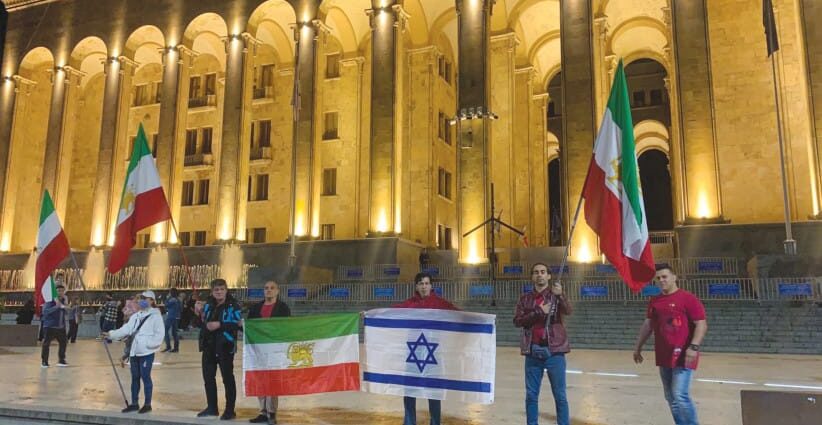
Switzerland rejects asylum application from Iranian refugee pursuing Judaism
The Federal Administrative Court of Switzerland has rejected the asylum application of Iranian refugee and Jewish conversion candidate Behnam Vali Heydarian, also known as Ben Vali, putting him at risk of deportation to Georgia and potentially Iran, Vali told The Jerusalem Post on Wednesday.
Vali previously spoke with the Post in August, describing the violent transnational aggression he said Iran had directed against him while he was in Georgia. A convert to Christianity at the time and a prominent figure in the refugee community, Vali drew the regime’s attention after initially being targeted for distributing Bibles in Iran and later for his pro-Israel advocacy following the October 7 attacks.
After being assaulted multiple times, Vali said he was threatened over his continued pro-Israel advocacy, had his bank accounts repeatedly frozen without warning, and was threatened with deportation by a person he believed was a member of Georgia’s security services.
‘He was an active, hardworking, kind, and responsible person’
Mikheil Grishashvili, a Jewish community leader and representative of the Peace Synagogue in Georgia, told the Post that Vali has been an active member of the community since 2023.
“He was an active, hardworking, kind, and responsible person, and he very quickly became part of our community,” Grishashvili said, adding that Vali became increasingly involved in Judaism.
Returning to Iran would likely lead to Vali’s execution
Aware that returning to Iran would likely lead to his execution due to his open support for Israel, his conversion and his proselytizing, Vali fled to Switzerland, where he had been granted a business visa.
Though Vali entered Switzerland legally, the country rejected his asylum application, stating that he had entered the country illegally and fled from a “safe” country, despite evidence he provided demonstrating what he described as a clear and present threat in Georgia. Offers from Swiss nationals to provide Vali with employment and housing, so he would not burden the system, also went unanswered.
“We appealed the reapplication, arguing that based on my individual risks and the problems I faced, they had to assess, analyze, and examine my individual case and circumstances. But they didn’t,” Vali said. “The final answer was that the State Secretariat for Migration had already done its job and that Georgia is a safe country. You can go back to the safe country and stay there. That’s it. That was the final hope that we had.”
Vali said that the entry ban now in place, preventing him from returning to Switzerland, would stop him from seeking refuge throughout the European Union. He said he has also been attempting to contact Israeli authorities, hoping his pro-Israel advocacy and position as a student of Judaism would encourage some protection, but did not receive a response.
Norwegian FOR party and youth wing to participate in Oct. 7 demonstration in support of Hamas
Norway’s Peace and Justice (FOR) political party is participating in a demonstration in Oslo on October 7 “in support of Hamas, Iran and Hezbollah.”
The activist group “Solidarity Network” in Oslo is organizing the October 7 event. The event slogan is “Support the Palestinian resistance!” and the promotional image is of Hamas and Palestinian terrorists on top of a tank on October 7, 2023, after having broken through the Gaza defensive wall.
Affiliated organizations include: The Lebanese Association in Norway; Peace and Justice, FOR; FOR Youth; Resistencia Intifada; Resistencia Oslo; Student Intifada and Young Communists.
In comments on her Facebook on Wednesday, FOR party leader Marielle Leraand wrote that “the entire Norwegian parliament buys into the media narrative, repeating the lie that it is possible for Israel, supplied with weapons from the US, Germany, and other NATO countries, to be a “victim” of a “terror attack from Hamas.””
‘The real terrorists are Israel, the US, and NATO’
“No, the real terrorists are Israel, the US, but also all countries that are part of the NATO alliance, including Norway,” she said.

“The least we can do is therefore support the struggle that Palestinians themselves are waging,” she said.
In an interview with Filter Nyheter the previous day, Leraand said October 7 was “a counterattack against a genocide that was already underway.”
Leraand has previously refused to condemn Hamas and Hezbollah, for example saying in a recent meeting: “We recognize that it is a legitimate resistance struggle that Hezbollah, Iran and Hamas are carrying out. In our part of the world, it is not allowed to say that, that we support their struggle. Because it is a liberation struggle for the Palestinian people.”
According to Aftenposten, Oslo Socialist Youth (SU) previously participated in the event but has since chosen to withdraw.
FOR was founded in 2023 by Leraand, a former deputy leader of the left-wing Red Party (Rødt).
The party presents itself as an anti-war, anti-imperialist, and peace-oriented movement.

NYT shareholders file lawsuit against paper’s parent org. over biased Israel reporting
Shareholders of The New York Times filed a lawsuit against the paper’s parent company Wednesday morning, arguing the paper has failed to follow its own editorial standards.
The suit, filed by the State Board of Administration of Florida (SBA) and the National Center for Public Policy Research (NCPPR) in New York County Supreme Court, requests the Times board of directors to release internal records.
The company has refused to produce the records for four months, the majority of which pertain to the paper’s coverage of the Israel-Hamas war.
Requests were first made by the National Jewish Advocacy Center (NJAC), representing NCPPR, on May 29 following the May 11 Nicholas Kristof column titled “The Silence That Meets the Rape of Palestinians,” but the NYT has not complied.
Lawsuit alleges that board failed to establish adequate oversight
The new lawsuit, as reported by The Jerusalem Post, notes that the Times’ reputation for independent journalism is “its most valuable” asset and alleges that the board failed to establish adequate oversight mechanisms to ensure compliance with the company’s own editorial standards.
It cites examples of corrections and disputed reporting, including the October 2023 Al-Ahli hospital explosion coverage, claims about Gaza war reporting errors, and concerns raised by a purported newsroom whistleblower who said internal reporting channels did not resolve her complaints.
The whistleblower, who is not named in the suit but who is said to be a Jewish former New York Times newsroom employee with about a decade’s tenure, said that that in the immediate aftermath of Hamas’s October 7, 2023, attack on Israel, staffers spent weeks searching for evidence that Hamas did not use the tunnels beneath al-Shifa Hospital, even after the Israeli military released its own footage of the tunnels in November 2023.
Whistleblower claimed she raised concerns internally
On November 20, 2023, the head of the video department reportedly referred to the tunnels as “alleged tunnels” in the desk’s morning meeting.
The whistleblower claimed she raised concerns internally about what she believed were violations of the Times’ own editorial standards through internal channels, including EthicsPoint, the Standards desk, Employee Relations, and Human Resources, on at least 15 occasions beginning in 2019.
The filing says the whistleblower’s records include allegations that complaints about newsroom standards were not properly escalated, concerns about bias in coverage were not addressed, and senior leadership was aware of some complaints but did not take corrective action.
According to the filing, the whistleblower alleged that the internal complaint system failed to address her concerns and instead turned against her.
The petitioners argue they are not seeking to direct editorial decisions, but want records showing whether the board monitors compliance with the Times’ own standards and manages reputational risks.

Canadian NDP leader slammed for Yom Kippur message claiming Jews failed ‘to stop ongoing genocide’
Canadian New Democratic Party Leader Avi Lewis is facing widespread criticism following a social media post published on Monday at the start of Yom Kippur, with critics alleging that he stated that Jewish people failed to do their part to “stop an ongoing genocide” in Gaza.
Lewis posted on X on Sunday, “Tonight Yom Kippur begins, the most somber moment of the Jewish calendar. It’s a time of atonement – a time to grieve those who have been lost, a time to acknowledge and take responsibility for harms we have caused, individually and collectively. For Jewish people, the personal has always been political and the political always personal. This year I’m reflecting on the fact that we failed to do our part to stop an ongoing genocide committed in our name. There are many other fronts where I have to do the work of repair. But nothing on this scale.”
Tonight Yom Kippur begins, the most sombre moment of the Jewish calendar. It’s a time of atonement – a time to grieve those who have been lost, a time to acknowledge and take responsibility for harms we have caused, individually and collectively. For Jewish people, the personal…
— Avi Lewis (@avilewis) September 21, 2026
Later that evening, news broke that a gunman had opened fire outside the Sons of Jacob Synagogue in Belleville, Ontario, during Erev Yom Kippur services. Constable Jeff Smith was injured during the exchange of gunfire while protecting the community as congregants took cover inside.
Following the shooting, Lewis published a second post on X, stating, “The shooting outside a synagogue in Belleville is deeply upsetting and has traumatized a community that gathered to pray. It is yet another reminder of the work that remains to create a Canada that is truly safe for people of all faiths, including Jewish people – to worship, to come together, to live without fear. Today, I am sending love and solidarity to the Jewish community in Belleville and across the country on this Yom Kippur, the most solemn and holiest day of the year.”
The shooting outside a synagogue in Belleville is deeply upsetting, and has traumatized a community that gathered to pray.
It is yet another reminder of the work that remains to create a Canada that is truly safe for people of all faiths, including Jewish people – to worship, to…
— Avi Lewis (@avilewis) September 21, 2026
The initial remarks drew immediate backlash from federal politicians, advocacy groups, and commentators, who argued that attributing collective responsibility to Jewish people for the actions of the Israeli government violates standard definitions of antisemitism and endangers communities.
‘Holding Jews responsible is despicable,’ says Liberal MP
Liberal MP Anthony Housefather condemned the remarks on X, writing that “holding Canadian Jews and Jews across the world collectively responsible for events over which they have no control is despicable.”
Fellow Liberal MP Ben Carr similarly criticized the post when speaking to CPAC reporters, calling the comments “irresponsible” for a political leader, and warning that “it’s dangerous and it’s the type of narrative that is actually contributing to the type of threats that we’re seeing levied against the Jewish community.”
Advocacy organizations also weighed in heavily on the controversy. The Center for Israel and Jewish Affairs (CIJA) issued strong rebukes, pointing out in a post on X that “libels have consequences,” and emphasizing that “when Jewish people are collectively portrayed as complicit in atrocities, that rhetoric can become a justification for targeting Jews here at home.”
Mike Fegelman, executive director of HonestReporting Canada, criticized the post online as well, writing that “the criticism of @avilewis is entirely warranted. His Yom Kippur message is a near-perfect example of the hypocrisy at the heart of the anti-Zionist movement,” and noting that “he is invoking Jews collectively, on Yom Kippur, and assigning them a responsibility to atone for the conduct of a foreign government.”
In The Globe and Mail, columnist Robyn Urback published an op-ed arguing that “Avi Lewis’s foolish statement on Jewish people should be disqualifying,” emphasizing that assigning collective responsibility to a religious group during their most solemn holiday crosses a dangerous line where portraying Jewish communities collectively as complicit serves as a justification for targeting them at home.
Lewis defends his remarks on Jews
Addressing the controversy during a press conference on Monday, Lewis defended his remarks and rejected accusations that he was blaming Jewish people for Israel’s military actions. When asked by a reporter to respond to criticism regarding his post on Gaza, Lewis stated: “Yeah, I did not blame Jews for the actions of the Israeli government. That’s simply untrue. Holding Jews collectively responsible for the actions of the state of Israel is antisemitic. I’ve never done it. I think it’s dangerous, and that’s absolutely not what I did.”
Lewis added, “I spoke as a Jewish Canadian from a place of profound sadness on the day of atonement and a day of the deepest and most solemn reflection in our calendar and said what many, many Jews feel and many Jews have said, that we have not done enough as Jewish people among a family of faiths and communities around the world. Humanity has not done enough to stop an ongoing genocide in Gaza.”
Lewis also noted, “I just read today as part of my own reflections three Kol Nidre sermons from rabbis over the last couple of years about the failure of humanity and of Jewish people of the Jewish faith to stop an ongoing genocide.”
Concluding his remarks on the controversy during the press conference, Lewis stated: “I come from a religious tradition which has a diversity of views which has debate at the center of our practice and our culture as Jews. I’m not going to police how other people reflect on Yom Kippur. And I think it’s pretty ugly to see these partisan points being used to score partisan points like that. I won’t be doing that. This was a personal reflection that I know is shared by many people. And just one more time, holding Jewish people collectively responsible for the actions of the state of Israel is not something I would ever do. It’s antisemitic, and it is wrong.”
The NDP did not respond to a request for comment by publication time.

Tech giant CEO announces she will attend Trump-Xi state dinner
As U.S. leadership in artificial intelligence (AI) and the semiconductor industry remains a central economic and national security issue, Advanced Micro Devices (AMD) Chair and CEO Lisa Su said she will attend President Donald Trump’s state dinner for Chinese President Xi Jinping.
“I’m honored to say that I will be at the dinner tomorrow night,” Su told FOX Business’ Liz Claman in a fireside chat on Wednesday during a trip to the New York Stock Exchange celebrating women in business. “It is an honor… to be there.”
“This summit between the presidents, President Xi and President Trump, is very impactful, very important. I think technology is one of those areas where we rely on the global ecosystem to come together. So, yes, I think we’re anxiously looking at what will come out of it. And the truth is, we want to ensure that there’s good stability across the global ecosystem as it relates to technology.”
DEMOCRATIC LAWMAKERS URGE TRUMP TO PRESERVE BAN ON CHINESE AUTOMAKERS AS HE PREPARES TO MEET XI
Su will join other prominent American tech leaders, including Tesla CEO Elon Musk, OpenAI CEO Sam Altman, Nvidia CEO Jensen Huang and Apple’s Tim Cook. The tech leaders’ anticipated attendance at the Trump-Xi state dinner comes at a time of geopolitical tensions, including over the development of AI and access to both models and the chips that power them.
The U.S. and China are competing to develop increasingly capable AI tools, a source of tension between the two countries. China’s access to specialized chips that power advanced AI models has been restricted through U.S. export controls on advanced semiconductors, including those made by Nvidia.
President Trump recently described AI as potentially the greatest industrial revolution in history. As demand for compute capability grows, leaders in the industry face a dual responsibility to expand U.S. technology while establishing technical safeguards.
“I am an AI optimist,” Su said. “You know, I will say that for sure… And I’m not, you know, just saying this because I’m a technology person. In terms of power, of technology and what I’ve seen over my career over the last 30 plus years, it is the most powerful technology I’ve ever seen.”
“The world is going to be very ambitious with AI. The world should be very ambitious with AI. And I think we as technology companies and we as the American U.S. ecosystem must continue to be very aggressive while also ensuring that everybody comes together and realizes that we must build trust in AI,” she continued. “It is absolutely non-negotiable that we must build trust in AI.”
GET FOX BUSINESS ON THE GO BY CLICKING HERE
A red carpet rollout is planned for when Xi and his wife, Peng Liyuan, arrive at Joint Base Andrews on Wednesday evening, replete with an arrival ceremony for the man who has found himself at odds with Trump on issues ranging from artificial intelligence and intellectual property theft, trade practices, rare-earth minerals to the communist country’s support for Iran during America’s military conflict there. Xi hasn’t visited the nation’s capital in more than a decade.
AI will be a major topic of discussion during the two-day summit, which officially begins Thursday morning and ends Friday evening, according to a senior administration official.
FOX Business’ Eric Revell and Fox News’ Peter D’Abrosca and Ashley J. DiMella contributed to this report.

New subway photo exhibition reveals the behind-the-scenes work that keeps NYC moving

A new photography series in the New York City subway system seeks to illuminate the workers and infrastructure that keep New Yorkers moving behind the scenes. Unveiled Tuesday by MTA Arts & Design, “In Service: MTA Photographs by Christopher Payne” features images shot at 13 MTA facilities and manufacturing plants across four states, revealing the work and coordination required to keep the city’s transit system running. The series of 50 photographs is displayed on 52 decommissioned advertising lightboxes at five major transit hubs, marking the first time the agency has presented a single photographer’s work across its entire network.

MTA Arts & Design began converting decommissioned advertising lightboxes into canvases for rotating photography installations in the 1990s, with individual exhibitions programmed one at a time. “In Service” pilots a new model for the agency, bringing the work of a single photographer to multiple transit hubs as the program celebrates its 40th anniversary.

Building on Payne’s long-standing interest in the hidden infrastructure that keeps New York’s transit system running, the project grew out of his “MTA Overhaul Shops” series, which he shot at the 207th Street and Coney Island overhaul shops. The New York Times later featured the series in a 2024 story about subway car repairs.
Ten photographs from that exhibition anchor “In Service,” while Arts & Design commissioned an additional 40 images that Payne captured between May and August of this year. The photographs explore themes that highlight the range of the MTA’s behind-the-scenes work.
Over roughly five months, Payne gained access to numerous MTA facilities, where he carefully composed images that went beyond simple documentation. Instead, he sought to create a “wow” factor that captured the beauty of the city’s transit infrastructure and the people behind it, as he described to Curbed.
Inside the Grand Avenue Central maintenance facility in Maspeth, Queens, Payne sought to capture the inner workings of a city bus, stripped of its wheels and suspended above the ground as workers tinkered beneath it. The scene offers a view of the vehicles that is a major departure from how most New Yorkers typically experience them.
At Coney Island’s overhaul shop, Payne captured worker Conrad Samuels as he worked on a gearbox for a subway car-wheel motor. The job requires considerable skill, time, and effort, and Payne’s image means to highlight the human labor that goes into maintaining of the transit machinery.



At Grand Central Madison, the images depict service at scale across the MTA’s five operating agencies, revealing the breadth of its operations and the people behind them. At the Grand Central Terminal Dining Concourse, portraits of workers in maintenance and manufacturing spaces highlight the care and craftsmanship that go into keeping the city’s transit running.


Bryant Park’s installation features images of everyday components, reconsidered through Payne’s distinct visual aesthetic. At Bowling Green, commuters can follow the stages of bus manufacturing and maintenance, from welding frames and assembling accessibility ramps to the final bus wash at the end of each route.


At Atlantic Avenue-Barclays Center, the lifecycle of subway cars is traced from Kawasaki R211 cars currently in production in Nebraska to testing in Yonkers and maintenance at overhaul shops.
Payne’s photographs bring the people who work in these spaces to the forefront, portraying them not as background figures but as critical components of the system that keep NYC’s transit network running.
“Photographing the subway’s power substations is what made me a photographer, and the MTA has been the subject I’ve returned to throughout my career,” Payne said. “But this project went further than anything I’ve done before.”
“I saw everything: where subway cars, buses, and locomotives are built, where they’re repaired and rebuilt, and the people who make all of it possible,” he added. “Most riders never see the system or the workers behind their commute. This was my chance to show them.”
The 52 lightboxes displaying Payne’s photographs are spread across five major transit hubs: the 42nd Street-Bryant Park station, with seven lightboxes; Atlantic Avenue-Barclays Center, with eight; Bowling Green, with seven; Grand Central Terminal’s Dining Concourse, with 20; and Grand Central Madison, with 10.
“This exhibition is a visual love letter to the MTA and the people who make it run—from the mechanics and inspectors in our shops to the welders and assemblers who build our fleet,” MTA Arts & Design Director Tina Vaz said.
“Christopher Payne took their work seriously and they welcomed him in so riders could appreciate the craft behind the system they rely on every day,” she added.
RELATED:
- Data Vandals turns facts about NYC into art and conversation in an abandoned subway kiosk
- New York will test new thermal tech that cools down NYC subway platforms
- Vending machines to replace vacant newsstands at 26 NYC subway stations
The post New subway photo exhibition reveals the behind-the-scenes work that keeps NYC moving first appeared on 6sqft.




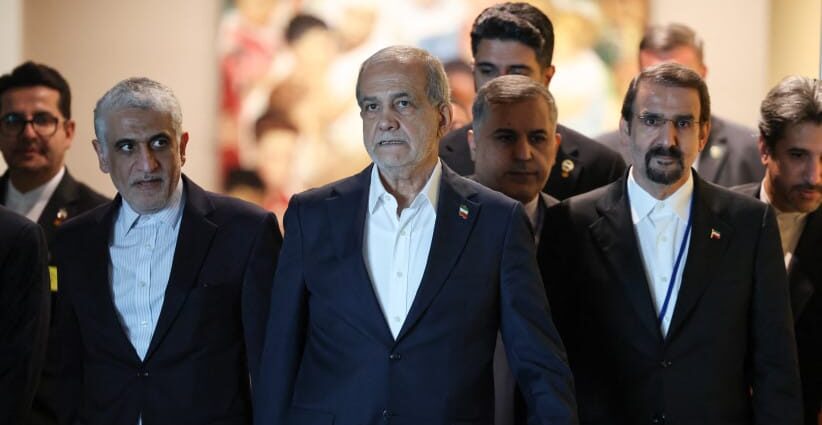
Rubio repledges US commitment to Saudi Arabia while addressing diplomatic exchanges with Iran
US Secretary of State Marco Rubio said Wednesday that the United States would uphold its commitments under its defense agreement with Saudi Arabia when asked about a military campaign by the Houthis.
Rubio also addressed the diplomatic exchanges between the United States and Iran, as indirect contacts took place on the sidelines of the United Nations General Assembly.
“We understand the Strait issue,” Rubio told reporters, adding that the United States would continue to defend and keep open strategic waterways. He said President Donald Trump has a number of options available, including military options.
A deal with Iran would require “hard work over a period of time,” Rubio said, while reiterating that Trump also retains military options.
Rubio described Tuesday’s discussions between US and Iranian officials as largely an exchange of ideas and messages. His comments referred to meetings involving US special envoys Steve Witkoff and Jared Kushner, who met with mediators to discuss a possible agreement to end the Iran conflict.
Trump says US, Iran moving toward settlement as Tehran links Hormuz reopening to deal
US President Trump said Tuesday at the United Nations that US officials had held a “very good” three-hour meeting with the Iranian delegation.
He said Washington and Tehran were moving toward a settlement, while a senior Iranian official said Tehran could reopen the Strait of Hormuz within days if the US eased military pressure and lifted its blockade on Iranian ports.
Iranian officials later said Tehran was reviewing the US response to its proposal to end hostilities, but that significant differences remained between the two sides as diplomatic efforts continued, a senior Iranian official told Reuters on Wednesday.
The reopening of the Strait of Hormuz and the lifting of the US naval blockade on Iran were among the issues discussed during Tuesday’s indirect talks with Washington, the official said.
دیروز در حاشیه نشست مجمع عمومی سازمان ملل متحد، در ادامه گفتگوهایی که توسط کشورهای میانجی بین ایران و آمریکا در جریان بوده است، دور دیگری از تبادل و تبیین پیام از طریق میانجی قطری بین ایران و آمريکا صورت گرفت.
در این فرآیند که حدود دو ساعت به طول انجامید مواضع و شروط ایران برای…
— Esmaeil Baqaei (@IRIMFA_SPOX) September 23, 2026
دیروز در حاشیه نشست مجمع عمومی سازمان ملل متحد، در ادامه گفتگوهایی که توسط کشورهای میانجی بین ایران و آمریکا در جریان بوده است، دور دیگری از تبادل و تبیین پیام از طریق میانجی قطری بین ایران و آمريکا صورت گرفت.
در این فرآیند که حدود دو ساعت به طول انجامید، مواضع و شروط ایران برای…
— Esmaeil Baqaei (@IRIMFA_SPOX) September 23, 2026
Iran says it clarified conditions for resuming diplomacy with US during Qatar-mediated talks
Iranian Foreign Ministry spokesperson Esmaeil Baghaei said on X that another round of “message exchanges and clarifications” took place between Iran and the US through Qatari mediators on Tuesday.
Baghaei said Iran had clarified its conditions for resuming diplomacy during the two-hour exchange, including an understanding on ensuring safe passage through the Strait of Hormuz between the two coastal countries.
Iran’s stated conditions also include the lifting of US sanctions, including the naval blockade, an end to the war, and the release of frozen Iranian assets.

Stocks Open Lower; Strong Business Data Adds To Rate-Hike Worries
U.S. stocks opened lower Wednesday as rising oil prices and Treasury yields pressured investors, before a strong September business survey added fresh concerns about inflation and borrowing costs. S&P Global’s preliminary report showed the fastest private-sector expansion in more than five years, accompanied by mounting supply constraints and price pressures.
At the 9:30 a.m. Eastern opening bell, the Dow Jones Industrial Average fell 92.3 points, or 0.18%, to 51,771.41. The S&P 500 slipped 2.7 points, or 0.03%, to 7,761.94, while the Nasdaq Composite declined 30.8 points, or 0.11%, to 27,213.52. These are opening figures, not subsequent trading levels.
The economic report arrived at 9:45 a.m., after those initial declines. It sharpened the question facing markets: Can businesses keep expanding rapidly without generating enough inflation to require further Federal Reserve tightening?
S&P Global’s flash Composite PMI Output Index, which tracks manufacturing and services, climbed to 58.4 in September from 56.0 in August. That was its highest reading since July 2021. A reading above 50 signals expansion.
The strength was broad, with activity improving across factories and service businesses. Companies increased hiring to handle growing orders, but also reported difficulty finding suitable workers. Unfinished work accumulated as demand stretched operating capacity.
S&P Global said the survey was consistent with economic growth running at approximately a 5% annualized pace. That is an estimate inferred from survey responses, not an official government measurement of gross domestic product.
For businesses, stronger orders offer a welcome source of revenue. The difficulty is fulfilling them profitably when staffing, supplies and transportation become more expensive or harder to secure.
The survey’s input-price measure rose to 66.4 from 59.9, reaching its highest level since October 2022. Companies also reported longer supplier delivery times and shortages. Those readings indicate more intense cost pressure; they do not mean prices rose by 66.4%.
Chris Williamson, chief business economist at S&P Global Market Intelligence, warned that growing backlogs and limited capacity were giving companies greater pricing power. That creates a risk that strong demand will translate into additional increases for customers.
The bond market reflected that concern. The yield on the 10-year Treasury note moved back above 5% following the PMI release, according to Trading Economics. Higher market yields can increase financing costs and make interest-paying investments more competitive with stocks.
Housing is particularly sensitive to borrowing costs. Mortgage rates respond to longer-term financial conditions, although they do not move in lockstep with either the 10-year Treasury or the Fed’s benchmark rate.
Fed Governor Michael Barr addressed that distinction Wednesday, saying monetary policy influences mortgage rates alongside other factors. He also warned that high home prices combined with elevated mortgage rates have put ownership beyond the reach of many families.
The Fed raised its benchmark rate by a quarter percentage point on Sept. 16, bringing the target range to 3.75%–4%. Officials’ median projection indicated another quarter-point increase by year-end, although projections remain conditional assessments rather than promised decisions.
Barr reinforced the case for further tightening in his Wednesday remarks. He said economic growth and employment remained solid, while inflation was above the central bank’s 2% target and was not clearly moving toward it quickly enough.
“In my base case, further policy adjustments are likely to be needed,” he said.
For investors, the competing forces are clear. Stronger demand can support corporate earnings, but rising costs can squeeze margins. Higher interest rates also increase financing expenses and reduce the present value investors assign to profits expected far into the future.
The next question is whether businesses can expand capacity fast enough to meet demand without repeatedly raising prices. Markets will be watching subsequent inflation and employment reports, together with oil and Treasury trading, for evidence that growth can remain strong while price pressures ease.
JBizNews Desk | Wall Street
© JBizNews.com All Rights Reserved. Reproduction or distribution without written permission is prohibited.

French soccer star Thierry Henry seeks $25M for his Soho penthouse

French-born footballer Thierry Henry has put his New York penthouse on the market for $25 million, according to WSJ. Henry bought the three-story penthouse for $14.85 million in 2010, when he was signed to the New York Red Bulls; after his retirement in 2014, he has stayed with the game as a manager and announcer. Now 16 years later, the penthouse at 39 Crosby Street (also known as 425 Broome) is once again on the market. The 6,086-square-foot condo with 3,400 square feet of outdoor space spans three levels, plus terraces overlooking the Hudson River and a rooftop deck that looks big enough for a soccer match.

Henry and his partner, Andrea Rajacic, renovated their downtown digs while in residence, so the home’s interiors feature the latest in fixtures and finishes to complement 360-degree skyline views and impossibly high ceilings.
The building, built in 1872, has the classic bones of an authentic brick loft in the heart of the Soho Cast Iron Historic District. According to Crain’s, the World Cup winner had previously listed the penthouse for $27.3 million in 2024.




The seventh floor holds the home’s primary living spaces. A stunning great room opens beneath 14-foot ceilings. On all sides, views from the Brooklyn Bridge and One World Trade Center to the rooftops of Soho dazzle. The room offers a gas fireplace and a terrace to enjoy the view from outdoors.
The great room opens into a dining area. A sleek home office is tucked under the stairs. A European-style main kitchen is a perfectly calibrated culinary creation machine. A hefty marble island anchors the room, where Italian cabinetry wraps integrated appliances by Miele, Sub-Zero, and Bosch.



On a separate level, the primary suite has its own private terrace of nearly 800 square feet, joined by two en-suite baths, dressing areas, and additional closet space. A second bedroom and a laundry room share the floor. Below on the fifth floor you’ll find a second great room, a catering kitchen, and a second laundry room serving three more bedrooms.



At the home’s zenith, a 1,221-square-foot roof terrace boasts a full outdoor kitchen surrounded by 360-degree Manhattan skyline views. This rooftop aerie also includes an indoor bamboo garden and a media room with access to another sprawling terrace.

This singular property rises above the neighborhood, jewel-like, anchored by the historic loft building below.
Residential perks include keyed elevator access, direct access to two deeded parking spaces, and 250 square feet of private storage.
[Listing details: 425 Broome Street, #PHN at CityRealty]
[At Sotheby’s International Realty by Joshua Judge, Glenn Norrgard and Sam Sitinas]
RELATED:
- Seagram heir’s Soho penthouse rents for $120K a month, a neighborhood record
- Hotelier Andre Balazs lists his flashy Soho condo for $12M
- Jon Bon Jovi’s former Soho penthouse returns for $38M
- This hip, huge artist loft in Soho will not come cheap
The post French soccer star Thierry Henry seeks $25M for his Soho penthouse first appeared on 6sqft.
Morgan Stanley Investigates Misfired Email

Dollar Hits Two-Month High As Fed Rate Outlook Supports Gains
Dollar Hits Two-Month High As Fed Rate Outlook Supports Gains
The dollar strengthened to a two-month high Wednesday as expectations of further Federal Reserve interest-rate increases supported demand for the U.S. currency, potentially easing costs for importers while adding pressure on American companies selling overseas. The advance followed the Fed’s Sept. 16 decision to raise its benchmark rate to 3.75%–4%. (Profit by Pakistan Today)
The dollar index, which measures the currency against six major rivals, rose 0.16% to 100.71 in one Wednesday trading update carried by Reuters. The euro fell to $1.14282, its weakest level since late July, while sterling traded at $1.3316. Those figures represent an intraday snapshot, rather than closing prices. (Profit by Pakistan Today)
Behind the move is a widening focus on the returns investors can earn from holding dollar assets. When U.S. interest rates rise relative to rates elsewhere, American investments can become more attractive, encouraging purchases of dollars. The response depends on what markets already expected and how other central banks respond; a Fed increase does not automatically produce a stronger currency. (federalreserve.gov)
The Fed’s latest decision was unanimous, with all 12 voting members supporting a quarter-point increase. Its statement described solid economic growth, resilient domestic spending and elevated inflation.
“Today’s policy action will support a timelier return to the Committee’s 2 percent goal,” the committee said in its announcement. (Federal Reserve issues FOMC statement)
Officials’ September projections indicated another quarter-point increase by year-end, which would bring the target range to 4%–4.25%. That represents policymakers’ assessment of an appropriate path, not a binding commitment to act at a particular meeting.
The forecasts also showed why officials remain concerned. The median projection put inflation excluding food and energy at 3.4% for 2026, measured from the fourth quarter of last year to the fourth quarter of this year. Overall inflation was projected at 3.7%. Both figures remain above the central bank’s 2% objective. (federalreserve.gov)
For businesses buying goods overseas, dollar strength can provide some relief. A U.S. importer paying suppliers in euros needs fewer dollars to settle the same euro-denominated invoice when the euro weakens.
The benefit does not necessarily reach store shelves immediately. Many international contracts are priced in dollars, and foreign suppliers may keep their dollar prices unchanged. Federal Reserve research has found that exchange-rate movements pass through only partially to U.S. import prices. (Federal Reserve Board)
Travelers can see the effect more directly when paying expenses in local currency. As an illustration, a €1,000 hotel bill costs $1,150 at an exchange rate of $1.15 per euro. At approximately $1.143, the same bill costs about $1,143 before conversion fees—a saving of roughly $7. A stronger dollar helps, but a modest currency move produces a modest saving.
Exporters face the opposite calculation. When American products are priced in dollars, buyers abroad must spend more of their own currency to purchase them. Manufacturers and agricultural producers can face pressure to lower prices or accept weaker demand. Fed analysis identifies reduced export competitiveness as a principal way dollar appreciation affects the U.S. economy. (Federal Reserve Board)
The international consequences also extend to borrowing. Businesses abroad that earn revenue in local currency but owe debt in dollars can see repayment burdens increase as their currencies weaken. That pressure can restrain investment and spending even outside the United States. (federalreserve.gov)
Oil remains a complication for the rate outlook. Wednesday’s currency reporting showed the dollar drawing support from tightening expectations even as crude prices eased. Sustained energy-price relief could soften inflation pressure, but traders were still weighing uncertainty surrounding the Middle East conflict. (Business Recorder)
The next test is whether incoming inflation and employment figures justify the additional tightening investors anticipate. Stronger-than-expected price data could reinforce support for the dollar. Softer readings could weaken that support, particularly if other central banks maintain higher rates than markets expect. The dollar’s next move will depend on changes in those expectations, not simply on the fact that the Fed has already raised rates.
JBizNews Desk | Wall Street
© JBizNews.com All Rights Reserved. Reproduction or distribution without written permission is prohibited.

Central Elections Committee bars Arab Ra’am, Joint List parties from running in October elections
The Central Elections Committee voted Wednesday to bar the Joint List (formed from Arab parties Ta’al, Hadash, and Balad) from competing in the October 27 election, hours after it voted to disqualify Ra’am, MK Ofer Cassif and Balad chairman Sami Abu Shehadeh.
Ra’am, the United Arab List led by MK Mansour Abbas, may appeal the decision to the Supreme Court, which is set to hear election-disqualification cases next week. Unlike the disqualification of an individual candidate, a decision barring an entire party list does not automatically go to the court for approval.
The vote followed three requests filed by the Likud, Otzma Yehudit and the Choosing Life forum of bereaved families and victims of terrorism.
The applicants alleged that Ra’am supported armed struggle by a terrorist organization and rejected Israel’s existence as a Jewish and democratic state, two of the three grounds for disqualification under Section 7A of Basic Law: The Knesset.
They cited alleged connections between Ra’am, the Southern Branch of the Islamic Movement, and charitable organizations that the applicants claimed had transferred assistance to bodies linked to Hamas. They also cited statements by Abbas that they argued showed the party presented different positions to Hebrew- and Arabic-speaking audiences.
Ra’am denies allegations of supporting terrorism
Ra’am denied the allegations, arguing that the petitions failed to provide clear and convincing evidence connecting the party to support for terrorism or any other prohibited objective.
Adalah attorney Suhad Bishara, representing Ra’am, told the committee that the applicants had not presented evidence capable of establishing the unequivocal factual record required for disqualification. She also pointed to Abbas’s condemnation of the October 7 massacre and his efforts on behalf of hostages held in Gaza.
Attorney-General Gali Baharav-Miara and State Attorney Amit Aisman opposed barring Ra’am, finding that the evidence did not establish any of the statutory grounds required to exclude it from the election.
The Supreme Court has interpreted Section 7A narrowly, requiring clear, convincing and unequivocal evidence that a prohibited objective is central to a party’s activity. The evidence must demonstrate that the objective is a dominant feature of the list’s conduct rather than a marginal or isolated one.
In 2019, the committee voted to disqualify a joint Ra’am-Balad slate, but the Supreme Court overturned the decision and allowed it to compete.
Wednesday’s decision marked the third disqualification approved by the committee during its first day of hearings. The decisions concerning Cassif and Abu Shehadeh involve individual candidates and therefore require Supreme Court approval before taking effect.
Ra’am Chairman Mansour Abbas responds to disqualification decision
Abbas released a statement in response to the Central Election Committee’s decision, saying, “The Elections Committee’s decision to disqualify Ra’am is a political, improper, and anti-democratic decision made contrary to the position of the Attorney General, based on false accusations and fabrications. We will refute these claims in the High Court of Justice, as we have done in the past.”
He accused Netanyahu and his allies of maneuvering to prevent the formation of “the next change government” by disqualifying the Ra’am party.
Abbas said that the disqualification is an attack on coexistence between Arabs and Jews in Israel, as well as free democratic participation of both Jews and Arabs.
Joint List calls ban ‘attempt by Netanyahu, Ben-Gvir, to steal election, disenfranchise over a million Arab Israelis’
The Joint List also denounced the CEC’s decision, saying that it is a “political, racist, and anti-democratic decision, and we expect the Supreme Court to reject it outright.”
“It bears stating the obvious: this is an attempt to disqualify the political representation of over a million voters, who constitute 20% of the country’s citizens,” the party added.
“This constitutes a severe violation of the fundamental right to vote and be elected, and is a direct continuation of the long-standing delegitimization campaign waged by Netanyahu and right-wing elements against the Arab public. Netanyahu and Ben-Gvir know that their only path to remaining in power is by disqualifying Arab representation and suppressing the Arab vote; this is how they seek to pave the way for another term,” it said.
“It is deeply regrettable to see that those who purport to replace Netanyahu are once again falling into the racist trap set by Netanyahu and Ben-Gvir, lending a hand to this political campaign. In doing so, they contribute to the ongoing racist persecution of the entire Arab public, the deepening of racism, and the perpetuation of the rule of Netanyahu and his political partners,” the Joint List said.
“The Joint List is the only party that has made the struggle for democracy for all, true equality, justice, and a comprehensive peace its central mission, and it is the only alternative to the racist policies of Netanyahu and Ben-Gvir,” it continued.
“The Joint List, together with democratic Jewish forces, will continue to fight against political disqualification, continue to fight racism, continue to fight Netanyahu and Ben-Gvir, and will prevail,” it concluded.
Hadash, Communist party ‘fundamentally reject’ decision
Hadash and the Communist Party of Israel (CPI), also issued a joint statement condemning the decision.
“The Central Election Committee’s sweeping approval of petitions from the fascist right to disqualify slates representing the Arab public and Jewish democratic forces is a blatant trampling of the most basic rules of the democratic game,” they wrote.
We fundamentally reject the very fact that a political committee, composed of representatives from currently serving Knesset factions, grants its members the right to persecute and silence voices that depart from the consensus and oppose occupation, racism, and Jewish supremacy.”
They emphasized that they stood with Abu Shehadeh and his “right to express his views as a leader in Arab society,” pointing out a lack of justification behind his disqualification.

IRGC benefiting from false hopes of renewed negotiations, expert tells ‘Post’
The indirect talks between Iranian Foreign Minister Abbas Araghchi and US envoys Steve Witkoff and Jared Kushner, which many have viewed as a sign of Tehran’s willingness to reengage in negotiations aimed at ending the conflict and reopening the Strait of Hormuz, are only a “half-truth” of what is really taking place, INSS Iran expert Beni Sabti told The Jerusalem Post on Wednesday.
For the first time since the Memorandum of Understanding failed in July, Araghchi and the American envoys communicated through mediators on the sidelines of the UN General Assembly in New York.
Sabti said that the talks and promises to open Hormuz meant little when Iran was continuing to attack ships and attempting to assert control over Hormuz.
A senior Iranian official told Reuters on Tuesday that Tehran was willing to reopen the strait provided Washington openly committed to resolving the conflict diplomatically. However, only a day after the statement, the United Kingdom Maritime Trade Operations center reported that a cargo vessel was struck, resulting in two casualties.
Hassan Qashqavi, spokesperson for parliament’s National Security and Foreign Policy Committee, also confirmed on Tuesday that the Islamic Republic had no intention of abandoning its attempts to control the Strait of Hormuz. Parliament adopted provisions allowing the regime authorities to seize 20% of a vessel’s cargo, or its value, from ships violating Iran’s rules for passage through the strait.
‘This is the Iranian way’
“They talk, and they attack, and this is the Iranian way, the terrorist organization way. It is exactly what Hamas did during the war. There were negotiations, but there were also attacks and war. They want all their conditions to be met, and then there will be negotiations or an opening of the straits. They want all of the frozen money released, all the wars, especially by Israel against their proxies and against themselves, to stop, and other conditions,” Sabti said. “These seven points cannot be fulfilled, and they know that. So they come for negotiations, but not with 100% desire and will, goodwill, or a true heart. It’s just kind of a theater, a lie that they bring.”
IRGC spokesperson Hossein Mohebbi admitted on Tuesday that he viewed negotiations as another strategy of the war, insisting that “If the country’s interests require it, negotiations can be part of the battle while we remain prepared for combat…One war is fought with weapons; in negotiations, the war is fought with words, arguments and diplomatic methods.”
In an interview with Agence France-Presse, Mohebbi also claimed that Iran had tightened its conditions to end the conflict and had refused Washington’s multiple attempts to return to the negotiating table.
The stark difference between Mohebbi’s narrative and what is being portrayed in New York is where the half-truth lies, Sabti explained. Those in New York were “not the relevant people to talk to” as the IRGC is firmly in control of Iran.
‘This is the problem of the West’
“This is the problem of the West: They think the entire Iranian regime is one entity and that it is all the same. If you talk to the president or the foreign minister, it’s like talking to the whole regime, because this is the way it is in the Western world,” he said, adding that those in the IRGC were profiting from Western naivety and using diplomats to “buy a little more time.”
With reports indicating that Saudi Arabia is restarting operations at its East-West Pipeline, potentially allowing 7 million bpd of oil to return to the global market, and frustration growing with the Houthis, Iran’s strategy of holding the strait hostage is slowly failing, he claimed.
With the Iranian economy suffering after years of sanctions that have intensified since Operation Economic Outcast, IRGC officials running the country are also hoping for some relief as a gesture of goodwill from the West, regardless of whether they have any real intention of following through, Sabti concluded.

Fire in Jerusalem’s Mea She’arim neighborhood prompts mass emergency response
Firefighting teams are responding to an active fire that broke out in a residential building in the haredi (ultra-Orthodox) Mea She’arim neighborhood in Jerusalem.
Police officers and medical personnel are on standby at the scene to provide immediate aid, though firefighters have ruled out there being any trapped residents in the building.
Firefighters rescued several Torah scrolls from the burning structure. The scrolls sustained significant damage in the fire.
“Firefighters acted decisively to tackle the intense fire in the temporary structure and conducted rapid searches that ruled out the presence of trapped people,” said Incident Commander Deputy Chief Shai Nehemia. “During the operation, crews rescued several Torah scrolls from the flames. We are currently focusing our efforts on final extinguishment, and the incident is nearing containment.”
This is a developing story.
Jewish leaders urge Kamala Harris to press Senate candidate El-Sayed on Israel views
A coalition of progressive Jewish leaders and Michigan Democrats sent a letter to former Vice President Kamala Harris on Sunday urging her to press Senate candidate Dr. Abdul El-Sayed on his positions regarding Jewish safety and Israel during their joint campaign appearance on Tuesday. The group, known as Nonnegotiable Michigan, represents rabbis, cantors, and community leaders across the state.
In their letter, the coalition acknowledged Harris’s record on combating antisemitism, noting that she has consistently stood by the community. However, the leaders expressed deep concern regarding El-Sayed’s candidacy, stating that he “has had every opportunity to meet our request to support our basic needs” but “has declined even to respond.” The coalition outlined five core principles candidates must address to guarantee Jewish safety, including for Zionists, protecting identity rights, upholding Jewish sovereignty in Israel, welcoming full political participation, and providing an affirmative vision for the Middle East.
El-Sayed has been criticized for blaming Israel for local issues in Michigan
The letter criticized past remarks by El-Sayed, pointing out that he has called Israelis “bloodthirsty,” referred to American support for Israel as “purchased loyalty,” blamed Israel for local issues in Michigan, and rejected Israel as a Jewish state. Emphasizing that support cannot be taken for granted, the coalition wrote in their open letter that “every constituency must occasionally remind its party that support is earned, not owed,” describing the campaign as “a good faith effort to make our needs unmistakably clear, and to invite any candidate seeking public office — now or in the future — to engage, listen, learn, and grow.”
Building on their message from the letter, coalition leaders expanded on these themes during a subsequent press conference. Rabbi Michael Moskowitz of Temple Shir Shalom captured the widespread unease felt by families, stating that “we have been greatly concerned in the midst of this campaign and the language that we hear being used,” expressing concern “when language comes out that is using antisemitic dog whistles, things that have concerned us greatly over the years it worries my community.” Moskowitz added that his congregants felt “homeless right now and not sure where they can turn,” and that his community is a Zionist congregation and said, therefore, “we want our candidates who are running for office that we want to support to understand that and appreciate our concerns and what matters to us as a Jewish community.”
Echoing these concerns, Cantor Regina Hayut of Temple Beth Emeth in Ann Arbor noted during the event that she and many others have been feeling politically homeless, stating, “I’ve been a lifelong Democrat, and I’ve never felt alienated from my party until recently. And I feel like if I just walk away, then I’m giving up so much that I care about.” Hayut added that Israel is still a place for Jews to call a “safe homeland” and that “the rhetoric that’s out there has been demonizing an entire people not just in Israel but here in the United States and here in Michigan.”
Looking beyond the immediate election cycle, Joan Lowenstein, president of the Ann Arbor Jewish Federation, emphasized the deep ancestral connection to Israel, stating, “Both of these places are my home, and I have always been part of trying to convince people that the Jewish connection to Israel is not a political one. It’s our ancestral home, and it’s the center of 3,000 years of Jewish history.”
‘You can’t untangle Judaism from Zionism’
David Kramer, a prominent Democratic fundraiser and community leader, underscored the political and moral imperative for leaders to act, stating that “You can’t untangle Judaism from Zionism,” and that “Jewish people and Zionism are one and the same, you can’t untangle them, and I think some of the efforts by particular candidates, the senate candidate being one of them, to imply that the Jews should be protected but Zionists are on their own is deeply troubling.”
Harris and El-Sayed held a roundtable discussion in Detroit on Tuesday, focused on maternal health, reproductive freedom, and black maternal mortality alongside healthcare experts and reproductive rights advocates. The recorded public roundtable focused entirely on healthcare and maternal mortality, with neither Harris nor other speakers addressing the letter or the controversies surrounding El-Sayed’s past statements on Israel.
Harris’s office did not respond to a request for comment by publication time.

Trump shares Channel 13 election poll showing Netanyahu’s bloc leading with 54 seats
US President Donald Trump shared a Newsmax article about a recent Channel 13 election poll projecting Prime Minister Benjamin Netanyahu’s bloc to win 54 seats in the upcoming elections, in a Wednesday post to Truth Social.
According to the poll, Gadi Eisenkot’s Yashar led with 22 seats, while Netanyahu’s Likud fell to a low of 18.
Despite this, the Netanyahu bloc strengthened to 54 seats, compared with 52 for the change bloc.
In August, Trump told FOX News that he “may endorse somebody” in the upcoming Israeli election, though he conceded it would be “most appropriate for me to stay out of it.”
Trump’s comments to FOX followed reports across Israeli media that figures close to Netanyahu’s main political rivals, including Gadi Eisenkot and Naftali Bennett, have in recent months conveyed messages to Trump’s associates through acquaintances, donors, and political allies, asking him to remain neutral in the election.
The comments also follow an Axios report noting that Trump questioned the prime minister on the Likud’s position in the polls during the latter’s late July visit to Washington.
Israel’s elections are slated for October 27.
Where does Netanyahu’s bloc actually stand in recent polling?
Five election polls published last week, however, showed a divided political landscape, with Gadi Eisenkot’s Yashar holding a slight advantage over Likud at the party level, but with no clear outcome between the blocs.
A KAN News poll showed Eisenkot’s party leading with 24 seats, while Netanyahu’s Likud dropped to 20. According to KAN, the balance between the blocs remained inconclusive, with 52 seats on each side, leaving neither with a majority to form a government.
Yashar continued to lead in the Channel 12 poll with 23 seats, down two from the previous survey. Netanyahu’s Likud also weakened, losing one seat to reach 20. As such, the bloc opposed to Netanyahu fell by two seats to 66, including 54 seats for Zionist parties and 12 for Arab parties.
While other polls left the political system deadlocked or showed a slight advantage for the bloc opposed to Netanyahu, the Channel 14 poll presented a different picture, with 64 seats for the right-wing bloc.
Channel 16 polling showed the Netanyahu bloc at 52 seats, compared with 53 for the opposition.
Eisenkot leads polling average, Netanyahu close behind
Across the five polls, Eisenkot’s Yashar averaged 22.2 seats, ahead of Likud’s 21.2.
The bloc picture remained inconclusive. The Netanyahu bloc, including People of Israel, averaged 54.4 seats, compared with 51 for the Zionist opposition parties.
Maariv contributed to this report.


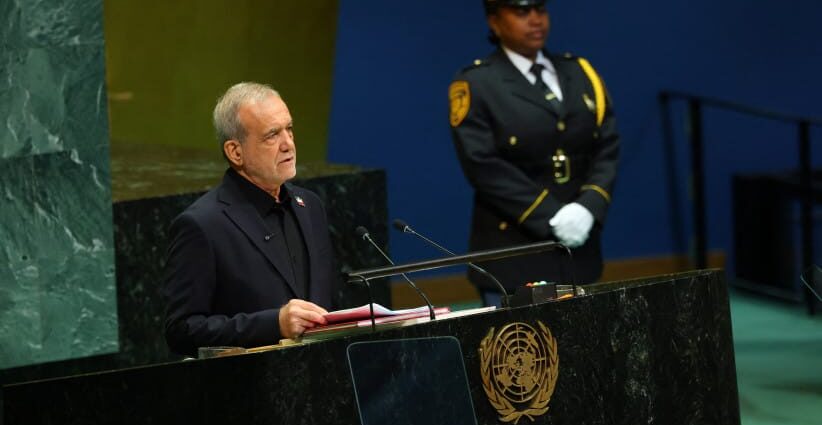
Iran’s Pezeshkian says unfair that Israel ‘has’ nuclear weapons while IAEA inspectors watch Tehran
Iranian President Masoud Pezeshkian denounced Israel’s alleged possession of nuclear weapons while International Atomic Energy Agency inspectors are sent to monitor Iran’s nuclear program during his Wednesday address at the UN General Assembly.
“The topic of this gathering is mutual trust. That cannot be achieved with words alone, but by abandoning double standards. Atomic and nuclear weapons are in the hands of the ‘Israeli regime,’ but the [IAEA] inspectors are requested to come to Iran,” Pezeshkian said.
“Israel has the bombs, has the weapons of mass destruction. Not a member of the Non-Proliferation Treaty (NPT). During their shameful lives, they have not allowed a single inspection, but they are rewarded with all the means necessary to bomb any capital of the region at will,” he said.
“Our regional issues must be resolved in the region; no relationship with a foreign power can become the tool of threatening countries in the region,” he added.
“For our country, peaceful nuclear technology is part of our progress…”Iran does not accept nuclear technology to be at the disposal of a handful…We will not bow our head, and we say it clearly. No nuclear weapons, and no limitations to our peaceful nuclear development,” the Iranian president said.
“Israel has murdered savagely over 70,000 civilians in Gaza, while Iran, behind the table of negotiation, was being bombed,” he added.
“Palestine remains an open wound on the conscience of the international community, and Gaza remains a visible symbol of the failure of international mechanisms to prevent civilian suffering…For decades, resolutions have been adopted, and occupation has continued. Lasting peace in West Asia is impossible without justice for Palestine. As long as occupation, aggression, and injustice persist in the world, resistance will continue. If it’s weakened in one form, it will reemerge in others,” he said.
“Gaza, despite relentless killing and widespread destruction, has strengthened the people’s will of resistance. This is human nature,” he stated.
Pezeshkian also addressed US President Donald Trump’s Tuesday address, during which the American leader attacked Iran and the Islamic Republic’s regime.
“I had prepared a speech to present to you yesterday, when the US president described us as terrorists. We have been victims of terrorism. I come from an Iran where our supreme leader was assassinated without any legal reasons, where they bombed a school. The children perished under bombs with weapons used by Israel and the US; they had committed no crimes,” Pezeshkian said.
“The words of the US president yesterday show that those who are experts in international law, dialogue, diplomacy, and basic human standards know that everything uttered against our country goes against the charter of the UN… Trump must understand that Iran is ready for the way of dialogue and negotiation, without accepting the language of war,” he added.
“Those who are terrorists, and train, and protect terrorists, described us as terrorists. We are defending ourselves; we are not terrorists,” he claimed.
“We responded, but we didn’t target civilians…The day I became president, they assassinated [Hamas leader] Ismail Haniyeh. They target any neighborhood, any province, in any place,” he said.
“Are we the sources of instability? We only seek to live independently…”We don’t want anything. We have received our response. We need strength, because a people that is not capable of defending itself will be trampled on,” he claimed.
“For the past 200 years, Iran has never attacked any territory. We have defended ourselves, but never attacked…”We do not seek power to attack or commit aggression; we seek energy for progress, not to threaten…The people of Iran have been in the last seven months in support of our homeland,” Pezeshkian said.
“Iran must be powerful, so to avoid being threatened, to avoid its future being threatened…Our defensive systems are being built so that the bombing of Iranian cities doesn’t go unanswered. We do not seek anyone’s approval for our defense,” he said.
“We don’t see our neighbors as security rivals. We want strong neighbors. But we can not let some gain access to our waterways and then use it to attack us,” Pezeshkian said in reference to militarization of the Strait of Hormuz, including US Central Command (CENTCOM)’s ongoing blockade.
Syria’s Sharaa insists Golan will remain Syrian territory
Syrian President Ahmed al-Sharaa also addressed the UNGA on Wednesday morning.
Sharaa, in his address, stated that the Golan Heights will remain Syrian territory, and attempts to achieve any other outcome “will be thwarted.”
He also called on partners to “abide by international law.”
“When land is usurped, when sanctity is violated, people suffer, and people pay the price,” Sharaa said.
With seven states, we started to destroy chemical weapons and worked with the IAEA to combat chemical and nuclear weapons, the president said.
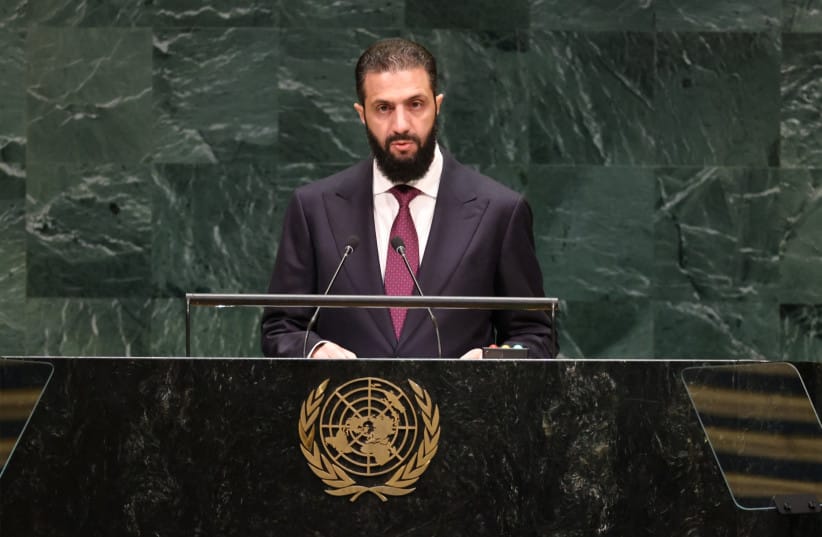
“Syria went from being a crisis to an opportunity for many countries,” he stated.
“We have consolidated our values and the rule of law. Any attempts that violate our sovereignty will be stopped. [The] Golan [Heights] will remain Syrian territory,” the president said. “Any other attempts will be thwarted.”
Sharaa’s family fled the Golan Heights during the 1973 Yom Kippur War. He was born in Riyadh to two Syrian parents and chose the nom de guerre Abu Mohammed al-Jolani [from the Golan] to highlight his heritage during his time as leader of Hayat Tahrir al-Sham.
“I ask our partners to abide by international law…The world is encouraged by our return, but Israel keeps attacking Syria,” he continued.
“We will continue to serve our people; we will continue to serve god. God will always reward you for your actions… There have been 500 airstrikes, more than 1200 incursions, and 300 detentions. This is at odds with the orientation that we are seeing at a global level. It is reminiscent of an era that we thought was long gone. We are committed to the 1974 agreement; we call for the withdrawal of Israeli forces to the line of the 8 of December of 2024,” he stated.
Romanian president insists Iran will not possess nuclear weapon, must allow IAEA access, comply with NPT
Meanwhile, Romanian President Nicusor Dan addressed Iran’s nuclear weapons program, demanding that the Islamic Republic cease its attempts to produce a bomb.
“Iran must not possess a nuclear weapon. Iran must comply with the NPT, and must restore access to the IAEA,” Dan said.
“Romania will continue to provide maritime security and unrestricted navigation in the Strait of Hormuz and the Black Sea,” Dan added.
Tobias Holcman and Idan Kweller contributed to this report.

Poverty, child labor, and child marriage partially behind Iran’s unfilled classrooms
Thousands of primary school-aged children in Iran have been unable to receive an education due to financial hardship, Iran’s Education Ministry confirmed to Iranian media on Tuesday.
Rezvan Hakimzadeh, deputy minister of primary education, confirmed that 140,562 students were identified as not attending school last year, with the majority located in Sistan and Baluchestan, Tehran, Razavi Khorasan and Khuzestan provinces. Of those children, 54,445 were in the first grade of primary school.
The minister confirmed that nearly 42,000 of the students were found to have left Iran with their families, while 18,000 were not required to enroll due to disabilities. Thousands of others were found to be out of school due to family financial hardship, child labor, a lack of adequate guardianship, or enrollment in unlicensed education centers.
There were also 86 cases in which a primary school-aged child was not attending school because they had married. Primary school in Iran is for children aged six to 12 years, while Iranian law generally requires girls to be 13 and boys to be 15 to marry, although a judge’s approval can allow for marriage at a younger age.
The start of the school year in Iran has also drawn greater attention to the country’s population crisis. According to the Astan Quds Razavi foundation-affiliated Iranian media site Quds Online, only 1.154 million six-year-old children began primary school in Iran this year, a decrease of around 76,000 from last year.
Iran’s challenged demography
Iran’s declining birth rates, delays in marriage and childbearing, economic pressures, and lifestyle changes have all impacted the country’s demography.
Alireza Sajedi, head of Iran’s Population Monitoring Center of the National Organization for Civil Registration, also complained to the site that the number of births fell from around 1.116 million in 2021 to fewer than 980,000 in 2024.
The population decline could eventually lead schools to reduce both classroom sizes and the number of classes in cities, but in rural areas, it may no longer be viable to keep schools open, Quds Online warned.

Gaza journalists operating under Hamas media controls were given platforms in Westminster
Gaza-based journalists who worked amid what photojournalist Motaz Azaiza has described as a “Hamas-controlled media environment” were given prominent platforms in Westminster, researcher Emma Schubart of the Henry Jackson Society (HJS) revealed to The Jerusalem Post exclusively on Tuesday.
Schubart’s discovery follows comments made by Gazan photojournalist Motaz Azaiza in a September 3 podcast interview with journalist Ahmed Biqui.
During this conversation, Azaiza mentioned the existence of a Hamas-administered WhatsApp group called Smart, which, he said, included “every journalist working in Gaza.” The group’s icon displayed a Hamas flag and was administered by “the director of media for the Rafah Border Crossing,” who has been identified as Wael Abu Mohsen.
According to Azaiza, the group coordinated media messaging and organized campaigns against journalists whose reporting departed from the sanctioned line.
“It was never a spontaneous thing,” he added.
Gazan photographers ‘accustomed to lowering cameras’ to criticism of Hamas
Azaiza added that photographers in Gaza had “become accustomed to lowering their cameras” when civilians criticized Hamas.
HJS reported that several journalists who operated within this Hamas-controlled media environment were subsequently welcomed into Westminster and presented to British parliamentarians as authoritative witnesses to the war. Other journalists from this environment have been involved more indirectly with the British government.
For example, Al Jazeera’s Gaza bureau chief Wael al-Dahdouh was hosted in Parliament in September last year.
MPs host Hamas-linked journalists
Hansard [the official report of all Parliamentary debates] records Labour MP Yuan Yang saying on September 10, 2025, that she had “co-hosted an event in Parliament for Wael al-Dahdouh” the previous evening.
During that visit, Dahdouh also met with Labour MP Afzal Khan for Manchester Rusholem (formerly Manchester Gorton), who posted publicly that he had met Dahdouh, calling the meeting “an honor.”
While neither the Post nor HJS has independently verified the membership of the group, Azaiza said it included every journalist working in Gaza at the time.
Then there is Azaiza himself, who on May 15, 2024, addressed a Nakba Day gathering at Westminster Central Hall, yards from Parliament, sharing the event with Sir Alan Duncan, the former Conservative Foreign Office minister.
Additionally, Scottish National Party (SNP) MP Brendan O’Hara co-organized a cross-party panel in a House of Commons committee room in mid-July 2025 with Oxfam GB and the Council for Arab-British Understanding.
Gaza journalist Abubaker Abed spoke alongside Oxfam’s then-CEO. Abed addressed MPs and journalists who were in attendance on conditions in Gaza and called for an end to UK arms support for Israel.
Finally, Al Jazeera and the International Centre of Justice for Palestinians (ICJP) held a sold-out Westminster screening of the documentary Gaza in October 2024, followed by a panel. Al Jazeera Gaza correspondent Youmna El Sayed appeared as a panellist, with MPs and peers attending.
“One of Gaza’s most famous ‘journalists’ has described, in his own words, how Hamas controlled the media environment,” Schubart said.
Schubart noted that this is of great importance to every international outlet that has relied on Gaza-based journalists yet still claims that their reporting is editorially independent of Hamas.
“The question is straightforward: Why were British politicians giving a parliamentary platform to journalism produced under Hamas control?”
Schubart has personally written to the Speaker of the House on these findings. The letter was viewed by the Post.

Balad chairman barred from running in election following 31-4 Central Elections Committee vote
The Central Elections Committee voted 31 to 4 on Wednesday to bar Balad chairman Sami Abu Shehadeh from running in the October 27 election, accepting an Otzma Yehudit petition alleging that he supported armed struggle against Israel by a terrorist organization.
The decision is not final. Under Basic Law: The Knesset, the disqualification of an individual candidate requires Supreme Court approval before taking effect. The court is set to hear the election disqualification cases next week.
Abu Shehadeh, who is third on the Joint List slate, said he would challenge the decision, calling it an attempt to silence Arab society’s political voice and exclude it from the political arena.
In an exceptional move, committee chairman and Deputy Supreme Court President Noam Sohlberg joined the vote in favor of disqualification, departing from a two-decade practice under which committee chairmen have abstained to preserve their neutrality.
Sohlberg said Abu Shehadeh had failed to provide a satisfactory explanation for the statements at the center of the case.
Sohlberg: Disqualification must remain a last resort
“If there is a case in which the application is clear, this is the case,” Sohlberg said. The last committee chairman to participate in such a vote was Supreme Court justice Mishael Cheshin in 2003.
Sohlberg’s vote followed a warning at the beginning of the proceedings that disqualification must remain a last resort because it denies an entire constituency the ability to support its chosen candidate.
Section 7A of Basic Law: The Knesset allows a candidate or list to be barred for rejecting Israel as a Jewish and democratic state, inciting racism, or supporting armed struggle against Israel by an enemy state or terrorist organization.
The Supreme Court has interpreted those grounds narrowly. Disqualification requires clear, convincing, and unequivocal evidence that the prohibited position lies at the heart of a candidate’s political activity, generally demonstrated through a sustained pattern rather than an isolated statement.
The Otzma Yehudit petition centered on an Arabic-language article Abu Shehadeh published on October 8, 2023, one day after the Hamas massacre.
In the article, Abu Shehadeh described the attack as an “important historic event” in military, political, and strategic terms. He wrote that if “small and besieged Gaza” could surprise Israel on that scale, others could do so more effectively.
Otzma Yehudit argued that the article praised Hamas’s attack and encouraged others to learn from it. Party chairman Itamar Ben-Gvir told the committee that Abu Shehadeh’s subsequent explanations were implausible, given what was already known about the killings and abductions.
The attorney-general’s position was unusually severe compared with her responses to the other disqualification requests.
In their written submission, Attorney-General Gali Baharav-Miara and State Attorney Amit Aisman said the evidence, particularly the October 8 article, apparently indicated that Abu Shehadeh had expressed support for a terrorist organization’s armed struggle against Israel. They initially stopped short of expressly recommending disqualification, noting that previous cases involved extensive, long-term evidence of systematic conduct.
During Wednesday’s hearing, however, the attorney-general’s office said Abu Shehadeh’s explanations remained unsatisfactory and that there was a basis for the request. His failure to condemn the attack in the article was not a neutral omission, the office argued.
Abu Shehadeh: ‘I oppose armed struggle’
Participating remotely, Abu Shehadeh said he had written the article on October 7, before he understood the full scale of the atrocities, and acknowledged that it should not have been published in that form.
“I have never called for violence or terrorism,” he told the committee. “I oppose armed struggle.”
Abu Shehadeh said his description of the attack as historically important meant that events after October 7 would not resemble those before it. He argued that the article analyzed Israel’s intelligence failure and called for an end to the military path in favor of a diplomatic process led by the Palestinian Authority and Arab states.
He also condemned the Hamas massacre and cited other writings in which he opposed armed struggle and harm to civilians.
Adalah, which represents Abu Shehadeh, said the decision rested on a false portrayal of his political record. The organization said his three decades of public activity, together with repeated condemnations of harm to Jewish and Palestinian civilians, demonstrated a commitment to nonviolent political action.
Adalah general director and attorney Hassan Jabareen argued that the article contained no direct call for violence and that its central conclusion favored a political solution.
He also accused the attorney-general of applying an expansive interpretation to a single Arabic-language article while finding that broader records cited in petitions against Otzma Yehudit and the Religious Zionist Party (RZP) did not reach the evidentiary threshold for disqualification on grounds of racist incitement.
The disqualification nevertheless attracted support from coalition and opposition representatives.
Democrats chairman Yair Golan said genuine democratic partnership required “redlines,” while stressing that his party opposed the blanket exclusion of Arab parties and would also support barring Otzma Yehudit chairman Itamar Ben-Gvir.
The plenum of the Central Elections Committee (CEC) is primarily a political body composed of representatives of factions in the outgoing Knesset. Its decisions have frequently been overturned by the Supreme Court, including previous decisions barring Balad and its candidates.
The combination of Sohlberg’s vote and the attorney-general’s position distinguishes Abu Shehadeh’s case from the other challenges heard this week.
The Supreme Court will decide whether the exceptionally grave timing and language of the October 8 article can satisfy a legal test that has generally required a broader and more sustained body of evidence.
The CEC separately voted Wednesday to disqualify Hadash MK Ofer Cassif.
It also considered requests involving Ra’am, the Joint List, and Balad. Challenges against Otzma Yehudit, the Religious Zionist Party-Zehut list and The Democrats are scheduled for Thursday.

Israel Navy moves toward semi-autonomous fleet with robotic ships
The Israeli navy is moving toward becoming a semi-autonomous force and may eventually become nearly fully autonomous, the IDF said.
It has been reported that the Israeli navy has operated autonomous sea vehicles in recent years, though it is unclear when swarms at sea will be ready to roll out.
Elbit Systems has already been among the Israeli companies developing such technologies, including its publicized 12-meter Seagull autonomous surface vessel, designed to patrol offshore infrastructure for up to four days. It also “incorporates mine countermeasures (MCM), anti-submarine warfare (ASW), maritime security (MS), electronic warfare (EW) and other advanced systems and technologies.”
Other countries like France, Singapore, and the Netherlands are also shifting their navies toward more autonomous operations.
Despite those navies’ progress, Israel’s navy said it is even more advanced in using robots and autonomy.
The need for robots and autonomous operations is clear, given that ships can spend weeks or longer at sea.
Even the most resilient sailors have trouble with this amount of time at sea, and an overwhelming portion of the population is just incapable of doing it at all.
Israel faces growing naval threats from Turkey, Iran, Houthis
In addition, Israel faces growing naval threats from Turkey, and possibly from Iran, the Houthis in Yemen, and others.
The navy said this means it will need more ships in the future to secure Israel’s maritime national security interests.
However, the navy does not believe the country or the military will grant it additional staffing power for more ships, so the only stable way to expand Israel’s naval fleet sufficiently will involve fewer human soldiers per ship, and eventually zero or close to zero.
At one stage, Israeli soldiers can focus solely on maintenance and safety issues with robots and autonomous systems operating most other systems.
Robots are a double-edged sword
At a later stage, robots may be able to undertake all or much of the maintenance work.
But robots are a double-edged sword.
Enemy forces are also expected to use robots and autonomous systems against Israel.
This will create a number of challenges: land-to-sea and sea-to-sea.
In addition, the IDF is aware that China, Russia, and other countries have explored cutting underwater cables, which foreign reports have confirmed going back to at least 2023 in the Baltic Sea, near Britain, Norway, and at other locations.
Israel is working on and will need to expand its defense of these underwater cables going forward.

Netherlands to return to Eurovision 2027 after boycotting Israel’s participation
The Netherlands will join the 2027 Eurovision Song Contest after boycotting the event this year over Israel’s participation, Dutch public broadcaster NPO said on Wednesday.
NPO took over from the original public broadcaster AVROTROS, which formally announced in August that they would not participate in the contest, stating that the event could “no longer be considered neutral” while a participating country, referring to Israel, remains involved in a large-scale military conflict, NL Time reported Wednesday.
In August, AVROTROS director-general Taco Zimmerman stated that the contest was meant to unite people and countries involved in international conflicts, undermining the contest’s “neutrality” character, saying, “The Eurovision Song Contest was originally created to bring people and countries together.” It is undeniable that international conflicts are increasingly affecting the contest, undermining its neutral character.”
The broadcaster noted that it had returned responsibility for Dutch participation in Eurovision to the NPO. This organization oversees the overall Dutch public broadcasting system.
The European Broadcasting Union (EBU) had initially set a September 15 deadline for countries to confirm their participation. NPO requested additional time to evaluate its options after taking over responsibility for the Netherlands’ Eurovision entry and was granted an extension until the end of September.
Countries weigh Eurovision return as Bulgaria prepares to host 2027 event
The Netherlands was among five countries, together with Ireland, Spain, Iceland, and Slovenia, that withdrew from the 2026 Eurovision contest in Vienna. Ireland’s broadcaster RTÉ has since said it will also skip and not broadcast the 2027 contest, while Spain and Iceland are still reviewing whether they will participate, according to Eurovoix.
The contest’s final semi-final rounds ad grand final will be held in Burgas, Bulgaria May 11-15, 2027 hosted by Bulgarian National Television (BNT) alongside the European Broadcasting Union (EBU).
Reuters and Tzvi Jasper contributed to this report.