Dow futures drop 200 points, Brent oil jumps as market rout continues: Live updates
2026-03-19
Wall Street is coming off a dismal trading session as inflation fears took hold.
This post was originally published here

Wall Street is coming off a dismal trading session as inflation fears took hold.
This post was originally published here
This post was originally published here

This post was originally published here
California Attorney General Rob Bonta said the proposed merger was illegal and would lead to higher pay-TV prices and reduce jobs.
This post was originally published here
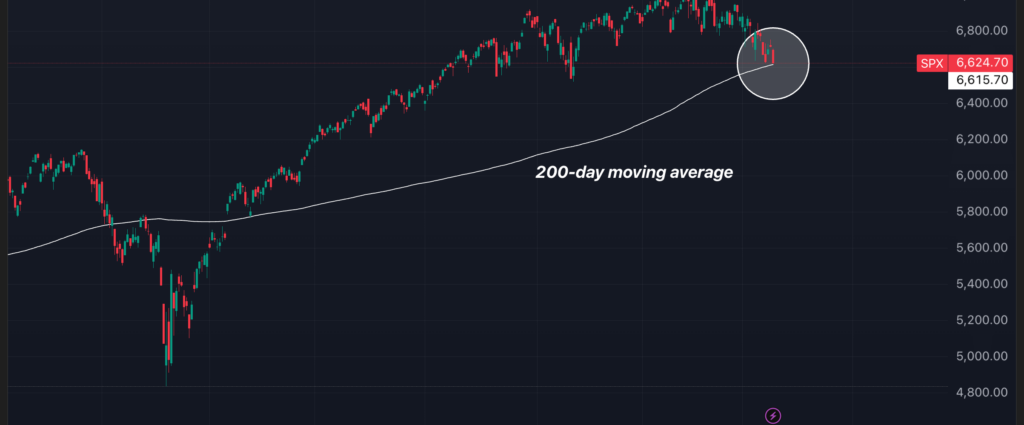
Both the S&P 500 and Nasdaq 100 are poised to break below their 200-day moving averages for the first time since March 2025.
Meanwhile, the Brent-WTI crude spread blew out to $17 per barrel early Thursday — the widest since April 2020 when WTI went negative — as Israel’s strike on Iran’s South Pars gas field triggered retaliatory missile attacks across the Gulf and markets began pricing in the risk of U.S. crude export restrictions.
Brent surged 7.11% to $115.01, while Middle East benchmarks Murban and Dubai crude exploded above $128 and $136 respectively.
S&P 500 Could Break Below Its 200-Day Moving Average For First Time Since March 2025
WTI crude oil futures — as tracked by the United States Oil Fund (NYSE:USO) — traded at $98.35 per barrel early Thursday, up $2.03 (+2.11%). Since the start of the war on Feb. 28, WTI prices have surged roughly 45% from a pre-war level near $68 per barrel.
Brent crude — tracked via the United States Brent Oil Fund, LP ETV (NYSE:BNO) — jumped 7.11% to $115.01 per barrel following Iranian missile strikes on Gulf energy infrastructure.
Middle East benchmarks saw even sharper moves: Murban crude surged 10.34% to $128.84 per barrel, while Dubai crude spiked 11.05% to $136.42 per barrel, reflecting an acute physical supply squeeze in the region.
The Brent-WTI spread widened to approximately $17 per barrel — the widest since April 2020, when WTI famously went negative amid the pandemic storage crisis. Excluding that historic anomaly, the current spread is …
After a 1,088-day wait, a jury acquitted the man Nichols accused. She describes her experience of the system as a complainant – and explains why she went public
Warning: this article contains graphic testimony
Sitting in the House of Commons, waiting for the speaker to call her name last week, the MP Charlotte Nichols was doing breathing exercises to try to keep calm. “I was just trying to get myself into the headspace where I could say what I wanted to say without either completely garbling it or just crying or bottling it at the last minute.”
She didn’t bottle it. She stood up, asked MPs to be gentle with her, and then went public with her biggest secret.
This post was originally published here
Decision comes as concerns mount over economic fallout from Iran war bringing inflation shock
The Bank of England has kept interest rates on hold and signalled it could be forced to increase borrowing costs within the coming months as the US-Israel war on Iran threatens to drive inflation in the UK above 3%.
As households brace for a surge in living costs, the Bank’s rate-setting monetary policy committee (MPC) voted unanimously to keep its base rate at the current level of 3.75% amid growing concern over the surge in energy prices triggered by the conflict.
This post was originally published here
A curated list from one of HBR’s most popular newsletters.
This post was originally published here
Non-traded, publicly registered REITs raised $593 million from investors in January, an increase December, according to Stanger Investment Banking.
This post was originally published here

Bitcoin (CRYPTO: BTC) is down 2% compared to gold sliding 4% after the Federal Reserve delivered hawkish signals, an unusual reversal as Bitcoin typically underperforms the precious metal during risk-off moves.
Positioning may explain the divergence as gold surged 90% over the past year and hit record highs in February before the Middle East conflict started.
That left it overbought and vulnerable. Bitcoin crashed 50% from October highs, leaving it oversold and ready to bounce.
Since the Iran war began, Bitcoin has been one of the strongest performing assets outside energy. Meanwhile gold sits 17% below its January peak, approaching bear-market territory.
The Federal Reserve delivered a more hawkish-than-expected tone Wednesday, pushing back against market expectations for imminent interest-rate cuts.
This weighed on …
Here are Thursday’s biggest calls on Wall Street.
This post was originally published here
Uber plans to invest up to $1.25 billion in Rivian as part of a deal to deploy up to 50,000 robotaxis in several countries through 2031.
This post was originally published here
An eight-month study of 2,500 employees at KPMG discovered indicators that can help identify superusers.
This post was originally published here
Carnival Corporation’s more than 23% fall since the start of the U.S.-Iran war is similar to the impact other military conflicts have had on the stock.
This post was originally published here

At the Emergency Hospital, dozens crowded around a thick book to check the names of the victims killed in an airstrike on a rehabilitation center. The U.N. says over a hundred people were killed.
(Image credit: Fazelminallah Qazizai for NPR)

This post was originally published here
A conversation with HBS professor Tsedal Neeley about the types of organizational change needed for AI to thrive.
This post was originally published here

“What torments of grief you’ve endured from evils that never arrived,” wrote Ralph Waldo Emerson, the 19th-century American philosopher and writer. Millions of workers are feeling similar. How many jobs will artificial intelligence destroy? And are we all worrying unnecessarily?
“The demand for human labor will not go away,” Mohit Joshi, the chief executive of the Indian information technology giant, Tech Mahindra, tells me. The world is entering an era of technology complexity and new business opportunities. The changes are likely to increase demand for ‘humans in the lead’, even though the job specifications will be radically different.
Joshi has data and historical precedent to back up his assertion. In the 1990s, many companies, spooked by the threat of the Millennium Bug, invested heavily in technology updates as a protective measure. The bug—linked to the New Year date change from the 20th century to the 21st—never materialized, leading to predictions that tech spending would fall back to 20th century levels. It went in the opposite direction and the ‘trend to spend’ continued.
“The demand for human labor will not go away.”
Mohit Joshi chief executive of Tech Mahindra
Similar momentum is apparent in 2026 when it comes to the effects of artificial intelligence on workforces. “We think the productivity gains will not result in immediate headcount impacts,” Joshi says. “There is a lot of investment that will need to happen over the next couple of years to drive simplification, modernization and optimization. And, especially on the data side, investment will be required beyond the three to five years that it will take to modernize and simplify systems.”
“In the best case beyond that, I feel the complexity of organizations will increase dramatically. And, if the AI premise gets realized fully, the economic growth is going to be so much more significant. It should create more opportunity, because you will have a much larger landscape.”
Elon Musk talks of an era of abundance, ushered in by an applied AI revolution where a robot can do your shopping and energy comes from space. The journalist Ezra Klein has written a book of the same name, Abundance, arguing that governments have a key role to play in ending the age of scarcity. Products and services will change so radically that demand for employees will increase.
“My own advice to my teams is that there will always be somebody who’s a winner,” Joshi says. “And my sense is that the people who are winning will have a few attributes. The first is that they will be fast, because there’s a gigantic premium for speed. You need to be able to pivot very quickly.”
“The second is curiosity. And the final thing is, at a time of great change, leaders will need a degree of empathy and kindness to be able to carry teams along with them.”
The ‘waterfall method’ of change is well known to business leaders—a sequential plan where projects are strictly defined and work is often driven through divisional silos with little opportunity for re-assessment. Most now lean towards the ‘agile method’, a more flexible approach to project management which encourages working between teams across the business.
How to build AI into the agile process is the key question. “What can you do to drive productivity and efficiency in your business?” Joshi says. “What is it that you should be doing to drive revenue in your business? Because productivity is nice, but revenue is really the most important piece.”
“…at a time of great change, leaders will need a degree of empathy and kindness to be able to carry teams along with them.”
Mohit Joshi
Return on AI investment is the key metric boards will want to see. “It’s very clear that organizations are going to get a lot flatter,” Joshi says. “You will have people at the top who will have a lot more in terms of span of control. You will have maybe a bulging middle instead of the traditional pyramid that we’ve had.” Employees with five to ten years’ experience will become ever more valuable.
Not everything is digital. Joshi laughs as we notice that we both write with pens on paper (it helps me think more clearly). He encourages his children to read physical books, with a small pocket-money boost for each one completed.
“What I tell my kids, almost obsessively, is that the ability to read and write well will never go away. So read as widely as you can early in life, because you will never again get this opportunity of unbroken periods of time where you can read, nor will your memory ever be as good to absorb as much as you can today. Learn to speak and write beautifully, and I think everything else will fall into place.”

This story was originally featured on Fortune.com
This post was originally published here
Four strategies for closing the gap between what leaders perceive and what employees actually experience.
This post was originally published here
Paul Griggs says senior staff at consulting firm who are not ‘paranoid about being AI-first’ are likely to be replaced
The US boss of PricewaterhouseCoopers has warned that partners who do not get to grips with AI have no future at the consulting firm.
Paul Griggs said senior staff who were not “paranoid about being AI-first” would probably be replaced by others who were ready to embrace the technology. “I don’t think anyone gets a free pass here. Anyone,” Griggs told the Financial Times.
This post was originally published here
Good morning. The Walt Disney Company’s CEO transition is notable not just for who is ascending, but for how deliberately the company built financial stability around it by extending CFO Hugh Johnston’s contract months before a new CEO was even named.
Josh D’Amaro, a 28-year veteran of the company, took over as chief executive at Disney’s annual shareholders meeting on Wednesday, succeeding longtime CEO Bob Iger. Named to the role on Feb. 3, D’Amaro most recently served as head of Disney Experiences, which includes the company’s theme parks, cruise line, resorts and consumer products.
There was some praise for Iger on social media. “What you have built is not a career, it’s a LEGACY,” NBA star Chris Paul said in a post on LinkedIn.
Iger, who had a long career at Disney, served as CEO from 2005 to 2020, then returned in 2022 following the controversy-filled tenure of his first replacement, Bob Chapek. He will temporarily stay on as a senior advisor and board member, stepping down eight months ahead of schedule.
A potential merger between Paramount Global and Warner Bros. Discovery could increase competition for Disney (No. 46 on the Fortune 500). But D’Amaro could be well-positioned to lead growth. Under his leadership, Disney’s parks and experiences became the company’s primary profit engine, accounting for more than 70% of operating income despite representing under 40% of total revenue, Fortune reported. Streaming is the other major growth driver, following consecutive quarters of profitability.
In November, Disney extended Johnston’s contract through Jan. 31, 2029—before the new CEO was even announced. He joined Disney in 2023, following a long career at PepsiCo. Johnston has a “well-earned reputation as one of the best CFOs in America,” Iger said in a statement in 2023.
At the Morgan Stanley Technology, Media and Telecom Conference earlier this month, Johnston called Disney’s CEO succession process a strength. “I would tell you they looked internally, externally, they really pushed hard on the candidates, and came to a conclusion that is a terrific one,” he said.
He described both D’Amaro and Dana Walden, who will become the company’s president and chief creative officer, a new role, as “terrific growth-oriented executives.” Walden was widely reported to be a CEO contender.
“There’s a lot of energy there in terms of people being excited about Josh, being excited about the fact that this process was also handled so smoothly,” Johnston said. “You all know some of the history of Disney and CEO successions going all the way back to Michael Ovitz. This couldn’t have been more different than that. It was a really smooth, well-run process with minimal drama.”
Johnston reaffirmed guidance for double-digit EPS growth in both 2026 and 2027. On M&A, he said Disney doesn’t need to do significant deals. “We’re very fortunate that with the moves that Bob Iger made during his tenure as CEO, whether it was acquiring Pixar, Lucasfilm, Marvel, and then the Fox acquisition, we were kind of in front of the curve in terms of generating a large collection of IP,” he said.
Sheryl Estrada
sheryl.estrada@fortune.com
This story was originally featured on Fortune.com
This post was originally published here
Covid-related downturns and reductions in alcohol consumption have taken a toll on a once booming industry
In the early 2000s, Chris Bell, then a student at University of Colorado Boulder, followed a common path among people interested in brewing beer. He started doing so at home, then spent years working at established craft beer makers Long Trail Brewing in Vermont and Avery Brewing in Colorado before opening Call to Arms Brewing Company in 2015 in Denver.
In a crowded market, the business was successful. Its More Like Bore-O-Phyll beer won a gold medal in the fresh or wet hop ale category at the 2018 World Beer Cup. A local outlet called it one of the city’s best breweries, and it had a 4.7 rating from more than 400 reviews on Google.
This post was originally published here


This story was originally featured on Fortune.com
This post was originally published here

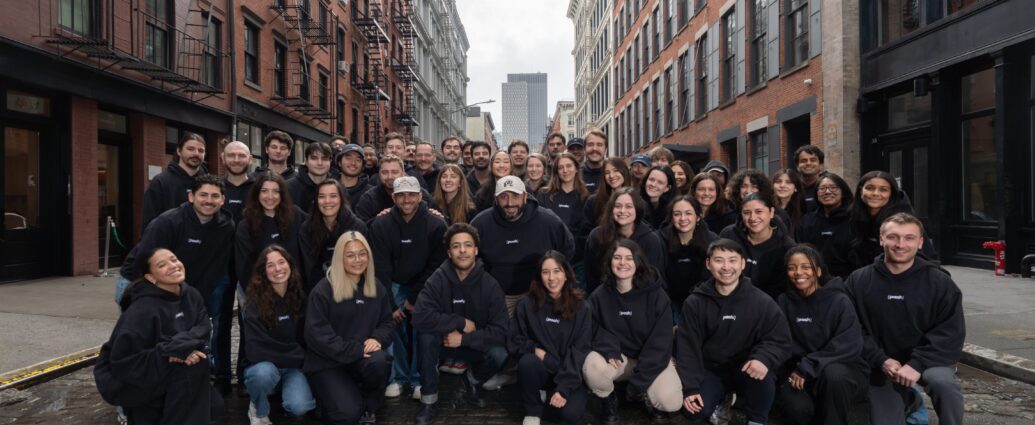
Event platform Posh raised a fresh $37 million to solve one of the quintessential “tarpit” startup ideas: turning the “what are we doing tonight?” group chat into an actual plan.
Founded in 2019 by then‑New York University students Avante Price and Eli Taylor‑Lemire, Posh began as software they built to run their own events after getting cheated by promoters and hitting the limits of Eventbrite. “I was using Eventbrite and other products to manage events, and then realized that the technology components were missing a ton of the capabilities that I needed,” Price told Fortune. That pain point became Posh’s product: a business‑first platform where organizers, not the marketplace, sit at the center. The company is already capturing corners of the events industry which is on track to be worth more than $2 trillion by 2028.
Now, the company has raised its $37 million Series B led by FirstMark Capital with Causeway Ventures, Goodwater Capital, Companyon Ventures, and Epic Ventures, Fortune has exclusively learned.
Posh’s model is straightforward: Posh takes about a 10% cut on paid tickets plus a 99‑cent fee per ticket, its primary revenue stream. In 2024, the company generated roughly $10 million in revenue on more than $83 million in ticket sales (the same year it raised $22 million in Series A funding). Today, the business has grown to an estimated $40 million in cumulative revenue, according to Price, processing $350 million in GMV and 25 million tickets since inception, with top organizers generating over $10 million on the platform. “What you have to do is you have to own the transaction first,” Price told Fortune.
Posh already powers everything from Palm Tree Festival and We Belong Here to brand activations with Lamborghini, Adidas, the NBA, Celsius, HBO, and Complex. The company has also poached talent from Meta, Reddit, Amazon, Hinge, Spotify, Block, and Canva to accomplish its goals. For the first four years, Posh was essentially “Shopify for events,” focused on tooling for nightlife: white‑label pages, SMS CRM, referral kickbacks, linked ticket tiers, and instant payouts. Now, with roughly 50,000 organizers and nearly 8 million users, the center of gravity has shifted toward demand—what Price calls a “Netflix‑style feed” that surfaces parties, activities, food and drink, and other categories based on where your broader social graph is actually going.
“The solved problem is your core group chat,” he says. “The harder problem is those 10 or 20 people you’d love to catch up with but never text. We’re trying to reintroduce that serendipity.”
See you tomorrow,
Lily Mae Lazarus
X: @LilyMaeLazarus
Email: lily.lazarus@fortune.com
Submit a deal for the Term Sheet newsletter here.
Joey Abrams curated the deals section of today’s newsletter. Subscribe here.
This story was originally featured on Fortune.com
This post was originally published here

Bitcoin fell to around $70,000 as ETF outflows and a higher inflation forecast for 2026 weighed on markets.
Bitcoin ETFs saw $129.6 million in net outflows on Wednesday, while Ethereum ETFs reported $55.5 million in net outflows.
Cryptocurrency |
Ticker | Price |
| Bitcoin | (CRYPTO: BTC) | $70,205.74 |
| Ethereum | (CRYPTO: ETH) | $2,175.81 |
| Solana | (CRYPTO: SOL) | $89.89 |
| XRP | (CRYPTO: XRP) | $1.46 |
| Dogecoin | (CRYPTO: DOGE) | $0.09420 |
| Shiba Inu | (CRYPTO: SHIB) | $0.055756 |
Meme coin market capitalization is down 5.3% over the past …
The move would be a major escalation in the US-Israel war against Iran. Plus, FBI director admits to buying data tracking Americans’ locations
Good morning.
Donald Trump threatened to “massively blow up” the world’s largest gasfield after Israeli strikes on Iran’s South Pars field led Tehran to take revenge on energy facilities across the Middle East.
What’s happening to oil and gas prices? Brent crude rose by 8% to $116 a barrel. European gas prices jumped, with the Dutch wholesale gas price up 24%.
What do we know about the war’s economic cost? The war cost the US $12.7bn by day six – the total is likely to have now exceeded $18bn. Here’s a visualization of how that has been spent.
Could US-Israeli attempts to take out Iranian leaders backfire? Some analysts think so. “It is not an approach that produces Jeffersonian democrats but hardened resistance fighters. It breeds more resistance,” said Sanam Vakil, an Iran expert at Chatham House.
Follow our live coverage here.
Who has spoken out? Labor rights activist and co-founder of the UFW Dolores Huerta, 95, released a statement on Wednesday saying: “I have kept this secret long enough. My silence ends here.” The report also includes the stories of two women, who were daughters of organizers in the movement, who said they were children when the grooming and abuse began.
This post was originally published here
And further angers economically frustrated citizens
This post was originally published here
Energy company plans full return to London by moving global HQ to new development on South Bank
BP has agreed to sell its giant German oil refinery site in Gelsenkirchen to the investment firm Klesch Group as part of the British oil company’s plan to sell off $20bn (£15bn) worth of assets and cut its costs.
The value of the sale was not disclosed but BP said it would save the oil company about $1bn of underlying operating expenditure at the complex, which processes about 12m tonnes of crude oil every year, mainly as fuel for cars and aircraft.
This post was originally published here
We rank the poor world’s exposure and buffers
This post was originally published here

This post was originally published here
As the sex economy grows, it deserves serious analysis
This post was originally published here

This post was originally published here

People in China are rushing to buy preowned computers to try OpenClaw with demand for MacBooks particularly high, according to one reseller.
This post was originally published here
Report shows how minerals critical to defense readiness have seen a ‘near total’ disruption in seaborne trade
The closure of the strait of Hormuz is causing a “paralyzing, real-time problem” for any prospective manufacturing surge in the US defense industrial base, and even for the repair of defense equipment damaged by Iranian attacks, according to analysis published by West Point’s Modern War Institute.
In particular sulphur, a vital upstream input in the extraction of critical minerals including copper and cobalt, has seen a “near total” disruption of seaborne trade in the straits, which makes up half the world’s total shipments, and prices have spiked nearly 25% since the war began, and seen a 165% rise year on year, the report said.
This post was originally published here
Kennedy’s appointees promoted ‘treatments’ like bleach enemas, but new committee has only one autistic member
The first public meeting of US autism advisers – notably, since Robert F Kennedy Jr reshaped the committee – was cancelled recently with few details, coinciding with the creation of a rival organization that has prompted some questions within the autistic community about their focus.
Kennedy, the secretary of the US Department of Health and Human Services (HHS) who has long argued for a debunked link between vaccines and autism, chose entirely new members for the Interagency Autism Coordinating Committee (IACC) in late January, with fewer autistic people and several anti-vaccine advocates.
This post was originally published here
The Gulf states have said Iran’s attacks on energy infrastructure won’t “go unanswered” but, so far, they have not hit back. That stance could change soon.
This post was originally published here


Sen. Richard Blumenthal, a panelist in Sen. Markwayne Mullin’s Department of Homeland Security confirmation hearing, discusses the reforms he wants for the agency and shares his views on the Iran war with NPR’s Steve Inskeep.
(Image credit: Anna Moneymaker/Getty Images)

This post was originally published here
Oil prices jumped as markets react to escalating tensions after Qatar said Iranian missile strikes damaged a key liquefied natural gas export facility.
This post was originally published here
Lilly is betting big on retatrutide as the next pillar of its obesity portfolio after its weight loss injection Zepbound and its upcoming pill, orforglipron.
This post was originally published here
New work will be choreographed and directed by Benoit Swan Pouffer, artistic director of Rambert, with Davies and Pet Shop Boys serving as executive producers
It’s a Sin, the award-winning TV series about friendship during the 1980s Aids crisis, is to be adapted for the stage as a dance show. The new production is being developed by Rambert who had a hit in 2022 with its prequel to the TV series Peaky Blinders.
The creator of It’s a Sin, Russell T Davies, is executive producer on the new work which will be choreographed and directed by Benoit Swan Pouffer, Rambert’s artistic director. “Storytelling sits at the heart of Rambert’s mission,” said Pouffer on Thursday. “Collaborating with Russell – one of the most powerful storytellers of our time – is incredibly exciting. Together we’re exploring how dance and choreography can carry urgent, emotional narratives in a visceral way.”
This post was originally published here


Japan Prime Minister Sanae Takaichi will be the first U.S. ally to visit the White House since President Trump asked for help in sending ships to patrol the Strait of Hormuz.
(Image credit: Tomohiro Ohsumi/Getty Images)

This post was originally published here
This post was originally published here

Artist who topped UK charts with Because I Got High created comedic videos from footage, which officers claimed invaded their privacy
Chart-topping US rapper Afroman has been cleared of wrongdoing after Ohio police filed a lawsuit against him, alleging defamation, emotional distress and invasion of privacy after the artist used footage from a police raid on his home in a series of mocking videos.
In 2022, police searched the rapper’s home for evidence of drug possession and trafficking, and kidnapping. No evidence was found and no charges were filed.
This post was originally published here

Sunway Healthcare shares rose 28% in their first day of trading, following the company’s 2.9 billion ringgit ($732 million) IPO, the country’s largest in nearly a decade. Shares of the Kuala Lumpur-based hospital operator, previously the healthcare arm of Malaysian conglomerate Sunway Group, closed at 1.85 ringgit on Wednesday, up from the offer price of 1.45 ringgit. The listing is Malaysia’s biggest since 2017’s IPO of Lotte Chemical Titan Holdings.
Sunway Group previously said the spin-off will help unlock shareholder value and improve the business’s access to capital markets. In Sunway Healthcare’s IPO prospectus, Sunway described the health business as a “distinct and viable business of its own.”
Sunway Healthcare generated 1.6 billion ringgit ($403 million) in revenue during the first nine months of 2025, a 17.8% year-on-year jump, according to its prospectus. Yet the company’s profits over the same period declined by 22% year-on-year to hit 140 million ringgit ($35.4 million).
Following its IPO, Sunway Healthcare will continue to operate its network of private hospitals, ambulatory care services and ancillary services, with plans to expand to eight hospitals totalling over 3,400 beds by 2032. Sunway Group will also retain majority control of its healthcare offshoot, owning 69.4% of the shares.
Sunway Group, No. 190 on Fortune’s Southeast Asia 500 list, posted record revenue of 9.8 billion ringgit ($2.5 billion) in 2025, up 24.5% from the year before. The revenue jump was fueled by strong performance across most of its business segments, including property investment and construction.
Sunway hopes to tap growing healthcare demand in an aging and wealthier Malaysia. “The outlook for Malaysia’s private healthcare services industry remains positive,” Sunway Group wrote in its Q4 2025 earnings report. “Malaysia has one of the largest middle-income populations in ASEAN, coupled with rising life expectancy and a growing incidence of non-communicable diseases.”
Malaysia has a rapidly aging population, with 14.5% of its population set to be 65 and older by 2040, according to the Malaysian Department of Statistics. Over 2 million Malaysians are living with non-communicable diseases including diabetes, hypertension, high cholesterol and obesity.
Investors are eager to invest in Malaysia’s healthcare boom. KPJ Healthcare, No. 303 on Fortune’s Southeast Asia 500, hit a record share price of 3.53 ringgit during intraday trading on March 18.
Malaysia’s stock exchange, the Bursa Malaysia, has also been having a blockbuster year. The KLCI Composite Index is up by 14.1% over the past 12 months, and breached a six-year high in mid-January. According to Deloitte, Malaysia had more IPOs than other Southeast Asian markets, with 59 IPOs raising 5.5 billion ringgit ($1.4 billion) in 2025.
The Malaysian ringgit has also risen to its strongest value in five years, propelled by AI optimism and rising energy prices. “The Ringgit should be one of the best performing currencies in Asia this year,” wrote Goldman Sachs strategists in a March 14 research note.
This story was originally featured on Fortune.com
This post was originally published here
World leaders are scrambling to contain a spiraling Middle East conflict on Thursday after Israel and Iran traded strikes on gas production facilities.
This post was originally published here
Unemployment holds steady, but Bank of England is unlikely to be convinced by ONS data to cut interest rates
Wage growth slowed sharply in the three months to January, according to the latest snapshot of the jobs market from the Office for National Statistics.
Average earnings growth fell to 3.8% in the three months to January, down from 4.2% – a larger fall than forecast by City economists. It was the slowest rate of wage growth in more than five years.
This post was originally published here
Lemi Limbu, who has severe intellectual disabilities, remains in prison and will now face retrial for the murder of her daughter
A woman with severe intellectual disabilities in Tanzania has had her conviction and death sentence quashed after spending more than a decade in prison awaiting execution.
Lemi Limbu, now in her early 30s, was convicted of the murder of her daughter in 2015. On 4 March, a court in Shinyanga, northern Tanzania, declared she can appeal. She will face a retrial, but a date has yet to be set.
This post was originally published here
Now, the total is likely to have exceeded $18bn and counting. Where are America’s war dollars going, in a war that was never declared in the first place?
This post was originally published here
Rulings in cases alleging antisemitism on US campuses say common pro-Palestinian speech is constitutionally protected
Few debates from the last few years have been more contentious than whether criticism of Israel and Zionism is antisemitic, threatens Jewish people or violates their civil rights. Allegations of antisemitism have cost people jobs, provided pretexts for censorship and fueled an unprecedented crackdown on protest over Israel and shows of support for Palestinian rights, especially at universities.
Pro-Israel groups have filed hundreds of lawsuits or legal actions in an effort to silence some of this speech, with the vast majority filed since 2023 in response to the protest movement surrounding Israel’s recent war in Gaza. The most important rulings to have come out of these cases, experts say, have found that speech and slogans at the heart of the controversies are protected by the first amendment.
This post was originally published here
Dozens said they weren’t given chance to arrange care for their kids after being deported at short notice, study shows
The Trump administration is deporting a significant number of parents without asking them if they have children or allowing them to decide whether to bring their children with them, in apparent violation of its own policies, a major report has found.
In interviews with dozens of parents deported to Honduras, as well as physicians and psychologists, government officials and staff at reception centers for deportees, researchers found that many parents were deported quickly after they were detained, without a chance to arrange for the care of their children.
This post was originally published here
My oldest daughter starts an internship at Deloitte this year. She’s capable and motivated. She’s also walking into a professional environment that is wildly different from what it was even a few short years ago.
I started my career more than a few short years ago. Back then, success had a simple formula: be the first one in, be the last one out, and always ask for more work. Effort was measured in hours. Visibility was measured in face time. That commitment still matters — I’m not going to tell my daughters that hard work doesn’t matter. But I am going to tell them that hard work alone won’t cut it anymore.
They need to work differently — and so does everyone else.
From my experience as both a CEO and a father, I’m genuinely impressed by Gen Z’s fluency in digital communication. They text. They message. They send voice notes. That’s very useful when communicating with each other. But it has its limits, even in this hyper-digital moment. Building trusted relationships is more important than ever.
A workplace includes people who came up through email culture, phone call culture, and even memo culture. Every generation connects differently, and each method has its place. My daughters will need to adjust their approach to fit the preferences of the people they work with, rather than expecting everyone else to adapt to them.
I’ve told them this directly: figure out how your manager prefers to communicate — even ask them — then use that method. Figure out how the finance team operates, how the field team talks, how the executives want information delivered. This isn’t about abandoning your style. It’s about building range. Be a communicative chameleon.
Building that range also means building capacity for adaptation. Gen Z’s digital fluency will seem outdated to the generations behind them — and they don’t even have to wait for Gen Alpha to enter the workforce. Things are changing much faster than that. Adaptation isn’t a strategy. It’s the baseline.
AI has become one of the most practical tools available for exactly this kind of adaptation — and most people entering the workforce aren’t using it this way yet.
I do this in my own work. Before major presentations, I feed my deck into an LLM and ask how my message might land with different audiences — the board, my direct reports, a customer. It doesn’t do the work for me, but it surfaces perspectives I might not have considered, helping me tailor my communication for maximum impact. If a Fortune 500 CEO is using AI to pressure-test how his message will land before a board meeting, a 22-year-old starting her first job should be doing the same thing.
For someone entering the workforce, this is a practical starting point. You’re walking into rooms — virtual or otherwise — full of people who think differently than you do, communicate differently than you do, and have expectations you haven’t learned yet. AI can help you anticipate how a message will be received before you send it. It can help you build emotional intelligence across departments and age groups — skills that used to take years to develop through experience, trial and error.
The tool is new. The goal isn’t. You’re still trying to connect with people — AI just gives you a way to rehearse before the stakes are real.
AI can help bridge communication gaps, but it’s still just a tool. There are people on both ends of every interaction, and there’s no substitute for human connection at work.
“Showing up” looks different in many companies now, with in-office, remote, and hybrid work physically separating colleagues. But digital elements are facilitators — not replacements. Showing up means more than logging into meetings; it’s about turning your camera on, engaging actively, and looking for ways to add value. True presence, whether virtual or in-person, requires intentional effort to connect, build trust, and participate fully.
My daughters will enter a workforce where building relationships across teams takes deliberate effort. Nobody’s going to bump into them in a hallway and offer career advice. They’ll need to seek it out and cultivate a circle of trusted advisors to help them through every stage of their careers.
Early in my career, someone told me: look for ways to take on more than your job description. Don’t wait to be asked. Find the gap and fill it.
That advice hasn’t changed. Work ethic is still the foundation. But outworking your peers today means something different than it did in 1995. It means adapting. It means communicating in ways that land with people who think differently from you. It means using the tools available to sharpen your judgment, not replace it.
My daughters are smart enough to figure most of this out on their own. But the rules of the game have changed fast enough that even people 30 years into their careers are still catching up. The advantage goes to whoever adapts first.
The opinions expressed in Fortune.com commentary pieces are solely the views of their authors and do not necessarily reflect the opinions and beliefs of Fortune.
This story was originally featured on Fortune.com
This post was originally published here

Autism experts plan to convene in Washington Thursday to propose a research agenda at odds with the one endorsed by the Trump Administration.
(Image credit: Tom Williams/CQ-Roll Call, Inc)

This post was originally published here

This post was originally published here
The tech giant is one of several Chinese AI firms that have been rushing to catch up to U.S. companies in the AI race.
This post was originally published here

Shares of Five Below Inc (NASDAQ:FIVE) rose sharply in pre-market trading after the company reported better-than-expected fourth-quarter financial results and issued FY26 EPS guidance above estimates.
Five Below reported fourth-quarter revenue of $1.73 billion, beating estimates of $1.70 billion, according to Benzinga Pro. The company posted adjusted earnings of $4.31 per share for the quarter, beating estimates of $3.98 per share.
Five Below shares jumped 7.2% to $227.80 in the pre-market trading session.
Here are some other stocks moving in pre-market trading.
This post was originally published here

This post was originally published here

This post was originally published here
Taith programme, set up after UK’s post-Brexit withdrawal from Erasmus+, faces uncertain future over funding
A “life-changing” international learning programme set up in Wales after Brexit is at risk of being closed down.
Taith, which means “journey” in Welsh/Cymraeg, was established by the Senedd in 2022 after the UK pulled out of the Erasmus+ student exchange programme. Its reach is much wider: many participants get involved through schools, youth groups or adult education centres, and nearly half come from underrepresented backgrounds. Data suggests Taith has already funded approximately twice as many projects in Wales as Erasmus+ did, working with less money.
This post was originally published here

The anticipated ¥1 trillion ($6.3 billion) fee for SoftBank Group Corp. (OTC:SFTBY) from a U.S.-Japan project has been slashed by over 90% due to intervention from Tokyo officials amid growing concerns over the $550 billion joint investment plan between the U.S. and Japan.
SoftBank was originally slated to earn fees from building and operating a $33 billion gas-fired power plant in Ohio. The project marks the first outcome of a trade deal in which Japan secured tariff relief from Washington in exchange for a $550 billion investment in the U.S., the Financial Times reported on Thursday.
The fee was intended to compensate it for its role as project developer, as it does not hold any equity in the power plant. The facility would be entirely financed by Japan and jointly owned by the U.S. and Japan through a special-purpose vehicle created under the trade agreement.
Despite the reduced fee, SoftBank will continue to receive payments over 15–20 years if …
This post was originally published here
Most dangerous offenders on probation will now be watched more closely than ever before, says government
Tens of thousands of offenders will be released from prisons in England and Wales wearing tags that track their location in real time as part of the biggest expansion of electronic tagging in British history, ministers have announced.
The prisons minister, James Timpson, said a new pilot scheme would track domestic abusers and stalkers, alerting authorities if they approached their victims, while other offenders will wear geolocation tags that will enable probation officers to track their live location.
This post was originally published here

Jailed cryptocurrency fraudster Sam Bankman-Fried lauded on Wednesday the effectiveness of Operation Epic Fury, the joint U.S.-Israeli military campaign against Iran.
Bankman-Fried, also known as SBF, posted on X an Al Jazeera op-ed titled “The US-Israeli strategy against Iran is working. Here is why,” describing it as an “excellent” article.
The piece, penned by Muhanad Seloom, Assistant Professor of International Politics and Security at the Doha Institute for Graduate Studies, argued that the operation has succeeded in “dismantling” Iran’s capacity to wage war, including its missiles, drones, and air defenses.
“The assassination of Supreme Leader Ali Khamenei eliminated the apex of the authorisation pyramid. His son Mojtaba’s appointment as his successor, a dynastic transfer without precedent in the Islamic Republic, signals institutional fragility, not continuity,” the report read.
This post was originally published here

Good morning. For more than 120 years, UL has put its mark on products from tree lights to toaster cords to convey a promise: This won’t kill you. Last week, for the first time, the $3 billion-a-year safety science company issued a new certification for AI-embedded products. As UL Solutions CEO Jennifer Scanlon told me: “Innovation without safety is failure.”
Rarely has there been a technology that’s evolved so fast with so little oversight. (The patchwork of emerging state laws adds to the confusion.) This week, the spotlight is on OpenClaw, the autonomous virtual agent that’s spawned a new craze in China. It got a shout-out from Nvidia CEO Jensen Huang during his developers conference this week, where he announced NemoClaw and declared OpenClaw framework to be “the next ChatGPT.”
Can private-sector safety standards do what Washington has not: provide guardrails to fast-moving technologies with potentially profound consequences? The UL mark already goes on about 22 billion products worldwide every year. This latest standard, UL 3115, evaluates whether an AI-enabled product is safe, robust and well-governed with a “human in control” throughout a product’s lifecycle. “Whether or not there’s government regulation around this, our customers are coming to us because they need broader protections and assurances,” Scanlon told me. “They’re clamoring to have at least a standard that they can adhere to that gives them the confidence in how they’re getting out in front of their customers.”
UL’s expertise is in functional safety. As Scanlon puts it: “When you turn the radio on in your car, you do not want your brakes to slam. So how is that embedded software being tested and proven? They’re embedding AIs in toys. How do we know those toys are safe for kids?”
That’s why UL’s AI Center of Excellence set out to apply its safety protocols to the new world of AI-embedded physical products. “We start with an outline of investigation, which is a precursor to safety. That’s our engineers and scientists working with customers to understand what they’re worried about, what they believe the challenges are—and then we come at it from the scientific perspective, which is: what else should you worry about?”
“In the case of AI‑embedded products, they started thinking about: How transparent is the algorithm? How much bias is built into those algorithms? What’s the veracity of the training data? And if some of that training data is not true, how do you eliminate it from the learning model? And type of human oversight and verification—that essential final check—is in place? What are those processes?”
Thus far, two products have been AI‑certified: Qcells’ Energy Management System, an AI-enabled control engine for data centers, and the Omniconn Platform 4.0, a smart building solution. It’s one part of the puzzle in a world where leaders are trying to match speed with safety.
Contact CEO Daily via Diane Brady at diane.brady@fortune.com
This story was originally featured on Fortune.com
This post was originally published here
A Virginia after-school cursive club went viral. More than two dozen states require cursive in their curriculums. Is it an effective learning tool or just nostalgia?
(Image credit: Anna Rose Layden for NPR)

This post was originally published here

President Trump started a war with no clear end in sight. If his predecessors’ experiences are an indication, conflicts don’t bode well for presidential approval ratings.
(Image credit: Mario Tama)

This post was originally published here

If the U.S. follows through on its threats to bomb the oil assets on Kharg Island, the war would likely escalate and oil prices would increase exponentially.
(Image credit: Atta Kenare)

This post was originally published here

Taxpayers who purchased a new vehicle in 2025 may qualify for a new deduction on their taxes — even if they’re not itemizing. But not everyone is eligible.
(Image credit: Brandon Bell)

This post was originally published here

The risky lending business has been booming — but now its problems are becoming increasingly visible on Wall Street and beyond.
(Image credit: ANGELA WEISS/AFP via Getty Images)

This post was originally published here

Investigators in the U.S. search for motives in three recent instances of targeted attacks, and whether they are related to the war in Iran.
(Image credit: Kevin Dietsch)

This post was originally published here
Iran attacks world’s largest liquified natural gas complex, Sen. Markwayne Mullin faces lawmakers at DHS confirmation hearing, organizers reckon with abuse allegations against activist Caesar Chavez.

This post was originally published here
Immigration agents took DNA samples from observers and protesters they detained during the Minnesota ICE surge, NPR has found, raising questions about how the government uses that personal data.

This post was originally published here

Investor and “Shark Tank” personality Kevin O’Leary said the real winners in business will be those who pair AI with critical thinking and storytelling, warning that leaders who rely solely on technology risk irrelevance.
On Wednesday, in a post on X, O’Leary shared an interview with Fox News and emphasized that execution, not technology, determines business success.
“If you’re a CEO and you’re just pushing a button to generate garbage, you’re dead in the water,” he wrote.
He added, “I don’t care if you have a liberal arts degree or an MBA; if you can’t tell a story that actually moves the needle on customer acquisition, you’re worth zero.”
O’Leary highlighted the rise of creators who combine storytelling with AI skills, noting that some employees who once earned $48,000 a year now generate $600,000 in measurable impact for companies.
In a clip, he said, “The number one inflation is creators, like storytellers, writers that actually have …
This post was originally published here

President Trump said that Israel acted alone when it struck the South Pars gas field in Iran. Trump threatened Iran to halt its attacks on Qatar’s facilities, or face a “blow up” of their South Pars field.
(Image credit: Oliver Contreras)

This post was originally published here
British motoring journalist James May of Top Gear fame has listed his likes, as well as issues with the Tesla Inc. (NASDAQ:TSLA) Model 3.
In a video released on YouTube on Wednesday, May first outlined that he liked the “quiet” and “refined” nature of the Model 3. He also hailed its performance, adding that EVs can achieve high performance with a more powerful motor and a bigger battery.
Coming to the issues, May shared that he did not like that Tesla was associated with CEO Elon Musk, adding that he did not “care” about the billionaire. He also shared the complicated driver’s assistance system controls, like turning off the lane departure warning system, which involved three separate steps …
This post was originally published here

If you’re an investor who has notched magnificent returns from the Magnificent 7, it might be time to ask: Is it time to get out? The answer is yes according to Rob Arnott. Arnott is the founder and chairman of Research Affiliates, a firm that oversees strategies for nearly $200 billion index funds and ETFs for the likes of Charles Schwab and Invesco. Overall, his predictions for the markets are grim: He warns that shareholders in U.S. big caps will make one-fifth the returns over the next 10 years they pocketed since 2016, and those meager gains will barely edge the CPI.
But U.S. big tech investors are a in for a special world of hurt, he predicts. When he digs into the difference in prospects between the S&P value and growth contingents, a big gulf emerges. The RA model predicts 4% annual gains in the former and a shockingly puny 1.4% in the latter, meaning the recent champs’s returns will lag inflation by one-percent. Much of the drag, he says, arises from the big valuations, on top of earnings so gigantic they’ll be hard to grow big from here. A major reason we saw that double-digit EPS boom rampage, he avows, “is the stupendous growth in the Mag 7.” Now, he adds, “Valuations for growth stocks are very stretched, driven by the Mag 7. The market’s saying it’s a foregone conclusion they’ll grow earnings like crazy. But to beat the market, they’d need to grow earnings even faster than those lofty expectations.”
Arnott’s especially skeptical of the premium prices awarded by investors expecting fantastic profits from AI. “The companies making money from AI are the ones selling the tools,” he says. “They’re now lending to their own customers so that those customers can keep buying their stuff. And their customers are having a hard time monetizing that equipment.” Arnott related that he’d just used Perplexity to perform an in-depth study of how various tax increases being proposed would affect marginal rates at different income levels, and paid nothing for the service. “These AI providers will figure out how to make money,” he says. “But not as fast as the expectations that are built into their stock prices. It will be a slow build over a long period, meaning returns on these stocks will be much lower than the market’s baked in.”
Here’s his advice: “If you’ve owned the Mag 7, say ‘thank you very much, Mag 7,’ and get out and don’t ride them back down.” Arnott believes that returns will be much bigger outside the U.S. than stateside. For example, RA posits that developed nation, non-U.S. value stocks will provide 7.4% returns going forward, more than twice the expectation from the S&P 500, and that emerging markets value shares will do even better at 7.6%. Arnott concludes that the best strategy is to “first, own no U.S. shares or at least lighten up, and second, own no growth stocks anywhere.”
This story was originally featured on Fortune.com
This post was originally published here

As the national debt careens above $39 trillion, the Trump Administration is weighing policy changes that could heap hundreds of billions of dollars onto the growing tally, economists warn.
Earlier this month, a host of Republican lawmakers, led by Texas Sen. Ted Cruz and South Carolina Sen. Tim Scott, sent letters to Treasury Secretary Scott Bessent urging an executive action to index the agency’s calculation of capital gains taxes to inflation. The change would lower taxable capital gains through an adjustment of the cost basis of an asset to account for inflation.
The Committee for a Responsible Federal Budget, a Washington-based fiscal watchdog, warned in a report published on Tuesday that the executive action would slash tax revenue, heaping an additional $170 to $950 billion onto the national debt by 2035, citing data from the Yale Budget Lab.
“The last thing we need is more deficit-financed tax cuts—especially ones enacted by executive fiat,” CRFB president Maya MacGuineas said in a statement. “With debt approaching record levels and interest expenses exceeding $1 trillion a year, we need more revenue, not less.”
Republican lawmakers have advocated for tax breaks on the basis that individuals having more money in their pockets can be used to increasing spending, productivity, and economic growth. Efforts to cut taxes through capital gains indexation have been going on for years, including during President Donald Trump’s first administration, when Cruz introduced a bill in 2018 calling for then-Treasury Secretary Steven Mnuchin to change regulations around indexing capital gains. Proponents argue adjusting capital gains for inflation prevents investors’ “phantom” gains from being taxed, and that taxing investments should be curtailed to incentivize injecting more money into the economy.
Investors also have a lot more to gain from indexation today. The Yale Budget Lab noted that in 2018 when legislation around capital gains tax cuts was introduced, the Congressional Budget Office projected $9.5 trillion in taxable capital gains realizations over a ten-year period. Today’s projection has nearly doubled to about $16.5 trillion, driven by the S&P 500 being nearly twice its 2018 value and after years of low pre-pandemic inflation that suppressed cost-basis adjustments.
These investors also skew wealthy, with more than 90% of stocks owned by the richest 10% of Americans, according to Federal Reserve data. As a result, tax cuts through capital gains indexation are regressive, benefiting the top tier in the K-shaped economy of the rich getting richer as lower-income Americans continue to struggle. The Yale Budget Lab found the top 0.1% by income would see about $350,000 in tax savings from 2026 to 2027, but the bottom two quintiles of income would see no benefit at all.
According to CRFB, the juice isn’t worth the squeeze for the broader economy. The national debt is growing by about $2 trillion per year, with an additional $1 trillion spent on paying interest on that debt. The watchdog said in a report earlier this month that in the next five years, interest on the national debt will exceed GDP growth, hurtling the U.S. into a “debt spiral.” That risk grows as interest rates remain high, making it harder to make a dent in repaying the balance.
Tax revenue is even more crucial following the Supreme Court decision to strike down tariffs imposed under the International Emergency Economic Powers Act, which would have generated $1.7 trillion in revenue through 2036, CRFB argued.
Elena Patel, co-director of the Urban-Brookings Tax Policy Center, said another argument against indexing capital gains is that while assets would be adjusted for inflation, liabilities and debt would not be. This means an investor could borrow money, deduct nominal interest payments, and invest in an asset with gains indexed to inflation: something that benefits borrowers at the expense of the tax base.
The one-sided adjustment would be a particular burden on homeowners, most of whom do not pay capital gains tax anyways as a result of existing tax exemptions. A policy indexing capital gains would therefore not be beneficial to the 12 million homeowners taking advantage of this benefit, Patel told Fortune.
“As a homeowner, I don’t want that, because that means my deduction is eroding over time and worth less and less,” she said.
This story was originally featured on Fortune.com
This post was originally published here

The Securities and Exchange Commission approved a proposal by Nasdaq Inc. (NASDAQ:NDAQ) allowing certain stocks to be traded and settled in tokenized form on the exchange.
The SEC found that the proposal was “consistent” with the Securities Exchange Act of 1934 and rules governing national securities exchanges, according to a filing. The initial scope includes Russell 1000 constituents and exchange-traded funds that track the S&P 500 and Nasdaq 100.
Nasdaq proposed to the SEC in September that its member firms be permitted to tokenize “certain” equity securities and exchange-traded products.
The proposed changes will enable investors to choose whether they want the …

The year is 2036. You’re sitting at your office desk—alongside 100 AI agents.
At least, that’s how Nvidia CEO Jensen Huang imagines work could be one day at Nvidia. Speaking at a Q&A session for media at the Nvidia GTC conference in San Jose, the CEO and cofounder said that in a decade, the company could expect to have about 75,000 workers—nearly double the 42,000 currently at the company—all working alongside millions of AI agents.
“In 10 years, we will hopefully have 75,000 employees, as small as possible, as big as necessary. They’re going to be super busy” Huang said to laughter. “Those 75,000 employees will be working with 7.5 million agents.”
That’s a 100-to-1 ratio of agents to humans. Huang’s comments reflect the rapidly growing AI adoption across industries. And companies are increasingly bullish on AI, encouraging employees to dive headfirst into the technology. Accenture CEO Julie Sweet said failure to adopt AI could actually cost workers a promotion. Other executives from companies like OpenTable and Salesforce see AI agents as the future of work.
Huang said those AI agents won’t exactly replace workers. Instead, they’ll be picking up the grunt work human employees don’t need to complete. “They’ll be working around the clock,” he said. “So hopefully our people don’t have to keep up with them.”
AI agents differ from what most people think of as AI, like the chatbot or LLM you turn to to search for a recipe, or to plan your next vacation. AI agents, instead, are software programs that autonomously achieve certain goals set for them by reasoning, planning, and taking actions, rather than simply responding to prompts.
Huang doesn’t foresee this technology solely being used by Nvidia. At the GTC conference, Huang also unveiled an open agent development platform, the Nvidia Agent Toolkit, to help enterprises build and run their own AI agents.
“Claude Code and OpenClaw have sparked the agent inflection point, extending AI beyond generation and reasoning into action,” Huang said in a press release. “Employees will be supercharged by teams of frontier, specialized, and custom-built agents they deploy and manage.” Nvidia notes companies like Adobe, Palantir, and Cisco are already working with Nvidia’s Agent Toolkit to enhance agentic capabilities across their platforms.
A November 2025 McKinsey survey found 62% of organizations were at least experimenting with AI agents (McKinsey itself has about 25,000 AI agents working alongside its 40,000 employees, according to CEO Bob Sternfels). But nearly two-thirds of surveyed companies hadn’t yet begun scaling AI.
AI agents have recently caught the attention of those both in and outside of Silicon Valley. Entrepreneur Matt Schlicht founded Moltbook, a platform where AI agents could speak with each other without human input, and the results were both captivating and terrifying as agents chatted about everything from productivity to the nature of their existence. Meta recently purchased the platform for an undisclosed sum. And Andrej Karpathy, one of the founding members of OpenAI, recently conducted a test with an AI agent, charging it with finding a more efficient way to train a small language model. The agent ran 700 experiments in two days, resulting in 20 optimizations.
Huang is optimistic about the power of AI, and believes agents are a critical building block on the road to solving some of humanity’s most complex questions. “We’re gonna solve some really incredible problems,” he said. “The things that we are thinking about today to solve, 10 years ago nobody would even imagine that [they’re] solvable”
“We’re thinking about drug discovery like it’s an engineering problem, people are talking about extending lives,” he continued. “We will all feel superhuman.”
This story was originally featured on Fortune.com
This post was originally published here
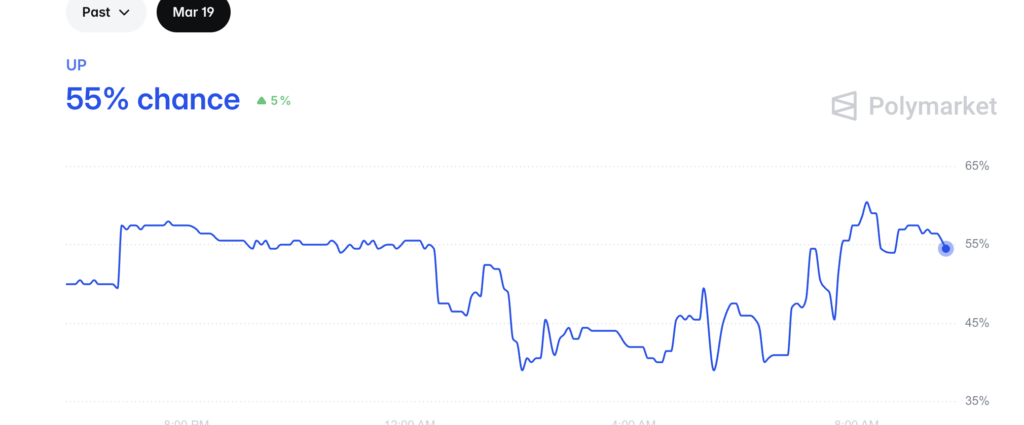
The S&P 500 fell 1.36% on Wednesday to close at 6,624.70 after a hotter-than-expected PPI report, and Federal Reserve Chair Jerome Powell‘s cautious inflation comments stoked fears that the U.S. economy is heading toward stagflation — lower growth and higher prices simultaneously.
The Polygon-based (CRYPTO: POL) Polymarket crowd is bearish heading into Thursday. The “S&P 500 Opens Up or Down on March 19?” market sits at 55% “Down,” 45% “Up,” with over $54,000 in early traded volume.
The inflation picture deteriorated sharply on Wednesday. February PPI came in at 0.7% — more than double the 0.3% consensus — before energy prices from the Iran …
This post was originally published here

A widely followed cryptocurrency analyst identified on Wednesday a bullish reversal pattern for Dogecoin (CRYPTO: DOGE) similar to the one that preceded massive memecoin rallies previously.
Ali Martinez took to X, highlighting a fractal pattern on Dogecoin’s monthly chart that mirrored the previous two bull cycles. The setup delivered over 9,000% gains for DOGE in the 2017-18 cycle and a staggering 30,693% in 2021-22.
“Once you see this Dogecoin fractal, you can’t unsee it,” Martinez said, suggesting a similar explosive rally to $10, though without giving a specific timeline.
Residents of Coen and surrounding towns in far north Queensland spent Thursday sandbagging, stockpiling food and preparing for power outages ahead of possible category 5 storm
In some ways, it seemed a pleasant, wet season morning in the remote Aboriginal community of Coen in tropical far north Queensland on Thursday – and Sara Watkins was preparing for a sausage sizzle.
“It’s a day that you’d spend going fishing,” she said.
This post was originally published here

Serina Therapeutics Inc. (NYSE:SER) jumped 39.45% in after-hours trading on Wednesday, climbing to $1.78, after the clinical-stage company announced a $15 million private placement closing on Friday.
Serina said in its Wednesday announcement, made after markets closed, that a second tranche of up to $15 million is expected by April 30, with warrant coverage potentially raising an additional $33.3 million.
CEO Steve Ledger noted that with the first patient dosed in the registrational trial and a clear 505(b)(2) pathway aligned with the Food and Drug Administration, the financing positions Serina to execute on its most value-creating milestones to date.
Serina’s transaction is led …

The CNN Money Fear and Greed index showed an increase in the overall fear level, while the index remained in the “Extreme Fear” zone on Wednesday.
U.S. stocks settled lower on Wednesday, with the Dow Jones index dipping more than 750 points during the session as investors digested the latest economic data and comments from the Fed chief.
The Federal Reserve held interest rates unchanged at 3.50%–3.75% for the third straight meeting on Wednesday, as widely expected by market participants.
The FOMC statement noted that while economic activity has been expanding at a solid pace, job gains have remained low and inflation remains somewhat elevated.
In earnings, Jabil Inc. (NYSE:JBL) stock fell around 1.4% on Wednesday after the manufacturing services provider delivered stronger-than-expected fiscal second-quarter 2026 results and raised its full-year …
This post was originally published here

With U.S. stock futures trading mixed this morning on Thursday, some of the stocks that may grab investor focus today are as follows:
This post was originally published here
Ireland’s former taoiseach warns of conservative Russian influence and says US is now ‘off the pitch’ under Trump
LGBTQ+ rights in Europe are caught in a “chill wind” from east and west as Vladimir Putin’s Russia exports its conservative agenda and the “Americans are off the pitch” under Donald Trump, Ireland’s former taoiseach Leo Varadkar has said.
Varadkar, who in 2017 became Ireland’s first out gay prime minister, said Europe needed to “step up” to avoid the continent becoming further squeezed by global forces seeking to chip away at recent progress.
This post was originally published here
Move will put national security and lives overseas at risk, critics say, as overall UK aid budget is slashed to 0.3% of gross national income
Climate aid to developing countries from the UK will be cut by about 14% to roughly £2bn a year under government plans, in a move critics said would put national security and lives overseas at risk.
The move follows bitter rows with the Treasury, which wanted deeper cuts owing to pressure on spending resulting from the war in Iran.
This post was originally published here

Lamborghini’s wealthiest customers are still buying supercars—but tariffs are taking a quiet toll on the bottom line.
“Being the U.S., by far our biggest market, we could not, let’s say, increase the price [at] the same level as the tariffs were increased, and, at the same time, the market was going down,” CEO Stephan Winkelmann told Fortune. “So we had less cars sold, and with less margin on those cars to be delivered in the second half of the year.”
The luxury automaker, owned by the Volkswagen Group through Audi, reported its full-year earnings for 2025 on Thursday. Lamborghini saw a new delivery record of 10,747 cars in 2025 and reached $3.7 billion (€3.2 billion) in revenue, a 3.3% year-over-year increase. However, operating income fell to $885 million (€768 million) from a record of $962 million (€835 million) in 2024, and the carmaker had a profitability of 24%, also slightly down from last year.
Winkelmann noted the dip in operating margins was in part a result of tariffs imposed by the Trump administration at the beginning of 2025, which precipitated a price increase for the luxury cars. Lamborghini said last year it would raise prices for its Temerario and Urus models by 7% and for the Revuelto by 10%. Winkelmann indicated Lamborghini would be unable to raise costs more, with the import taxes cutting into profitability as a result.
Tariffs cost the auto industry nearly $35 billion last year, according to an Automotive News analysis, with vehicles from the European Union, such as Lamborghini, hit with a 15% import tax. For luxury automakers, the import taxes have had a range of effects. For Ferrari, customized deliveries helped offset the impact of the levies and lower shipments for some models. In January, Mercedes reported a 19% slump in sales growth in the U.S. and a quarterly sales decrease of 12% year-over-year in part as a result of the tariffs.
Lamborghini also saw a dip in operating income as a result of negative exchange rates and the decision to pivot away from a fully electric Lanzador in favor of a plug-in hybrid model instead, Winkelmann said.
Lamborghini appears poised to continue navigating tariffs. Last summer, Winkelmann noted that even Lamborghini’s wealthiest customers were reconsidering the timing of their purchases as a result of the tariffs, waiting for import tax levels to become stable.
“Some are waiting because they want to be sure that this is the final number that is going to be in place,” Winkelmann said in an interview with CNBC in August 2025. “Others are fine with it, or we will have negotiations.”
Winkelmann told Fortune tariff uncertainty interrupted between six to eight weeks of shipments for the automaker, but was able to offset some disruptions and order cancellations from customers waiting on the company’s shortlist.
He expected more consistent deliveries in the coming year as tariffs level off. The company was not impacted by tariffs imposed under the International Emergency Economic Powers Act, which were struck down by the Supreme Court last month, so the import taxes have and will remain at about 15%. Winkelmann said he predicts “a new normality” of customers knowing what to expect with tariffs and adjusting to the cars’ new prices.
Lamborghini’s next challenges will be navigating the war in Iran, with conflict in the Middle East threatening the key luxury car market in the area. According to GlobalData, the United Arab Emirates typically sees more than 300,000 vehicle sales annually, with about 20% of those being premium imports.
With a drop in both the U.S. and Chinese markets, and turmoil in the Middle East, Winkelmann said Lamborghini will rely on sustained demand in markets in Europe, as well as Japan and Korea.
“The global economy, all this so far, could not offset the clarity of Lamborghini,” he said.
This story was originally featured on Fortune.com
This post was originally published here

In 2023, artificial intelligence was capable of just a fraction of what it has achieved today. ChatGPT had just launched. Distorted AI photos and videos had just started to hit your timeline. The technology was improving, but adoption was slow and productivity gains were a dream away. Today, it’s being rapidly deployed across industries, and that pace has sounded the alarms for workforce researchers.
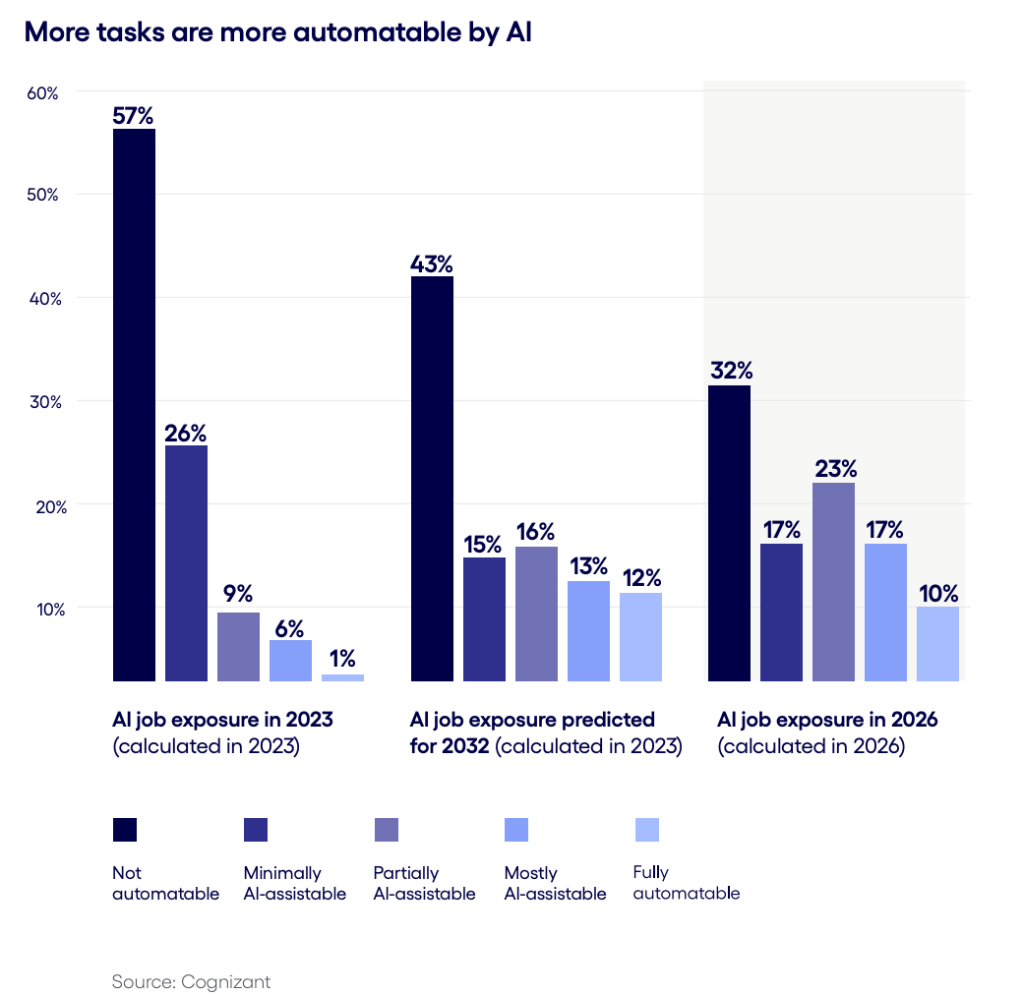
Professional services company Cognizant (number 217 on the 2026 edition of the Fortune 500) has reassessed its estimate of AI’s impact on the workplace, and the results are starker than before. They’ve updated their original forecast made in 2023—formulated by examining 18,000 tasks and nearly 1,000 jobs from the U.S. Department of Labor occupational data—to find that 93% of jobs could undergo at least some disruption from the technology. And the threat has become existential for a wider range of jobs. The research found that 30% of jobs could face an existential threat from AI, 15 percentage points higher than the initial assessment. In total, the report estimates AI-driven disruption could shift roughly $4.5 trillion in labor from humans to machines.
“We underestimated the impact of the technology,” the report reads. “What we projected might take until 2032 to unfold is happening now before our eyes.”
A growing chorus of business leaders and insiders is sounding the alarm on the looming threat AI poses to the workforce, particularly in white-collar roles. And those predictions are slowly becoming reality as companies—especially tech firms—have started to cut sizable chunks of their workforces, attributing the layoffs to AI. Jack Dorsey’s Block cut nearly half of the company’s workforce thanks to AI automation. Australian-American tech firm Atlassian cut 10% of its workforce to fund AI investments. And now Meta reportedly plans to cut 20% of its roughly 79,000-person workforce, which tech analyst Mark Shmulik warned could lead to “a cascade of hurried pivots, half-formed strategies, and reactive restructuring across the ecosystem” as firms race to remain competitive in the AI era.
“Today—six years ahead of schedule—93% of jobs could be impacted in some way by AI,” the report reads. “The technology, in short, is affecting more jobs, faster, and to a greater extent than we anticipated.”
The report found that the current potential for AI disruption extends beyond the professional world. The technology has started to encroach on the once-assumed safe realm of manual-labor tasks. In construction, for example, the technology can now help with interpreting blueprints. And in transportation, it can examine shipments or perform safety inspections.
“Tasks once considered purely manual actually contain embedded cognitive elements that AI can augment,” the report reads. “When those improvements occur across every shift and every site, the gains become transformative.”
In health care, too, AI is already showing signs of disruption, moving from assisting with small tasks to automating complex ones. The study found that the technology has improved diagnostic accuracy and patient care.
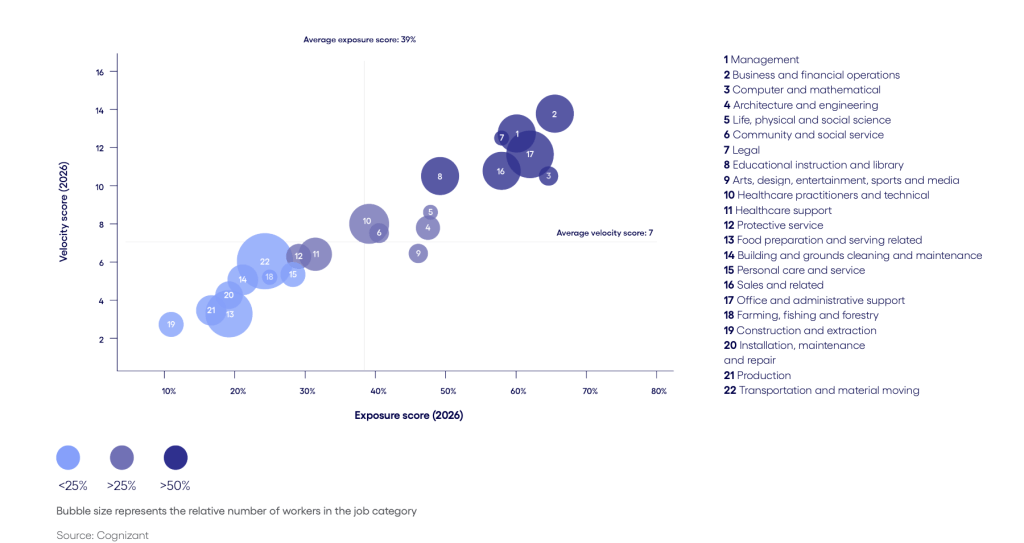
AI still has a long way to go before establishing a workforce that’s majority machine and minority human, according to Matt Sigelman, president of the Burning Glass Institute, a think tank that analyzes the workforce. “Some of these disruptions will take much longer to play out than we assume,” Sigelman told Fortune. “The timeline of disruption will be longer, the nature of the impacts may be more subtle.”
The study found that while the majority of tasks today are in some way able to be assisted by AI, just 10% are fully automatable. And while the researchers calculated an average exposure score of 39% by industry, several sectors with big workforces, including transportation and construction, are still far off from facing substantial exposure to AI.
But Sigelman adds that while the timeline may differ from Cognizant’s projections, the overall impact on the workforce could be just as significant. He said AI will usher in requirements for a completely different skill set, which can disrupt even some of the most established professionals, potentially requiring significant retraining and upskilling.
“People who have been in a job for decades may no longer be qualified for the job that has defined their careers.”
This story was originally featured on Fortune.com
This post was originally published here

Despite the unpredictable wildcard of an Iran war and concerns regarding software companies amid the rapid rise of fears around artificial intelligence (AI), Evercore Founder and Senior Chairman Roger Altman remains optimistic about the U.S. economy, noting that foundational strengths and technological advancements outweigh current geopolitical fears.
Addressing the rapid evolution of AI in a conversation with CNBC, Altman pushed back against doomsday predictions surrounding the tech sector.
While he acknowledges AI will be “very transformative,” he believes the market’s focus on what AI might destroy has gone too far. When asked if the market is facing a “SaaS apocalypse“—the idea that AI will decimate software-as-a-service companies—Altman was definitive.
“I don’t see that,” he said, pointing out that software stocks have historically bounced back from sharp corrections. “At the moment, I don’t see AI as a force that should undermine markets and cause economic forecasts to be marked down. In fact, I think that it’s likely to be positive.”
These statements come as top U.S. software stocks like Microsoft Corp. (NASDAQ:MSFT), Oracle Corp. (NYSE:ORCL), and Salesforce Inc.
This post was originally published here

Pikachus at every street corner. Leveling up before getting into the gym. “Pokémon Go to the polls.” You remember this era well: Pokémon Go became a frenzy, with hundreds of millions taking to the streets for their chance to snap up the rare Azelf or special edition Charizard. Now, not only does it seem that Pokémon Go took the world by storm, but it also was using crowdsourced data to map it.
Over the past decade, Pokémon Go players voluntarily submitted photos and short videos of public landmarks, street corners, storefronts, and urban intersections—all coming together to create a dataset that now stands at 30 billion images captured at ground level, across nearly every major city on the planet. Niantic Spatial, the enterprise AI and mapping division spun from Niantic Inc., has spent years converting that trove into something the robotics industry has never seen before: a photorealistic, street-level, continuously updated model of the physical world, built specifically for robots.
That model is now being deployed to navigate Coco Robotics’ roughly 1,000 delivery bot fleet operating in cities across the country and around the world, including Los Angeles, Chicago, Miami, Jersey City, and Helsinki, logging millions of miles of deliveries to date. Brian McClendon, Niantic Spatial’s chief technology officer and one of the original creators of Google Earth, explains the data strategy plainly.
“We look at the player data as very high-quality ground training data for other lower-quality datasets,” McClendon told Fortune in a statement. “The long-term philosophy of Niantic Spatial is that we can solve these hard problems of localization, reconstruction, and semantics by using very concentrated places to train models and then use much more broadly available data at lower resolution to be able to localize, visualize, and understand from ‘bad’ data.”
The 30 billion Pokémon Go images aren’t just a map: They are a master key that unlocks the potential of how to create a real-world, real-time map. The player scans teach the model what precision looks like—it’s so precise, in fact, that it can even signal when the input is imperfect. It’s a strategy that positions Niantic Spatial less as a gaming company that pivoted and more as the most ambitious mapping operation ever assembled—one that was funded entirely by its own users’ enthusiasm for catching digital creatures.
Niantic Spatial’s Visual Positioning System, or VPS, solves a problem that has quietly stunted the autonomous delivery industry. GPS, the backbone of most navigation systems, doesn’t fare that well in dense urban environments, where tall buildings interfere with satellite signals. For a delivery robot that needs to drop food at a precise doorstep, being several feet off means unhappy customers complaining their burger is cold—or in their neighbor’s tummy. Instead, the VPS bypasses satellites entirely, comparing live camera feeds from the robot against its vast image database to determine position in real time.
“The model will work in real time, taking in images from the robot and comparing them to both publicly available as well as proprietary datasets we’ve collected to determine the robot’s global position and heading,” a Niantic Spatial spokesperson told Fortune in a statement. The company knew where this tech performs best: “Niantic Spatial’s VPS is particularly resilient in urban canyons where GPS performs badly.”
“Our initial VPS was built using scans that users choose to take in games—but no single source defines the model,” the Niantic Spatial spokesperson said. Player participation was always opt-in: users had to actively choose to submit a short video scan of a specific public landmark. Today, the model increasingly learns from the data Niantic Spatial’s enterprise customers generate themselves. The underlying engine—a large geospatial model, or LGM, trained on billions of posed images and hundreds of millions of real-world scans—powers three capabilities: reconstructing spaces as navigable 3D models, localizing machines within those spaces, and understanding environments semantically. As CEO John Hanke wrote in a recent blog post: “For the past several years, we’ve been building a large geospatial model that acts as a living, breathing map of the world, one that is native to robots and AI.”
For Coco CEO Zach Rash, the problem is with robots’ critical thinking skills (or lack thereof).
“Robots don’t have the same intuition yet as a human, where a human can understand, ‘My GPS isn’t really working, but I understand that’s probably the right place to go,’” Rash told Fortune. “We need the robot to have that sort of intuition.”
“When we go into really dense areas with high rises, that’s where the VPS solution can be really helpful,” Rash said. “Our GPS and our existing solutions might fail in that sort of environment.”
The stakes, he noted, are felt by customers at the very last moment of a delivery: “It is a terrible customer experience if the robot parks in the wrong place waiting to receive that order.”
“It’s very early with [Niantic Spatial], and I think we’re excited to collaborate with such an incredible team on figuring out how we add this toward existing technology to make the service better. VPS is an obvious one,” Rash continued. “They’re very good at doing this. If I can more precisely figure out where to drop off food, my customers will be happy.”
This story was originally featured on Fortune.com
This post was originally published here
In today’s newsletter: After a spate of infections linked to a nightclub in Kent, some parents and experts are questioning the UK’s vaccination regime
It is every parent’s worst nightmare. University students enjoying themselves at a nightclub, only to fall ill a few days later with a potentially deadly illness. So far, two young people have died and more are seriously unwell in hospital after a meningitis outbreak in Kent, which appears to have started at Club Chemistry in Canterbury in early March. Health authorities have launched a major response: 30,000 people have been given antibiotics and up to 5,000 University of Kent students will receive a meningitis B vaccine, the strain that is believed to be behind the outbreak.
The health secretary, Wes Streeting, has urged calm, explaining that the risk of transmission is low, urging students to keep going to school and insisting that people do not need to seek private vaccinations. But that has not stopped a rush for jabs, causing a national shortage. The high street pharmacies Boots and Superdrug say they have seen a major spike in bookings, with some locations running out of stock.
Middle East | Israel struck Iran’s giant South Pars gasfield on Wednesday, marking a major escalation of the war, hours after Israeli forces killed the regime’s intelligence minister and launched some of the most intense airstrikes in Beirut for decades.
Reform UK | Nigel Farage called for the release of Sean “Diddy” Combs and commended the efforts to free a former Honduran president jailed in the US for drug trafficking. The remarks were made on the personalised video platform Cameo.
Assisted dying | Senior ministers believe Keir Starmer will not intervene to give the assisted dying bill further time in parliament as he is wary of opening up new divisions among Labour MPs.
Media | The former Google executive Matt Brittin is expected to be named as the BBC’s next director general within days, with the corporation’s board meeting this week for a final discussion about the appointment.
Green party | A government led by the Green party would not set targets for GDP growth but would instead focus on people’s mental health, social cohesion and community welfare, Zack Polanski has said in a major speech to set out his plans for the economy.
This post was originally published here
This blog is now closed
Tropical Cyclone Narelle tracker map: where and when will it hit the Queensland coast?
Get our breaking news email, free app or daily news podcast
Agriculture minister says government monitoring any price gouging of fertiliser
Julie Collins, the federal minister for agriculture, said the government is monitoring any price gouging for fertiliser amid the turmoil in the Middle East.
I think our government has been very clear that this should not be seen as a commercial opportunity for anybody. This is about what is in the national interest. This is a conflict that is impacting globally, and what we need Australians to do is to act in the national interest, and that includes everybody along that supply chain.
This post was originally published here

For decades, the standard formula for financial success was the same: go to college, get a degree, and land a prestigious white-collar job—probably a lawyer, consultant, or investment banker.
But entrepreneur and author Daniel Priestley is sounding the alarm on a major job-market shift. He suggests the traditional hierarchy of labor (white-collar over blue-collar) is actually flipping.
Priestley, founder and CEO of Dent Global, an entrepreneur accelerator, said he’s observed that the nature of the economy is changing so rapidly that he envisions a future in which “plumbers regularly earn more than lawyers,” as blue-collar roles are elevated while professional services face unprecedented disruption from AI.
“For the last 25 years I’ve been building companies from scratch and I’ve been through the Global Financial Crisis,” Priestley said during a recent appearance on the Diary of a CEO podcast. “But I have never experienced what we’re experiencing right now.”
“I’ve never seen more fear for the disruption that is coming,” he continued.
He argues we’re witnessing a “swinging pendulum” in which the high value once placed on “white-collar work behind a screen” is moving toward “blue-collar work with your hands.” Other CEOs like Ford’s Jim Farley have sounded a similar alarm, arguing there’s far more demand for blue-collar work than there are people who want to do it.
He’s concerned about staffing AI data centers and factories, which he calls a crisis affecting the “essential economy” of blue-collar workers who make up $12 trillion in U.S. GDP, according to the Aspen Institute. Farley has also said AI could wipe out half of white-collar jobs, instead ushering in mass demand for skilled trades and blue-collar work.
“There’s more than one way to the American Dream, but our whole education system is focused on four-year [college] education,” Farley said during the Aspen Ideas Festival last summer. “Hiring an entry worker at a tech company has fallen 50% since 2019. Is that really where we want all of our kids to go? Artificial intelligence is going to replace literally half of all white-collar workers in the U.S.”
Over the past couple of years, at least some of Gen Z have started drifting away from the classic desk job path and more toward skilled trades. Enrollment in vocational-focused community colleges climbed 16% in 2023 to its highest level since the National Student Clearinghouse started tracking in 2018. This includes a surge in students studying construction trades, HVAC, and vehicle repairs.
“There’s still a stereotype that getting a university degree guarantees and results in a well-paid job, but I soon realized that isn’t the case,” Emily Shaw, a Gen Z apprentice at British construction company Redrow, told Fortune’s Orianna Rosa Royle. Some have even started their own blue-collar businesses, bringing in six-figure incomes. Another Gen Z electrician interviewed by Fortune’s Nick Lichtenberg skipped college because he said he wasn’t a good student, and now makes six figures working a trade instead.
A Jobber analysis of Labor Department data also projects demand for electricians, plumbers, and HVAC technicians will grow well above the 4% average for all occupations through 2033.
To be sure, some of Gen Z’s blue-collar pivot is driven by the same AI anxiety Priestley described—and a realization college may not really be worth it anymore. Nearly 80% of Americans have noticed an increased interest in trade careers from young adults, according to a Harris Poll survey of more than 2,000 U.S. adults for Intuit Credit Karma.
Priestley—and countless other executives—have warned that change is coming fast. And he said the shift is being accelerated by the “instantaneous” AI rollout. Unlike the Industrial Revolution, which unfolded over decades and required massive infrastructure buildout, change will come much faster in the AI era.
“The minute an AI learns how to be a lawyer in one place, it can be a lawyer in every place,” he said, because the digital network already exists. A Brookings Institute study published in February 2025 also suggests more than 30% of U.S. workers could see at least 50% of their tasks disrupted by generative AI. A 2023 commentary published by Brookings also said AI will “revolutionize” the practice of law by dramatically increasing efficiency in drafting, research, discovery, and document production, although it doesn’t argue the tech will completely eliminate the need for lawyers.
Meanwhile, blue-collar workers, such as electricians and bricklayers, are experiencing a “blue ocean” of opportunity due to a severe labor shortage. Priestley said the imbalance is due to “market distortion” from government-backed student loans.
“Lots of young people who should have been plumbers, electricians, and concreers, and brick layers went off and got a master’s degree in mating habits of butterflies or some random degree that doesn’t have a job attached and they end up in [$60,000; $70,000; $80,000] worth of debt to get this degree that no one was asking for,” he said. “That market distortion means that we now don’t have many plumbers and electricians.”
This story was originally featured on Fortune.com
This post was originally published here